Your CFO wants you to justify this quarter’s culture budget line by line. You can easily cut the offsite. But what about that pulse survey licence?
At face value, they both seem like logical costs to cut. But cutting your offsite and cutting your pulse survey licence have very different consequences.
You know how to communicate the in-year savings of each decision to your finance counterparts. But how do you demonstrate the potential costs over the next four quarters?
In this article, we’ll walk you through how to budget your culture costs into trim, keep and protect categories, identify certain costs that should be outside HR’s P&L, and how to continue listening to your employees on a reduced budget while maintaining anonymity and a good relationship with your works council.
Which culture investments should companies keep, trim or cut during times of budget constraints?
- Why does employee culture get sacrificed first?
- Volatility is no longer a phase you can wait out
- Isn’t a "strong" culture the same as an adaptive one?
- Weaving in the four kinds of shift: are you asking the right questions?
- A trim, keep, protect method to sort your employee culture priorities
- An invoice that arrives later
- Don’t go dark during a restructure
- How you can use Sparkbay to keep your finger on the pulse during a restructure
Why does employee culture get sacrificed first?
It’s easy to focus on the direct cost of an employee offsite when you think about the cost of an employee offsite vs. a deteriorating culture.
The cost of employee culture is harder to pinpoint. It’s spread across multiple budgets since it’s considered a discretionary expense on the event budget, software budget, or learning and development budget. Employee culture’s benefit is felt in the operations department’s numbers, not HR’s numbers, so its full value isn’t reflected on one line item.
Plus, you want to be careful about offering specific cost savings if you haven’t checked your contracts. You may think you’re saving money by cancelling a multi-year licence, but if you’ve missed the window to cancel without penalty, you may not save any money this fiscal year. And if you’ve pre-paid a deposit for an event, that money’s sunk.
Finally, timing matters. Cutting back on employee culture activities right after a mass layoff is a big decision. Your organization has fewer workers, but the same amount of work.
Taking away key tools to help you measure how you’re managing that workload is different than shelving a fun event.
You’ll notice the impact of redistributed work after a lag and in a specific order. First you’ll notice missed deadlines, then an uptick in short-term sick leave, then resignations. If you don’t have a mechanism to hear these signals, you’re more likely to notice this at stage three, when it’s too late to redistribute the workload.
It’s important to note that even in the best of times, according to Gallup’s global research, only a small share of employees are engaged at work. So your engagement baseline after a major reorganization might be even lower. And you might not want to compare your first, post-reorganization engagement survey to the results of a previous year’s annual engagement survey.
You want to keep that data separate, since a drastic organizational restructuring will impact employee engagement. Otherwise, you run the risk of thinking that you’ve failed at the team level while you’re really dealing with a larger, structural bottom line reset.
So yes, do what you must to cut costs, but don’t take your eye off the data you need to evaluate the success of your own decisions.
Volatility is no longer a phase you can wait out
In volatile times, many organisations put culture work on the back burner until "things settle".
But what if they never do?
Most people who answered the World Economic Forum’s Global Risks Survey put volatility as a short-term and long-term reality.
So what does this mean for organisations?
Well, the modus operandi of doubling down on listening to employees before a change happens and easing up once the change arrives, isn’t going to work anymore.
But there’s a bigger risk here.
Volatility brings with it a stream of changes: new priorities, new reporting lines, new systems.
All of which must be understood and communicated by your managers, who are already strapped for time.
As a result, by the time you get to the third or fourth round of changes, the front line receives a garbled copy of a garbled copy of the original message.
Research on change fatigue from Gartner shows that employees are grappling with more change than before, and their capacity to absorb these changes has decreased.
One quick way to assess whether your teams are overloaded with information is to ask them to name the top three priorities for their area.
Then, ask someone on your team to come up with the top three priorities for your organisation’s executive team.
If your teams’ responses match the executive teams response less than half the time, you’ve got a communication problem that’s much bigger than an employee engagement problem.
The solution isn’t to launch another employee engagement programme. It’s to get better at cascading priorities and cutting down the number of messages sent out at once. (Plus, it makes for a simpler chat with finance!)
How can you tell if your method for cascading priorities needs a refresh?
Ask yourself: When I send this announcement out, is it a true reflection of what the leadership team meant to say?
Isn’t a "strong" culture the same as an adaptive one?
Not necessarily. And this is important for budget decisions.
When you have a strong company culture, your people stick together and perform well under pressure. But this can also make your organization slow to recognize when its old way of working is no longer serving it well.
In Corporate Culture and Performance, John P. Kotter and James L. Heskett write that having a strong culture alone is not enough for long-term positive results. Instead, adaptive cultures outperform strong cultures. In adaptive cultures, leaders focus on the needs of customers, employees, and shareholders, and initiate change when the conditions around them change.
Kotter and Heskett also noted that strong cultures that focus on maintaining the status quo tend to become insular and arrogant - characteristics that negatively impact company performance, even if the organization still feels cohesive.
Consider your budgeting decisions through this lens.
On one hand, you may want to spend money on something that maintains the status quo. After a merger, it may feel important to fund a new hire event or offsite for the people of one legacy organization to show that their culture "won". But this may lead to the loss of goodwill from the other part of the organization.
On the other hand, adaptive spending is also important. This allows your organization to take a step back and notice when the status quo needs to change. Using Kotter and Heskett’s logic, this is an activity worth continuing to fund.
For each budget item, consider what it allows your organization to do. Does it allow you to identify that a new organizational structure isn’t working as designed? Does it force managers to have a difficult but necessary conversation?
Does it allow your leadership team to get back on track before another shift lands on top of this one?
Protect initiatives that allow you to detect problems and respond to them.
So in practice, this may mean protecting a modest pulse survey from your budget while putting a large event on hold. It may mean protecting a manager’s one-to-one time with their employees instead of funding a values relaunch (which may not be taken seriously during a reorganization).
Weaving in the four kinds of shift: are you asking the right questions?
Before you dive into budget requests, consider which of the four types of shift your population is experiencing. You can then ask the right questions.
For example, strategic shifts are about adding new priorities without subtracting old ones. A helpful question is: What activities have you stopped doing since the introduction of this new strategy?
If your teams struggle to name anything they’ve stopped doing, it suggests that the "new" strategy is simply an addition to the old strategies, not a replacement.
Structural changes may result in discontinuing work that hasn’t been documented. What happens when teams lose people? Are there informal activities that may no longer happen (e.g., someone used to do reconciliations on Fridays) or can be passed on to others without an appropriate decision about who should own them (e.g., a client who only ever called a specific person)?
What happens when organizations deal with delayering? Should a manager who previously managed 7 people now manage 14? What does that mean for their availability to those employees?
With twice as many employees to look after, can they spend as much time with each employee? Would you like to ask the question of those employees whether their managers are able to hold one-on-one meetings regularly?
In mergers and acquisitions, do you know where people feel they can escalate issues? Do they adhere to the new organizational hierarchy, or do they keep escalating through legacy organizations because that’s the person who responded to them last time? Want to know where the real decision-making happens?
Track where people escalate to, not where the new org chart says they should go.
When a new leader is introduced, teams get to know them by watching for early signals - Who does this leader promote? What meetings do they cancel? What do they praise in public?
People quickly form opinions about this new leader, and it’s hard to change those impressions.
So a team manager who inherits a team through an acquisition or a reorganization needs an impression of the team quickly. They can’t wait until the next annual performance review cycle to get a sense of where their team stands. They need to know within the first few weeks, before first impressions solidify into reputation.
In operational shifts, organizations roll out new tools and workflows. Leaders are tasked with tracking whether promised time savings in the business case actually happen. Employees may create workarounds and shadow spreadsheets to keep things running.
Do you know how many organizations don’t go back to track whether those projected time savings actually happened? Your organization may be one of those unlucky places. You may only have your listening data to prove that those time savings did not materialize.
What if your population shift involves multiple kinds of shifts? An organization-wide reorganization may include the introduction of a new leader or the introduction of new priorities. It’s easy to overlook smaller issues when larger issues take focus.
Where is your organization feeling the impact of these changes? This is a great place to start listening. If your team is experiencing two or more of these shifts at once, it’s a critical spot to check in.
A trim, keep, protect method to sort your employee culture priorities
Trim: fun items that employees will miss but can manage without
Think swag, big celebrations, fancy offsites, and overlapping employee tools.
When things are going well, it’s easy to add perks and swag, so they’re the obvious items to trim. It doesn’t mean they weren’t valuable at all - just that they can be put on hold. And it’s useful to explicitly acknowledge that they may be brought back.
These events are often designed for a specific purpose. For example, your company may have organized an offsite to get a newly assembled leadership team on the same page with decision rights. If that’s the case, consider turning it into a focused working session instead of a weekend trip away.
This’ll reduce the costs drastically.
If your offsite is primarily a reward for work, it’s time to put it on pause and let employees know why.
If you’ve recently merged or acquired another company, an easy area to trim is overlapping employee tools. For example, you may have two sets of employee surveys or two recognition platforms.
Bringing these together not only saves money but yields a richer analytical benefit. Using the same tools and questions allows you to compare the two separate legacy populations directly instead of trying to match survey results on different scales to make a meaningful comparison.
When sharing these cuts with employees, try to share them all at once instead of drip-feeding the information. You want to avoid restarting the anxiety with every new piece of news or causing employees to view any small change as a sign of more cuts to come.
Keep: core items that can be scaled back
For instance, you may decide it’s worth keeping recognition, but you can do away with all the production costs that go into making a fancy ceremony.
Another potential use of your recognition data during a redressal period is to analyze who gets recognized and who recognizes others. This data can help you understand who people go to for information, access, and help. These individuals likely don’t hold a high role on the organizational chart, but they’re the ones you can’t afford to lose.
You can also scale down your learning programs to focus on what you truly need. Do you need learning programs on how to manage through a redundancy program, how to lead merged teams, or how to lead a team whose span of control has doubled overnight? Focus on those topics first and put general catalogue courses on the backburner.
Try not to place all DEI initiatives on hold. Instead, find ways to scale back from external sources and put fewer events on the calendar. That said, you should continue doing DEI work that reorganizations can have an impact on.
An important priority is to conduct an adverse-impact analysis to selection decisions before they’re finalized. This should be done for selections related to redundancy and selections related to the post-organization allocation of stretch roles and visible projects prior to the next promotion cycle. Many organizations conduct adverse impact analyses under legal privilege.
Check in with your legal team today to ensure you’re doing work that protects your organization, before you have that sensitive data.
Protect: items that give leaders valuable info for gauging risk and taking action
Make sure you "protect" the following capabilities so you can keep leaders in the loop and assist them in making key decisions.
- A way to hear from employees about their experience during the company change
- How managers are doing when it comes to managing their team through the company change
- How at risk you are retaining talent in critical roles (this assessment should be based on how difficult a role is to replace, and how important the role is to business success, not the senior level of the position)
- Receiving honest status updates from leaders about what they know and when they expect to know more information
These "protected" capabilities can be protected even if they’re not in the exact same format. You may shorten a survey or change the cadence of a survey, but you want to keep a company’s ability to hear from employees at key moments.
A helpful thing to do is ask yourself, for every line in the employee culture budget, "Does this line help us keep the people we need? Or deliver the change we’ve already paid for?"
Before your meeting with finance, bring a one-page grid with the following items for each budget line:
- Annual cost of the budget line
- The team or business change that’s happening
- The business risk that budget line will help minimize
- The success indicator that budget line will help you impact
- The impact of removing this budget line
Filled out honestly, the grid helps you easily come to most trim, keep, or protect decisions and demonstrate to finance that you’ve already done most of the triage work.
Once you’ve collaborated with team leaders to fill out the grid, ask each person who owns a protected culture initiative one more question: What specific decision will you make based on this data and who will make it? This helps you evaluate whether a given opportunity to hear from your employees really warrants a "protect" ranking.
And if that leader cannot affirmatively state a specific decision that will be informed by data from this "protect" item within two quarters, then you can consider reclassifying it to a "keep" item - albeit at a scaled level.
An invoice that arrives later
You’ve already booked the savings, but now it’s time to start accounting for the cost of your cutbacks.
The first cost is the impact on the talent you wanted to keep. This may not be immediate or evenly felt. Your hiring freeze may not prevent people with easily transferable skills from moving to another employer - these are the people you’ll find hardest to replace.
If you want to quantify this cost for Finance, avoid the standard replacement cost multiples they tend to brush off. Instead, come up with a figure based on your own data.
How many days does it take to fill a role? How much do you spend on overtime or contractors to cover the role during that time? How long does it take for a new hire to reach full productivity?
These are the types of considerations that will help you come up with a number. Even if the number is smaller than a large, industry estimate, your smaller number will garner more trust because it’s based on your own data.
Timing may also create challenges. Your best people may wait and see before making a move, but when things pick back up in the job market, they may all leave at once.
Take a look at whether all of your retention bonuses vest on the same date - you may have inadvertently planned your own mass exodus.
Second, the change may impact the return you get from the change.
Even though you’ve rolled out your new structure, work may not flow through it as smoothly as you anticipated. Prosci’s research shows that projects with excellent change management are several times more likely to meet their objectives than projects with poor change management. If your leaders don’t hear about issues related to decision-making in the new structure before it’s too late to address them, it may impact the return you see from your change.
In many cases, managers will be the ones to funnel this direct feedback about how the new structure is working up to leaders. This places managers in an uncomfortable position. On the one hand, they are dealing with more direct reports and presumably the same expectations as before.
On the other hand, they need to answer questions about workload and job security.
Remember that Gallup attributes 70% of the variation in engagement levels between teams to the manager. So if managers are providing less support and less feedback, there’s a real risk engagement levels will drop.
Third, you may find that your remaining employees subtly disengage and stop going the extra mile. This won’t show up as a massive, obvious wave of departures - which is great! - but it may not show up at all in your attrition report. Instead, over time, you may start to notice it in your cycle times, in your error rates, or in how many people stop offering ideas in meetings.
Where does this leave you? Most of these costs won’t hit HR at all - they’ll land in the organization’s operations teams in the form of delayed projects, extra hiring work, and reduced output.
This is why it’s important for HR to agree with finance in advance on what business metrics they’ll track to keep an eye on the impact of the cutbacks.
Don’t go dark during a restructure
Have you noticed that when the company stops asking you, "how are things going?", it feels like a bad sign?
During a re-org, employees interpret this silence as a sign that their voice doesn’t matter anymore.
Stopping all touch points to employees during a re-org is a dangerous move.
You don’t need to check in via a long survey.
Long surveys are expensive, so your company may be tempted to pause them altogether during a re-org. Instead, send out mini, pulse surveys at key moments during the organizational change.
You might send one a few weeks after the new reporting structure is live, and another after teams have worked through one full cycle of the new priorities. These pulses can include 3 to 5 fixed items related to role clarity, workload, and whether there’s a clear path to escalate issues. Make sure these items have the exact same wording each time, so any changes in responses are due to people’s experiences and not a rewording of the questions.
Pay attention to fluctuations in response rates by business unit, as well as changes in response scores. A sudden drop in participation rate within a specific team is often a leading sign of disengagement.
Consider supplementing your mini pulse surveys with stay conversations for critical roles. While surveys provide how the group feels, stay conversations empower managers to learn what would make a specific person want to stay. Brief managers on these conversations so they know these aren’t loyalty checks - make sure they know their employees will be wary of that.
Once you have survey results at the team level, share these results with managers while maintaining anonymity. Here’s a catch-22. Your teams may not be the same as during the previous survey results, thanks to the re-org.
And some new teams may fall below the minimum team member size required for reporting.
Before you launch your surveys, create a new roll up rule, so that small teams are automatically rolled up to the next level up.
That way, you don’t have to change rules later because a leader wants more granular data. This could expose people on small teams. People are more mindful about being identified during a re-org, so you don’t want to risk breaking their trust.
If your re-org requires works council or union consultation, wait one moment before sending your pulse surveys. You’ll want to show these stakeholders the pulse survey items ahead of time. Once they’ve reviewed and approved the pulse surveys, they can view them as supporting their consultation process.
Otherwise, your pulse surveys might be seen as an attempt to circumvent the council or union.
Should companies pause their annual survey during re-org? There’s genuine disagreement on this point among experts.
One camp believes it’s best to continue the annual survey during the re-org in order to maintain the pre/post baseline.
Others argue that while the annual long survey is in the middle of a re-org, people will provide low-quality answers, meaning leaders won’t have actionable data in time. They recommend pausing the long survey, sending out mini pulse surveys, and using the pulse survey items word for word from the annual survey to maintain some level of baseline. This way, employees still have a way to share issues while the annual survey is paused.
Above all, make sure you share what you heard and what the next steps are. And if there are decisions that leaders can’t change, then it’s important to share that too.
How you can use Sparkbay to keep your finger on the pulse during a restructure
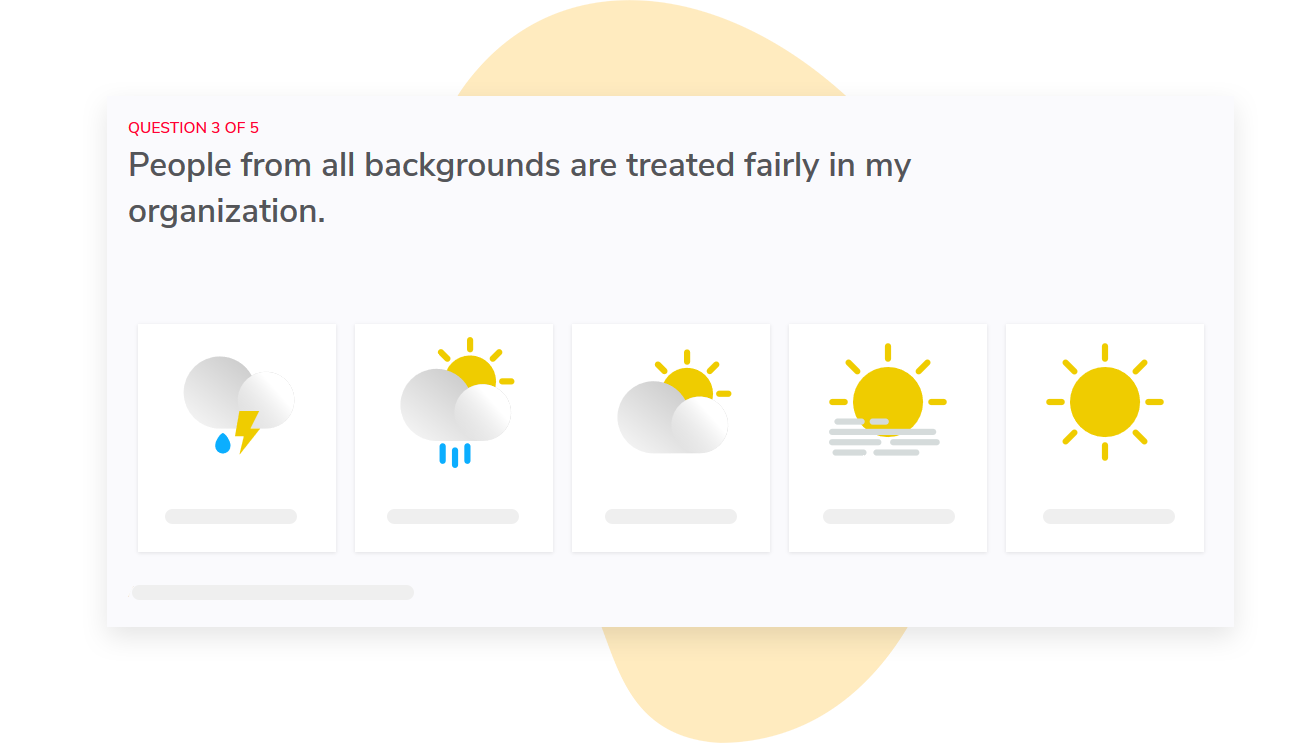
Instead of waiting for the annual cycle, you can send out a few focused questions once teams have settled into their new structure.
You can customize the wording of survey questions and dashboards to suit the specific change your employees are going through.
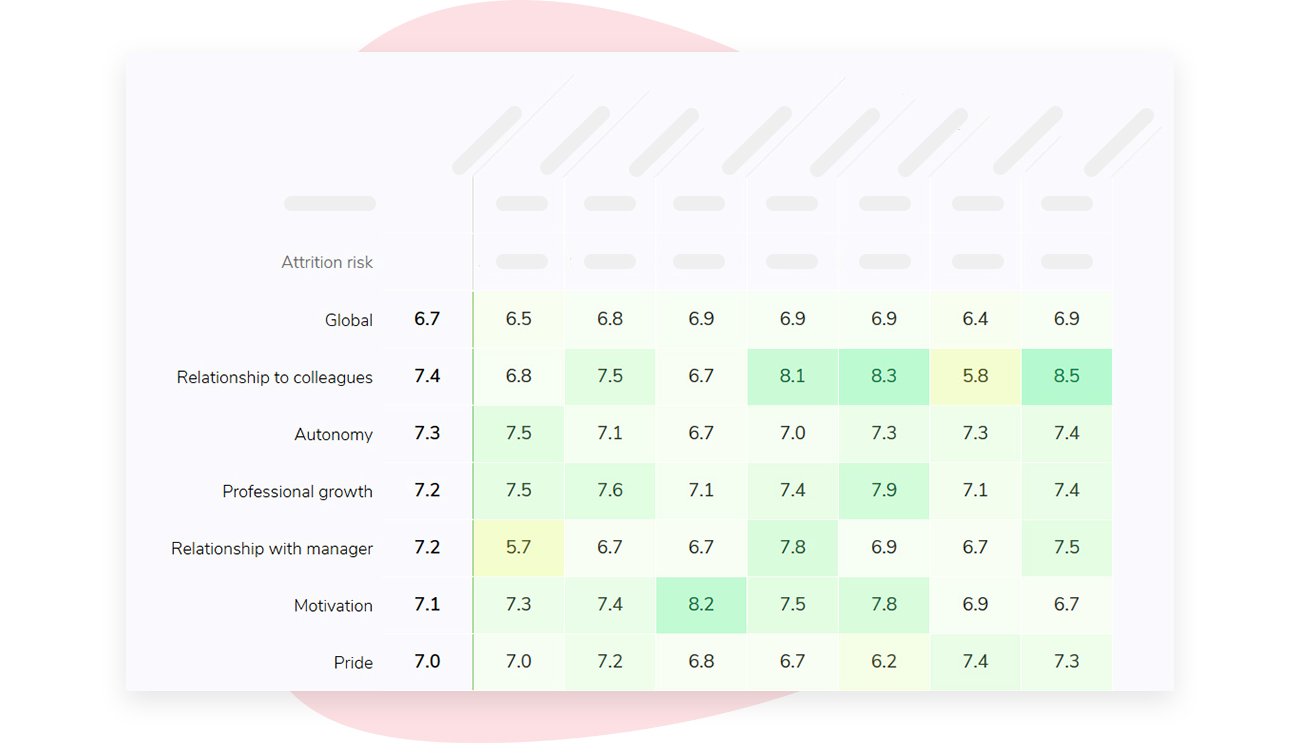
Then, you can track how the engagement score (out of 10) changes at different stages of the reorganization.
Company-wide results are important, but they won’t tell you which newly formed team is struggling.
Sparkbay allows you to compare different parts of the organization.
Report access is automatically mapped to the org hierarchy, so managers only see reports for their teams.
If you keep your org hierarchy up to date during your reorg, managers will see reports for the teams that currently report up to them.
Plus, we hide results if there aren’t enough responses (5 by default, but you can change this) to ensure the anonymity of respondents.
If you’re interested in learning how Sparkbay can help you build a more engaged workforce, you can click here for a demo.
Frame the "why" in terms of risk
By this point, your CFO knows in theory that employee engagement is important. What they need is an answer to the question, "What do we lose if our engagement metric drops to zero?"
To answer this question, you’ll need to come up with some numbers related to the items you want to protect. For instance, if your engagement helps retain a critical group of employees, you’ll need to quantify how much an empty seat costs and how much time it takes to train someone new up to speed.
How early would you need to detect a change in engagement related to "intent to stay" in order to take preventative action before people start to resign?
If your organizational change is focused on improving decision-making speed, then you’ll need to identify areas where approvals get bottlenecked. Combining qualitative data from your teams with quantitative data on how long it takes business units to receive key decisions from leadership will help make your point.
Presenting an employee engagement score alongside a metric the finance team already monitors makes it easier for them to see the benefit.
It’s unlikely you’ll be able to demonstrate that one survey directly prevented one employee from leaving. That’s not how employee engagement works. But you can demonstrate how much it costs to operate without that insight.
You can also outline which risks you’ll be monitoring and the people responsible for initiating action if a certain metric drops below a threshold.
And you can agree on a review date with your finance team. For example, two quarters after the reorganization goes live, are we going to review the effectiveness of this engagement investment?
At this point, you want to commit to a "kill criterion" - if you can’t demonstrate this protected item was used to make a decision or trigger an intervention by the review date, it will be considered during the next round of cuts. Making this statement yourself adds credibility to the item in your protect list.
Arriving to your meeting with a review plan in hand AND the items you’re willing to cut demonstrates that you’ve already consolidated real savings.
If you’re interested in learning how Sparkbay can help you build a more engaged workforce, you can click here for a demo.