Why does your team keep ignoring surveys?
You’ve noticed the warning signs: fewer people respond, some pick the "middle" choice for every question on the list, or people who once gave examples no longer leave any written comments.
Your usual moves are to cut the length of your surveys, send extra reminders, or push for more replies by comparing response rates across departments. These steps deal with survey fatigue caused by the number of surveys, but they don’t do much when team members have quit taking part because they believe their opinions don’t count.
Survey fatigue caused by too many surveys is a real problem, but there’s a more worrying type of survey fatigue called futility fatigue. This is when people stop answering surveys because they feel like their answers went nowhere. Making pulse surveys shorter and sending them more often won’t fix this feeling of futility.
Think about the most recent time your team pointed out a problem in a survey. Did anyone let them know what became of what they said?
As a manager, you’re not expected to "fix" every problem your team brings up. In fact, a lot of the choices about problems raised in employee surveys won’t be yours to make.
Why teams stop answering surveys and what managers can do between survey cycles
Not all survey fatigue is the same
There are a few ways you can find out whether your team is experiencing survey fatigue:
-
Compare different types of surveys.
If participation rates are down across the board - even for short pulse surveys - then making your surveys shorter may not work. However, if you notice a drop in participation on longer surveys, or during weeks where there are several survey requests, you may be experiencing survey volume fatigue.
-
Assess participation within the survey itself.
If people skip questions, write shorter comments, or provide the same answer for a string of questions (e.g. mostly in the last third of the survey) then there’s a chance they’re experiencing survey fatigue or annoyance. However, if these brief answers or skipped questions are spread out evenly from the beginning of the survey to the end, it’s possible that people were disengaged from the start.
Repetitive questioning can also induce survey futility fatigue. Consider the following scenario.
Your team mentions that they receive urgent requests outside of their working hours. At the next team meeting, you ask them what they think about their workload. The following week, your team receives a survey that includes a question related to employee wellbeing.
And the week after that, another survey goes out that asks employees about their work-life balance.
From the organization’s point of view, this might be three separate surveys with three separate questions. From your team’s point of view, this is the same question being asked over and over again, with minimal variation.
By the time that third survey rolls around, it won’t feel like a chance to be heard, but rather a waste of time.
Research done by Qualtrics shows that there’s a disconnect between employers who collect feedback from their employees, and employees who trust that their employer does something with their feedback. Many employees are not convinced that their employer acts on the information they provide.
In some cases, it may be that organizations do act on employee feedback, but they do so months later as a policy change or an item on an all hands meeting slide, that never gets linked back to the feedback from the survey. Employees don’t make the connection between the survey and the action.
When you share changes that came from a survey, be sure to clearly link it back by saying something like:
"This came from the March survey"
Even if you haven’t made any changes yet, it’s worth sending an update. You can keep it short and sweet, simply acknowledging that you’ve heard people, that you’ve started looking into the issue, and let them know when you’ll get back to them. If you can’t make changes right now, that’s okay - you can also say that.
Did you just join the team?
There’s a special case we want to acknowledge. If you’re a new manager or take over an existing team, you may inherit a history of survey fatigue. If the previous manager didn’t act on survey results, it’s possible that your team views survey results through that lens. This may not be a reflection on you as the new manager. Instead of pretending you’re starting from zero, it’s ok to acknowledge this on your first time sharing survey results ("I gather the last few surveys didn’t lead anywhere visible").
Do you want to plot a course correction before your response rates plummet?
When your survey’s response rate finally falls, the trust behind it has usually been wearing down for one or two cycles already.
To catch some early signals before your response rates drop sharply, look out for the following:
- Comment rate: If the number of people leaving comments falls, but the scores stay about the same, it’s a sign that people are still answering, but they’re putting in less effort
- Spread of answers: If answers start bunching towards the middle of the scale, it can be a more telling sign than a mean score that drops by a few tenths.
Survey researchers call this satisficing (popularized by the work of Jon Krosnick) where people just give an answer that’s good enough, but not necessarily accurate, because they don’t want to put in the effort.
One of the tricky things about judging your survey response rates is that your response rates can rise for the wrong reasons.
For instance, if you send out a lot of reminders, you may push your response rate up, but only because you’ve attracted the least interested people to your survey.
As a result, you end up with a lot of low effort answers, even though your survey response rates have bounced back. So if you see a rate increase, but a comment rate decrease, it’s a bad sign.
You should also be suspicious if your results tell you that an entire team is rainbows and butterflies, when you know from team meetings that people are saying something else.
This is especially concerning if teams are fairly small and the number of responses you collect is barely above the anonymity threshold. People may not feel comfortable sharing their true thoughts if they know they’re one of six respondents. Whatever the reassurance email told them, they may tone down their answers to protect themselves.
Of course, none of these signs are proof that people no longer trust your survey. Quick comments could easily be a result of a question that didn’t call for a long answer.
That said, if you notice these kinds of weak engagement signs two survey cycles in a row, it’s a sign that you’ll need to do more than just send one more reminder.
You’ll need to spend some time reflecting on what happened after the last survey:
- Did you share the results with people?
- Did you share why a change requested by the team didn’t come to fruition?
- Did you follow up on feedback where you said you’d look into it?
You can also pose this question directly to your team during a meeting: "What would make it worth your time to answer the next survey?"
This keeps the floor open for uncomfortable answers.
If someone says they don’t see the point of participating, you can simply thank them for their honesty.
You’re the missing link between data and change
HR organises the survey process and analysis that takes place at the organisation level. Senior leaders handle the big-picture issues.
But for the bulk of employees, you’re the person who determines what that entire process feels like from day to day. How you engage your employees in the two weeks after the employee survey results are released, impacts how they view the entire process.
Keep in mind that Gallup’s research says the person’s manager accounts for 70% of the variance in team engagement levels.
So does this mean that every single aspect of your employees’ experience is in your control? Not quite. But this does mean that your actions in the weeks following the employee engagement survey are the element that the employees will notice the most.
There’s one more complicating factor to discuss. Linking employee survey results to manager objectives or bonuses can impact how managers view their survey results. For instance, as the survey period nears its end, they may start nudging for a high score by making offhand comments like, "We need good results this cycle" or "Don’t forget how important this survey is."
Employee engagement experts don’t agree on whether it’s worth linking survey results to manager objectives in the first place.
But for now, it’s important to note that if your teams feel like they’ll be "graded" on these survey results, it will impact how they view the survey process. They’ll see it as an evaluation of their manager’s performance as opposed to an opportunity to share their feedback.
Departmental competitions as to which units can receive the highest participation rate can add another layer of complexity if your organisation chooses to run them.
Your employees may be pressured to quickly participate in the survey just to get the nagging to stop, because their department doesn’t want to look bad in the participation league tables.
Even though this may boost participation rates, it creates a problem for your organisation’s data.
If your organisation holds participation competitions, it’s best to ignore them when you’re evaluating your team.
Focus instead on the qualitative comments you receive and your department’s adherence to follow through.
If there’s internal competition, and pressure to "rank" well, it can make managers feel less comfortable receiving critical survey feedback through the survey. They may feel compelled to justify why they received a low score or spend the entire survey readout explaining and defending a decision they made in the past.
In their book, Thanks for the Feedback, Douglas Stone and Sheila Heen discuss this phenomenon. They explain that how people react to feedback depends on who the feedback comes from as well as what they hear in that feedback.
So once you receive feedback from an employee survey, review it on your own, so you can separate your feelings about its fairness from your feelings about what it says. Take time to ask questions like, "Is this feedback fair?" and also, "What is this feedback telling me?"
This is important, because in a meeting with your team, the only suitable question to pose is, "What is this feedback telling me?"
Finally, remember that you don’t need to explicitly ask for your team’s "permission" to escalate an issue or explain why a change is beyond your power.
You can always direct a question to HR, escalate an issue to your manager, or even communicate why something isn’t within your power to change.
Don’t leave your employees guessing as to what happened to their feedback.
Close the loop with your team
What does your team hear after you distribute a survey?
Timing is everything. You want to send out or present the results no more than two to three weeks after the survey ends. Any longer than that and your team will be focused on other things and the results will feel out of date.
Share as much as you can, even if you’re not happy with certain results. Keep in mind that most managers don’t realize how quickly their teams pick up on "selective sharing." This also trains employees to provide the answers you want to hear instead of what they really think. This goes for ALL results, not just the good ones.
Take some time to let your team digest the survey results before jumping into a solutions session.
Once the results are shared, it’s important to turn the insights into sound bites that your team can easily respond to. For example, "People told us the handover between shifts isn’t working well" is something your team can react to and discuss. This is better than showing them a slide full of scores.
From there, you can work together to identify 1 to 3 areas from the survey results that you’ll work on improving. Decide who will be the action owner for each area of improvement (e.g. is it you? Is it a member of your team?) and together, set a date for a follow up with the team.
You don’t want to be the owner of all of these action items. If you are, it’ll easily slip down your to-do list once you get busy. You also don’t want your employees to see improving engagement as something that happens to them, rather than something they actively work on as well.
Have a conversation with your team to understand what the priorities should be. While it may be intuitive to start with the lowest rated item, these are often related to structural items (e.g. pay bands, paths to promotion) that are outside of your team’s control. To identify priorities, ask your team:
- "Which problem impacts us the most on a regular basis?"
- "Which of these problems can we (as a team) fix within the next six weeks?"
If your team picks something for question 2, you’ll have a quick win which will buy you the patience to work on the more challenging problems that arise from question 1.
And finally, when you send out follow-ups, be mindful of crafting messages that begin with, "You said, we did." This creates the expectation that you’ve done more than you have, and your employees will pick up on it. Instead, think about presenting a range of responses beyond a simple "Yes, we did this." For example, a follow-up may need to state:
- "Trying it out"
- "Passed up to operations leadership - we should have an answer on this by the end of the month"
- "Not going ahead - here’s why"
The same goes for follow-ups that go beyond your approval level.
Instead of removing a follow up request from your list, it’s better to share who you’ve talked to and when you expect to hear back from them. This way, employees aren’t left waiting for a response that never comes.
You might also decide not to act on certain requests at all. Instead of asking for consensus that you won’t act on a request, it’s better to simply inform people of your decision. Most people would prefer a clear no, rather than waiting in limbo for a response that never comes.
In addition, it’s important to keep your responses short and sweet. You don’t need to write a paragraph. Something as simple as "You told us the handover wasn’t working. We’re testing out a shared handover note for 4 weeks and will check in with both shifts to see if it helps" is perfectly fine.
If the change helps, share that with your team. If it doesn’t, share that as well and ask for feedback on what you and the team may have missed. This builds more trust on employee engagement than simply letting a trial fade away without comment.
Gallup research shows that employees are more engaged when they believe their voices matter.
Ask less, listen more
Keeping your commitment to listen to your employees doesn’t mean you have to stick surveys in their calendar.
You may not be aware of it, but HR isn’t the only team sending surveys to employees. Alongside your main pulse survey, there are one-off data collection forms made by local teams, feedback forms for events, IT satisfaction surveys, onboarding surveys, and project retrospectives.
Check in with your HR team to see what other surveys are planned for your team. If there isn’t a company-wide policy on how often an employee can be asked to take a survey, push for one.
A good general rule of thumb is:
"Don’t send out surveys more often than you’re able to act on what they tell you."
In other words, if it takes your team six weeks to go from survey results to the first action people can see, expecting them to answer a pulse survey every month is a bit hasty. You either need to speed up your response process or slow down your data collection process. If data can get into the hands of managers quickly and each pulse survey is accompanied by a short update on what has been done since the last pulse survey, then distributing a pulse survey each month is doable.
If your team is working towards a big deadline or going through a reorganization, consider pushing back on non-urgent surveys or sending a truncated set of questions with a note explaining the need for responses right now.
And remember that a reorganization is a legitimate reason to not "wait until things settle down." It’s important for leaders to know how people feel during a period of major change, but this information has to be actionable and focused on the reorganization itself. Sending a standard pulse survey halfway through a reorganization, with questions about employee recognition and career development as if nothing’s going on, is a surefire way to lose people’s trust.
You also want to be mindful of how much time your employees will need to complete your survey. Studies by survey experts show that longer surveys result in fewer completions. There’s no hard and fast rule, but a short 5-minute survey is better than a long 15-minute survey.
That said, you don’t want to trim down the survey to the bare minimum. You need to have a consistent core set of items so you can follow trends over time (this is one reason why changing the wording of core questions each survey cycle causes problems). It also makes sense to swap some questions in and out depending on decisions the business is currently making and drop questions you include out of habit.
Before sending any survey, complete this sentence: "We’re asking because we need to decide whether to..." If you can’t complete it, it may be better to have a chat with a few people.
"Only ask your team to rate a problem if someone is prepared to take the next step on it."
This doesn’t mean you have to be ready with a solution. But it does mean that you need to know who will review the survey responses and when employees will hear an update.
Turning feedback from a checkbox exercise to a meaningful conversation
At this point, it might feel like you’re going through the motions. You’ve heard the feedback from your surveys, plugged the data in the system, and moved onto the next task on your to-do list.
But now there’s an actual opportunity to implement meaningful change based on your team conversations. And your team is more likely to bring fresh perspectives, new ideas, and even the energy needed to tackle this problem.
Once you identify a theme in your team survey, bring it up during a meeting. Instead of asking, "How come we only scored a 5 on this survey?", ask a question like, "What’s the thing that slows down the pace of our work every week?". Avoid questions that put people on the spot or make them feel like they need to backtrack on their original response.
Then, ask: "What should we prioritize to change?"
In Humble Inquiry, Edgar Schein explains the importance of differentiating between genuine questions and polite directives. A key point is whether or not the person asking the question truly doesn’t know the answer. For instance, if managers host a meeting after a readout and already know what fix they want to implement, once again asking "Does everyone agree?" isn’t really a question.
People pick up on this, so if you already have an idea, keep it to yourself until everyone has a chance to describe the problem in their own words.
Similarly, watch out for attempts to protect anonymity that don’t actually work. For instance, asking people to put up their hands if they agree with a statement or going around the table to get everyone’s opinion on a low-scoring item effectively asks people to reveal how they answered the survey to their team.
Encourage one-on-one conversations as a way for team members to speak up, be heard, and feel listened to. This is an opportunity to privately share thoughts with employees. Make sure to keep this conversation open-ended by reminding your employees that they can share as much or as little as they like.
This meeting is not meant to interrogate who wrote what comments on the survey.
It’s also completely fine if you don’t want to have a team chat right away. You can say, for example: "You can always send me your ideas, or come and talk to me privately later."
Finally, keep in mind that if your teams are split across different locations - or if your teams work on a shift basis - you run the risk of excluding some voices from the follow-up conversation.
For instance, if half of your team works night shifts, hosting the conversation during the day gives them limited opportunities to be heard and share their thoughts.
Make sure you either have a second follow-up conversation at a time that works for everyone on your team or provide an option for people to asynchronously contribute their thoughts in a shared channel.
How Sparkbay can help you keep the feedback loop going after your team survey
At Sparkbay, we want to help you hear from your employees more than once a year without having to start from scratch.
Plenty of organisations opt for a monthly pulse survey, and we built a platform that allows you to easily change the questions in your survey or the wording in your dashboard to collect the information your teams need.
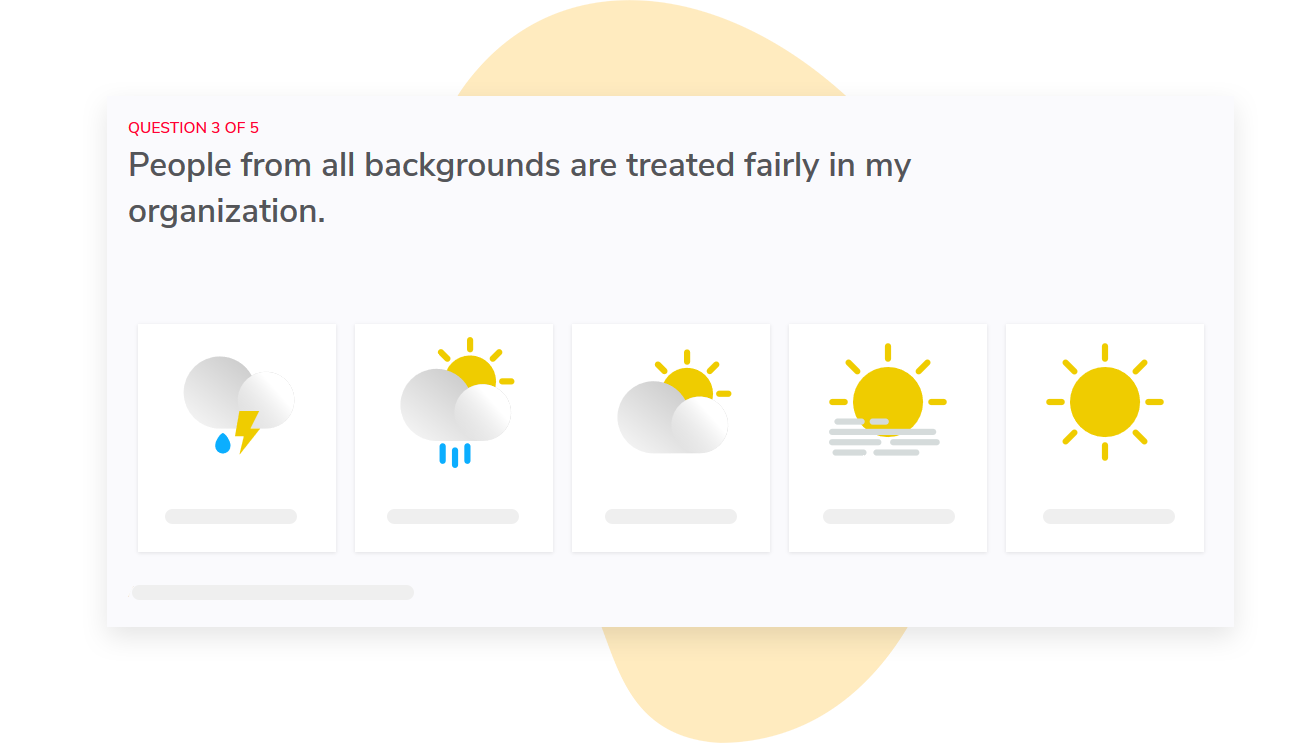
As responses come in, you can track your engagement score out of 10 over time. This way, if you make a change (e.g. the team chooses to try a new method for handing over work) you’ll know whether or not it made a difference within a few weeks instead of waiting for the next annual survey cycle.
One score can hide all sorts of differences within a big organisation. With Sparkbay, you can compare results by group within your organisation to ensure the follow-up conversation happens at the right level. Access reporting is automatically aligned with your organisation hierarchy, so managers only see the results for their teams.
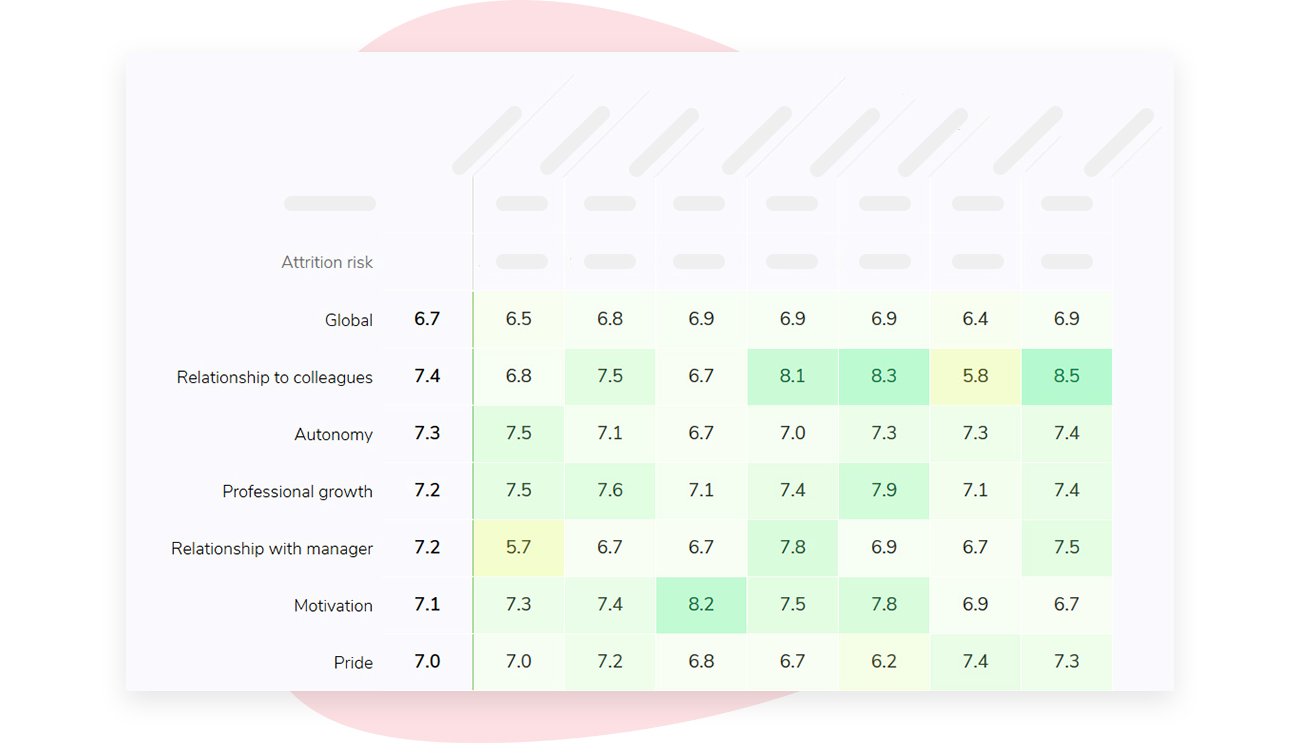
If you’re interested in learning how Sparkbay can help you build a more engaged workforce, you can click here for a demo.
Make honesty feel safe
If people suspect their manager will try to track them down later, they won’t feel at ease giving an honest answer.
Studies of psychological safety find that how willing people are to speak up is tied to the way teams react to errors and hard news. Amy Edmondson’s research on teams finds that how you react matters as much as how you ask people to share. In real terms, the way you first respond to bad news in the results readout has more impact on how open people will be in the next cycle than anything you write in the survey invitation.
So if you see a critical result, avoid pushing back against it in the meeting. Instead, ask people to share examples that showcase the work problem behind it. Thank them for bringing up the concern - even if you need more time to give a proper answer - it’s important to acknowledge the information.
At Sparkbay, we also protect survey results by hiding results for any group below the minimum response threshold (5 responses by default). We do this to protect the integrity of the reports, but we can only go so far in preventing someone from guessing. This is why it’s important to resist the temptation to speculate, ask follow-up questions about who said what, or quietly piece together what you already know about people’s tenure, role and location.
The same applies for comments. If a comment mentions specific projects or incidents, there are fewer people who could have written it. If someone says something like, "I think I know who wrote this" (even as a joke), the whole team learns to write bland comments next time.
So it’s important to just reply to the comment on its own and leave the person who wrote it alone.
It’s fine to ask your team what they need - it’s not okay to ask someone to own up to an anonymous answer.
If you’re interested in learning how Sparkbay can help you build a more engaged workforce, you can click here for a demo.