You don’t always have to wait for your scheduled employee engagement survey to make business decisions.
Suppose your company makes a significant change to its hybrid working policy in June.
It may be several months - or even up to eight - before you notice the impact of this change on your scheduled employee engagement surveys.
This is because an annual employee engagement survey is meant to keep everything consistent. The questions need to be the same, the answering scale needs to be the same, so they can be compared from year to year or unit to unit.
This also means that it’s not a great tool for addressing very specific localized problems. A company-wide survey may dilute the responses from a single team that’s feeling the effects of that specific problem. It also doesn’t give that team much opportunity to explain what’s going on.
This is where an ad hoc employee survey comes in handy. An ad hoc survey is a short, one-off survey that’s tied to a specific decision. This survey also has a very clear end date.
This allows you to gather feedback while your decision is still open, so it’s not too late to act on what you’ve heard from your employees.
When to run one-off employee surveys, how to avoid survey fatigue and what an engagement platform needs to support them
In this article
- What makes a survey ad hoc?
- How one-off surveys fit with your engagement program
- Seven moments that call for a one-off survey
- When to hold off
- Design a survey around the decision
- Keep one-offs on the same calendar
- Tell employees what happened next
What makes a survey ad hoc?
An ad hoc survey is conducted because there is a decision that needs to be made. It has a clear owner and a clear end point. It’s not something that’s scheduled to happen every year at a specific time.
For instance, you might conduct an ad hoc survey to help you make a decision about a new shift pattern. Or you might distribute a set of questions to a specific division after you see employee engagement scores dramatically decrease. Once the decision has been made and communicated, the ad hoc survey should be retired.
You don’t want ad hoc surveys turning into regular surveys without people realizing that they’re supposed to be used for building a trend line over time.
This is very different from your engagement survey which is designed to be comprehensive and comparable from year to year. It’s also very different from a pulse survey which is designed to be frequent with stable questions.
An ad hoc survey only targets a portion of your workforce, focuses on a specific topic, and offers a limited time frame for employees to take action. It also allows you to ask questions that are different from those questions you’ve previously asked, since you’re dealing with a new issue. The drawback of asking new questions is that you won’t have any baseline data to compare it against.
So it’s important to take these questions at face value and not compare the results to your engagement benchmarks.
Not every urgent or interesting question will call for an ad hoc survey. To determine whether you’re going to need one, consider whether you need breadth, comparability across groups, and/or anonymity that can’t be guaranteed in a conversation. This critical thinking process is much more helpful than simply considering the size of the group with the question.
For instance, if you have a handful of people with a burning question after a difficult meeting, a conversation may be better. But if you have hundreds of people who would like to weigh in on whether a proposed schedule works, a survey helps you collect everyone’s voice. Similarly, if you know lots of people will be asked to respond to a question about their experience with a proposed schedule during a town hall, a survey can ensure you get more candid responses.
Before you start writing questions for your quick go/no-go survey, ask yourself the following questions:
- Is there a named decision that needs to be made?
- Is there a possibility that the decision maker could use the result to change the decision?
- Is the size of the group affected by the decision large enough to provide anonymous results?
- Is there someone on the team committed to sharing the results of the survey by a certain date?
How one-off surveys fit with your engagement program
Your recurring surveys tell you that something moved. A one-off helps you work out why, in a particular place and time.
Say the engagement score falls in one division after a restructure. Before writing anything new, check which recurring drivers moved. If workload and role clarity dropped but manager items held, you already know where to aim.
The one-off then separates the remaining possibilities: role security, the new reporting line, or work that landed on desks without headcount.
Leave the recurring instrument alone while you investigate. Editing it mid-cycle to chase the problem breaks the trend you’re trying to explain.
Should ad hoc results be folded into the trend? Practitioners disagree. Our view: report them alongside it, not inside it.
The respondents are, by design, the affected group. Their answers aren’t comparable to a company-wide baseline, and blending them distorts both.
Watch who responds. In a targeted survey, the people most affected, and the most frustrated, are the most motivated to answer. A 40% response rate from a group of 300 tells you what those 120 people think, not what the 180 silent ones think.
Before acting, check whether respondents skew toward one site, shift, or role, and say so when you report.
Timing changes what you measure. As Daniel Kahneman explains in Thinking, Fast and Slow, the peak-end rule means people judge an experience by its most intense moment and its ending rather than by the whole. Ask about a policy six months after rollout and you get the settled verdict, not the friction of the first weeks. Both are valid, but they answer different questions, so decide which one your decision needs.
Scope the audience to the knowledge. The people using a new scheduling system know things others don’t. Mixing their answers with company-wide noise makes the signal harder to read.
Seven moments that call for a one-off survey
So when is the extra request worth making?
The test is whether the answers can still change what happens next. If they can’t, you’re running a sentiment check and calling it consultation.
After a merger or restructure
The org chart settles reporting lines. It doesn’t settle decision rights. People know who their manager is but not who approves spend, who resolves a cross-team conflict, or where requests go now that the old contact has moved.
Survey affected groups once they’ve hit real work under the new structure, not on day one. Ask operational questions: "In the last two weeks, did you know who to go to when X?" Don’t ask whether people support a decision that’s final. That invites either performative agreement or venting, and it signals a consultation that isn’t happening.
Get results to leaders while the handoffs are still fixable.
One sequencing point: if the restructure involves redundancies, wait until the consultation period has closed. Surveying during it puts employees in the position of rating a process that decides whether they keep their job, and the answers measure fear, not structure.
When a policy changes
A hybrid policy can pass every review and still fail on the ground. Anchor days clash with care arrangements, teams pick different office days, commute costs pile up.
A pre/post design works well here. Before rollout, ask what employees expect to be hard. A few weeks in, ask what actually happened, using matching items so you see where expectations were wrong.
Only run the pre-rollout survey if the parameters can still move; otherwise it implies a choice that doesn’t exist.
Pew Research Center finds that many workers whose jobs allow remote work value having that option. That’s reason enough to test the specifics by role and site rather than assume one schedule fits everyone.
When a new leader takes over
Wait until the team has real working experience with the leader. Results in the first weeks measure transition disruption, not leadership quality. Then ask whether people understand the team’s priorities and know where to raise a concern.
Don’t turn it into a popularity vote. Gallup research finds that managers account for at least 70% of the variation in engagement between teams. That’s exactly why the questions should give the leader something specific to work on: clarity of expectations, access to support, how decisions get made.
Let the leader see results first and lead the debrief.
When an engagement result needs explaining
First, check whether it’s real. On a team of eight, a visible swing comes from two people changing their answers, and a follow-up survey tells you no more than a conversation would.
If it holds up, keep one or two items word-for-word identical to the main survey, same scale included, so you have a direct comparison. Then add a small number of new questions aimed at the drivers that moved.
After a crisis or safety incident
Don’t survey while people are still waiting for basic facts or immediate support. When you do, ask what would help going forward: information, time, flexibility, a changed process. Don’t ask people to relive the event in a form field.
Make it optional and say who reads the results. Two practical points get missed. First, a survey is not a reporting channel, so point people explicitly to the formal route for safety concerns.
Second, free-text answers sometimes contain allegations that create an obligation to act even when anonymous. If an investigation is open, involve ER or legal before launch and agree how such comments will be handled, including who reads raw comments and who sees only themes.
Before you build something
Before you choose a tool or redesign a space, ask the people who’ll use it about their current workarounds. Workarounds show where the process actually breaks, which is rarely where head office has drawn it.
Be explicit about which choices are still open. If the contract is signed, don’t ask employees to pick the tool. That’s the fastest way to teach them that surveys are theater.
Ask what they need to get productive on it instead.
When a broad topic needs a closer look
Burnout, career growth, and inclusion each produce a low score for very different reasons. A focused survey separates those reasons so you respond to the cause rather than the label.
For burnout, ask about job demands before you buy another wellbeing program. Can people finish their work in normal hours? How often are they expected to respond after hours? How much of their week goes to meetings? Gallup’s workplace research finds that 76% of employees experience burnout at least sometimes. What you need is which demands people in your company want changed.
When to hold off
Survey fatigue sets in when employees are inundated with surveys, especially when these surveys don’t lead to anything.
Every department has its own surveys, and employees don’t know which ones to take seriously. Meanwhile, the departments responsible for taking action based on survey results find themselves unable to keep up.
Does this mean you can’t send out any surveys? Not necessarily. You just need to keep track of the number of surveys each person is being asked to take.
Consider the IT, L&D, or vendor surveys HR may not be aware of.
If a particular group has been asked to respond to 3 surveys in a single month, that’s very different from a group of employees that hasn’t had to participate in any.
Another reason to hold off on a survey is that there isn’t clear ownership or accountability for what happens next. If team leaders don’t feel empowered to review the survey results or take action based on them, then distributing a survey serves as little more than a tick-box exercise.
And employees notice. They’ll be less inclined to take future surveys seriously, such as your engagement survey.
Take a look at the calendar. If you’ve got a one-off survey planned shortly before your main employee engagement survey, you risk competing for your employees’ attention or forcing them to answer similar questions twice.
This also applies to surveys during peak operating times, the end of a quarter, or holidays.
You also want to be mindful of your workplace’s governance structure. If your employees are represented by a works council or union, you may have information or consultation obligations before distributing a new survey, particularly if it includes questions related to working time, schedules, or monitoring in many jurisdictions.
This may require you to adjust your timeline for distributing surveys, and failure to do so can cause your employee feedback exercise to turn into an undesirable industrial-relations dispute.
Finally, if your workplace includes small employee groups, your minimal response rules may not be enough to protect employee anonymity. Even if each employee group meets the minimal response threshold, it’s possible that publishing results both by team and by role could allow someone to subtract the two and isolate a small number of people.
You can avoid this by only reporting at one level of aggregation, combining results into a larger group, or choosing to have conversations rather than distributing a survey.
And if you already know what you need to know (for example, if exit interview feedback, manager check-ins, and existing employee comments all point to the same issue with workload) it may be worth holding off on a survey that’s designed to postpone dealing with a problem.
Design a survey that gets you the results you need
Write down the decision you’re going to make based on the survey results. If you can’t finish the sentence, don’t write any questions.
For example, if you’re deciding on a new hybrid schedule, your decision might be whether to change the number of days employees are required to come into the office. You may even want to go one step further and decide what survey result would lead to a change. This prevents stakeholders from dismissing results they don’t like when they arrive.
In practice, this might look like a one page brief that lists:
- The decision you need to make
- The decision owner
- The audience
- The threshold
- The date survey results will be shared with key decision makers
- The date and time survey results will be shared with employees
- The date the survey will be retired
If any of these are blank, you aren’t ready to roll out your survey.
Once you’ve written down your decision, it’ll be easier to determine who to include in your survey. Obviously you want to include everyone who will be affected by the problem. If your hybrid plan is only being rolled out at one location, your survey audience doesn’t need to be the entire company.
Similarly, you might not need to use a sampling method if your survey audience only numbers in the hundreds. There wouldn’t be much benefit from sampling, and it may send a negative message to the people who aren’t included.
Questions may vary from five to 10, depending on your situation. You’ll want rating questions if you need to compare groups or track changes over time. You’ll also want to include one or two open questions for survey respondents to share their views.
If the decision is very simple, you can do with fewer questions.
Focus on questions that are specific. Ask people about their behavior or how often they’ve done something within a certain timeframe ("In the past two weeks, how often have you...") instead of asking about their general feelings.
As Norman Bradburn, Seymour Sudman, and Brian Wansink explained in their book Asking Questions, memory is the weak link in self-reporting tasks. Questions that anchor respondents to a specific timeframe produce more accurate results than questions that ask them to summarize their experience.
Why does this matter so much? Well, chances are high that you’ll be using questions that have already been asked in your engagement survey. You’ll want to keep the wording of those questions the same. As Bradburn and his colleagues explain in Asking Questions, changes in phrasing or response anchors can change responses all on their own. If there’s a difference in results after you’ve changed the wording of a question, you won’t be able to tell if the difference is real or simply due to the change in question wording.
To get your survey results in time, don’t keep your survey open too long. If you’re distributing a survey tied to a specific decision, you’ll want to gather your data and analyze it quickly. As a rule of thumb, you may want to keep your decision-linked survey open for about a week to ten days.
This time-frame allows you to collect data from people who may be on different shifts or on leave, but also short enough that you can get your results while your decision is still open. If any part of your survey audience doesn’t work at a desk, consider how you’ll get access to their responses. You could arrange for them to use a kiosk or access a QR code while on site, or you could allow them paid time to respond to the survey.
In your invitation, clearly state why you’re asking employees to participate in the survey, when you’ll share the survey results, and who will have access to the survey results. If you’re conducting a survey with one team after a particular event (that everyone will know about), ensure you clearly state how you’ll protect the anonymity of participants. Otherwise, your generic anonymity statement may be met with skepticism!
Finally, send your survey questions to someone who’s close to the work. They’ll let you know if you’ve asked a question that presumes something about the way all your sites work or if the answer options include a response that doesn’t align with what people actually do.
Pro tip: Don’t ask a question unless you’re prepared to answer how the survey answer will impact your decision.
How Sparkbay can help you conduct a focused follow-up survey
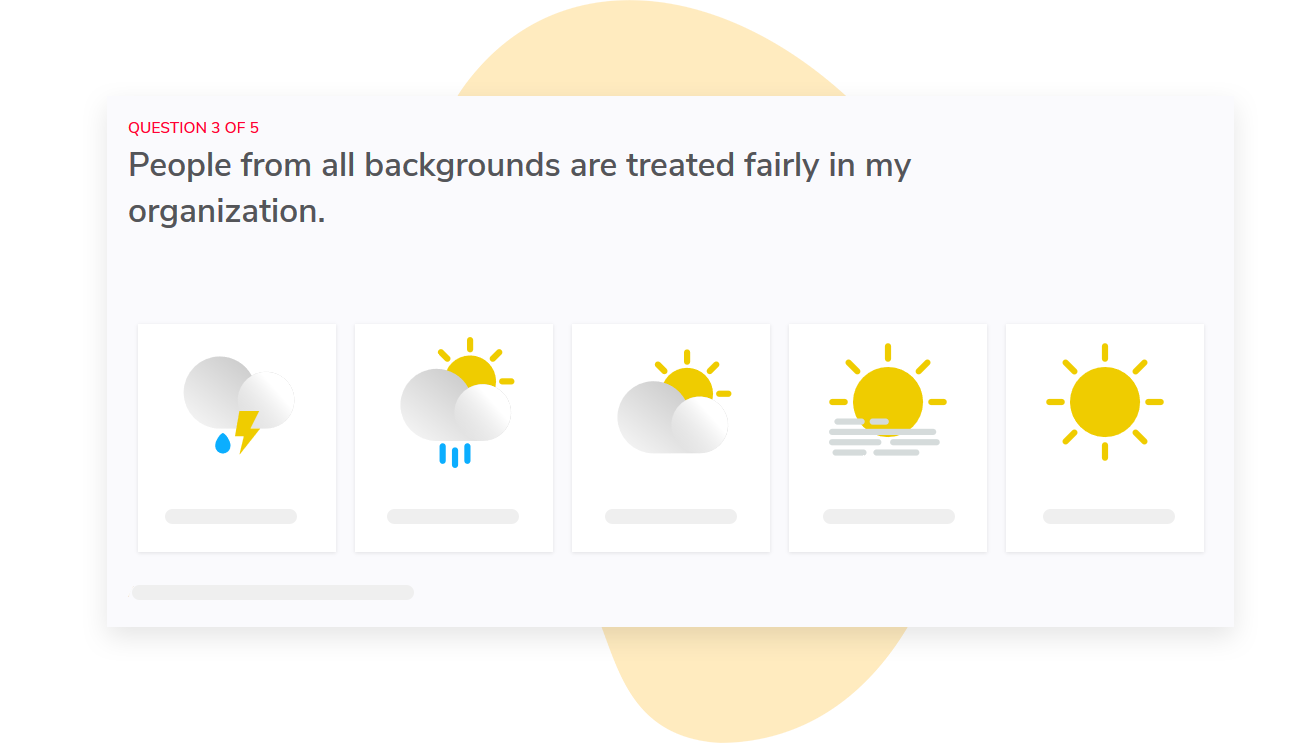
Let’s say you notice one team reporting a lower engagement score. Using Sparkbay, you can conduct a focused follow-up survey with that team without impacting the survey questions you use to track engagement across the company. This way, you can maintain the integrity of your trend.
Based on what happened with the team, you can modify the survey wording to better suit the situation.
You can then compare results based on your groups affected by the change. Since you can configure the contents and wording of your dashboard, you can present the details most relevant to your decision rather than presenting a generic dashboard layout. In addition, your report access maps can be automatically configured to your organization’s hierarchy, so each manager only sees their teams’ results while respecting data confidentiality.
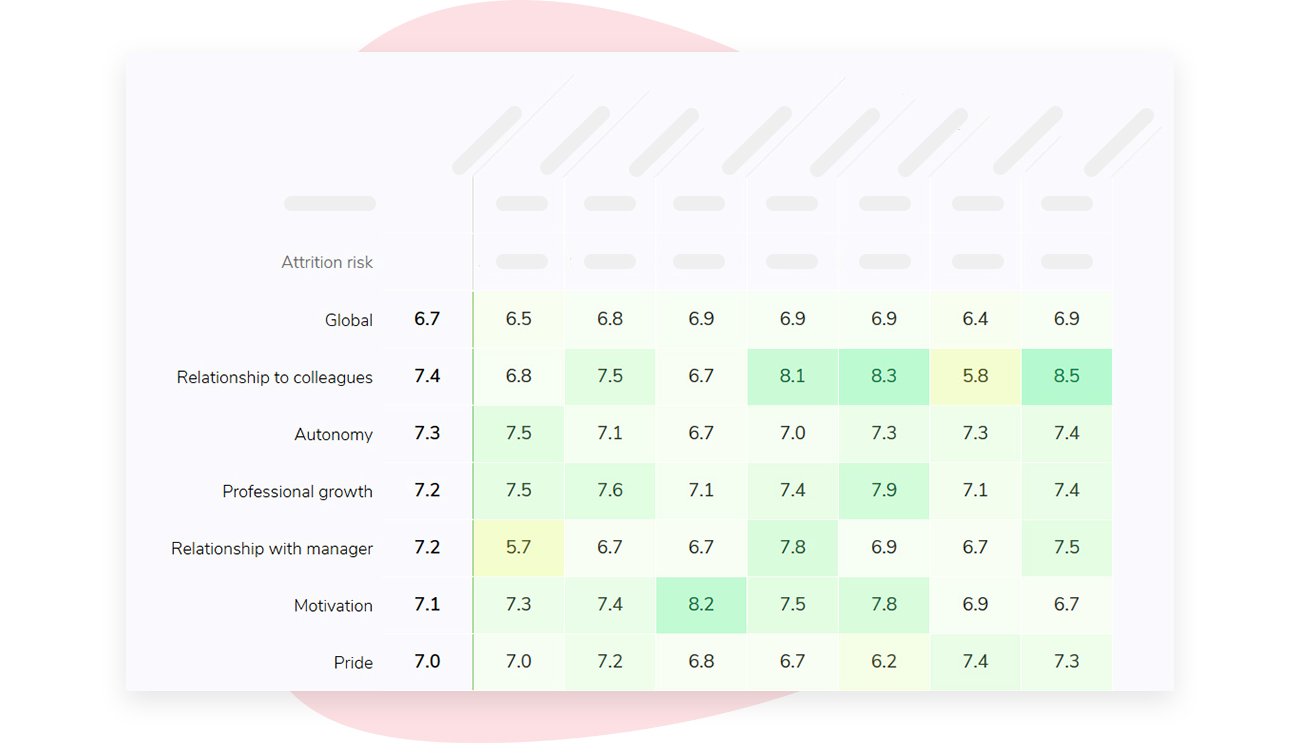
If you have a small group of survey participants, you can plan for anonymity from the start. Sparkbay automatically hides survey results that fall below a minimum response count. You can set the response count limit that works for your organization (the default is 5).
If you’re interested in learning how Sparkbay can help you build a more engaged workforce, you can click here for a demo.
Keep your one-offs on the same survey calendar
A centralized survey calendar allows your team to understand when the same employees will be hearing from HR, their division, or other teams in the organization.
Once you have this calendar created, assign someone ownership and a process for managing requests. This person shouldn’t just be a gatekeeper, but someone who works with teams to develop a strong survey question. At the same time, this person ensures that before a survey question goes out there’s a named decision owner, a defined audience, a clear time frame that’s not in conflict with other surveys, and a committed date for results to be shared back to employees.
This individual can use the one-page brief document created during the design process as a survey request form.
When you’re preparing for your big engagement survey, ask your one-off survey teams to limit outreach for a certain period before and after the survey. How long this "quiet period" is depends on your cadence and how heavy a lift your engagement survey is. An annual survey with a long questionnaire requires a longer buffer than a monthly pulse survey with five items.
Keep a log of which groups participated in each one-off survey and when along with what actions were taken based on the results of this survey. This will help you when you’re interpreting future engagement results. If you see an uptick in engagement scores for a particular team after a policy change, you’ll know to check whether there were any other one-off surveys or other changes to the organization that could’ve impacted those engagement scores instead of giving all the credit to that policy change.
This log will also help you identify pockets of over-surveying. You may have teams that are a popular choice for one-off surveys, such as high visibility teams, a flagship site, or a newly acquired business. If the same group is receiving a survey request from different owners within the space of a quarter, it’s a sign that those requests should be combined.
Tell your employees what happened next
Why?
Because your employees took you seriously when you asked them to complete an ad hoc survey. You told them you needed to act fast, so they expect a faster response than your next quarterly update.
As soon as a decision is made, share the results with your employees. Let them know what you intend to change, what you’ll continue to look into, and what won’t be changing. And if there’s something that won’t be changing, don’t sugar-coat the reason.
There’s more trust in a straightforward "no, because" than a vague "we’re exploring options".
When you share the results, also share the response rate and who responded. This way, if 70% of one site responded and only 20% of another, employees can understand why you’re choosing to follow up at the second site, and their minority view isn’t being ignored.
Give your managers a heads up before the employees see the results. Give them a version of the results that they can discuss with their teams and be clear about what decisions they can own. Otherwise, your employees may hear the results from you as an HR representative, ask their manager what that means for their work, and receive a shrug in response.
Research from the employee listening industry points to the fact that a large share of employees want to see their employers take action based on survey feedback. If you ask them again, before you’ve shared the results of the last survey, there’s little incentive to invest time in that survey.
Sometimes, your changes will take time. It’s okay to share a date for your next update and then continue to check in to see if there’s been an impact. If you don’t see a reaction in your next pulse or engagement survey, follow up directly with the impacted team instead of launching another survey.
If you’re interested in learning how Sparkbay can help you build a more engaged workforce, you can click here for a demo.