You distribute an engagement survey to the maintenance team on Monday. By Wednesday, the union steward has filed a grievance.
At first, these questions on an employee survey seem innocent and helpful. Do employees have the tools they need to complete their jobs? Are their schedules working for them?
What many employees in a unionized workplace don’t realize is that schedules are a mandatory subject of bargaining.
And so when unions see management distributing employee surveys - even with the innocent intent of obtaining feedback - they view it as an attempt to circumvent the bargaining table.
In reality, continuous communication with your employees is important, even in a unionized environment.
But an annual survey may only identify problems once they’ve already developed into grievances. And a monthly pulse survey of represented terms and conditions may be perceived as an attempt to communicate with the union member employees directly.
So how often should you distribute surveys in a unionized environment?
Before deciding on the frequency of your surveys, ensure you have agreed on the overall scope, access to data, and commitments on follow-up actions to be taken between bargaining sessions with the union.
Once you’ve agreed on these elements with your union, determining the cadence of your surveys becomes a mainly mechanical decision based on how long your action cycle actually is.
Should you conduct annual surveys, quarterly surveys, or pulse surveys? And how should you present these surveys to employee representatives?
- 1. why the frequency of employee surveys is important in a unionized workplace
- 2. where a survey can cross the line
- 3. annual surveys, pulse surveys and the options between them
- 4. align the bargaining calendar with the survey calendar
- 5. develop, or at least vet, survey questions with union leaders
- 6. set rules for anonymity and access
- How Sparkbay can help you arrive at a survey rhythm you and the union are comfortable with?
- 7. don’t ask again until people know what happened last time
1. why the frequency of employee surveys is important in a unionized workplace
Each time you distribute a survey to represented employees, you are continuing a conversation with the unionized workforce.
The union will not view this conversation in isolation. It will look at the entirety of communication and engagement activities from the employer.
This means that while the union does not need to be active in every communication channel, the cadence of those communications may impact how the union views the labour-management relationship.
There’s also a nuance here that many HR teams may not be aware of. If the employer has been distributing employee engagement surveys at a specific cadence for a few years, that frequency is now part of the labour-management relationship.
Infrequent employee surveys also pose risks. Engagement may drop between surveys, but it’s hard to tell how a change impacted one team or department when you aren’t measuring employee engagement levels often.
Establishing the frequency of your employee engagement surveys is not something you should decide on by yourself in the HR department.
Whether your team opts to distribute employee surveys twice a year or conduct short monthly check-ins with employee focusing on a narrow and pre-agreed upon set of issues, it’s important to have both of those elements in writing: why that frequency is necessary and what the frequency of surveys will produce.
2. where a survey can cross the line
If your survey includes questions related to pay, hours, or work schedules, you should be extra cautious.
These questions may ask employees to provide their preferences on terms your union negotiates. This can raise concerns that a survey is stepping into direct dealing territory.
Example of a survey question that is a diagnostic question: "Can you get the equipment you need for your shift?"
Example of a survey question that amounts to a bargaining proposal put forward to employees: "Would you be willing to trade a fixed rotation for a higher shift premium?"
Think about it this way: The first question is merely trying to find out information on possible issues employees may face. The second question is presenting a potential bargaining proposal to employees and suggesting they consider it.
When drafting survey questions, it’s useful to remember that you should ask employees about the conditions or experiences they have, but not ask them questions that amount to trade-offs between different options.
Of course, jurisdiction matters. We’re assuming you’re based in the US, in which case you should think about the direct-dealing doctrine and employee polling cases presented by the NLRB. Remember that Struksnes is usually the reference point when we talk about employee polling on union support.
If you’re an employer in Canada, recognize that the different labour codes in the country view direct-bargaining with employees as interfering with the union.
If you have operations in Germany, be aware that works council co-determination rights mean that questionnaires that collect personal data, and survey software that can monitor employees, generally need the works council’s agreement. This goes beyond simply seeking input from the works council.
Just because you cleared a survey question through legal reviews at one site, doesn’t mean the question will be deemed suitable at another site.
This is especially complicated when you’re a multi-site employer with different units under different agreements, or where a site is represented and another site is not represented.
Using a represented site’s questionnaire at a non-union site, when seeking to organize a union, presents a whole new host of issues.
Even if a seemingly innocent question has already been used on a survey, its meaning can change depending on when it’s used.
For instance, a question like "I trust senior leadership" might be a routine question to ask employees at any point during a collective agreement.
But if a question like that is asked four weeks before the expiry of a collective agreement, it might be read as a question designed to test whether members are supporting the union’s position. The union may want to know what the employer plans to do with the results of this survey.
A survey question that measures support for a proposal or for the union itself may be among the most highly scrutinized employer polls.
Finally, it may be tempting to think, "We’re only gathering employees’ opinions, so that’s okay." There are understandable reasons to make this assumption, but it’s important to recognize that content, timing, and later use all impact whether a direct dealing concern is valid.
In the US, unions have a broad right to information relevant to bargaining and contract administration, so it’s quite possible that they will request access to survey results. If survey data includes information about the working conditions of the bargaining unit, it’s easy to see why this data would be relevant.
This means it’s smart to assume your survey results will be requested. With this knowledge, it’s smart to design survey questions as though they’ll be presented as evidence in arbitration. Because they can.
It’s a good idea to run the whole package by your labour counsel. This means you should send them questions you’ve drafted, the dates they’ll be out based on the bargaining calendar, the language that’s in the relevant agreement, and the proposed rules around sharing survey results.
Once you’ve gathered all this info, run it by the union, so you can address any suggested changes, before questions are finalized.
It’s far better to spend time and money on labour counsel to review your employee survey plan than it is to spend labour counsel time and money to defend your survey plan.
3. annual surveys, pulse surveys and the options between them
Annual surveys are not ideal. Nevertheless, they have one advantage: they are predictable. Your union knows it’s coming, so they can work around it, ensure their stewards have appropriate time to attend to survey results and rank it as something that’s part of their labour-relations calendar instead of an interruption.
On the other hand, if an annual survey finds that an employee schedule isn’t working, it’s quite possible that plenty of employees have already spoken to their supervisor about it, spoken to their steward about it, and perhaps even gone through the grievance process. The annual survey results present information that everyone already knew.
Twice-yearly surveys might be the sweet spot for most represented units or workplaces. They allow a realistic timeline for sharing survey results, jointly agreeing on actions and demonstrating progress.
If it takes you five months to act on survey results, you don’t want to start distributing surveys on a quarterly basis, since you’ll never have anything to report back on.
To figure out what your action cycle time is, time yourself from:
- The moment the survey results are released,
- When you’re able to have a joint meeting to discuss the survey results,
- When you can agree on a course of action,
- The point at which the change is implemented when applicable, and finally,
- The point at which the change is communicated to employees.
In a represented workplace, all of these time stamps may be longer than you’d originally expect. You need to consider the time it takes to schedule a committee meeting, and if the issue impacts the collective agreement, the time needed for labour-relations review.
Once you start distributing surveys on a quarterly basis, there is less flexibility. If you want to focus on a short and static list of survey items that is agreed upon in advance, then this may be a workable option. Your parties won’t be constantly opening up survey items between each release.
But if you’re distributing monthly survey pulses it’s much harder to justify unless front-line managers can tell you what happened based on responses from the previous month. Most organizations can’t make that happen.
Gallup workplace research says that the minority of employees who strongly agree that their opinions count at work is quite low. If you’re a union-represented workforce, you already have a way to fill in that gap. But distributing yet another survey isn’t going to do it.
You need to demonstrate the link between survey results and joint action.
On the other hand, lifecycle surveys may be a little different. Onboarding surveys and exit surveys are not as risky but still useful. They help you understand whether what employees have learned during their training period matches what the job actually is, and whether there are issues new employees have not yet brought to light.
And exit surveys give employees a chance to bring up issues they did not feel able to bring up while working at the organization. As with all surveys, it’s important to have an agreement in place with the union. In particular, it’s important to make sure you have an agreement on whether the union will see exit survey information (presented in aggregate) for represented employees.
That’s because an excess of employees leaving a particular workplace or unit within the organization is a potential labour-relations issue for both sides.
What about post-change surveys? These happen after a change in work schedule or a change in duties. These are surveys directly related to represented work terms, so you need to be careful.
They’re not going to be a big deal if they’re something you can include in a side letter and they won’t be a big deal if they’re something you can negotiate with the union. But it is something you will want to think about within your arrangements with the union.
What about ad hoc surveys? These are the hardest to justify since the union can’t justify their inclusion or be prepared for them. If you need to distribute ad hoc surveys, you’ll need to let the union know.
You’ll need to explain why a regular survey can’t wait and need to reach an agreement with the union about survey items and how it will be distributed. You will need to be ready to hear that the union - through its steward network - already has an answer and that this is not an initiative they can support.
Bottom line: Which survey model should you opt for?
The best bet is to pick the slowest cadence that still allows you to identify problems within agreed scope and act on them within a reasonable timeframe.
4. align the bargaining calendar with the survey calendar
Your survey dates are usually scheduled based on your fiscal planning and HRIS calendar.
It’s important to align your survey schedule to your bargaining calendar.
Once the employer receives notice to bargain, any items related to hours of work, staffing levels, or matters related to leadership trust will fall on the bargaining table whether you want them to or not.
It’s cleaner for your organization to temporarily suspend your regular employee engagement survey for that bargaining unit until the terms of the agreement have been ratified.
During this blackout period, your labour relations team, in conjunction with legal counsel, may decide that there are limited operational items (e.g. a safety equipment check) that can still be sent in this labour unit.
Agreeing to quiet periods in advance is helpful.
This quiet period agreement would apply to a period leading up to notice or during active bargaining or during the ratification period. You may also want to include events that trigger a request for a pause such as layoffs or a significant increase in the number of grievances or an active organizing drive in a neighbouring labour unit.
This all sounds complicated and it is! If your organization has multiple unions, it’s helpful to develop a calendar for each of them since expiry dates may not align.
You should note somewhere that this approach might have implications on your overall reporting. You may not have data for all labour units at the same time, which may cause gaps in your organization-wide engagement trend data or make it difficult to compare engagement levels of different units within the same month.
This is preferable to forcing all units to complete their surveys at the same time, which may put you in a difficult situation if it coincides with a period where you’re negotiating with your employees.
Keep in mind that all these quiet periods relate to your employee engagement surveys specifically. This doesn’t mean that your labour units can’t continue to engage with you through other channels such as safety committees, the grievance process, labour-management meetings, etc.
Finally, after the terms of an agreement have been ratified, it’s worth waiting for a bit before engaging in an employee engagement survey.
Distributing an employee engagement survey in the first week after ratification will likely gather data on what employees think their expectations will be like in the new terms. Better to wait until a full scheduling cycle has passed with the new terms to get data on what employees have actually experienced with the new terms of the contract.
If you conduct your surveys twice a year, this means you’ll want one survey after a full scheduling cycle has passed following ratification and one survey that’s sufficiently removed from the next notice window.
It’s a good idea to outline who has the authority to request a postponement and how a new survey date will be determined to avoid this becoming another potential dispute.
5. develop, or at least vet, survey questions with union leaders
Ideally, you would develop survey questions in consultation with union leaders. Sending union representatives a packet of finished survey questions for "review" puts them in a difficult position. They can either approve the survey questions and be responsible for the results or object to the questions and be viewed as obstructive.
Most will choose to object. It’s better to bring union leaders into the process early when it is still a question set that can be modified.
A joint labour-management committee should agree on the purpose, scope, and timing of each survey.
Even better, they should agree on a process for sorting potential survey questions or issues into one of three categories:
- Survey
- Bargaining table
- Existing joint process (e.g., health and safety committee)
This pre-screening process reduces the risks of survey questions for both management and labour before a question is even drafted.
Ask union leaders for their input on survey questions. They can suggest questions based on information stewards hear that HR may not be aware of. Turning repeated steward complaints into a survey question produces better, more actionable survey data than a generic satisfaction question.
Plus, it gives the union a stake in taking survey results seriously.
Agreeing on how to invite employees to participate in the survey is also important. If employees receive a survey invitation through a message from HR alone - even if it’s carefully worded - they may wonder if the local union supports the survey. If the invitation message is co-signed by the plant manager and the local president, members are aware that the union has given its approval to the scope of the survey questions.
This reduces the chance union members will ask their steward about the survey questions before answering them. And of course, it reduces the chance union members won’t answer them at all.
As Richard B. Freeman and James L. Medoff argue in What Do Unions Do? unions provide employees with a collective voice that is more attractive than individually deciding whether to quit or keep quiet. That collective voice provides important information for management that it can’t easily acquire otherwise. A survey that feeds into that collective voice is one that a union will defend. One that competes with that collective voice will create issues.
Of course, developing survey questions jointly does not mean either side will get all the questions they want. Management may wish to delete a proposed survey question that asks employees to negotiate a desired term in the collective agreement or a question that management has no way to act on. Similarly, the union may wish to remove proposed survey questions.
Applying these standards consistently, and holding the union to the same standards, avoids turning the joint labour-management survey committee into another forum for bargaining.
To start, keep your first joint labour-management survey relatively small - a good working rule of thumb is to keep it under a dozen questions. Your main goal is to demonstrate that the shared survey design and action process works.
6. set rules for anonymity and access
"Anonymous" is not as straightforward as it seems. Achieving anonymity requires a minimum reporting size and filter controls. What often happens is differencing, where a manager views "Site A, all shifts" and "Site A, excluding nights" and subtracts the two to reveal a group of three.
To prevent this, you need to apply minimum reporting sizes to all data cuts, even the complement group. You may also need to merge or suppress small groups. You should also decide in advance what demographic filters will be possible within the bargaining unit.
For instance, if everyone on the night shift within a bargaining unit has the same classification and seniority band, a "classification" filter and "shift" filter would be the same filter. Therefore, you may want to approve combinations of filters rather than individual fields.
The last item to consider is access to free text comments, which are particularly vulnerable. If a worker writes a comment about "the Tuesday hand over" or refers to a specific incident and these comments are released to managers, even though there is no name attached, the worker could be easily identified. For small units - as determined by the committee - it may be appropriate to only release comments to managers in the form of themes.
Establishing who can access what information should happen before the survey is even launched. Managers should only have access to group results of employees within their reporting line. The union should receive the agreed group results at the exact same time as management to ensure neither side communicates a number to the membership that the other side hasn’t seen.
Reporting to supervisors and excluded staff separately from the bargaining unit helps avoid confusion in results and prevents arguments that the union results have been diluted with management voices.
At this time, you can also establish rules on what the information can be used for. For example, you may want to establish that the information cannot be used for:
- Discipline
- Individual performance decisions
- Presenting unit-level results during the bargaining process without prior agreement
If a vendor is used for processing the survey, specify what the vendor will have access to, what each party will receive from the vendor, the retention period for the information, and the security certifications of the vendor.
Determining retention time is important. If you keep raw survey responses indefinitely, they become a potential source for future information requests or litigation holds. Set a retention time for response-level data and keep only the agreed upon aggregates after that time has passed.
How will you know if your privacy rule is strong enough? The first time a supervisor asks you who wrote a critical comment. Be prepared to say no and remind them of the consequences of pushing.
How Sparkbay can help you arrive at a survey rhythm you and the union are comfortable with?
Let’s say you and the union agree on the items to include in the survey. Sparkbay will still let you configure the exact wording of the survey and the dashboards.
This way, you can keep a question focused on day-to-day work (e.g., time to complete a task) without altering the question to sound like you’re asking employees to agree on bargaining proposals.
You can also customize the results labels to include the language you and the union agreed on instead of using default language from a survey vendor.
With Sparkbay, you can easily run short check-ins on a schedule you agree upon with the union, without having to build a new survey from scratch every time.
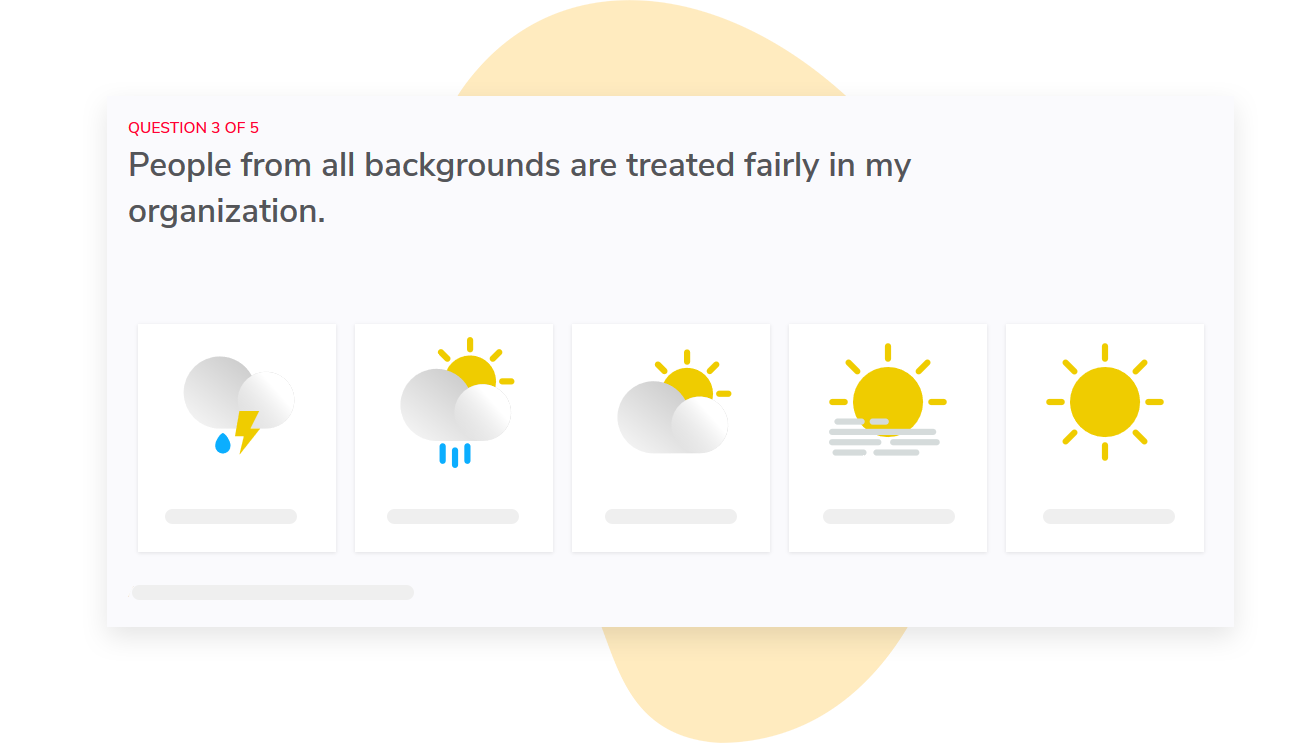
Sparkbay hides results when fewer than five people respond. That minimum can be raised for your whole organization, and it applies to comments too.
The main metric that you’ll see is the engagement score out of 10. eNPS is also available if the committee thinks it’s a useful secondary metric.
With Sparkbay, you don’t have to worry about manually managing report access for all the people in your organization. We automatically map access to your org hierarchy, so managers only see reports for their own teams.
This is helpful when you’re part of a large organization. You don’t have to worry about manually managing permissions.
The joint committee can also use group level views (e.g., heatmap of teams) to prioritize areas for follow-up within the company.
Sparkbay is ISO 27001 certified which can be helpful when you’re documenting third-party data handling for the union.
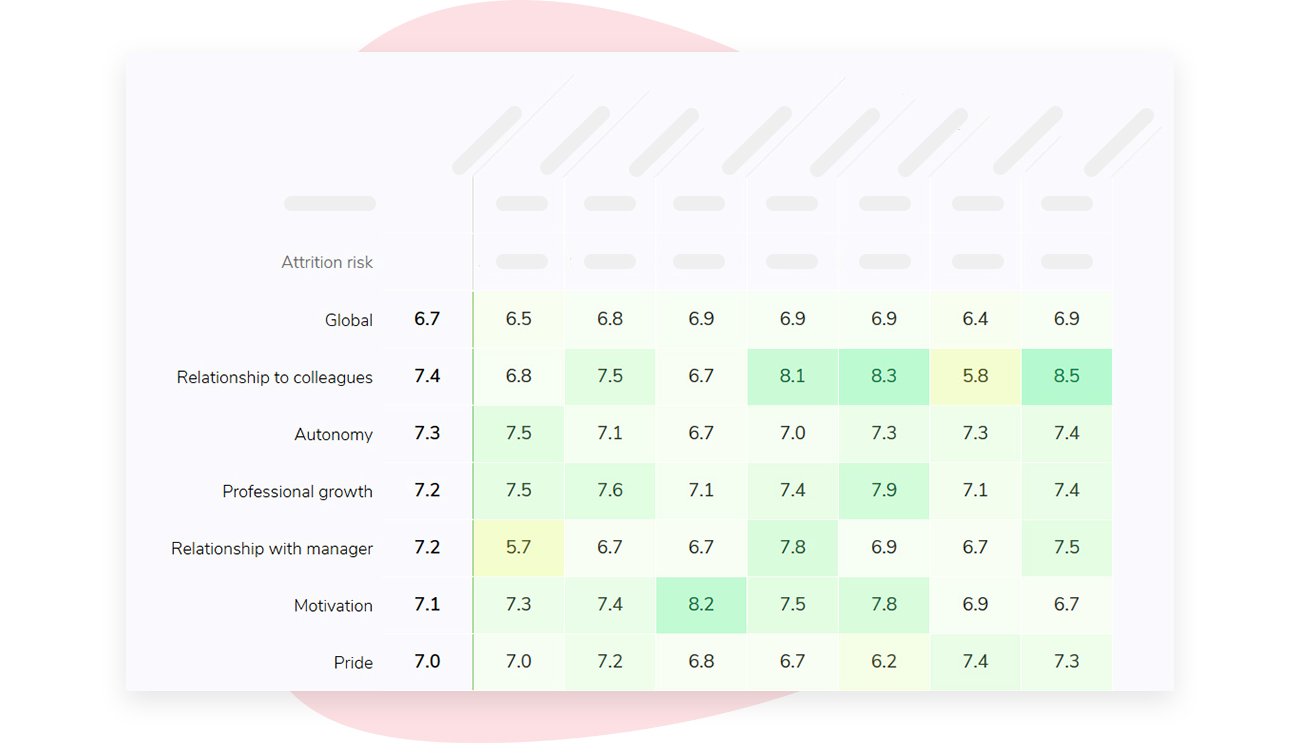
You and the union can agree on which group results will be shared with whom before you start using the platform.
Once you’ve established these rules within the platform, Sparkbay will ensure they are respected.
If you’re interested in learning how Sparkbay can help you build a more engaged workforce, you can click here for a demo.
7. don’t ask again until people know what happened last time
Survey fatigue isn’t just about the number of survey invitations people receive. It’s about being asked the same question a second time with no indication that their first response was read.
In the presence of a union representing the workforce, this can have an added cost. Your union may use this as evidence that your survey is a "joke" or a "show".
Instead, focus on what you do between survey rounds. Use the union to help you release results, clearly list the issues you’re working on with them, and schedule a date for the next update. It’s also helpful to clearly communicate what things won’t change and why.
Tell employees what came of the last survey before you send out the next one.
You don’t have to solve everything within a single survey cycle, but you do have to demonstrate action. If the last survey round identified an issue (e.g., an increase in employee downtime due to shift handover issues) make a point of informing the workforce whether the issue was addressed.
And if it hasn’t been addressed, be clear about why not. Is it a staffing issue? Is it an issue with contract language?
Is it an issue that requires more funds from the capital budget?
If it’s contract language that’s causing a problem, you can point this out as a reason to take it back to the bargaining table.
This is important because it means your union isn’t going to treat that survey result as a way to circumvent the union. Instead, they’ll understand that this direct feedback is something that can be taken back to the union management team responsible for ensuring contract language is correct.
According to Gallup’s research, the manager accounts for the majority of the difference in engagement levels between teams.
While there are many causes of engagement (and disengagement) that have to do with the union contract, this is one way in which a unionized workplace is different, and not quite so problematic:
It means that a manager calling off a follow-up conversation after a survey results has more "weight" than it might have had before, because employees look to the manager for signs of action.
Gallup’s research on people who leave a company shows that a large portion of departing employees say their manager or employer could have done something to keep them from leaving.
Establishing regular check-ins between formal survey rounds allows you to learn about these issues before they wind up in an exit survey.
Ask your joint committee to review the status of actions before signing off on the next set of survey items. If there are still open actions, the union and management can together decide whether to stick with the date and conduct a smaller follow-up survey or push back the survey date.
When making this decision, apply a simple rule: If over half of the actions you committed to during the last survey round show no visible progress, push back the survey date.
8. put the agreement in writing
Write down your agreement. This can be in the form of a memorandum of understanding, side letter, or even language in your collective agreement.
These different avenues allow for different levels of flexibility and ease of amendment and also have different implications in terms of dispute resolution.
Discuss these options with your labour counsel.
If you are entering into an agreement on employee surveys for the first time, a side letter may be an attractive option, as it can easily be revised by both parties without reopening the entire collective agreement.
Once the survey successfully goes through at least one round of bargaining, it could be converted into language in the collective agreement.
Once you’ve decided how you’ll document the survey agreement, consider the following items that should be included in your written plan:
- The frequency of surveys and circumstances under which either party may request a postponement
- The topics of the survey (and any topics that will be reserved for bargaining or other joint processes)
- The process for soliciting feedback on survey questions before they are sent out
- How to protect small groups within the workforce and handle written comments
- The intended recipients of survey results, when and how they will receive them, and what they may do with them
- The process for joint review of actions taken and re-evaluation of the cadence of surveys
You want to avoid locking yourself into a fixed survey frequency with no mechanism for re-evaluation.
Changes to your collective agreement, organizational restructuring, or rounds of collective agreement that produce limited usable data are legitimate reasons to revisit the survey frequency.
Without language in your agreement specifying a joint review of the survey protocol and frequency, any changes to the survey frequency would require renegotiation.
After the first full cycle of surveys, plan an end-of-cycle joint review meeting. Bring information on response rates by unit, survey results for the agreed groups, and information on actions taken.
If you notice a sharp decline in response rate within a specific unit, treat this as a labour-relations signal. A coordinated drop in response rates is a way for members to express that they don’t trust the process, essentially voting on the survey itself. Avoid following up with reminders from supervisors, which can be seen as coercive.
Instead, ask the local president what happened in that unit.
Based on this feedback, decide whether your next round of surveys will cover the same items, require fewer items, or be conducted at a different time.
If you’re interested in learning how Sparkbay can help you build a more engaged workforce, you can click here for a demo.