Every new manager makes the same, predictable mistakes. The only difference is how soon someone notices.
Usually, the timeline goes something like this:
- Your team recognizes your missteps within the first three weeks.
- Your manager recognizes your missteps within six months.
- HR hears about your missteps at your exit interview.
With the right pulse data, you can speed up this timeline.
But to do so, you have to view your pulse data as a starting point.
Because if your data says you’re only "average" as a first-year manager, you might be tempted to chalk it up to your predecessor, the last reorganization, or just the folks you happen to have on your team.
Which engagement drivers drop when a new manager makes each common mistake
From doer to developer
In Becoming a Manager, Linda A. Hill writes about how new managers expect to step into a role where they have authority and control.
What they actually discover is that they’re dependent on their team, their peers, and their boss.
In reality, they’re no longer the person who gets the work done. Instead, they’re the person who helps other people get the work done.
And this is something they have to learn as they go. This means making mistakes in front of the people they now manage.
Why are these mistakes so predictable? This is due to a structural problem.
The Chartered Management Institute found that most managers enter into management roles without any formal management training.
Even if a manager has undergone management training, it’s unlikely they have received training on how to handle a situation like the following:
It’s 4pm and a report hasn’t come in on time. What do you do?
Years of experience as a strong individual contributor have trained you to step in and fix it yourself. But now, as a manager, you have to take a step back.
As a result, there emerges a gap between what you as a manager are trying to do and what your team experiences.
While you may think you’re "being available" your team experiences approval limbo.
While you may think you’ve delegated responsibilities, your team is waiting for a decision that only you can make.
And perhaps neither side feels comfortable raising this issue in one-on-ones, because the new power dynamic makes the conversation awkward, especially if the manager was once a peer.
A structured feedback process can help bring these gaps to light while they’re still small enough to talk through.
So when is a good time for a new manager’s team to receive a first pulse?
As soon as the manager has completed at least one full round of one-on-ones with every direct report.
Anything sooner, and you’re measuring the predecessor.
Five responses your team will raise in their feedback, so be wary of them
As you dive into your team’s feedback results, if you notice one of the above areas dipping, you might consider focusing on a single item. After all, that’s the easiest way to identify issues and develop remedies.
On a small team, however, a single person changing their response to a question can drastically impact the average results. Try to spot clusters of related items moving in the same direction before drawing conclusions.
As a good rule of thumb, you should only be worried if at least two items within a group are moving in the same direction, and this cluster of responses happens two cycles in a row, while similar teams at the same skip-level are staying the same or improving.
This means that if you see a dip after just one survey cycle, or you see that a whole department has dipped in a certain category, it’s worth having a conversation, but it’s not worth worrying over. While you may want to see an immediate improvement, especially if the comments relating to a particular group of items are difficult to read, you should keep this in mind when prioritizing your focus areas.
Hovering over every detail
It’s easy to assume first-year managers who micromanage have control issues. In reality, it’s often the case that they were star players themselves and when they’re trying to meet a deadline, they fall back on the habits that led to their promotion.
When they micromanage, it annoys people and by doing so, they signal to their team members that they shouldn’t be making decisions that are supposed to be in their remit. Plus, they shouldn’t be delivering finished work that their manager can approve. In short, they take up valuable time away from things they should be focused on.
What’s more, micromanagement is self-perpetuating. The more pieces of work that get sent back to the manager, the deeper they get pulled into the details, setting them up for future micromanagement.
You may find that your manager is micromanaging based on survey results that show questions on team members’ feelings of autonomy, their trust level with their manager, etc. If the downward trend on these survey results is focused on a manager’s area of expertise, that’s a sign that their micromanagement is affecting team member responses. Other signs may be written comments that mention the manager’s area of expertise or survey results broken down by role (to keep responses anonymous) that support this assumption.
Gallup research indicates that managers account for most of the difference in teams’ engagement scores. So if your manager has recently changed and your teams engagement scores have changed for the worse, don’t buy the assumption that "they had a tough quarter" just yet.
So how should you coach your managers? It’s important that they understand when their intervention is helpful and when it prevents team members from succeeding.
For instance, a manager may believe that simply telling themselves to "let go" will save the team from a micromanagering crisis. What they need to learn is how to have conversations and come to agreements with their team about what the expectations are for a specific piece of work (e.g. What are we expecting? What are the constraints? What decisions do you make versus me?). If there’s a real risk of failure, they can agree to touch base at a specific point rather than hovering over the entire piece of work.
Treating the team as a single unit
When you’re a new manager with limited time on your hands, choosing the same processes for your entire team (e.g. setting a template for one-on-one conversations, deciding on a fixed schedule for one-on-one conversations) is a sensible, responsible choice. This way, you can be sure that nothing slips through the cracks.
But the problem is that not everyone on the team experiences this formal process in the same way. Someone else who used to be your peer or is a close colleague may have an informal channel to chat with the manager in between formal conversations while the rest of the team relies on those formal conversations. While it seems like a fair solution to all team members, the result is an overall team sentiment with a split below the surface.
If your data shows lower survey responses for feeling recognized, feeling a good relationship with the manager, and feeling like there are enough growth opportunities while responses for workload and resources stay the same, it may be a sign that your team feels like their manager only knows what they produce from an intimate knowledge of the work rather than from any knowledge of them as a person.
Another red flag is written comments that use phrases like "favourites" or "the old team" or that point out specific people or roles in a breakdown of responses that meets the anonymity threshold.
If someone on the team was in the running for a manager job, but didn’t get it, their survey responses may be off for the first couple of months, which makes their one-on-one conversations with their manager super important.
You can coach your manager to have a conversation with each member of their team that asks, "What do you think is a useful form of support for you when you get stuck?" and "What would you like to be doing a year from now?" With these answers written down, each manager can revisit these responses after a four to six week period.
Managing up at the expense of managing down
New managers worry about managing their managers (since that’s who they’re actually being evaluated by) and trying to avoid sending a flagging signal that says they can’t manage a team. These worries may lead them to avoid managing up entirely or, on the flip side, over-reporting issues with workload or broken processes. Either way, this information never gets passed down to their team.
Once again, this is an issue that can be noticed in survey areas related to manager support, feeling heard by the manager, and confidence in different directions. While teams don’t expect their manager to always "win" an argument, they want to know if they kept their team’s interest in mind while speaking up and how that turned out.
One strategy for coaching managers is to encourage them to elevate the level of these conversations and focus on how these escalated issues impact their team’s ability to deliver. Once it’s clear that a manager understands how these issues impact the team, you can coach them on how to report back to their team, including how to communicate when there simply can’t be change, and why.
Hearing a clear "no, here’s why" can build more trust than constantly hearing nothing and wondering if the manager didn’t even try.
Before working on managing up, find out if there’s been a leadership change above your manager. If there has been, and if there’s a reported dip in "direction" for every team under the same senior leader, it may be a case of your manger simply passing along uncertainty. If that’s the case, no amount of coaching will help.
Instead, it’ll just teach managers how to deliver bad news more smoothly instead of having real conversations.
Your manager may get annoyed about a lower survey score on questions related to feeling heard, especially if they believe they do a good job listening to their team. While this may feel unfair, it’s important to look at this item differently from now on. Instead of focusing on hearing teams out, focus on whether managers provide clear examples of actions taken as a result of people speaking up.
Since this survey item looks back in time, managers should be aware that this score may only start to adjust one survey cycle after they’ve started listening better.
Leaning on the title instead of building trust
Were you promoted to manager over people on your team? If so, you may have fallen into one of two traps: over-leveraging your authority or avoiding difficult discussions to protect existing relationships. Both scenarios erode trust on your team, but in different ways.
In the first case, trust erodes because someone may come to you as their former colleague presents a problem only to be told that the decision has already been made. After a few occurrences of this, they stop bringing problems to you altogether, cutting off an early-warning system and distorting future survey data while limiting opportunities for change.
In the second case, the people on a team may continue to trust their manager, but the overall sense of fairness and accountability on the team dips due to a refusal to deal with poor performance.
It’s important to track survey areas that focus on psychological safety, speaking up, and trust in the manager. Gallup research already shows that only a minority of employees strongly agree that their opinion counts at work, so expectations are already quite low. So if these numbers dip on a team with a new manager, it’s definitely time for a conversation.
If your manager keeps a track record of responses with "the decision had already been made," then you know you have one data point in a larger trend.
Encourage your managers to open discussions by explaining what is open for discussion and what isn’t (e.g. "The deadline is set in stone, but the approach is not.") This avoids pushing teams further away by shutting down discussions.
It also helps shift how managers deal with these discussions by giving them conversation starters for explaining why certain suggestions can’t be taken up as opposed to sending follow-up emails that may be taken as a brush off.
Pretending you have all the answers
To keep things calm, new managers often project confidence even when they don’t have all the answers. This is especially true when managing former colleagues who worked with them before they got promoted. They don’t want to be caught bluffing.
But one wrong answer is bad enough, but it’s even worse if it offers a new lesson to the team: don’t ever show uncertainty and only share good news.
This also makes early survey data results look deceptively "neat" if teams learn to hide uncertainty in those survey responses as well.
On later survey cycles, keeping an eye on trust, psychological safety, and the number of comments (and level of candidness) can help identify whether there’s an evolving culture of opening up on teams.
For instance, if there’s a slight dip in speaking up by round two, there are mixed takes on whether that signals eroding trust or people beginning to tell the truth.
If the comments are more detailed and specific than in previous cycles, that’s a sign that people are starting to be more open. If comments are shorter and more vague while the score drops, then people are holding back.
Coaches can encourage managers to simply speak truthfully by saying things like, "I don’t know yet," I’ll check with the people involved and get back to you on Thursday. These conversations build credibility.
Of course, this doesn’t mean managers should voice every doubt they have to their teams. But they should keep their teams from acting on something that’s really just an educated guess.
If your grouped data points to one of these patterns, before you act, test your data hypothesis by conducting a light check during your one-on-one conversations. You don’t want these dialogues to feel like a "why did you answer this survey question like that" exercise for your employees, which compromises the reliability of your next cycle of data.
| Mistake | Survey clusters to look out for | Questions to ask |
|---|---|---|
| Hovering over every detail | Autonomy, trust, growth | "Where would you like me to step back?" |
| Treating the team as a single unit | Recognition, manager relationship, growth | "What kind of support helps you most on this work?" |
| Managing up at the expense of managing down | Manager support, feeling heard, direction | "What have you raised that I haven’t followed up on?" |
| Leaning on the title | Speaking up, psychological safety, trust | "When have I made it hard to disagree with me?" |
| Bluffing through uncertainty | Trust, psychological safety, candid feedback | "What’s something you’ve held back from telling me because it wasn’t good news?" |
Treat your first results as a baseline
Keep in mind that your "first" round of results as a manager may not actually be a reflection of you.
Perhaps your team’s last manager canceled every 1-on-1 for months, or the team’s in the middle of a heavy reorganization that hasn’t calmed down yet, or your reports used to be your peers and they’re still getting used to the new dynamic.
It may feel unfair to compare "apples to oranges", but that’s exactly what many organizations do, simply because they have managers side-by-side on their data dashboards.
So before you compare, ask yourself: which "apple" did that manager inherit?
As Michael D. Watkins writes in The First 90 Days, new leaders must focus on different areas depending on the situations they walk into. A team in turmoil requires a different approach than a team that’s slowly losing its way, which in turn requires a different approach than a team that’s performing well.
The same applies to interpreting data.
If you inherit a team in turmoil and you receive a low score, consider that you’ve received a baseline.
On the other hand, if the team was doing well six months ago and they’re scoring poorly now, you may have a problem with a transition period.
Before coaching a manager on a low score, consider what the low score really reflects for their team. For instance, if a question asks about clarity and the team provides a low score, are they truly lacking clear priorities?
Or do they constantly switch gears because of decisions made further up? Chances are, it’s the latter. Gallup reports that many employees don’t strongly agree that they know what’s expected of them at work, so low scores on this item are common.
If a manager’s priorities are constantly changing because of decisions made further up, they don’t need coaching on this item. The problem lies one level up.
Similarly, consider how a manager’s results change overall, over the course of two or three cycles, and connect any changes to specific events. Did "autonomy" increase after they changed their approach to delegation? Did the "feeling heard" score remain the same, despite a promise to escalate an issue to management?
Has the makeup of the team suddenly changed? The departure of two people and the arrival of two new employees will impact your data.
Consider the participation rate as well. If your scores go up, but fewer people participate, it could mean the unhappy employees stopped filling out the survey. And if there’s a sudden spike in participation because the manager urged people one by one to respond, keep that in mind.
People may feel the need to give a different answer when they know their manager is tracking who participates.
If your overall team scores are low, if the previous manager had low scores as well, and if the counter-part teams also reported low scores, then it shouldn’t be surprising that you’re starting out with low scores.
If your scores dramatically drop after a new manager takes over a team, you may once again have a transition issue.
In either case, allow your managers the freedom to focus on one thing they can control and be intentional about improving it. Then, during the next cycle, see if that item has improved.
A low score in your first year is still a starting point that you can improve on. It’s not a verdict on how well you’re doing.
Use the scores to coach, not convict
So what should HR do when the results come in?
First, ask managers to share what they thought their results would be before showing them their actual results. This provides a useful coaching opportunity by identifying the gap between what managers thought their results would be and what the results are.
If a manager was relatively accurate in their predictions, this will help you focus your coaching efforts on areas where they may not be following through. On the other hand, if a manager was surprised by the results, there may be a perception gap that can be addressed through a discussion around information sharing within the team and what the manager is or isn’t hearing.
Ask managers to identify one or two drivers they want to work on. They may pick the lowest driver, but it’s also possible that they’ll choose one that they think they can work on. For instance, if they notice that both trust and autonomy have gone down, they may decide that this doesn’t call for a full-on development plan, but a conversation with their team about division of responsibilities and a commitment to no longer sending back finished work.
When managers share their feedback results with their teams, coach them to avoid an information session where team members discuss why they scored certain questions the way they did. This compromises the anonymity of the survey. Instead, encourage managers to keep the session short and to the point: "Here’s what you told me, here’s the one thing I’m going to create change on, and here’s when we’ll check in to see if that’s making a difference."
Encourage managers to schedule a midway check-in with their teams. Alert managers to the importance of this meeting and suggest that they bring an agenda that includes what they’ve tried, feedback they’ve received from the team, and any outstanding issues. Waiting until the next survey to check in on progress isn’t an effective use of time.
When you are coaching managers, ensure that you create a sense of psychological safety that makes it okay for them to be open and honest. If all conversations are focused on adding something to their file, they will be less forthcoming with information.
Similar considerations apply at the organizational level. If early survey results are used to assess a manager’s performance, there’s a real incentive to disregard the data or to pressure team members to take it slowly in the lead-up to the next survey. Both options compromise the integrity of your data.
Instead, seek an upfront commitment from the manager’s manager that initial engagement survey results for a manager’s first year are for developmental purposes only. Then ensure everyone keeps to this commitment, even if the results are uncomfortable.
Hill’s research stresses that becoming a manager is a process of learning on the job, which includes making mistakes in the spotlight. Your opportunity as an HR professional is to shorten a manager’s learning loop by helping them spot these moments, try something different, and report back on whether it worked.
Of course, there will be a point when coaching is no longer enough. After two survey cycles, if the same driver remains low, and comments are specific about behaviour, and you have other signals that corroborate this trend (requests to transfer, regretted attrition), it may be time to have a performance conversation with a manager.
This performance conversation should come from a manager’s manager and focus on specific behaviours rather than a readout of survey scores.
How Sparkbay can help you identify a new manager’s blind spots
With Sparkbay, you can ask the same questions over time to see if your new manager’s team feels more trusted after they change how they delegate.
Monthly pulses can show you trends months before an annual survey would.
Since you can fully configure the wording of your survey and dashboard, you can phrase questions to match the drivers you’re coaching managers on.
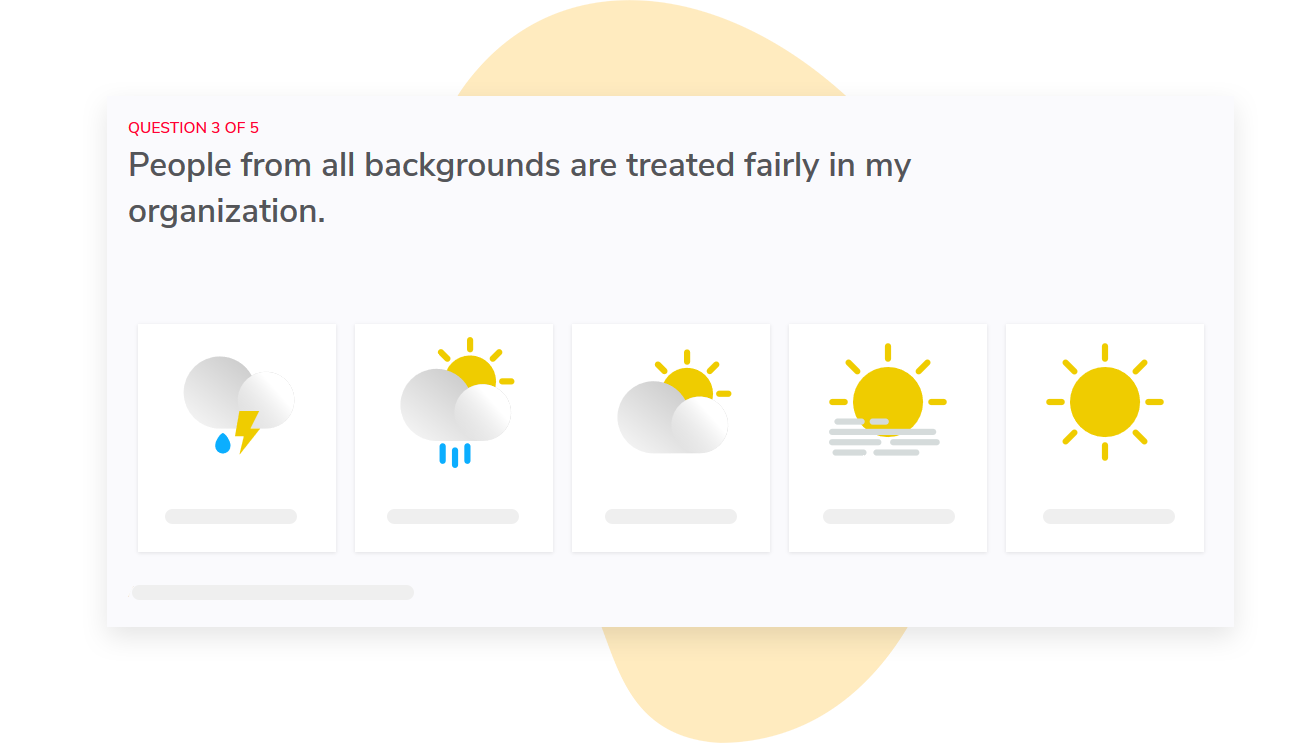
From the engagement score out of 10, you know where to focus your efforts.
From the questions that make up the score, you know what to coach your managers on.
Comparisons across groups show you whether a negative trend is limited to one team or part of a wider shift across the department.
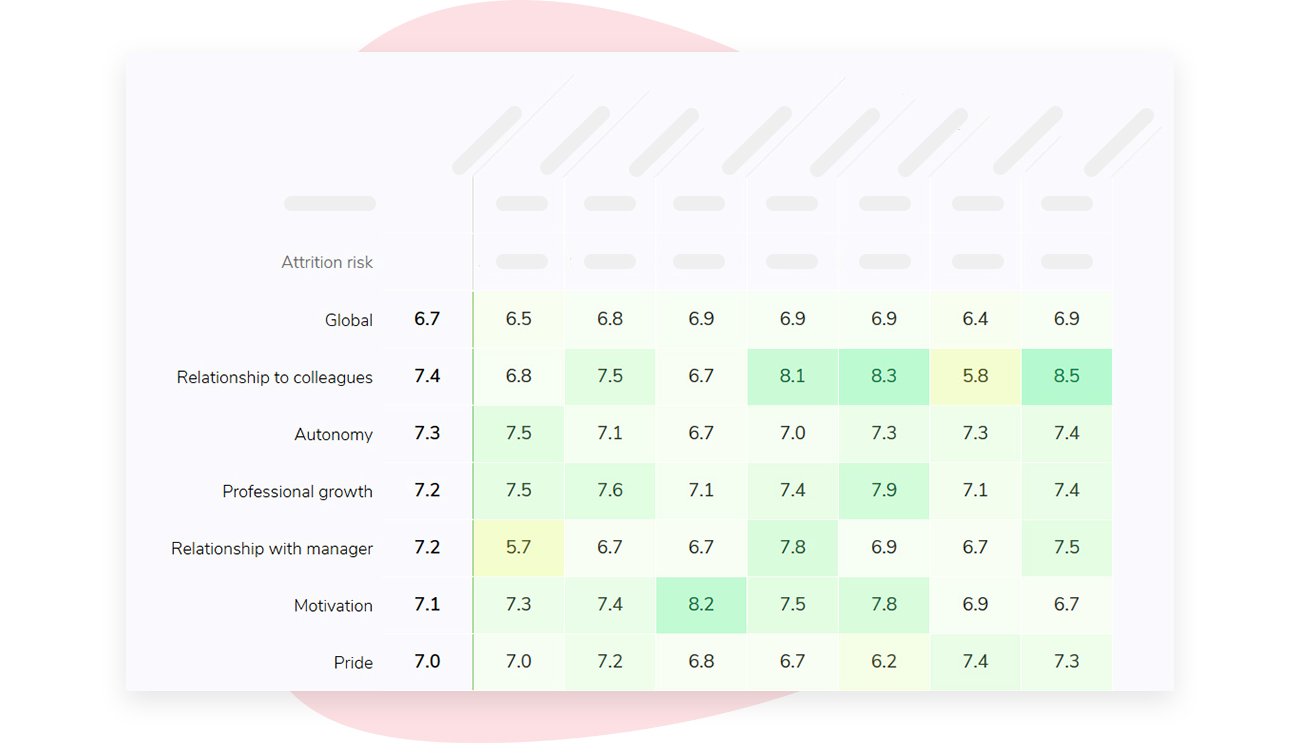
In a large organization, the system automatically maps report access based on the org hierarchy.
This way, each manager only sees data for their teams, while HR can look across groups and bring the right context to a coaching conversation.
If you’re interested in learning how Sparkbay can help you build a more engaged workforce, you can click here for a demo.
What if my team is too small to survey?
If you have a small team, your clearest feedback may come from conversations, but your riskiest feedback may come from survey results.
With only a few respondents, your scores may directly identify certain team members, and comments make it even easier to guess who said what. People on small teams know this and often censor themselves accordingly.
It’s important to keep the anonymity threshold in place. Sparkbay hides survey results if the number of responses is below the set minimum (5 by default, and can be changed). You shouldn’t change the threshold to produce a report for one new manager.
Maintaining trust is important for the entire organization.
Eventually, your new manager may ask why they don’t have a survey report. You should have an answer ready by deciding how to handle sub-threshold teams before the first survey is distributed.
One option is producing a combined report for sibling teams under the same skip-level that are working on similar tasks. This gives you a report with some useful information about a management layer. But combining teams that work on very different things will produce noisy results.
Be mindful of overlapping survey cuts. If your organization is looking at department views, and there are views of all but one sub-team within that department, there’s a way to identify members of that remaining sub-team by subtracting.
You want to be mindful of this when applying filters like tenure or location to small teams as well.
If you have a stable team that hovers near the threshold, another option is to extend the reporting window. This may be a slower way to get your results, but it’s a safer, more specific approach.
In the meantime, you may want to consider using channels that don’t depend on aggregation. You could use skip-level conversations, so long as you’re explicit up front about who will see the information shared and what the next steps will be. And remember, your managers already have one-on-one conversations where they can check in with people and ask what support they need.
They don’t have to ask anyone to account for a survey response.
You’ll also want to be mindful about how you write your open questions. Encourage people to provide specifics about their behaviour by asking questions like, "What would have helped you with your last handoff?" rather than questions that ask them to identify themselves through context like their role, project, or tenure. And when you review comments, remember to apply the same logic you use when reviewing scores: Comments can make it easy to identify the author, too.
Even if you don’t want to produce a report, you can still help your team create a baseline. You can do this by agreeing on a few working norms with your team and setting a date to revisit them together.
If you’re interested in learning how Sparkbay can help you build a more engaged workforce, you can click here for a demo.