
Your VP of Operations shares the new org chart, and your team spends the rest of the meeting staring at the boxes.
Leading your team through the ending, neutral zone and new beginning of a reorg
- In this guide, you will find
- Why the boxes move and why everyone flinches
- Organizational change may happen quickly, but transitions take time
- Days 1-30: let people ask about the old before you sell the new
- Days 31-60: work through the messy middle
- Do you want to assess engagement levels, or wait until you can properly respond?
- When the reorg breaks your dashboard
- Days 61-90: give the new org structure a chance to work
In this guide, you will find
- Why your boxes are moving and why everyone is flinching
- What to expect during the first 90 days after a reorganization
- What to do during days 1-30 after a reorganization
- What to do during days 31-60 after a reorganization
- How to handle questions from your team members
- What to do if your data gets messed up after a reorganization
- What to do during days 61-90 after a reorganization
- Your 90-day reorganization cheat sheet
Afterwards, Priya asks whether she still owns customer escalations.
And Ben wants to know what happened to the project lead role he was promised.
But you don’t have either answer.
And you’ve already got a team meeting on the calendar, so you can’t deal with these questions right now.
Most reorganization tips tell you what to do up until the reorganization announcement, or how to communicate the rationale for the reorganization.
But what happens in the next 90 days?
After 90 days, the charts are official, but decision rights, workloads, report permissions, and survey baselines might still reflect the old organizational structure.
During those 90 days, what’s your role as a manager?
It’s a little different than "driving change". It’s focused on closing specific, outstanding questions on a timeline, identifying people who are quietly disengaging, and avoiding making assumptions based on data that has a different population than before.
In this guide, you’ll find helpful tips on how to handle "I don’t have the answer" questions, what to look out for as new roles settle in, and how to interpret survey results when your teams have changed.
Why the boxes move and why everyone flinches
Your leadership team presents a reorganization as a cost-cutting, market-focused, growth-oriented, or integration-focused decision.
But what you’ve been presented with and what you’ve been told the organization is working towards are two different things. Reorganizations are often the result of months of discussions and decisions before they’re announced.
Meanwhile, your employees quickly try to make sense of what this means for them personally.
How much of their status will they lose?
Will they still be able to make the decisions they used to make?
Will the person they relied on to help them whenever they got stuck still be responsive?
Will they now report to someone they’ve never worked with before and therefore have to spend time proving themselves?
Worst of all, they may have lost someone like a colleague who helped them get approvals through or even a skip-level manager who was aware of their work and what they’d accomplished. All of these changes may happen without a word of announcement.
This is why it’s frustrating to hear a well-reasoned explanation for the organization’s reorganization. It’s an answer to a question that no one in the room had been asking.
During your first few weeks after learning about a reorganization, avoid trying to sell the merits of the updated org chart. Instead, focus on making the reorganization tangible for everyone by identifying what they currently have, what they’ve lost, and what’s up in the air.
Organizational change may happen quickly, but transitions take time
As William Bridges eloquently explains in Managing Transitions, while organizational change takes place rapidly (often as soon as the day it’s announced), transitions take much longer. It takes time to move through the psychological phases of an ending, entering a "neutral zone" where the old way of doing things no longer exists but the new way isn’t fully operational, and finally, a new beginning. These phases all require different responses from managers.
One thing managers forget about transitions, which Bridges calls the "marathon effect", is that they started their transitions well before their teams did. They started them while they were still involved in the design process of the change. This leads to impatience while waiting for teams to move through their transitions.
If you were involved in the design, it’s important to recognize that you may be further along in your transition than your team is. Be mindful of thoughts like, "why are they still talking about the old structure?" when you hear them, because it’s a sign that you’re out of step with the rest of the team.
Keep in mind that just because someone on your team may have advocated for an organizational change or reorganization, they may still be mourning the loss of the team or way of working they had when that change occurred. They may not be the easiest person to hear that expression of loss from, so check in with them and ask them what they miss.
During the neutral zone, shadow organizations may form. Your employees may copy two managers on every decision, continue to route work through the old informal network, or wait for permission from someone who doesn’t have the authority to give it. At this point, you don’t want to suppress these workarounds.
Instead, you want to acknowledge them because they represent areas where people are seeking clarity about decision making.
During the new beginning phase, your team will need to see evidence over and over again that the new organizational structure works when it comes to making real decisions.
Use the 90 days as a runway, not a deadline to have your team "over it"
Keep in mind that these phases can overlap and different people on your team will move through them at different speeds. On a given week, you may have someone who is still in their ending because they lost a close colleague within the organization. You may have another person who feels like they’re in that new beginning because their role has expanded.
Days 1-30: let people ask about the old before you sell the new
"I don’t know yet" works if you add a date
Questions will arrive before leadership has settled the answers. The temptation is to fill the gap with your best guess about who gets promoted or whether another round is coming. Once that guess circulates, people treat it as a commitment.
Separate what’s confirmed from what’s open, and attach a check-back date to every open item. If the honest answer on that date is "still undecided," say so on that date.
For instance: "Priya, I know the escalation team will report to Operations. I don’t know who owns customer escalations next month. I’ll ask today and update you by Thursday."
Ben’s case is different. As Denise Rousseau argues in Psychological Contracts in Organizations, the obligations an employee believes the employer owes them carry real weight, written or not. A perceived breach damages trust even when no formal promise was ever made.
So before you talk to Ben, check whether the promise was documented in a development plan, an offer or a written note. If it was, bring HR in before the conversation. If it wasn’t, the breach still feels real to him, so don’t argue the paperwork.
Either way, don’t apologise for a decision that hasn’t been made: I know you were expecting that role. I can’t tell you yet whether it exists in the new structure. I’ll find out who makes that call and when.
Keep an open-questions log with an owner and a date for each item, and share it with your HR partner. When several managers log the same question, you’re looking at a gap in the org design, and it needs fixing centrally. When a date slips, tell the person before they have to chase you.
The hardest version is when your own role is one of the open items. Don’t pretend it isn’t. Say "my scope is also being finalised," then name what stays stable for the team whatever happens to you: their goals for this month, and who approves their work this week.
Talk to the room, then talk to the person
The team meeting makes sure everyone hears the same facts. It won’t show you how those facts land with the person whose closest colleague left, or whose new manager has never seen their work.
Order your one-on-ones by impact. Start with the people whose roles, reporting lines or key relationships changed most. Reach them before they’ve pieced together their situation from peers.
Ask what they think they’re losing, what’s unclear and what you can resolve this week.
Listen for the question behind the question. "Who approves my projects?" can mean "Do I still have the freedom to do my job?"
Gallup’s engagement research has long treated clear expectations as foundational, and its surveys find that only around half of employees clearly know what’s expected of them. A reorg quietly invalidates goals cascaded from the old structure. Re-cut them now rather than at the next planning cycle.
Redraw the map out loud
Bring the new chart to a working meeting. Trace one real piece of work end to end, such as the next customer escalation, from first contact to final decision.
Who decides? Who needs to weigh in? Where does it go when those people disagree?
The gaps cluster in predictable places: handoffs between merged teams, approvals tied to spend thresholds, and dotted-line relationships the chart draws but nobody has defined. Log them as open questions with owners. Unlogged gaps turn into permanent workarounds.
Map the informal network too. A team can know its new reporting line and still have lost the person it went to for a quick answer every afternoon. That loss shows up as slower cycle times weeks before it shows up in a survey.
Days 31-60: work through the messy middle
The people who stayed are carrying more than you think
The headcount came out of the business case. The work didn’t. Remaining employees absorb departed colleagues’ tasks long before anyone decides what to stop.
Survivor guilt and fear of being next look the same from the outside: longer hours and a very quick "I’m fine." Both run down capacity you’ll need in month 3.
Microsoft’s Work Trend Index research finds that most workers already say they lack the time or energy to do their jobs well. Absorbing a departed colleague’s work with nothing taken away turns that chronic problem into an acute one.
Survivors also watch how the people who left were treated: the notice they got, the reasons they were given, the dignity of their exit. The people who stay judge the organisation by that process, not only by whether they kept their own job. If the exits were handled badly, acknowledge it.
Acknowledge the departure briefly, without making a speech of it. Then go through what that person owned and sort each item into continue, pause or stop. Get your own leader to sign off the stop list.
Without that sign-off, your team carries the risk of whatever gets dropped.
If you’re handing someone a new responsibility, take an old one off their plate or tell them when you’ll revisit the load.
Don’t promise job security you can’t guarantee. People can tell a firm answer from an attempt to calm the room.
Read the silence without diagnosing it
Quiet isn’t the same as disengaged. Someone learning a new job, or dealing with something outside work, can look identical to someone who has checked out.
What matters is change against their own baseline, not against the team. A naturally quiet engineer staying quiet tells you nothing. A vocal one going quiet does. Seven shifts are worth a check-in:
- They stop raising the questions or challenges they used to bring to meetings.
- They stop volunteering to help peers with work they once enjoyed.
- They drop optional forums they used to value.
- They answer every one-on-one question with "fine."
- They deliver what’s assigned but stop flagging problems early. This is the most costly change, because you find out about the problem when it has already landed.
- They pull back from colleagues who were once their first call.
- Their camera goes off when it used to be on, alongside other changes in how they take part.
No single item is a signal. Treat a cluster as a reason to ask.
Don’t monitor job-search activity either. Beyond the legal exposure in many jurisdictions, being found doing it destroys the trust you’re trying to rebuild.
Ask instead: "You’ve been quieter in our planning meetings. Is there something about your new role we haven’t sorted out?" That question lets the employee correct your read.
Gallup’s workplace research consistently finds that a large share of employees are watching for or actively seeking another job, even in stable periods. You won’t identify who’s leaving by reading behaviour.
Rehearse the conversations you don’t want to have
Around month 2, people start testing whether the new reporting lines mean what the announcement said.
The usual flashpoints:
- A former lead now reports to a peer.
- Two managers claim the same work.
- Another team courts a high performer you’re relying on to hold yours together.
Before each conversation, be explicit about what you can decide and what needs someone else’s approval. When role scope, pay or reporting lines are disputed, bring in HR or your own manager before you say anything that sounds like a commitment.
When someone says they’ve lost status, don’t argue that they haven’t. Ask what actually changed in their week. Then be precise about which decisions they still own and which are still open.
If another team wants one of your people, talk to the employee before you defend your staffing plan. Many internal mobility policies limit a manager’s ability to block a move, and practitioners disagree on how hard to hold.
Here’s the test: if the person has already decided they want something your team can’t offer, blocking the internal move converts it into an external resignation a few months later. Then you lose them and the company does too. Hold only when the move is about timing, and agree a release date instead.
Do you want to assess engagement levels, or wait until you can properly respond?
Should you assess employee engagement during an active reorganization?
There are differing opinions on this among practitioners. Our opinion is that you should only assess engagement if you will be able to meaningfully act on the responses within the next few weeks. If you can’t, it’s better to wait until you can clearly communicate to employees why you’re asking these questions and what the next steps will be.
You should also consider the timing of your assessment based on consultation requirements. In some jurisdictions with works councils, it’s problematic to distribute an employee engagement survey in the middle of a formal consultation process.
Understanding the difference between these two options is important:
- A short engagement pulse survey will allow you to assess whether people know who the decision-makers are or whether there’s been an increased workload due to employee departures.
- A full-blown employee engagement survey will ask employees to provide their feedback on a workplace that’s undergoing a lot of changes.
By distributing an employee engagement survey during a reorganization, be mindful to ask questions that you have control over. For instance, "Do you know who to go to when work gets stuck?" is a good question because it’s something you can change. "Are you confident in the future of the company?" on the other hand, is not something you can address in a team meeting.
Also consider including a couple of core items, worded exactly the same way as they were in previous surveys, to ensure some level of survey consistency before and after your reorganization.
When you’re analyzing survey results, it’s important to understand the leadership, function, or location-specific feedback groups the responses come from. The teams most impacted by reorganization are more likely to experience survey fatigue. So while your overall response rates may look good, you may notice an impacted team didn’t respond at all.
This is an important insight.
When you’re analyzing responses, beware of using negative feedback as a reason not to distribute your survey. You’re expected to respond to feedback, and in this case, the responsibility falls on managers to respond while already balancing a lot.
Based on Gallup’s findings on employee voice, only a minority of employees strongly agree that their opinions count at work. So distributing a survey during a reorganization and then going quiet gives employees another reason to stop providing honest feedback.
Make sure you set a date by which you’ll share survey results, and on that date, share both of the following:
- What changes you will be implementing at the local level
- What changes you’ve escalated, and to whom those changes now belong
When the reorg breaks your dashboard
Report access has to follow the new hierarchy
Your HR system changes are effective-dated, but your survey platform only reflects the hierarchy you gave it at a specific point in time. Before launching your next survey, confirm which version of the hierarchy your results will be attributed to.
You don’t want a former manager to have access to a team they no longer manage, especially if they’re the subject of that team’s comments. It’s important that the new manager has access to the results they’ll be expected to act on.
Avoid workarounds like circulating exports to different managers. This undermines your anonymity protection. Instead, make sure your reporting lines are corrected in your source data, and confirm users’ access levels before distributing the results.
Small teams still need anonymity
If a team that previously met the minimum response requirements splits into 2 groups that don’t, you’ll want to withhold those results. Avoid workarounds to get around the minimum response threshold.
If you roll these teams up into a larger group, you may be able to identify general patterns without compromising anonymity. But watch out for differencing, where a user views the parent unit’s results with and without a specific subgroup. They can then subtract the responses to identify a small number of individuals.
Using filters (e.g., tenure, location) to narrow down a group can have the same effect. The same goes for a manager who knows who responded - they can use differencing to attempt to identify individuals.
If your safe view is too large to make decisions at the local level, use your one-on-one discussions to raise work issues. And remember: it’s never appropriate to ask anyone to justify or explain their survey response.
Put a break in the trend line
Suppose you notice a drop in employee engagement in a specific department, but the change happened after that department absorbed another team. This trend isn’t the result of people becoming less engaged - it’s a composition effect.
You can attribute the old result to the previous population, note the reorg date on your trend, and start a new baseline.
If the majority of people in a department remain the same, it’s reasonable to compare current results to previous results, as long as you note the caveat. A quick sanity check is to see if the people who were in both groups reflect the overall change. If they do, your observed trend is real.
If only the new members show a difference, you’ve got a composition effect.
Before explaining a score change, check if the same people were in both sets of results.
How Sparkbay can help you keep track of a changing team
During a reorg, we’d start with questions that managers can act on. Sparkbay lets you configure the wording of surveys, so you can ask a short pulse question like "Do you know who makes _______ decision?" or "Who should I talk to if my project is stuck?" while keeping core questions the same for consistency.
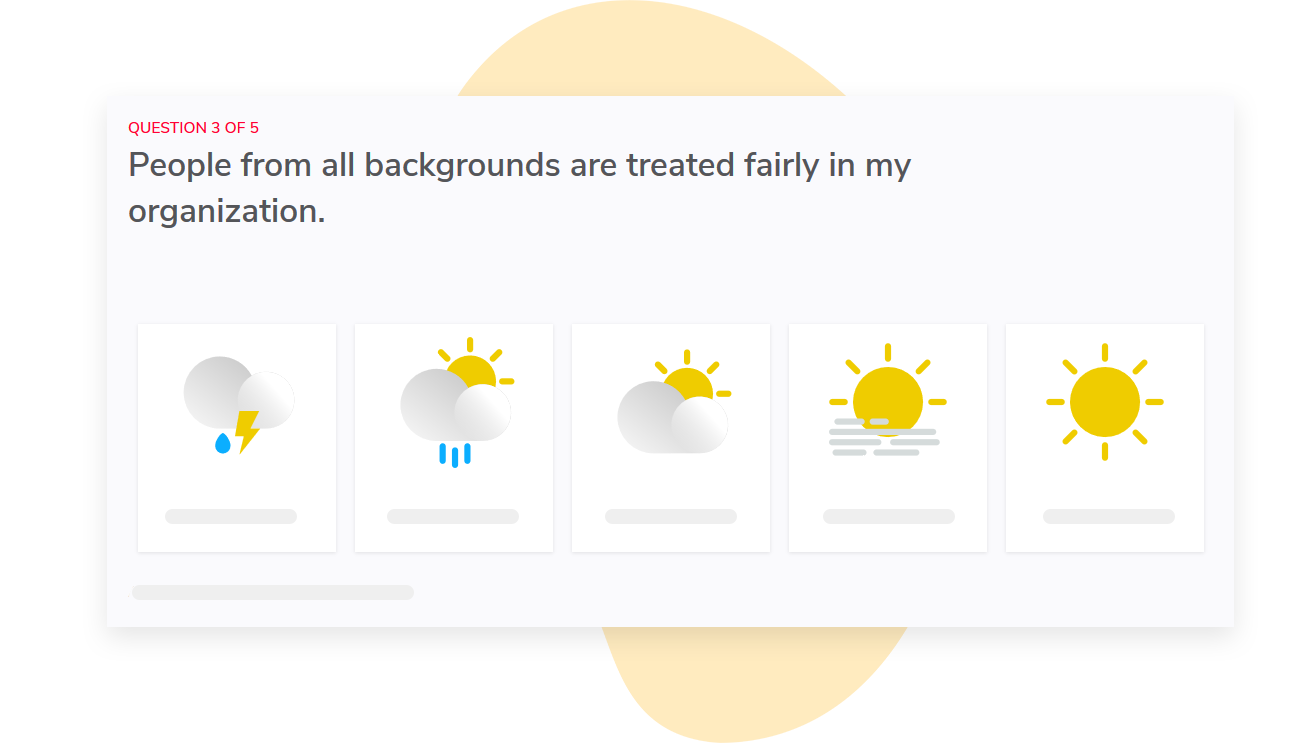
What matters is understanding the groups behind the answers. Our reports allow managers to view results by manager or department, so they can understand where unclear roles are causing friction.
In our reporting, if the responses are below the minimum threshold (5 responses by default, but customizable) then the results are not shown.
This is especially important if a team divides during a reorganization. Keeping these minimum response requirements in mind, and understanding team boundaries before and after reorganization, is important to avoid falsely identifying trend data in reports.
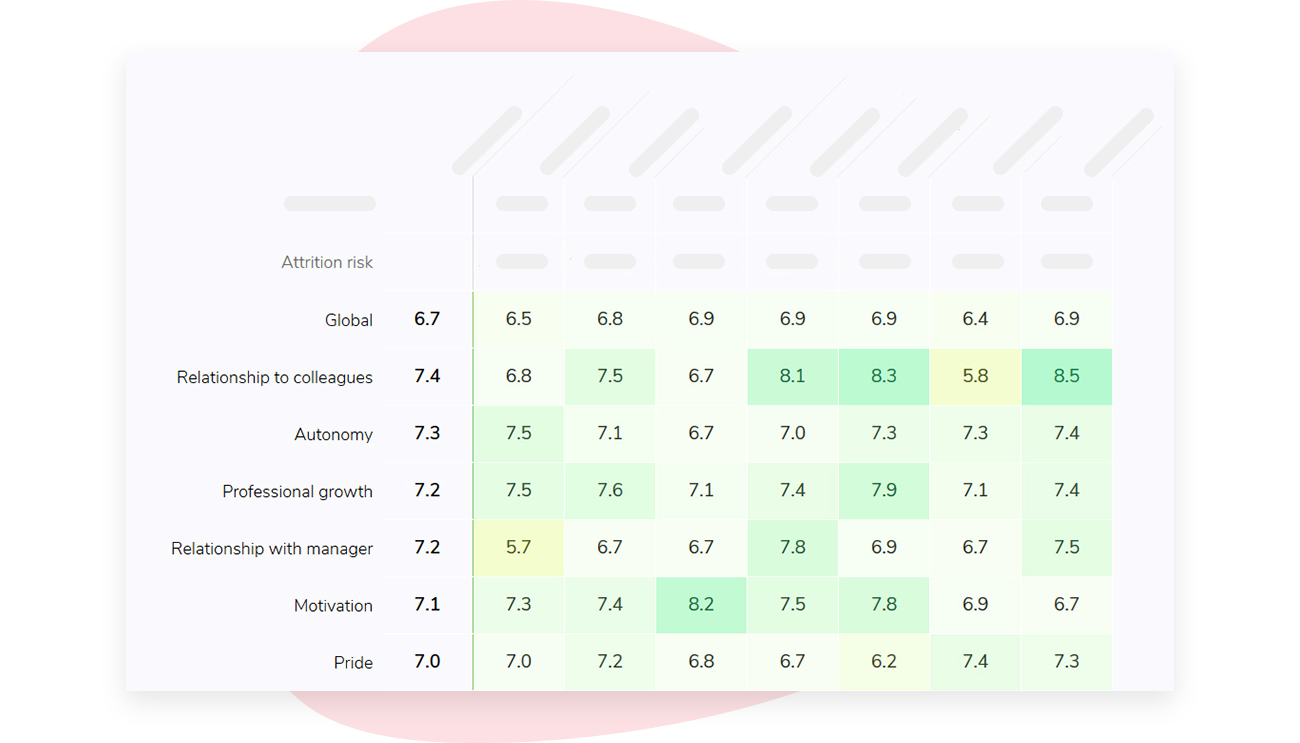
In Sparkbay, report access is automatically mapped to the org hierarchy, so managers only see results for their teams. Once your hierarchy is up to date, each manager will only have access to reporting for their teams.
If you’re interested in learning how Sparkbay can help you build a more engaged workforce, you can click here for a demo.
Days 61-90: give the new org structure a chance to work
By the time you’re wrapping up your third month, people have grown tired of hearing explanations about why the reorganization happened. They want to see evidence that things are actually working in the new org structure.
Bridges recommends hitting the four Ps when starting fresh: purpose, picture, plan and part. He says that most organizations focus on the purpose and picture at the company level, but forget about the importance of the plan and part at the team level.
Try turning each of these into team-level questions:
- What are we prioritizing this month?
- What does success look like for a customer or partner team?
- Who are we going to come to if a decision needs to be made and the normal channels don’t work?
Review a few decision-making scenarios with your team - including one that took longer than it should have - and discuss what the handoff was and how to improve it.
Officially retiring workarounds is another smart step. This means asking your team to stop duplicating information, ending a previously standing meeting, or archiving a previously active communication channel. These things happen because they aren’t officially discontinued.
As you start to notice early wins, share them with the team, but be careful of declaring victory. For example, if you notice that escalations are getting resolved faster because it’s clear who owns what, share these insights. And if you notice that something still isn’t landing properly between two roles, add it to the agenda for your next meeting.
What should you do in the next 90 days?
- Days 1-30: Identify and log your open items.
- Date your open items so you can keep track of them.
- Schedule one-on-one meetings with your direct reports (priority based on potential impact on business objectives) and understand their concerns and questions.
- Share your open questions list with your Human Resource Partner to identify any gaps in the reorganization design.
- Revisit your goals. You may have created them based on your previous organizational structure.
- Assess whether your role is impacted by the reorganization. If it is, communicate the uncertainties you will be managing and what will remain stable for your team.
- Days 31-60: Obtain a signed-off list of tasks from HR for team members who report to you that are no longer with the organization.
- As you meet with your team members, be alert for themes of change and compare to their baseline before reorganization.
- Conduct pulse checks, but only on the topics that you can help address.
- Respect core items on your agenda and note changes in response rates among different groups of people.
- Days 61-90: Understand your team’s purpose, what the bigger picture and plan are, and what part they play.
- Understand the real decisions your team is making and retire any "workaround" processes.
- Check access to reports within your team based on the new organizational structure.
- Create new baselines within your team, if necessary, based on changes in team composition.
If you’re interested in learning how Sparkbay can help you build a more engaged workforce, you can click here for a demo.