In his book Turn the Ship Around!, L. David Marquet shares that leaders get better results when the people doing the work make decisions about that work.
One of his most practical tips is to stop asking for permission by saying things like, "Can I...?" Instead, people on your team should feel empowered to say, "I intend to..." when they want to do something. Their manager simply responds with, "Very well." And just like that, the person who made the proposal owns the action.
Of course, this all falls apart when a team member misses a deadline. Suddenly, the manager starts asking for updates twice a day.
At first, this seems like the responsible thing to do. But after a few weeks, team members start waiting for approval on small decisions, the manager has even less time than before, and the next deadline slips again.
According to Gallup, managers account for a large share of the variance in engagement scores across teams. This suggests that manager behaviour is the most obvious place to make a change. But it doesn’t help HR leaders identify which manager behaviour is responsible for the variance in a given team’s engagement scores. And frankly, it’s hard to do anything about "micromanaging" since it’s such a vague term.
So what should HR leaders do to help managers build accountability without micromanaging? Is "trust your team" the answer? Probably not since that advice often gets thrown out the window when a client or senior leader wants to escalate something.
Instead, HR leaders need help identifying where the problem is. Is it that goals aren’t clear? Are decision rights held one level too high?
Is the team lacking the resources they need? Do team members take too long to share bad news with their leaders?
Each of these possible areas of improvement require different solutions. And applying the wrong solution can make things worse. For instance, adding more check-ins for a team that is lacking the resources they need is just going to add more reporting work to an already short amount of time.
How managers can build team accountability using clear ownership, follow-through on feedback and survey-based tracking
- In this article
- Micromanagement is a symptom
- Ask the team what they think before deciding what to fix
- Write questions that point towards a decision
- Learn to interpret the meaning behind your survey results
- Change the part of the job that’s getting in the way
- How Sparkbay can help you find what’s blocking team accountability
- Tell employees what changed
In this article
- Micromanagement is a symptom
- Ask the team before you pick a fix
- Write questions that point towards a decision
- Read the pattern, not just the lowest score
- Change the part of the job that’s getting in the way
- Tell employees what changed
- Check whether the change worked
Micromanagement is a symptom
When a manager constantly asks for updates from their team, it’s rarely because their team is micromanaging.
It’s more often because they’re compensating for something elsewhere in the system. If the manager’s manager asks them for updates several times a week, they’ve got to go back to their team and pull everything together again.
Ask the manager to log any time they request a status update from their team, for two weeks. They should also log what prompted them to make the request. After two weeks, most of these log entries will fall into one of the following categories, each with its own potential solution:
- The manager was prompted to request a status update by their own manager. A potential solution here is fixing the "up reporting" rhythm. For instance, their manager may agree to accept a written update once a week from the manager, so they don’t have to ask for updates on an ad hoc basis.
- The manager was prompted to request a status update because they were chasing a deliverable. If the manager is constantly chasing deliverables, teams may not be providing clear handoff criteria. In other words, the receiving team isn’t making it clear to the handing off team what "done" looks like and what the expected due date is. This is especially true for handoffs between teams with different managers.
- The manager was prompted to request a status or progress update by just a general feeling of uneasiness. These managers may benefit from improved fixed check-ins and escalation triggers, described below. This may be the only category where improvement may come from focusing on how managers do their jobs while they’re "onstage".
Notice how often the potential fixes have less to do with the manager themselves, and more to do with their environment.
According to one Gallup study, only about half of employees "strongly agree" that they know what is expected of them at work.
Unclear expectations and micromanaging feed into each other.
When managers have a vague understanding of what the finish line looks like, they wind up checking in more frequently. When employees get used to frequent check-ins, they learn to wait for managers to tell them what to do. After several cycles, managers interpret this waiting as a lack of initiative from their employees, which then justifies even more frequent check-ins.
Another thing to keep in mind is that managers were often promoted because they were good at the work they now manage. When they do the hands-on work, it feels faster to step in and address a problem than to draw clear boundaries. On any given task, this is often true.
But over time it affects the manager’s span of control. Once they have more than a handful of reports, they become the bottleneck for progress within that team. This creates capacity problems within the manager’s team, which their manager notices.
In his book, Leading Teams, J. Richard Hackman explained that the job of team leaders is to create conditions for people to work well. That includes setting a clear direction, creating a supportive structure, and ensuring a supportive context. It doesn’t mean micromanaging individual decisions.
Is there an exception to this rule? Yes. If there’s one individual who consistently fails to meet commitments while other team members (with the same goals, approvals, and resources) do, then it’s appropriate to focus on providing closer support for that individual with an agreed upon end date.
It’s not appropriate to muck up the entire team’s decision-making processes to account for one person’s needs.
Tip: Don’t automatically view a manager’s frequent status requests as evidence that they need another reminder to "trust people". Instead, use their status requests as a way to diagnose the team’s operating environment.
Ask the team what they think before deciding what to fix
The same bottleneck can feel very different depending on where you sit.
For example, a manager may say, "We need better follow-up when we hand off between teams," while the team may say, "We keep waiting for our manager to approve small changes before we can move forward."
A survey allows you to compare and contrast these views across many teams at once. This way, employees can identify this trend without having to face the discomfort of sharing this opinion directly to their manager.
In polling conducted by Gallup, only a minority of employees strongly agree that their opinions count at work. While conducting a survey may not move this number drastically, failing to act after conducting a survey could actively decrease this number, since workers have now witnessed a direct lack of impact from their voice.
What if your workforce views this survey as "Big Brother"?
They will be more likely to feel this way if you ask them questions like, "How many times did you NOT meet your deadlines?" and then give managers access to the employee names.
Instead, focus on asking workers questions about the conditions they work in. Not only will this keep your survey away from a performance review, but it’ll also result in more actionable data, since work conditions are what you can change.
Before launching your survey, be sure to share with employees what will be shared, at what level of aggregation, and when they can expect to hear back from us.
It’s also a good idea to schedule a specific date to hear back from the survey results. Saying something like "We’ll share results soon" because the information is not specific is a quick way to lose people’s trust.
Consider developing a parallel set of questions for managers to pose to themselves about the same work conditions.
For instance, instead of asking managers to rate which employees are "accountable" on a scale, ask them whether they feel like their team has clear priorities or enough room to make decisions.
Often, the most actionable insight for a manager will come from the gap between the manager’s responses and the responses of the team. Again, it’s important to present this as an opportunity for dialogue rather than an opportunity to pass judgment. If a manager feels like they will be judged based on this difference they’ll be more preoccupied with defending themselves during the debrief process than appreciating the decisions they still hold the power to change.
Finally, keep in mind that some of your teams may be very small. If you mandate a minimum of five responses per team, a team of four will never have their own results.
Identify potential combinations of teams in advance, so you can alert the relevant managers and avoid them looking for their team in the survey data.
Ensure that the potential teams you combine have a logical connection to one another, such as being in the same reporting line or sharing a workflow. Two completely divorced teams will create an average that doesn’t represent either team.
Write questions that point towards a decision
Ten to fifteen items is enough. If your repeat surveys start dropping in response rates, it’s probably not due to length. Usually, nothing noticeable happened after the last round of surveys to prompt people to take another look.
Often, you’ll notice the first warning sign in the open comments section (the responses get shorter and fewer) before your overall response rate starts to drop.
Make sure each survey item ties to something you would actually be willing to change.
In other words, if a person answers your survey, and their item says, "strongly agree" on a scale of "strongly agree" to "strongly disagree", you should be able to make a decision based on that answer.
For instance, you might want your employees to answer the following statements on a Likert Scale from "strongly agree" to "strongly disagree":
- Clarity: "I know what a successful result looks like for my current work."
- Ownership: "I know which decisions I can make without asking for approval."
- Resources: "I have what I need to meet the deadlines I commit to."
- Speaking up: "I can tell my team about a mistake or delay while there’s still time to respond."
- Feedback: "I get useful feedback on my work before a formal review."
- Management style: "My manager gives me room to decide how to do my work."
Suppose your survey asks an item like, "I take ownership of my work," and your employees respond to it. Well, nearly everyone would agree with that statement, so it wouldn’t help you differentiate one team from another.
What you want to know is, is there a gap between what people are held accountable for and what they actually control? This is often the cause of problematic accountability issues.
You won’t be able to identify this disconnect using a task tracker. You can with a well-worded survey.
Be sure to include at least one open question in your survey, such as, "What’s the main thing that makes it harder for you to deliver on your commitments?" You can encourage respondents to be specific by including a prompt on the importance of providing an example. If someone provides you with a more specific answer, like, "We have to get approval from someone who isn’t on the team and the step isn’t documented anywhere", or "Our priorities change every Tuesday", you have something you can actually act on. General responses about "communication" are not.
One more item you’ll want to include is about psychological safety. According to Amy Edmondson’s research about teams in hospitals, better led units reported more errors. This doesn’t mean that better units were making more mistakes.
Instead, it demonstrates that people felt comfortable enough to report these errors. This means that if you improve psychological safety, you may see an increase in reported problems before a performance increase. That’s something you’ll want to keep in mind and give a heads up to your leaders before they think a crackdown is necessary (which could reset the entire climate).
Finally, consider how different teams may interpret survey items. What constitutes "missing a commitment" on a hospital ward may be very different from what it means to a software team. Adapt the wording of your survey to your team’s situation, while maintaining the same underlying construct, so your string of longitudinal studies are actually comparable.
Finally, be mindful about how you describe anonymity. You may think you are being careful by collecting names and then throwing out any answer whose score or comment could identify someone. That is not always enough. On a small team, it’s possible to identify someone based on their choice of words or the incident they describe, even if there are enough responses to meet the minimum requirement.
Decide before distributing the survey what level comments will be shown at, make this clear to respondents, and don’t change it after the fact.
Learn to interpret the meaning behind your survey results
It is natural to jump to conclusions based on the lowest scoring item on a survey, but it’s important to consider items in combination to get a more thorough understanding.
For instance, if your teams report high levels of clarity and low levels of decision authority, it may mean they know what they want to do, but they are waiting for the green light to do so.
If several teams under the same manager report low levels of clarity, it may be related to how priorities are set one level up.
If teams report low speaking up levels, but indicate high levels of decision authority or ability to execute, it may indicate that managers are not hearing about problems or issues quickly enough and are counteracting this by over-checking in an attempt to stay in the loop. In this case, removing check-ins may not be effective and may cause anxiety among managers.
If teams report low resource availability, but high clarity levels and decision authority levels, it’s a sign that the team knows what they want to do and they are able to make decisions, but they lack the capacity to complete tasks. Sending managers to delegation training would be futile. What is needed is a staffing, tooling, or scope decision from above the team.
Understanding the spread of responses is also important. You may have an average score for "decision authority" that’s medium or okay. Upon further inspection, you may find that some people feel they have lots of ability to make decisions while others feel they have very little.
This may indicate selective delegation where managers only delegate tasks to people they already trust. Selective delegation is a more complicated issue to deal with than a uniformly low decision authority score, since people who aren’t delegated to see this as a reflection on themselves.
Another common issue is when there are huge differences between how managers rate themselves and how their teams rate them. It may be tempting to simply rank managers based on the size of their rating difference, but it’s more important to gauge what specific types of decisions are still routed to that manager for approval. If you can identify three types of approvals a manager can let go of, you’ve got a concrete step forward.
Ranking them in a league table only serves to put them on the defensive.
Moreover, if you ask your managers and teams to provide their tenure within a given workplace, you can take that into account. It makes sense for new team member to have more support and guidance for the first few months. So if their responses indicate low scores on autonomy, that may be appropriate.
On the other hand, a long-tenured team with low scores for decision authority may signal an issue. That signal may indicate that a team’s decision-making abilities were restricted following a leadership change and no one pushed to reverse that.
Let’s consider one more example. Suppose a team scores their level of clarity quite high, but they score decision authority poorly. Suppose their comments indicate that they feel they have to continually get sign off for routine client requests.
Sending that team to goal-setting training would be a mistake. Instead, you may want to sit down with their manager and review which client requests really need sign-off and which don’t. If there are requests that still need sign-off, it’s important to provide a reason why.
Finally, don’t take drill down and filter features at face value. There is nothing wrong with wanting to drill down to get specific information, but you don’t want to filter down to the point that only a handful of people remain in your sample size. You may think you are filtering people based on certain criteria (e.g., team × tenure × location), but in reality, you may be singling out a particular group.
There are different opinions on how granular drilldowns should be. My opinion is that it’s better to trust results at the departmental level (when that’s where you truly feel comfortable) than to go down to the team level and create a situation in which people don’t want to be honest going forward.
One large meta-analysis of work-design research studies concluded that there is a positive link between job autonomy and job attitudes. This doesn’t mean every job in the world needs the same level of autonomy. But it does mean that every approval rule should have a reason that can be easily articulated.
A good exercise is to ask your manager to justify each approval they make in one sentence. If all they can say is "It was like that when I arrived", then it’s a good candidate for removal.
Change the part of the job that’s getting in the way
This means matching your intervention to the problem.
In his book Turn the Ship Around! Captain David Marquet writes that you can only hand over control to someone else as fast as their technical competence and their clarity about the organisation’s goals develops.
If you try to hand over control before someone has the technical competence or clarity to handle that control themselves, they’ll fail.
And when they fail, they’ll use that failure as evidence that they need to take control back.
Set the outcome and let the employee set the course
If lack of clarity is the problem, then you need to coach your managers to be clear about the result they need, when they need it by, and which constraints are non-negotiable.
Everything else is up to the employee to propose.
If the goal is to successfully hand off a client to a specific member of the team, the manager will need to make it clear what success looks like (the client has been handed off) and when they expect that to happen by.
From there, it’s up to the employee to figure out which conversations they need to have with that client before the handoff can happen and in what order.
Of course, if the employee is still relatively new to their role, they may need more direction from their manager on how to achieve this goal.
In this case, it’s important that managers highlight when they will start offering less guidance. That could be a date or a milestone.
Make it clear who owns what and what decisions they can make
If lack of ownership is the problem, then it’s important for the manager to designate a clear owner for a particular outcome and make it clear what decisions the employee can make.
For illustration purposes, let’s say you’ve given an employee ownership over a particular delivery outcome. How do you make it clear what decisions they can make?
A very practical way of drawing the line is to decide what’s reversible and what isn’t. For example, a decision to choose a particular layout for an element of the delivery is easily reversed. So it makes sense for the employee to decide on the layout.
A decision to eliminate the delivery of a particular element is not easily reversed. And perhaps the employee cannot make that decision.
It’s also important that managers and employees discuss how much error is acceptable. What is the margin of error? If an employee makes an easily reversible decision and it turns out to be a mistake, the manager will reverse the decision and then discuss with the employee how to avoid similar mistakes in the future.
The manager will not take the decision-making power back. That discussion is a learning experience for the employee meant to help them make better decisions in the future. It’s not a justification for the manager to take ownership back.
Managers can use RACI charts to help project teams assign work and responsibility. But it’s important to consider how the "Consulted" column is managed.
It often becomes an unofficial veto. While the intention is for employees to use these consultations as opportunities to gather input to inform decision making, these consultations actually become moments for sign-off.
In terms of day-to-day work, it’s enough for managers to ensure an employee has ownership over a deliverable or function and provide a short, written list of what decisions they can make.
Then it’s worth checking in to see whether that employee behaves like an owner. Do they still ask for permission to make decisions that are on their decision list? If so, that might indicate someone above them up the chain still expects to have these decisions be consulted on.
Make manager oversight predictable with regular check-ins
When manager oversight is unpredictable, team members start managing their manager.
They try to stay on their manager’s radar by over-communicating trivial progress updates. On the flip side, they avoid communicating any bad news until they have a solution.
To avoid this, schedule a standing status update meeting for you and your team members. In this thirty-minute -one hour meeting slot, the team member provides an update on progress, talks about possible risks to fulfilling the deliverable, and discusses any decisions they need from you as their manager.
Schedule this meeting for the duration of a project and between meetings, agree on three to five points when the manager should be escalated. These could be anything from realization that they can’t meet a key dependency, receiving a client complaint, or budget variance over a specific percentage.
Anything that falls outside of this list, a team member agrees to leave until the scheduled meeting.
And of course, these meetings should be held even if everything is going smoothly!
Make it easier for team members to flag problems early
Do your team members feel too uncomfortable raising new problems because they don’t want to look unreliable? Take a look at what happens when a team member raises a problem in the first few minutes after it’s flagged? Does the manager immediately say something like, "Why didn’t you tell me sooner?" If so, that open door policy is shot.
Coach managers to open conversations with simple questions such as, "What has changed?" "What do you need from me?" and "What happens next?". Once the immediate issue is managed, coaches should discuss how to prevent similar issues in future during other meetings such as a retrospective. Keeping prevention conversations outside of performance conversations avoids training people that flagging problems will impact their performance.
The benefit to this approach is that managers will receive information earlier. For some teams, such as client delivery teams or clinical teams, this is extremely valuable as the cost of providing a late warning is expensive.
Make progress visible to the team
If feedback is often provided too late, one suggestion is to have teams develop a shared understanding of what they’re committed to doing and what their blockers are.
There’s a catch here. If managers comment on every single comment on the board between check-ins, the board risks becoming a surveillance tool that discourages people from providing honest updates to the team.
It’s also a good idea to avoid "presence"-based tracking such as monitoring how often someone logs in or how many messages they send. This focuses on visibility rather than output, teaching people to optimise for being seen instead of delivering results.
How Sparkbay can help you find what’s blocking team accountability
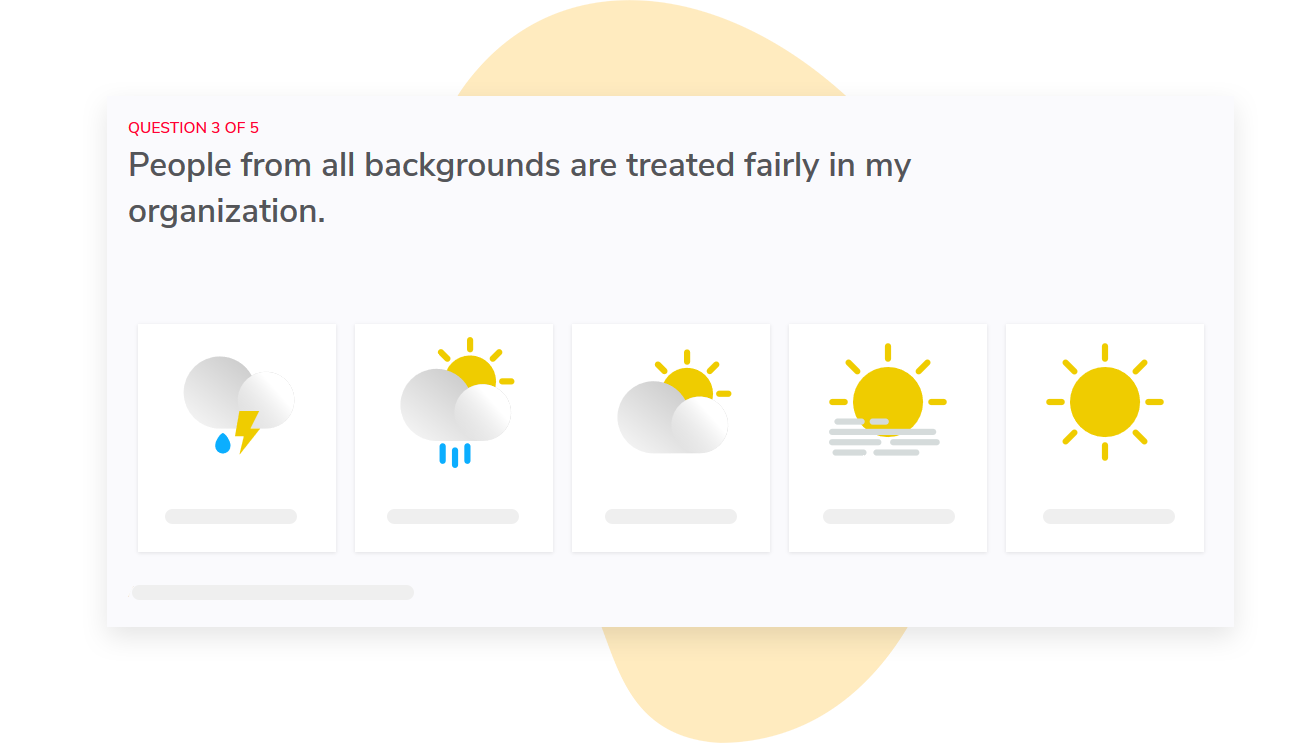
To get to the root cause of missed deadlines, you need to be able to ask your employees questions like, "Do you know what you own?", "Is there an approval step that slows you down?", and "Can you flag problems while there’s still time to act?".
Sparkbay allows you to tailor the wording of survey questions so they reflect the decisions your teams actually make. You can also tailor the wording and content of your dashboards to focus on the items you want to take action on.
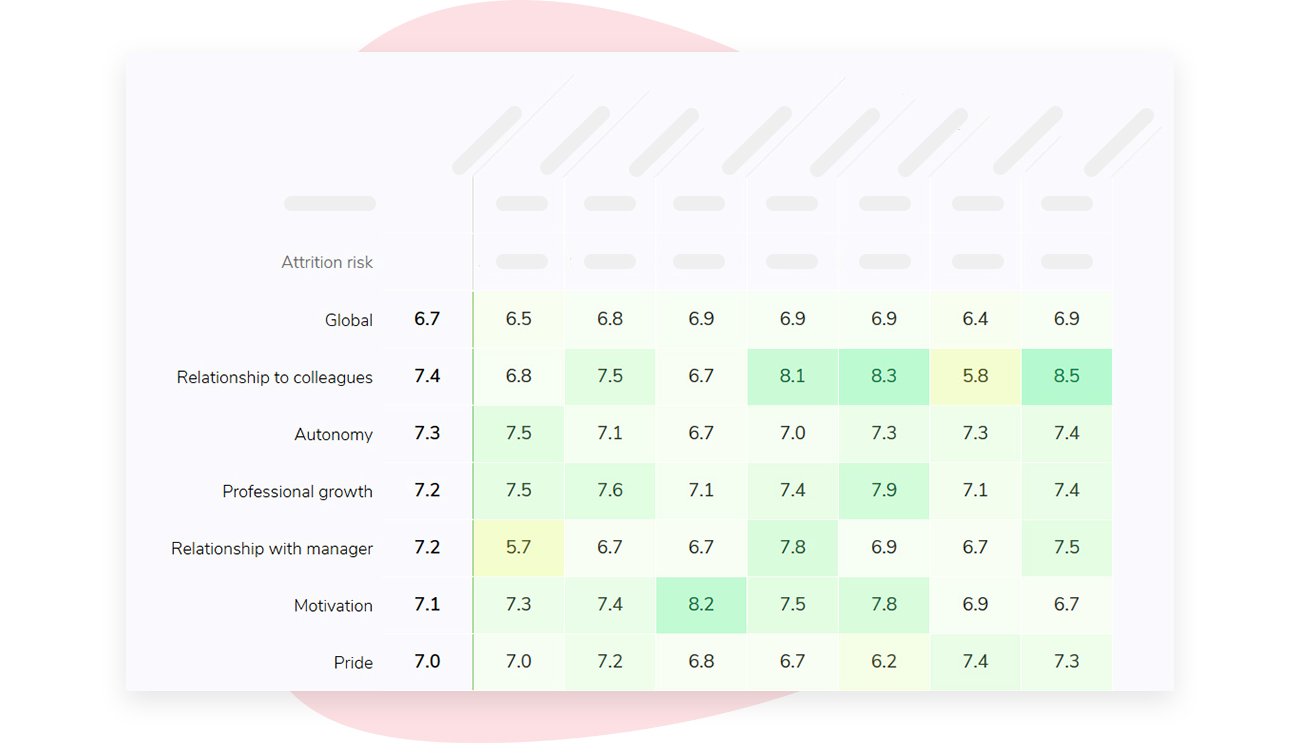
You can then view these items alongside the team’s engagement score (out of 10) to get the bigger picture.
For example, if one department reports that they have clear goals but they don’t have enough freedom to act, you can see if this is a one-off or if there are similar responses elsewhere.
Sparkbay lets you easily compare your results across groups, so your HR team can understand if the cause is organisational level or within specific teams.
Sparkbay automatically maps report access to your organisational hierarchy, so each manager only sees the teams they manage.
Sparkbay also hides results for any group with less than a minimum number of responses (5 by default, but can be changed by the administrator).
If you’re interested in learning how Sparkbay can help you build a more engaged workforce, you can click here for a demo.
Tell employees what changed
Avoid asking employees to take another survey by sending a survey invite while they’re already thinking about the last one.
Instead, wait until they see the result of the last round of surveys.
This means you need to let your employees know what the main finding was, what can’t be changed (at least for now) and why, and one action that will be taken including who is responsible for taking that action and when it will be reviewed.
It’s better to clearly articulate what won’t change and who made that decision than to share a long list of action items with no context.
For example, your team may want to remove the need for approval for routine changes for clients.
Your response may be that you’ll need to have a discussion with them to decide on what threshold of changes require approval and what don’t. This discussion may happen during your next team meeting where it’s decided that any changes below a certain threshold don’t need approval and anything above the threshold still needs to be approved by the manager.
After a month, the team will review whether that threshold is the right threshold.
Asking your team whether proposed policy changes will actually remove that bottleneck is important. They know where the real bottlenecks happen better than anyone.
They’ll also spot exceptions to the rule that HR and you as a manager might not.
Sometimes the "close the loop" conversation needs to be upward loops.
Your team may want faster decision making, but their manager may answer to a leader who’s adamant about approving every single change.
In this case, it’s not reasonable to expect a manager to fix this on their own.
Holding them accountable for this would also be unfair.
Instead, it’s time to bring that leader into the conversation. When you do, bring the survey evidence with you. Aggregated data from several teams makes it harder to dismiss than a manager’s complaint.
Check whether the change worked
How long should you wait before checking whether your change worked?
A good rule of thumb is to wait until your decision type has come up several times under the new rules. If your team handles weekly client requests, then waiting a quarter should suffice.
On the other hand, if you’re looking for a decision that happens once over the course of a multi-month project, then you’ll need to wait at least one full project cycle before evaluating success.
When you’re ready, re-run your original items.
Suppose your action was to change approval rules. You might focus on decision-authority scores and comments from responses about waiting for sign-off.
You’d also want to pull in an operational metric that your team already tracks, such as on-time handoffs to ensure you’re not evaluating success solely based on perception data.
Be mindful of the attribution problem. If you only targeted your lowest-scoring teams for improvement, then you might see some level of improvement simply due to regression to the mean. Regression to the mean is the phenomenon where extreme scores tend to move closer to the average when they’re measured again.
If possible, compare with similar teams that didn’t receive your intervention. If you observe improvements in decision authority and on-time handoffs and your comparison teams have not moved, then you have a strong case for continuing your intervention.
Keep an eye out for one possible second-order effect:
What if your speaking-up scores increase, but the number of reported problems also increases, while your on-time handoffs remains stable? This isn’t a bad sign. We discussed this pattern earlier when we discussed Edmondson’s work.
An increase in reported problems isn’t necessarily a cause for concern. This could just mean that problems are being identified.
What if you see an increase in reported problems with a decrease in on-time handoffs?
This would suggest that delegation has outpaced competence or clarity. The team is expected to perform in a changing environment that they can’t handle. You’ll want to move the threshold back to a manageable level for your team while setting a date to push the threshold forward again.
What if nothing moves? Nothing changes within your data?
Before you go back to a model of closer oversight, check in with your teams to understand which decisions they’re still effectively making with your current rules.
This is important because teams may have an old approval habit that creeps back in through a side channel. Maybe a senior stakeholder thinks they should still be copied on everything.
Your survey items won’t pick this up unless someone calls it out.
If you’re interested in learning how Sparkbay can help you build a more engaged workforce, you can click here for a demo.