Your employee value proposition (EVP) is not what your careers page says.
Your EVP is what a new hire experiences when they arrive at their new job and discover that "grow fast" means waiting for a manager who keeps cancelling their check-ins, all by the time they’ve reached month three.
When you want to improve your EVP, it’s important to understand which parts of the current EVP are recognized by your employees and which parts are silently discounted.
To do this, you need to think about statements about your company’s pay, growth, culture, and purpose as hypotheses with a pass mark.
In other words, there should be some survey results that would lead you to reject a claim you’re making about your company. If there are no possible results that would lead you to reject a claim, then you aren’t properly testing your EVP.
In this guide, we’re going to walk you through:
- How to break down your claims into survey items
- How to interpret survey items for different groups within your company, while avoiding identification risk
- How to decide whether a failing promise requires a change in job or a change in copy
- How to create one coherent EVP when different groups within the company are motivated to join for different reasons
Why is this important?
Because if new employees notice an employee value proposition gap between what they’ve been promised and what they’re actually experiencing, they’ll want to resolve that dissonance by leaving the company.
Cross-checking each EVP pillar with employee engagement data
- What your evp actually covers
- Transform them into claims that can be checked
- Why should an evp offer proof?
- Make sure your survey questions align with the claims in your evp
- Understand the results of each group while protecting employees’ privacy
- How Sparkbay can help you test your evp claims
- Remain consistent while avoiding the trap of "one size fits all" storytelling
- Assess whether new hires are getting what they signed up for
- Make checking the evp part of normal work
- Watch out for common mistakes that can lead to an evp gap
What your evp actually covers
In its simplest terms, an EVP is what you offer people in exchange for their skills and effort. But there are a few concepts that get confused with an EVP that we want to clear up for you.
Whether you call it an employee value proposition or an employer value proposition, make sure you’re not confusing it with any of the following 3 things:
- Your EVP is what you offer employees.
- Your employer brand is what people believe about your offer.
- Employee experience is what employees experience on a typical Tuesday.
- Engagement is an outcome that happens after everything else.
For example, if you have a high engagement score, that doesn’t prove that your EVP is accurate. You may have highly engaged employees who would laugh at your employer’s claim to offer "flexible working".
In an ideal world, your EVP, your employer brand, your employee experience, and your employee engagement would all four be aligned. But it takes more than a flashy careers page to bring them all together.
When you have a flashy careers page, but no employee experience to back it up, it creates a disconnect that candidates notice. It amplifies the gap between what they expect and what they experience.
Glassdoor research shows that a large majority of job seekers check employer reviews while researching a company. Take a look at your company reviews from the perspective of a job candidate. While they may not be a perfect representation of your company - they may skew towards employees who have left the company or a certain function - they’re an opportunity for candidates to gain insight.
If there’s a theme that comes up in your Glassdoor reviews and in your own open-text comments, candidates have likely already been made aware of it.
Transform them into claims that can be checked
Great. So now you’ve got these four pillars in your EVP.
How do you know that your claim to be "great" in each of these areas holds up?
Pay and benefits
What exactly is the "pay and benefits" part of the EVP about? Is it about what people are actually paid? Is it about whether they think their pay is working for them?
"Competitive pay" in an EVP is a claim about the market. "Fair pay" is a claim about what employees’ experience.
These statements are about very different things, so they need very different pieces of evidence.
For instance, a majority of workers believe they are underpaid, according to research from PayScale.
But it’s going to take more than a survey - or a report on pay market data - to assess whether your company is truly paying people fairly.
Employee perceptions of fairness can depend on how well they understand the rationale behind pay decisions as much as the numbers themselves. One of the biggest things that can bring down your "fair pay" claim is poor pay transparency.
And good news for companies trying to improve their pay transparency: It’s a cheaper thing to fix than a pay raise.
Career development
Is "career development" and EVP about learning opportunities? About promotions? Or about lateral moves?
"Propositioning" your company as one that offers "career growth opportunities" may actually only be verifiable for promotions.
Are employees supposed to be offered protected time to learn new skills? Is career advancement opportunities hindered by unsupportive managers who don’t want to lose a good player? Check your data on internal moves, particularly on how many moves happen and whether they happen by sending manager.
Culture
When you say your supportive management is part of the company culture, can that statement hold up during a reorganization?
During a peak season? After missing a big quarterly target?
Purpose
Does your EVP support the idea that employees feel like their work makes a difference (or is some kind of purpose)?
You may feel like your mission statement makes this statement relatively easy. But if employees feel like their jobs have absolutely nothing to do with the job they signed up for, that key element of the EVP is going to cause frustrations.
The longer they hear about the "sense of purpose" for the company, the more cynical they’ll become about how little their job has to do with that.
When you’re assessing the truth of each "pillar" of your EVP, it helps to reduce them down to "sentences" that an employee could agree or disagree with based on their experience.
If their response to questions like, "Compared to what?" or "Compared to when?" is a requisite to making a statement, that assertion is not specific enough to be judged.
Why should an evp offer proof?
In The Employer Brand: Bringing the Best of Brand Management to People at Work, Simon Barrow and Richard Mosley make the case that an employer brand needs to link to what people actually go through at work.
Sure, you’re selling the offer to potential candidates, but your existing employees are validating your marketing materials against what they see every day.
Plus, they represent your brand whether they’re the face people speak to or the reviewer who writes about your company.
Take "managers who support your growth" as an example. If your staff know that their one-on-one meetings with managers keep getting cancelled, or internal jobs go to people who have someone pushing for them, they’ll know which message is true. And they’ll share that truth with others.
Beyond the need to be consistent, there’s another more basic reason why your EVP needs proof behind it.
In Psychological Contracts in Organizations, Denise Rousseau explains that people form beliefs about what their employer owes them.
And if they believe they haven’t received what they’re owed, their reaction can be very intense.
This intense reaction is not the same as if they only hoped for something and then didn’t receive it.
As a result, your EVP marketing materials become something employees will compare their expectations and experiences to.
They’ll see that they’re broken promises from your specific claims in your marketing materials.
This creates a tricky problem. Delivering specific claims in your EVP is great for weeding out candidates who aren’t a good fit and attracting those who are. But these specific claims cause problems when they aren’t accurate.
So how do you determine how accurate a specific claim needs to be?
Research from Gallup showed that most of the difference in team engagement comes down to the manager.
In other words, making the claim that your company has great managers around all of them is really the average of dozens of individual promises made to employees.
Besides looking at the average, you also need to consider the range of employee experiences.
In other words, you want to avoid making a claim that’s fine on average but gives a large group of people a bad experience. That’s a surefire way to taint your reputation with that particular group of employees.
All this doesn’t mean you can’t use aspirational claims in your EVP. You can, but you need to be clear that these are goals you’re working towards and there’s visible evidence that you’re putting resources into reaching them. An aspirational claim like "we’re building a learning budget for every frontline role this year" can hold up to an employee survey, but "Every employee has a learning budget" might not if at least half of them don’t.
Make sure your survey questions align with the claims in your evp
Where should you begin?
Pull the claims from your job ads and your careers page (not from your internal EVP framework document), and gather a few of the outreach messages your recruiters send.
This keeps your attention on the bold claims that candidates are really hearing.
Split each claim into the things an employee would really need to experience for that claim to hold true.
Suppose you promise "You’ll grow faster here"; this touches on a number of things. It might relate to access to learning opportunities, whether employees have career conversations that turn into real opportunities, or whether people have a realistic chance of landing roles internally.
Your survey would have to measure each of these experiences separately, or you’ll end up with a mixed result that’s hard to act on.
For example, you can take the claims you may have built for your EVP and create a mapping like the one below, adjusting it to fit your employer:
- Pay and benefits: "Our pay is fair" Does your survey ask if employees feel they’re paid fairly for the work they do and if their benefits meet their needs?
- Career development: "You can grow here" Does your survey ask if employees can see a way forward for themselves at your company and if they’ve had useful chances to learn?
- Culture: "Your manager has your back" Does your survey ask if employees feel their managers back their development and if they feel they belong on their teams?
- Purpose: "Your work matters" Does your survey ask if team members feel like they’ve been helped to understand how their work supports the organization and if that link makes their job feel worthwhile?
Working this way lets you use 2 or 3 survey items to directly test a specific claim that may matter to your employer.
Also, merging questions may be handy for keeping a survey short, but it makes the results far harder to read. Avoid double-barreled questions.
If two questions are rolled into one, how can you tell whether low survey results come from a weak claim or a weak question?
Once you know how many employees agree or disagree with the statements in your survey, you can then measure how much they matter to them, using either an importance rating or a driver analysis.
This will show you what to do next with each of your claims:
- High importance - low survey score: You likely have a retention problem and you need to fix the real job employees are doing before you change your marketing materials.
- Low importance - low survey score: This may be a marketing problem - you may need to drop this claim or stop stressing it in your marketing, since it hurts your credibility but doesn’t do much to attract people.
- High importance - high survey score: This is genuinely setting your organization apart, and you can continue to highlight this in your marketing materials. Consider putting this in employee-centric language.
- Low importance - high survey score: This statement is true, but it doesn’t strike a chord with employees. You can mention it, but it shouldn’t be a marketing focus.
For instance, LinkedIn’s workplace learning research found a connection between employees’ sense of purpose and the learning opportunities they have at work. So if your survey shows employees value learning, but they rate your "growth" claim low, it may be time to look for things holding them back, such as time or access to learning opportunities or even a lack of chances to apply what they’ve learned. Each of these problems would fall to different owners in the organization to address.
Consider also adding an open-text question like, "What would you tell a friend who’s thinking of working here?" You can then code these answers based on your different pillars. This shows you whether there are pillars that aren’t linked to your organization when employees describe it.
Establish your pass mark before seeing the data
Once the survey data rolls in, it’s tempting to find reasons to match your view of things. To avoid this, set a pass mark before you even look at the data. Setting a pass mark as a percentage of favorable responses is one way to keep your survey results honest.
For instance, you might decide that each group you plan to target in your messaging needs to have at least 70% favorable responses before you keep a big claim like "Our pay is fair" in your marketing materials. This is just an example - your pass mark should depend on your scale and your past data.
Finally, watch for claims that don’t connect. If your EVP makes a claim about internal mobility but there are no survey items measuring internal mobility, you’ll have to add items to your survey or remove the claim from your EVP.
Understand the results of each group while protecting employees’ privacy
A company-wide result can lead to an overly optimistic assumption.
For example, if 75% of employees in a hypothetical company said they agreed with the statement, "I have opportunities to advance my career," you might be tempted to think things are pretty good. But if the data were divided, you might find that 85% of employees at head office believe this to be true while only 50% of employees on the front lines do.
Dividing groups can be complicated. You might want to start by dividing employees based on tenure. But even within a tenure group, you might want to make subgroups.
For instance, employees within their first year of employment might be sub-divided into those who are within their first 6 weeks of employment versus those who are within their 10 months of employment. The former employee might still be evaluating the company’s promises while the latter employee has experienced a full year.
Longer tenure groups may be made up of "survivors". If your EVP didn’t satisfy some employees they may have already left. Therefore, collecting data from employees with longer tenure may provide an overly optimistic reflection of your EVP claims. On the other hand, if your EVP claims only pass the muster for employees with longer tenure, this may be a red flag as well.
You should also be aware of differential response rates among groups of employees. If the response rate within a group is significantly lower than others, this may reflect another important data point in terms of employee trust or access to the survey. The survey results from that group will be biased towards people who felt comfortable responding for some reason.
When possible, include other relevant divisions such as function, location, level and work arrangement to help employees digest specific EVP claims. As well, only use demographic cuts when there is a legitimate, justified reason for collecting and using that data.
Protect anonymity when reporting survey results
To protect employee anonymity, only report results when the size of a group meets your minimum amount of responses. Keep in mind that this minimum amount may not be enough of a safeguard against identity disclosure through data differencing.
For example, you may suppress reporting the results of a small team’s survey responses. But if a manager has access to the total departmental responses as well as the results of all other teams within that department, the manager can calculate the small team’s results by subtracting all other team responses from the total department response. Consider the combinations of reports people in different roles will have access to when deciding whether results can be reported.
Five responses may be the common minimum number for reporting survey results, but there are valid debates within the survey practitioner community about what the appropriate minimum number is, especially when dealing with sensitive topics such as pay. If you can’t safely report on a gender, consider rolling the small group of 5 into a bigger one that will allow you to get an answer or clearly indicate to employees that you can’t report data for this cut safely.
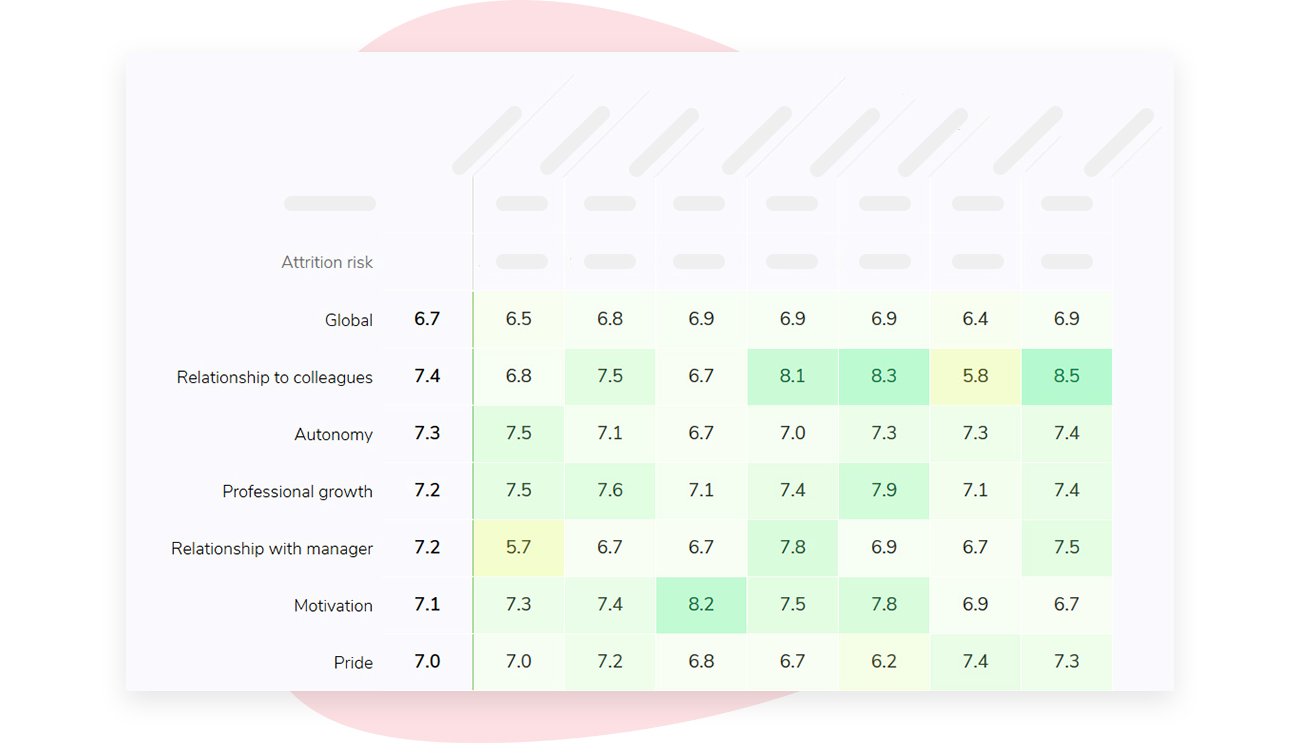
It’s important that employees don’t feel like their responses - comments or scores - can be linked back to them personally to avoid them censoring themselves or deciding not to answer survey questions. Either option would impact your ability to correctly assess your EVP. To accurately assess your EVP, your heat map should be able to determine where each promise message is believed by employees without making anyone’s answers identifiable.
How Sparkbay can help you test your evp claims
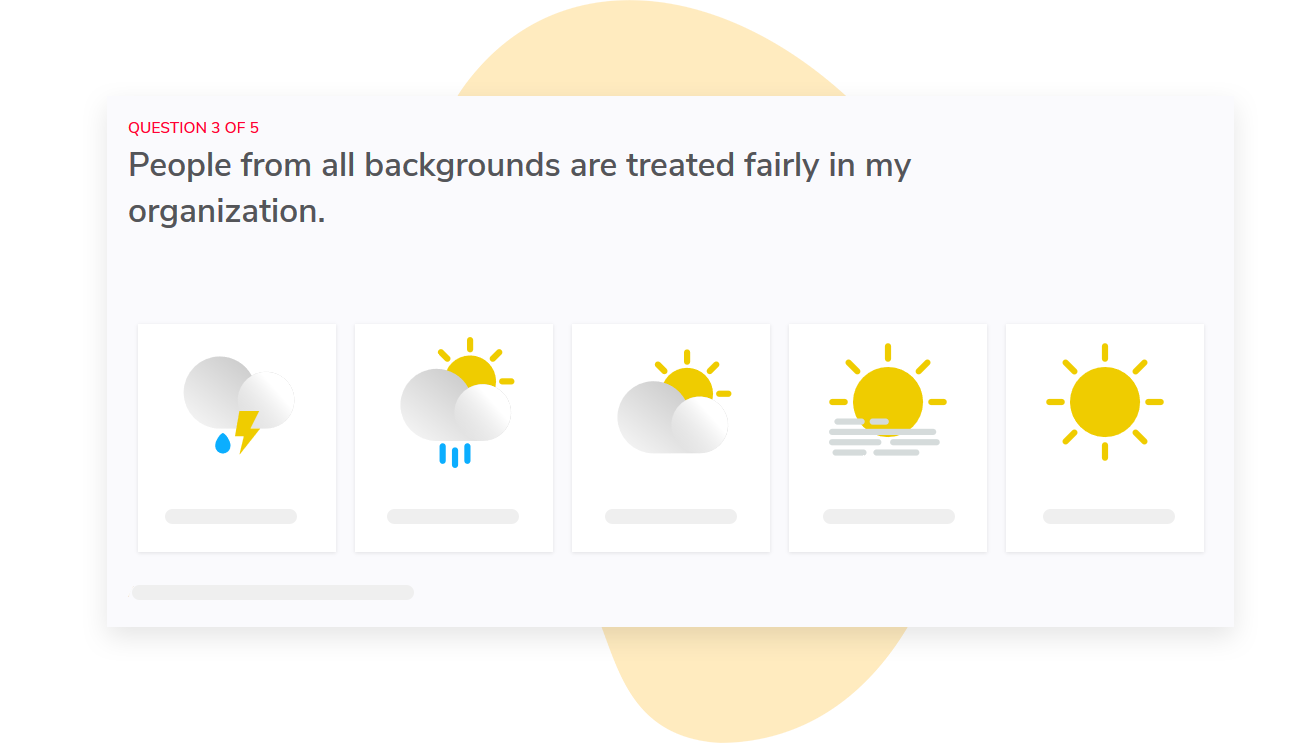
Once you’ve turned your careers-page claims into survey questions, you want to make sure you’re actually moving the needle on any gaps you address. With Sparkbay, you can write survey questions that reflect the language of your own EVP and send them out as recurring pulses. Instead of waiting a year to see if your efforts to improve "What is great about working at [company]?" have had an impact, you can check in on a monthly basis.
Sparkbay also shows you where there are differences in responses across teams and departments. This is helpful, since your "you can grow here" claim might be true when looking at the company as a whole, but not really address the concerns of the people you’re working hard to retain.
Sparkbay automatically maps report access to your organizational hierarchy, so managers only see results for their teams. Results are also automatically hidden if there aren’t enough responses (5 by default) to protect employee privacy. You can adjust this number to fit your privacy guidelines.
If you’re interested in learning how Sparkbay can help you build a more engaged workforce, you can click here for a demo.
Remain consistent while avoiding the trap of "one size fits all" storytelling
Should you present the same EVP to all employees?
There should be some nice, juicy, core commitments that you make to all employees. For instance, if you commit to providing fair treatment or providing room for growth, this should not be something that changes based on someone’s location or contract type.
At the same time, you recognize that people from different job families, such as a team of warehouse workers and a team of salespeople, may join and stay for different reasons. An overarching, broad statement that is true for those at a head office location may be vague and unclear for other locations.
Consider Deloitte’s research on younger workers that found that a large majority of them place importance on finding purpose in their work when choosing and deciding to remain at an organization. This doesn’t mean you should present a purpose-driven statement to all of your candidates.
How do you do this?
One approach to this is using a core-and-flex model. You can keep a short list of core commitments that have been tested on an organization-wide level, and then have a flex layer that highlights the employee experience that employees within that job can relate to.
Of course, you’ll want to ensure that these job-specific messages are reviewed and approved by business leaders on those teams, since they are the ones who control whether those promises can be delivered.
When is it worth adding this flex layer? When there are different job families that have varying opinions on what is most important. It’s not worth creating different messages for job families that have the same key priorities but just score their experience lower.
That highlights a delivery gap in your core message, and adding a new message is a Band-Aid solution.
Of course, you want to limit the number of these flex messages to the job families you have a lot of, for the sake of consistency and reliability in testing them.
Plus, remember that your messages will leak. Your candidates will read all of your job advertisements and your employees will switch job families or discuss their experiences. You don’t want to create contradictions.
For your larger field team, you may want to create a flex message that talks about how a "day of" may not be the norm but the company works with employees’ customer visits when scheduling. This prevents you from repeating flexible working statements. For your technical team, you may want to get specific about the amount of time and support employees will receive to expand their skills.
What if your core promises don’t work for certain groups? is it okay to change a core promise?
If it’s within your budget cycle and you’re actively hiring for that group, you’ll want to revisit your employee experience. If it’s a more structural issue, you’ll want to consider changing your message. For instance, if you have many employees in a shift-based role that can’t offer remote working, it may be time to change that flexibility promise instead of continuing to fail that promise year after year.
Assess whether new hires are getting what they signed up for
Inflating the EVP not only disappoints people, it attracts the wrong kind of people. These candidates may have made a different choice had they been given accurate information.
For instance, they may have accepted the job expecting to work towards quickly moving up or expecting an easily manageable workload. After a few months of the job, their experience tells them this isn’t the case and they choose to leave.
According to survey findings from Jobvite, a large share of workers leave their job within the first few months. This number includes workers who left for any reason, so it’s not a perfect way to assess your EVP, but it does highlight an area worth prioritizing.
Research, including work done by John Wanous, suggests that it’s best for organizations to present realistic job previews to candidates. In other words, honesty is the best policy when describing the job and its challenges. And this is most helpful when shared before a candidate accepts a job (when they can decide to opt out) as opposed to during onboarding.
In fact, it’s worth discussing how busy things get during certain periods of time or how long it usually takes to get promoted during the hiring process. If you present it up front, candidates accept it as part of their deal. But if they discover it on their own, they may feel cheated.
Think about developing onboarding surveys that directly correspond to the claims that were made during the hiring process. Ask your new hires whether the reality of their role matches what they were expecting. Ask again, after they’ve gone through a full cycle of their job, such as after their first quarter-end, after their first peak season, or after their first release.
Next, analyze your first-year turnover rates by role or location within the context of the responses to your onboarding surveys. If you notice a particular group within a certain role or location reports a gap between expectations and job reality, and there’s high turnover within the first year, that’s a sign you need to prioritize stay interviews with the remaining employees rather than exit interviews.
Stay interviews focus on understanding what employees like and don’t like about their job to improve retention. You can also use an exit interview question that asks employees what they were surprised by. This is a more useful question than asking them why they’re leaving.
Does this all sound like a lot? Consider the cost of replacing people. Not just the cost of using an agency to fill the vacancy, but also the cost of hiring manager and team member hours spent managing the vacancy by conducting interviews and re-onboarding a new hire.
Make checking the evp part of normal work
To reiterate, you don’t have to rewrite your entire EVP every time you get a slightly different score. You do need to have a process in place that allows you to interpret your results, and a point person who takes action.
- Assess your current EVP. Focus on one claim of your EVP at a time. Gather all the data you have related to this claim, including survey items, comments from coding, and notes from interviews. Review the results across each demographic group or large group within your organization.
- Understand the cause of your gap. Let’s say your frontline employees rate the survey item, "I believe I can build a career here" poorly. You would then examine why that is. Are jobs not actually being advertised to frontline employees? Are managers not making time for development conversations? Are there shift patterns that don’t allow for training opportunities?
- Focus on improving the employee experience rather than just changing the text. You might be tempted to start by changing the wording of your claim from "I can build a career here." to "I can explore career growth opportunities." This is a quick fix that’ll ensure you get better scores the following year without improving the employee experience.
- Assign an owner and communicate what you heard back to employees. Once you’ve identified an area for improvement, and you’ve communicated what you heard to your employees, assign the right owner to make a change happen. If your claim relates to career growth for frontline employees, it’s likely the operations leader, who can make decisions about employee rotas and internal job postings, more so than your HR team.
- Check in again after you know a change has taken effect. If you announce a change in your career framework, don’t ask your employees to re-take a survey a month later. You’ll only measure the announcement, not the change.
Gallup research found that a big share of people who voluntarily quit a job believed their manager or employer could have done something to keep them. This is a great reason to ask your current employees what will keep them.
Once you’ve updated your promise, share it with your employees before sharing it with candidates. Ideally, you’ll include people from the demographic that didn’t believe the promise to check for hyperbole. Then, use your regular survey cadence to re-affirm that promise.
Watch out for common mistakes that can lead to an evp gap
As you’re evaluating your EVP, keep in mind that something as simple as a slogan on the careers page or a list of perks may not be enough to test your EVP.
Keep an eye out for the following issues:
- Making claims in your EVP that you don’t have specific survey questions related to
- Reporting average results when there is a specific demographic within the organization that’s not doing well
- Reporting survey results from groups of employees that predominantly include "survivors" rather than "thrivers"
- Including conflicting messages about the company’s commitment to flexible work arrangements
- Altering survey question wording to produce more desirable results when comparing to EVP survey results
Above all, don’t conduct a survey asking employees whether the employer lives up to the promise only to disregard their responses.
If you’re interested in learning how Sparkbay can help you build a more engaged workforce, you can click here for a demo.