Your HR team has done a great job mapping out the seven stages of the employee lifecycle. But now you’ve got a new question from your People Ops lead: "Which touchpoint will our budget next quarter go towards?"
"We should invest in onboarding," you say.
"But what about all the exit data that shows employees are leaving because they feel unsupported and see no prospects for career growth? And the data that shows we lost a ton of hours due to absenteeism and returns from leave?"
"Well, we can’t invest in all three touchpoints right now," you say. "And to be honest, I’m not really sure which of these touchpoints is impacting our employee retention the most."
How do you figure out which touchpoint in the employee lifecycle to invest in?
In this article, we’re going to walk you through the questions you need to ask in order to determine:
- How to prioritize different moments based on data you already have
- When you need to conduct a survey to collect specific information
- How to avoid overwhelming your employees with surveys when they have multiple touchpoints
- How to determine the appropriate owner for each touchpoint
- How to handle special circumstances like rehires, transfers, and acquired companies
- How to evaluate the success of an intervention before deciding on your next investment
Building an employee experience strategy around the lifecycle moments that matter most
- In this article
- Diagnose which environment is failing before you fund a programme
- Use the seven stages as a checklist, not a budget structure
- Rank moments on impact, reach, and what you can change
- Look closely at the moments that change someone’s plans
- Choose whether you want to use a survey, have a conversation, or use signals you already have
- Avoid asking the same people the same questions
- How Sparkbay can help you listen at the right moments
- Make it clear who is responsible for each moment and ensure managers have a concrete role
- Make room for people who don’t follow the standard map
In this article
- Before jumping into a programme, diagnose which environment is failing
- Use the seven stages as a checklist, not a budget line
- Prioritise moments based on impact, reach, and what you can change
- Dive deeper into moments that cause people to change their plans
- What data do you already have based on your people? Survey, chat, signals?
- Avoid survey fatigue by varying and spacing out your questions
- Make it clear who owns the project and what managers’ role is
- Leave space for people who don’t follow the standard map
- Demonstrate whether the improvements had an impact
Diagnose which environment is failing before you fund a programme
Forget the difference between employee experience and engagement for a moment. Think about this instead.
In The Employee Experience Advantage, author Jacob Morgan breaks employee experience into three employee environments: culture environment, technology environment, and physical environment.
This breakdown is useful because it helps employers understand who should be responsible for implementing employee experience initiatives.
For instance, if employees complain about their onboarding experience and how long it takes to receive access to computer systems after they start, they’re talking about an employee experience that exists in the technology environment.
- This problem would be something that the IT department should be focused on solving, not human resources.
Or if employees express a lack of trust in how promotions are decided, they’re reporting an employee experience that relates to the culture environment.
- This is a leadership and process problem and not something that’s going to be solved with a communications campaign.
And if frontline employees don’t have a place to go and take a break, this is an employee experience issue tied to the physical environment.
- This is something that falls under the responsibility of the Facilities team and often requires a consideration of the company’s capex cycle.
Of course, this raises an important question: Should human resources departments fund any of these projects themselves?
For instance, would it be helpful for HR to fund a welcome gift for employees or a recognition programme?
For decades, researchers at Gallup have demonstrated that only a minority of employees worldwide are engaged at work. Yet, despite this, companies continue to invest perks and wellbeing initiatives instead of structural solutions. This is one reason employee engagement levels have struggled to show any meaningful improvement.
And one reason HR departments continue to organise these kinds of programmes is that it’s one of the limited levers HR has direct control over.
Before jumping into programmes, make sure you’re diagnosing the right environment.
Use the seven stages as a checklist, not a budget structure
Attract, recruit, onboard, develop, retain, exit, alumni.
While it’s helpful to think of the employee lifecycle in these seven stages, it’s not very helpful when it comes to deciding where to allocate your budget.
Why?
Because these seven stages map almost directly onto separate parts of your HR function - talent acquisition, onboarding operations, L&D, HRBPs and so on.
Budgeting by stage risks creating a budget that reflects your org chart instead of how your employees experience the company.
Consider your onboarding process. Imagine these two new hires.
The first new hire has a supportive manager and a team that’s warmly welcomed them. But their first week is spent trying to access the different systems they need.
The second new hire receives their laptop on day one, but they haven’t been given a clear idea of what "good work" looks like on their team.
Both of these "problems" relate to the onboarding process, but both have very different root causes that fall under the responsibility of different onboarding teams.
Then there’s the fact that people don’t move through these lifecycle stages sequentially.
In the space of a month, the same person might be in a period of development within their role, applying for internal roles, and interviewing for external roles.
An analytics dashboard that tries to achieve this through the seven stages of the employee lifecycle is probably going to count that person in one bucket, while obscuring important insights.
So while it’s helpful to think of the seven stages as a checklist to ensure you’re not overlooking any elements, think about building your investment strategy based on "moments".
These moments are meaningful events that an employee experiences (e.g. first week at the company, change of manager, promotion decision).
You want to manage a moment when:
- There’s a clear party within your organisation that can be held accountable for managing the moment
- You can detect when this moment happens based on data you’re already capturing within your HRIS
- There’s a measurable outcome of this moment that can be reported on
You also want to keep in mind that these moments in the seven stages relate to each other.
For example, research from Glassdoor shows that the majority of job seekers read company reviews on Glassdoor before applying to a job.
And a large portion of those company reviews are written by outgoing employees. This means a poorly handled exit process could have an impact on your future recruitment efforts, with this impact not accounted for in the exit budget.
Rank moments on impact, reach, and what you can change
When every function has a candidate moment, how do you decide which ones get funding and attention?
Why not score each candidate moment against the same criteria?
- Engagement impact: How closely does this issue track engagement in your existing survey data? Has that link been validated against a second, independent data source?
- Exit risk: Do people quit within weeks of going through this moment? Is that effect concentrated in the first 90 days or the first year?
- Reach: How many people go through this moment each year, rather than in total?
- Control: Can you change this moment without waiting on a vendor contract, works council consultation, or systems replacement?
A scoring system makes the trade-offs explicit and gives you something better than competing hunches.
Build in an override. Any moment that carries equity or legal exposure stays on the list whatever its reach score. Return from leave is the obvious example.
You probably hold more usable data than you think. Before you ask anyone a new question, try two things with what you already have:
1. Treat stated leaving reasons (e.g. "better opportunity") as sanitised. Timing is much harder to spin.
Plot resignations against time since the last manager change and time since the last promotion cycle closed. A cluster of exits a few weeks after a cycle closes tells you more than any exit interview code.
2. If you already have a driver analysis, check how it was built, because there is a problem experienced survey analysts will recognise.
When driver items and the engagement outcome come from the same survey, part of the correlation is shared method variance. That is a big reason the same few drivers, such as "growth" and "confidence in leadership", top the list at almost every company.
So a correlation doesn’t tell you that improving the driver will move the score. A more defensible test is whether the driver predicts something the survey didn’t measure: later attrition, internal applications, or the same team’s score next cycle. If "growth" only correlates with engagement inside one instrument, treat it as a hypothesis rather than a business case.
Once you have your top candidates, plot them on an impact-versus-effort grid and pick two or three.
One caveat. If nothing visible has changed since your last survey, put a quick, visible fix on the shortlist. Naming an owner and a lead time for getting laptops to new starters who were left waiting does more for credibility than a big culture commitment from an organisation that didn’t deliver on the last one.
If your organisation does have a track record of acting on feedback, you can afford to start with a harder, slower moment.
Pew Research Center found that a lack of opportunities for advancement was one of the top reasons people gave for quitting a job.
If your exit timing clusters around missed promotions, look past the decision itself to the conversation that followed it. Was the employee given concrete criteria for "next cycle", with a check-in date?
Look closely at the moments that change someone’s plans
In The Power of Moments, Chip and Dan Heath write that people disproportionately remember transitions, milestones, and low points.
These are also moments that organisations tend not to focus on designing properly. This matters, because it means companies don’t allocate enough budget to these activities. Yet, a clumsy transition can be interpreted as a sign of how much the company values you.
An onboarding process contains several transitions. During week one, the employee is asking more practical questions about whether everything is in place and what they’re responsible for. By day 90, they may be questioning whether this is the job that was sold to them during the interview process.
If you notice a lot of 90-day mismatches under specific hiring managers or recruiters, it a sign that you’ve got some work to do on your interview process and advertisements.
Another transition or period of uncertainty is during a promotion or pay cycle. Employees will be in a bit of limbo for weeks after the announcement of these decisions, so it’s worth checking whether your exit timing spikes happen during this period.
This is especially true if employees are being told "you’re close" to a promotion or pay raise, but there’s nothing written down or any follow-ups to honour that conversation.
A change of manager
According to Gallup’s research, at least 70% of the variance in engagement between teams is due to the manager. That’s why a change of manager is by definition a high-variance moment.
When this happens, there’s a risk that commitments that haven’t been documented will be lost.
For instance, a promotion that was verbally agreed to but never recorded, a flexible schedule that wasn’t formalised, or a development plan that existed only in the outgoing manager’s head. Don’t assume that an outgoing manager will volunteer these. Since they’re not documented, they may not have an incentive to share these details, especially if they’re leaving the company.
Instead, you can ask your HRBP or the incoming manager to reach out to team members within the first few weeks and ask, "What has been agreed with you that you’d expect me to honour?" and record these responses.
Return from leave
A return from parental or medical leave can involve several changes. The employee’s team may have been reorganised, their role may have shifted, and their own needs may be different. Usually, all three happen simultaneously.
After maternity, paternity, adoption or parental leave, employees in the UK and the EU generally have a right to return to their job or an equivalent one; in the US, the FMLA gives eligible employees that right after family or medical leave. So saying "We’ll figure it out when you’re back" isn’t just a bad experience for the employee. It can lead to real legal exposure.
Not all of these moments are automatically red flags in all contexts. Use your exit timing and exit interview data to determine whether they really matter at your organisation.
In fact, Gallup found that 42% of employees who left a job believed their employer could have done something to keep them.
Choose whether you want to use a survey, have a conversation, or use signals you already have
Survey: good for hearing from a lot of people at once and getting comparable answers
Surveys are useful when you want to hear from a lot of people at once and get comparable answers.
A pulse survey during the first week can confirm whether employees received all their equipment or access they need. A 90-day pulse survey can help you understand if the role differs from what was sold to the employee. You can also segment your 90-day survey results by recruiter or hiring manager to see if there’s a systemic issue or if the problem lies with a few places.
Conversation: good for personal experiences, providing context, or small numbers
Why do your small numbers matter when it comes to well-intentioned listening programmes?
Suppose you want to send out a pulse survey to the three people in a department who returned from leave this month. Their answers wouldn’t be meaningfully anonymous, regardless of the minimum number of respondents your survey tool requires.
If your survey results don’t meet the minimum number of respondents needed, your survey results will be suppressed and you won’t learn anything. But if, for some reason, those results do pop up, someone who knows who was on leave can identify responses through the process of elimination. This includes the manager who approved those employees’ leave in the first place.
If the number of people going through a certain moment in a quarter is smaller than your reporting threshold, a conversation is a better option. This rule of thumb can help you decide whether to use a conversation or survey based on the number of people involved.
You may also want to consider which questions you ask and when. For instance, you might not want to ask someone to rate how supported they felt after they had a difficult conversation about pay with their manager.
Signals: data you already have
The final option doesn’t cost your people anything at all. It involves using data your organisation already has.
- The amount of time between a start date and when access tickets are closed can tell you when there are onboarding issues
- A spike in the number of internal applications from a specific team can be an early departure signal
- Dates when employees report a change in their manager in the HRIS can let you know which teams need a check-in
Here’s a quick guide to choosing a method for different moments:
- First week or 90-day onboarding: Short survey that can be checked against access and setup records
- New manager: Short pulse survey sent to the team with a debrief conversation scheduled with the manager
- Missed promotion or return from leave: Private conversation with documented follow-up steps
- Internal move: Check-in conversation and review of employee access and role setup
- High-performer exit: A conversation with a system to track exit themes across cases
You don’t need to use the same method for all teams.
What’s important is that someone with the authority to do something about what they hear is named BEFORE the question goes out.
Avoid asking the same people the same questions
Once you start distributing event-triggered pulses, you’ll need to watch out for overlapping surveys.
Avoid this by distributing each pulse only when employees are in the best position to respond to it.
For instance, an onboarding pulse should be sent out at the end of the onboarding process, not after three days. A new manager pulse should be distributed after you’ve had a chance to work with the employee for a few weeks, not immediately after the first introductory one-to-one.
Moreover, each event pulse should only contain 3-5 questions at maximum.
If your organization is large, and you know you’ll have many employees experiencing that moment at once, consider distributing the survey to a sample rather than everyone. If your onboarding cohort is small, it’s better to distribute a survey to all of them or have a conversation instead. This avoids the small numbers issue we discussed earlier.
Finally, be mindful of survey timing. After distributing a pulse, include a quiet period (including your annual engagement survey) before distributing another survey.
Write precedence rules
What happens if you have an employee who qualifies for several different pulses?
Let’s say they’re an internal employee moving to a new team: they qualify for both an onboarding pulse and a manager-change pulse.
You might decide that the best default option is to distribute the pulse tied to the rarer, higher-risk moment while incorporating one or two questions from the other pulse.
To avoid distributing duplicate pulses, make sure that all your trigger logic is sourced from the same data hub of HRIS event data. If different teams are distributing pulses based on their own spreadsheets, there’s a real risk of duplication.
And finally, if you receive feedback that survey fatigue is a problem, don’t automatically trim all your surveys down. Instead, conduct a health check by comparing survey response rates by team with whether there was visible action from the last survey cycle.
If there’s a decline in participation within teams where nothing visible happened after the last survey cycle, then you know you aren’t dealing with survey fatigue. You’re dealing with action fatigue. And trimming your surveys down won’t fix this.
The solution is to share the results with people, share what you will change and what you won’t change (and why), and then come back with an update.
How Sparkbay can help you listen at the right moments
With Sparkbay, you can create short pulses based on the moments you want to prioritize.
We don’t expect you to make every employee answer every question.
You’ll want to ask different questions for a first week hire or an internal mover, which is why we allow you to fully customize the wording of your surveys and the wording and content of the dashboards reporting on those surveys.
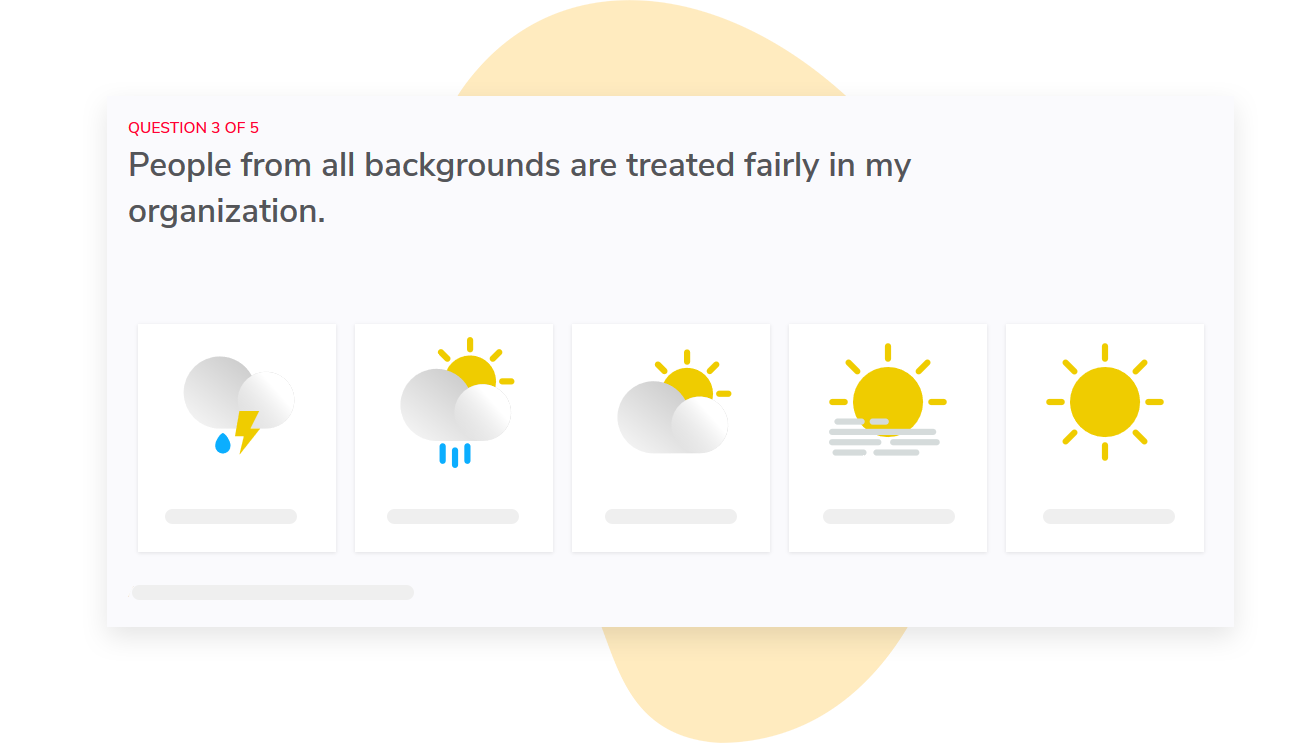
Once you start receiving answers, Sparkbay’s analytics let you understand whether you’re dealing with a team-specific issue or a recurring, organization-wide problem.
You can compare engagement scores across different groups of employees such as managers, departments, or tenure bands.
This helps you understand whether an onboarding issue is due to the onboarding process at the company level or just one manager.
In turn, this tells you where to invest your energy - into coaching conversations or into an IT fix.
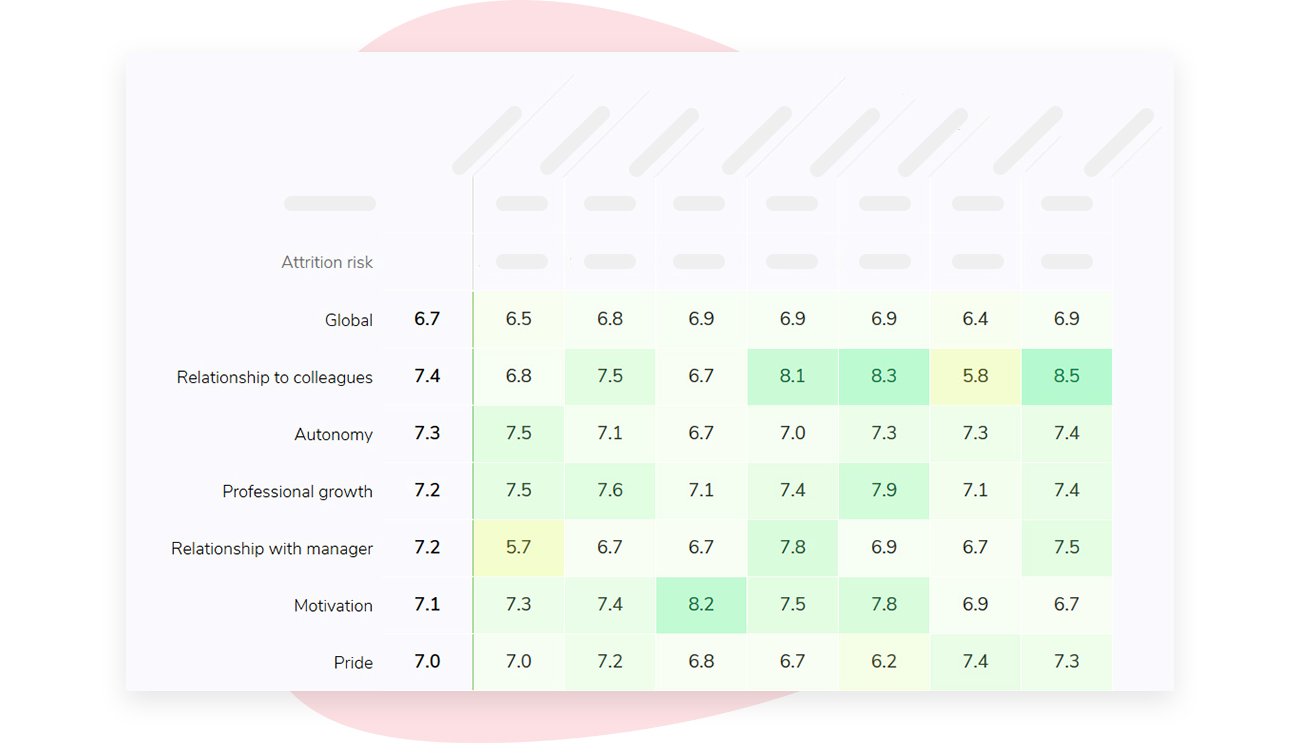
Sparkbay automatically maps report access to the org hierarchy, so managers only see results for their teams.
Results stay hidden until a minimum number of responses have been received. This number is customizable and the default setting is 5 responses.
If you’re interested in learning how Sparkbay can help you build a more engaged workforce, you can click here for a demo.
Make it clear who is responsible for each moment and ensure managers have a concrete role
It’s useful to have a central employee experience team to spot cross-company patterns, set rules for survey participation, and ensure two functions aren’t trying to solve the same problem in incompatible ways.
But when you’re trying to improve the moments of truth in the employee experience, it’s critical to remember that the central team is not the one who will be in the room when someone finds out they didn’t get promoted. Their manager is.
In an ideal world, you would have the following division of responsibilities:
- Your central team would be in charge of the design and measurement aspects of the employee journey.
- The functions that control the underlying system would be responsible for ‘fixing’ the system at a structural level (e.g. IT for access to systems, Facilities for physical space)
- And an employee’s manager would be responsible for all the face-to-face conversations and any follow-up that’s within their purview
Since these moments of truth often break down at these hand-off points, it’s also important to clarify what information needs to be passed between which teams and when.
- For onboarding: HR may be responsible for the onboarding journey and IT may be responsible for access to the necessary systems, but the hiring manager is responsible for ensuring the delivery of what the new hire needs by checking in with them before day one and ensuring they have what they need on day one.
- For promotion decisions: HR may be responsible for organizing promotion decisions with clear criteria and a calibration process, but it’s the manager’s job to deliver the message, agree on concrete next steps, and follow-up before the next promotion cycle.
- For returning from leave: HR may be responsible for delivering information related to the policies and entitlements, but it’s the manager’s responsibility to create a re-entry plan with the employee that addresses day-to-day work.
If you’re identifying these ‘moment of truth’ opportunities for managers, be sure to give them conversation prompts and a place to document what was agreed upon with their employees.
Otherwise, you’re asking them to take on something new without a clear standard for what ‘doing a good job’ looks like.
Should managers be evaluated in part on how engaged their people are? There are truly different opinions on this in the practitioner world.
On the one hand, this creates accountability within managers. On the other hand, it could lead to lobby-ing before employee engagement surveys or an unwillingness to bring bad news to the fore within teams.
Measuring follow-through - i.e. whether managers act on items they agree to act on - avoids most of these pitfalls.
So a reasonable way to proceed might be:
Understanding that if bad news currently flows upward easily within your organisation, introducing a small employee engagement component into your managers’ objectives creates accountability without causing too much disruption.
On the other hand, if this isn’t the case in your organization, measuring follow-through might be a better approach - at least until there’s more candour within the organizations.
Each priority moment must have a named owner responsible for follow-up (even if several teams are involved).
Make room for people who don’t follow the standard map
Boomerang hires
Boomerang employees pose a unique onboarding risk. Since they are already familiar with the company, their colleagues may not view them as "new" and therefore overlook potential onboarding issues related to new systems, new structures, and new expectations.
When handing off boomerang employees, explicitly communicate to the hiring manager what has changed since the employee left the company.
Prior to the first regular check-in, review the employee’s original exit interview, if possible. A key question for this first check-in is whether the reasons they left were actually addressed.
Internal transfers
Internal transfers are often not captured by onboarding triggers, or new hire attrition metrics, especially if their job change is recorded in the HRIS system.
Since they already have an email address, it’s easy to overlook the fact that their file access, key relationships, and success metrics have all changed. Discuss with the receiving manager what the first few weeks will look like instead of assuming the employee will plug and play.
Acquired staff
Acquired staff need to go on their own employee lifecycle journey.
They’ll need to know who their manager will be, which systems they’ll be working in, and what will happen to their projects that are already in motion. None of this is covered in a standard new employee survey.
Stay on top of retention-bonus vesting dates so you can spot potential retention cliffs months in advance. And keep your acquired staff separate from other employees during the first rounds of surveys. Their survey scores may reflect the acquisition more than your employee culture, and you don’t want to skew your overall company scores for no good reason.
Deskless employees
Deskless employees are one of the biggest potential sources of employee survey response bias.
They don’t often check their work email, so a survey distributed via email will have a limited reach and give a skewed result by only representing the office-based staff.
If your workers start their shifts all at once, consider using a shift-start check-in or distributing a QR code that employees can use at their clock-in point. If workers are alone or work in multiple locations, consider distributing the survey via SMS. If you’re using a kiosk, place it somewhere people can respond privately.
Sites like these also demand special consideration when it comes to privacy. A kiosk for responses that’s located near the supervisor’s office won’t garner honest responses.
Finally, once you start analyzing your survey data, consider the site response rates before you dive into the comments or scores. A low response rate from a specific site only gives you an idea of what a few deskless workers think on that site. To get a better response, make sure workers can complete the survey within their paid shift time and offer languages relevant to your workforce.
Demonstrate whether the fixes changed anything
Before launching your fixes, agree on what the primary outcome will be for each priority moment and record a baseline.
- Onboarding: 90-day quit rate or time-to-productivity
- Internal moves: early quit rate in the new role
- Manager changes: team engagement before and after the handover
Gauge how this outcome ties into the business as well. When Gallup compares teams with different levels of engagement, it also looks at differences in turnover, productivity, and profitability. Tracking engagement alongside the business outcome you’re really trying to move is important.
Be realistic about timeframes and numbers.
You may only have a small, noisy sample of early-quit data within a single business unit, so allow for enough cycles to measure a real change.
If possible, stagger your rollouts across different sites or regions. This gives you a comparison group within your business (the sites that haven’t yet rolled out the fix).
For example, suppose you’ve made changes to the first week set up process. You can ask new hires whether they received all their access on time, check this against access tickets, and then compare early quit rates to sites that are still using the old process.
Decide upfront what a "stop" signal is.
If after the agreed upon number of cycles the primary outcome hasn’t improved, you retire the fix and reallocate the budget to the next priority moment on your list.
If you’re interested in learning how Sparkbay can help you build a more engaged workforce, you can click here for a demo.