
What if you could understand "don't speak now, but we'll vent later" from the perspective of the organization?
When people don't speak up in meetings, it doesn't mean they agree with what's being said.
Your department head presents a new workload plan, asks for concerns, and looks around the room while 12 people nod along.
Nobody raises their hand to say anything, so the plan gets approved and the meeting wraps up 10 minutes early.
What do people do once the meeting's over?
They head to the washroom, where one employee says, I don't know how we're gonna get all these reports done on time.
Or maybe 2 more employees are discussing their frustrations over direct message while they grab a coffee.
Why didn't they say this in the meeting? Because they didn't want to say this in front of the person who assigns them work.
What's the problem with this way of communicating?
The organization misses out on the cheap, early information. Instead, it has to invest expensive resources to accomplish one of these outcomes:
- change the deadline
- replace an employee
- launch an incident review
So how do you measure whether people feel safe enough to disagree, admit they're struggling, or name a mistake?
One way is to design an Emotional Safety Index.
Such an index helps companies understand how to measure employees' day-to-day experiences to produce a clear set of scores related to expressive freedom, vulnerability, respect, predictable leadership responses, conflict repair, and belonging.
While this is a useful resource to understand, a safety index does not replace the work you've done or the work you need to do. Nor is it supposed to tell you how comfortable employees felt in every meeting.
Understanding the Emotional Safety Index, How It Differs From Psychological Safety, and How to Measure It Across Teams
- Beyond "bring your whole self to work": defining emotional safety
- An overlooked component of psychological safety
- What exactly does the emotional safety index measure?
- The scoring logic: turning feelings into data
- What do you want to find out from employees?
- Reading the room without a survey
- How to run your first assessment without breaking trust
- A low score on the survey is not an indictment!
- From score to shift: what moves the needle
Beyond "bring your whole self to work": defining emotional safety
People who feel emotionally safe at work believe they can show their normal, human reactions at work without the risk of being ridiculed, retaliated against, or damaging their reputation in the workplace.
The key term is reputation. The majority of employees don't worry about receiving a written warning. They worry about being quietly moved to a different category in the organization's talent management system.
For instance, they may no longer be considered a "high potential employee".
They may be in the category "needs further support".
They may be moved off specific projects or assignments.
Perhaps they'll be described during a talent assessment meeting as someone who "struggles under pressure".
All of these changes can have a massive impact on an employee's career progression.
This makes sense. You can see why we mentioned earlier that measuring a shared view of emotional safety is so important.
For example, a team may have a supportive manager, but that manager is the only reason why people feel safe.
Similarly, a team may have a trusted teammate or peer, but they aren't all that matters if there's a volatile skip level manager.
So how do you write the right questions?
Well, what we mean is we have to understand the difference between a referent-shifted item and a self-referent item.
In the context of your survey questions, a referent-shift item may look like this: "People on my team can...".
Aself-referent item would look like this: "I can..."
While both types of question are useful, it's important not to average them and call that your measure or construct.
Why not? Because the self-referent questions may produce variable answers, depending on the respondent's years of experience, their level of seniority, or how confident they are in their employability.
On the other hand, the referent-shift questions measure the climate or environment that you're trying to change within your organization.
Finally, it's important to understand that emotional safety is not the same as comfort.
In a workplace that is emotionally safe, there may be blunt feedback, hard trade-offs, and tense conversations.
The point is that people feel safe that the organization will treat these moments with dignity and a level of consistency.
A team can feel uncomfortable and yet be emotionally safe.
In fact, in healthy teams, people are more likely to bring up uncomfortable issues because they don't have to worry about wrapping every concern in politically palatable language first.
If you find that your emotional safety questions strongly correlate with "my team gets along well" on your employee engagement survey, you know you've simply created a temperature check for the whole mood of the team.
Similarly, it's useful to consider whether "bring your whole self to work" is the best way to think about emotional safety.
Firstly, this phrase puts the onus on the employee to disclose who they are.
Secondly, it distracts from the phenomenon you're trying to measure.
An overlooked component of psychological safety
One of the limitations of the popularization of psychological safety is that it overlooks the importance of emotional safety.
As discussed earlier, psychological safety defined by Amy Edmondson focuses on the interpersonal risks around speaking up with ideas, difficulties, errors, or questions.
In contrast, emotional safety asks whether you can be genuine and vulnerable while interacting with others without fear of being shamed or punished.
Why does this matter?
Because it helps us understand the concept of emotional labor and how it affects performance and voluntary turnover.
If employees don't feel emotionally safe they will engage in more emotional labor such as surface acting (expressing emotions you don't really feel). This leads to exhaustion and withdrawal.
To illustrate the previous point, consider the following example.
Suppose you have an engineering team that welcomes technical discourse and debate. But suppose they don't view feelings of overwhelm or being overworked as a team issue.
In this scenario, employees will feel free to express their opinions about the technical design of a product or the best approach. But they won't feel free to express their feelings of stress and being overworked.
So while your psychological safety metrics may look fine, your attrition rates (or voluntary turnover rates) among some of your most hardworking employees may be high.
In addition, Amy C. Edmondson's conceptualization of psychological safety is important for organizations to remember.
In The Fearless Organization, she emphasizes that psychological safety and accountability are independent factors, not opposite ends of a continuum. High standards with low psychological safety = anxiety. Low standards with high psychological safety = a comfortable team that accomplishes little. The goal is to have both high standards and high psychological safety - and this is the zone where learning happens.
This understanding can help teams avoid misinterpreting initiatives to develop emotional and psychological safety as a reason to lower standards.
It's important to note that there is research that supports Edmondson's original theory. Several studies have demonstrated the positive impact of psychological safety on learning behavior, team performance, and the willingness of employees to speak up.
One final point about the differences between psychological safety and emotional safety is important for potential buyers.
Some commercial psychological safety assessments give teams an overall 0-100 team score based on a short assessment.
While this is useful to get a conversation started, it can be dangerous to use this overall team score as a final target.
If you already use one of these assessments, it worth considering whether the assessment captures issues related to affect and repair.
What exactly does the emotional safety index measure?
An Emotional safety Index should measure a collection of related dimensions.
For instance, it is not very helpful or informative to ask employees one broad question such as "I feel safe at work".
Such a question cannot tell you if a high percentage of people selecting a low response is due to an unpredictable manager, an unresolved conflict, a feeling of pressure to conceal one's identity, and more.
And each of those potential factors would necessitate very different interventions.
A helpful emotional safety index includes the following components/sections.
- Expressive freedom: Employees can express frustration, fear, and disagreement without being dismissed or punished. This should be linked to the people who hold power over employees' opportunities such as assignments, promotions, and access to senior leaders (not just "colleagues" in general, since respondents tend to inflate scores significantly when thinking about the latter).
- Vulnerability tolerance: People can express when they feel overwhelmed, when they are uncertain, and when they are wrong. This includes what happens afterward - whether the person receives the support they need to overcome this challenge, or whether their status diminishes in quiet ways while others remain outwardly polite.
- Interpersonal respect: Basic respect and dignity regardless of position, role, or changing moods. This assessment can focus on whether behaviors are directional (e.g., sarcastic remarks and public shaming that are often directed at specific people or hierarchical levels, or frequent interruptions) which may point to systemic power imbalances or issues.
- Response predictability: This is assessing the variance in responses a person receives. A manager who is consistently demanding may score higher than a manager who is usually kind but becomes volatile when in stressful situations like at the end of a quarter. This can be assessed by understanding an employee's perception of the worst recent behavior.
- Repair capacity: After a negative event or harm, an repair effort occurs where someone acknowledges what happened, the group agrees to specific changes, and the relationship is healed.
- Belonging and identity safety: Employees don't feel the need to constantly 'edit' their accent, background, family circumstances, or personal style to ensure they are respected or taken seriously.
While these dimensions may overlap or relate to each other, they should be considered separately.
For instance, an organization may score highly on interpersonal respect but low on response predictability. This may be due to the overall good behavior of leaders under normal circumstances but escalated negative behaviors when pressure mounts and goals are at risk. This would necessitate an intervention (e.g., clear escalation protocols, workload conversations) that differ from training on civility.
The repair capacity section deserves special attention. Every team will have negative incidents or "drop the ball". The question is whether people are able to speak up about the harm that results, and whether the team attempts to rectify the situation fairly.
A focus on repair capacity is beneficial, but overlooked, because it is not commonly included in standard emotional safety instruments. Yet it is critical since it determines if a team will continuously suffer from a negative recent event. Teams with strong repair abilities bounce back from harmful incidents.
Teams without strong repair mechanisms accumulate these incidents over time, and this can often be linked to a team's decline back to one poorly managed encounter.
Research on workplace incivility indicates that experiencing low-level incivility can affect employees' ability to put in effort or cause them to avoid certain situations. Researches on the concept of belonging feel uncertain about one's social acceptance can alter how employees interpret everyday challenges and setbacks. This is why feeling a sense of belonging and identity safety often corresponds to expressive freedom within the same subpopulations.
The scoring logic: turning feelings into data
There isn't one universal Emotional Safety Index with fixed score bands that apply across every organization. Anyone selling you one is selling you their norm sample, not your reality.
Treat the index as a measurement framework you validate against your own workforce data.
Start with several items per dimension. A 5-point or 7-point agreement scale gives enough range without forcing artificial distinctions. If you're global, resist the urge to add points for "nuance" - extreme response style varies enough by country to muddy cross-market comparison as it is.
Calculate each dimension score from its related items. Reverse-code negatively worded statements before combining them.
You may convert the result to a 0-to-100 scale for easier dashboard use. Be aware of what that does politically: a 0.2 shift on a 5-point scale becomes a 5-point move on the dashboard, and someone will build a target around it.
Keep dimension scores visible even if executives want one headline number.
You could label locally tested ranges as Fragile, Developing, Stable, and Thriving. Use those bands as a guide, not a trap - they're a communication device for managers, not clinical cut-offs, and the moment they appear in a scorecard with a bonus attached you've created an incentive to manage the survey rather than the team.
A "Stable" result can still hide a meaningful cluster of employees choosing the bottom option. Look at the distribution and the proportion at the floor, not just the mean and median.
Three technical checks before this goes anywhere near an executive deck:
First, internal consistency and discriminant validity. Run a confirmatory factor analysis and check whether your 6 dimensions actually separate, or whether respect and expressive freedom are one factor in your population. If they collapse, report 4 dimensions honestly rather than 6 aspirationally.
Second, aggregation justification. You intend to report this at team level, so you need to show that team-level variance is real: ICC(1) for how much variance sits between teams, ICC(2) for reliability of the team mean at your typical response counts, and a within-team agreement statistic. A team of 7 with a split of 4 positive and 3 at the floor has no meaningful mean, and publishing one invites a manager to dismiss the whole exercise.
Third, measurement invariance across your translations and major regions. If the index isn't invariant, cross-country league tables are noise, and you should report within-country change over time instead.
Then test expected relationships with engagement, intent to stay, manager trust, and speak-up behaviour. Don't chase a perfect decimal place - you're looking for patterns, gaps, and movement.
One decision that gets made by accident: what counts as a real change between rounds. Work out the standard error of a team mean at your typical response count and you'll usually find that small movements on a team of 8 are indistinguishable from noise. Publish a movement threshold before the second round, or managers will spend the year explaining random variation.
What do you want to find out from employees?
These questions are what make up your culture index.
Broad, attitudinal questions produce broad answers. If you want concrete, behavior-based responses, ask specific questions that relate to a limited time period (e.g. the past month, the past quarter) so employees have something specific to evaluate. This will also ensure your culture index changes more frequently in response to real events as opposed to general feelings.
You might want to include questions such as:
- I can speak with my manager when I disagree with them without fearing negative consequences.
- When someone on my team admits they made a mistake, the focus is on solving the problem.
- In the past month, I've felt the need to hide how overwhelmed I felt at work.
- On my team, people can express their frustrations without being labelled as difficult.
- I can predict how my manager will react when I bring forward bad news.
- After a tense disagreement, my team addresses what happened.
- I alter my tone or behavior in order to be taken seriously on this team.
- If I said I was struggling, someone here would check in to support me.
- Senior employees are treated with more respect than junior employees when they raise the same concern.
- I can ask for help before things become urgent.
Note that the third and seventh questions focus on the employee's own behavior for concealment rather than their opinion of the culture. This is helpful because a self-reported "covering" behavior is harder for employees to answer aspirationally, and it rapidly adjusts to cultural changes (e.g. leadership changes) compared to attitudinal questions.
You should also include some reverse scored items, but don't make the survey unnecessarily complicated.
While negatively worded questions are useful for identifying response biases like straight-lining or acquiescence bias, they also complicate factor analysis by creating their own method factor. Negatively worded questions can also confuse translations. Be sure to consider all these implications ahead of time so you can have a plan for whether you'll include these method factors in your models or exclude these items altogether.
You don't want to figure this out once you're presenting a dimension score to a general manager.
There are a couple other wording snafus to avoid. One is double-barreled items (e.g. "my manager is approachable and fair"). If participants give a low score, it's unclear which one they had trouble with.
Another is using the word "safe" in your items. This can lead participants in operational and industrial environments to focus on physical safety (when you may be trying to ask about emotional "psychological safety"). It can also lead participants to provide a socially desirable response.
Finally, you can include one open-text questions that solicits helpful feedback for creating an action plan. Consider asking something like, "What usually happens when someone raises a difficult concern here?" instead of a generic "Any comments?" question.
Open comments are subject to the same privacy rules as the scaled-response comments, but you should consider the privacy of these open comments even more carefully. It's common for employees to re-identify themselves via their project name, dates, or specific incidents they mention. Before launching the survey, decide who will see the raw comments, whether anything needs to be redacted before LINE MANAGERS see it, and what your process should be if a comment includes a description of conduct that triggers an obligation to investigate.
Reading the room without a survey
Surveying employees isn't the only way to get a sense of how safe your employees feel speaking up.
Pay attention to how much airtime employees get during team meetings.
A manager may sincerely believe their team feels safe speaking up because they hold the vast majority of the conversation, but because employees aren't comfortable speaking freely, the manager doesn't realize how unsafe employees feel.
Another way to measure employee sentiment is to pay attention to what happens immediately after a manager asks, "Does anyone have any concerns?"
If it's dead silent in the room, but a manager receives a bunch of concerns via direct message 20 minutes later, it's a sign that employees don't feel safe raising concerns in a group setting.
There are other factors you can pay attention to, which may or may not be signs that employees don't feel safe speaking up.
How quickly does bad news travel up the org chart? How many meetings do employees hold to align on messaging before the actual meeting?
If people have a tendency to preface every concern or ask with an apology, that's also a sign to keep an eye out for.
If a high number of 1:1 meetings with a particular manager get cancelled by that manager, it's worth asking why.
Similarly, are there a lot of formal grievances being submitted? Are there informal escalations?
If there are a lot of employees in an organization and they do not take advantage of a hotline provided to them by HR, that may not be a great sign, either.
Repeatedly seeing employees cancel their meetings with a particular manager warrants further investigation, though this should be treated as a reason to ask questions, not proof of a problem.
While exit interviews are helpful, they aren't the strongest signal for identifying problems within the workplace.
They are beneficial because departing employees may be more likely to share concerns with their employer that they previously held. However, this is a self-selected data sample that happens pretty late in the game and may not reflect an employee's true feelings.
Stay interviews and structured 90-day check-ins with new employees are more helpful for gauging how safe employees feel to speak up.
New hires are a perfect opportunity to act as your "canary in the coal mine" when it comes to assessing how comfortable employees feel speaking up. Someone who's been an employee for a couple of months (or less) will be more aware of dynamics and behaviors that older employees may not notice.
They're more likely to be aware of who gets talked over, what topics are off limits, and what happens to people who ask the obvious questions.
Research on employee voice shows that people weigh the effectiveness of speaking up against the social and professional cost. If leaders don't act on their employees' concerns, it diminishes the utility of speaking up, vacuuming way any motivation to speak up.
Moreover, employees come into organizations with existing implicit beliefs about the best practices for raising their voice and concerns (e.g., don't embarrass the boss in front of the team, always go through the proper channels). These ideas are hard to change, even with a "my door is always open" mentality.
Finally, resist the temptation to engage in "covert surveillance" while you're trying to read the room. Analyzing employees' private message activity or other metadata is not only invasive, you risk sabotaging your entire efforts if the data leak becomes a big deal.
How to run your first assessment without breaking trust
So where do you start?
First, decide what you will do if you receive bad results, and write it down before you start your survey. Emotional safety surveys have an asymmetric risk profile when it comes to making employees feel safe. When you ask employees about retaliation and fear, it greatly increases their expectations of action more so than when you ask them about tools and workspace comfort.
If the honest answer is "I don't expect senior leaders to take these survey results seriously anytime soon," then consider conducting a different survey for this year.
Only ask questions that the organization is prepared to act on.
Second, decide on the minimum response threshold before the survey starts and communicate this in simple language. Employees don't worry about minimum thresholds as much as they worry about a lack of transparency around minimum thresholds. If you are using a platform that allows you to automatically enforce a minimum response threshold, let employees know what this is ahead of time.
Third, once you're writing your survey, be aware of laws and regulations in your country that may apply, especially because your survey may include items on "manager behavior" and "distress". These may require consultation with your company's works council, employee representative bodies, or a data protection impact assessment. Finding this out after you launch your survey is a huge, avoidable embarrassment.
You should also decide from the outset how comments that include sensitive allegations of harassment will be handled, and ensure that they'll be transferred to your organization's whistleblowing or ethics channel.
Fourth, decide what cadence works best for your organization. If your organization is going through a lot of changes, or recently experienced a major change, and a survey once a year is simply not fast enough to provide actionable results, consider a longer baseline survey followed by shorter surveys focusing on key items every few months.
Fifth, design your survey so that you can provide different segments based on team, level, tenure, and demographic group if your sample size allows. However, only provide these segments if there is also a guarantee that the organization will act on them.
Sixth, try to provide an initial readout within two weeks of the survey closing (if it can be done in that timeframe). This doesn't mean you have to fix everything, but you do have to let employees know that someone has read what they've written. This is a pinball effect.
Within your announcement, make clear what you've heard, what you'll need to look into further, and what actions managers will be taking.
Seventh, decide whether managers will receive their reports before or after their manager receives their reports. If managers receive their reports after their manager receives their reports, they may see the survey results as part of their performance review. This could lead to defensiveness during debrief meetings.
Providing managers a quick preview of their results before their manager receives it, WITH THE OPTION OF TALKING TO A COACH OR HR PARTNER ABOUT THE RESULTS could shift debriefs from defensive discussions to diagnostic discussions.
Eighth, wait a few weeks after announcing potential redundancies or a reorganization before launching your survey. You don't want to gauge the overall temperature of your org by gauging your employees reactions to an announcement. Moreover, if you do this, you'll poison your ground truth for the next few years.
Finally, once you've finished your survey, it's crucial that you take some time to respond. The absolute worst thing to do is ask your employees how safe and comfortable they are to express themselves and then go quiet. All this will do is fuel another round of cynicism the next time you conduct a survey.
At Sparkbay, we can customize your survey based on the emotional safety dimensions your organization has selected. This includes customizing the wording of each survey item, response scales, and what each level of leader will see on their dashboard.
You can start with a deeper baseline survey, then conduct shorter regular check-ins (based on our recommended cadence).
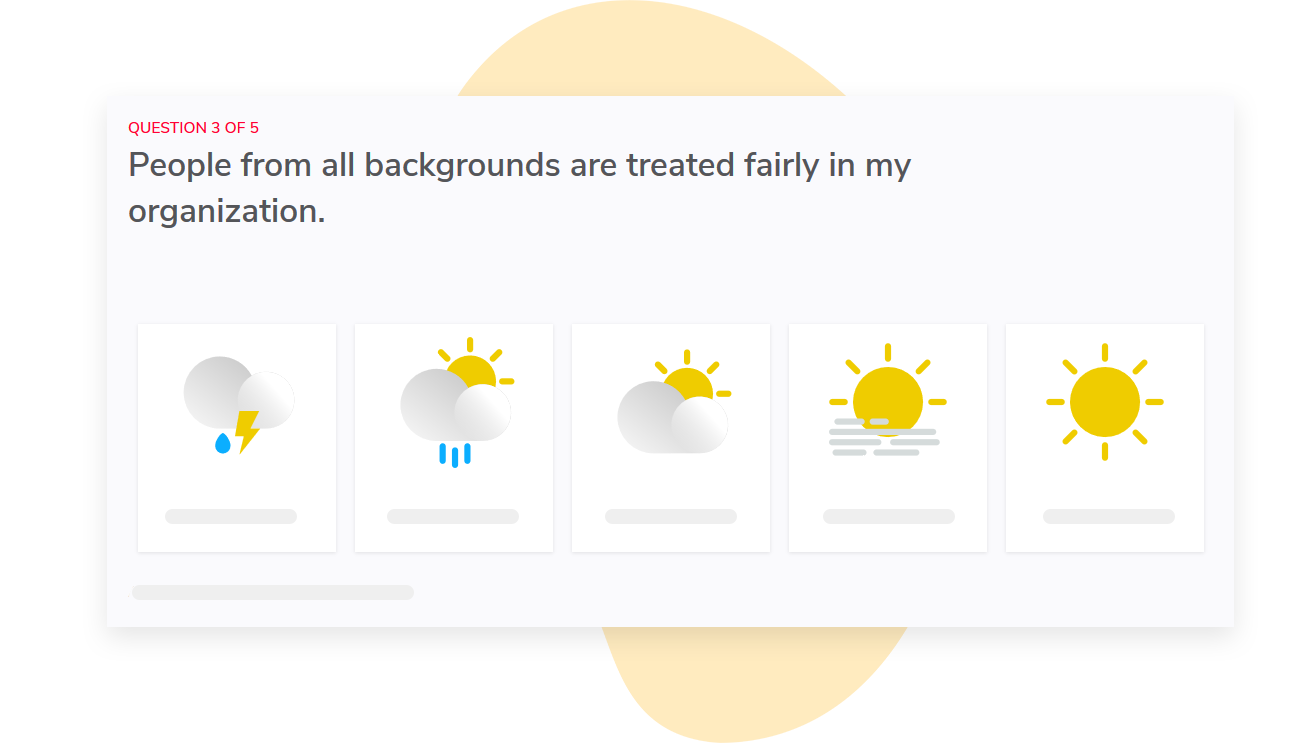
We also report engagement using a score out of 10. Your emotional safety items can be included in this broader engagement measure. This allows your team to test if changes in expressive freedom or response predictability correspond with changes in engagement within your population, instead of assuming they do based on literature.
For large enterprises, that means there is hard work still to be done once you break down the company average into different local contexts.
Our reporting feature allows you to compare results across managers, departments, tenure groups, and other approved segments, so you can see where a simple headline number is hiding very different local realities.
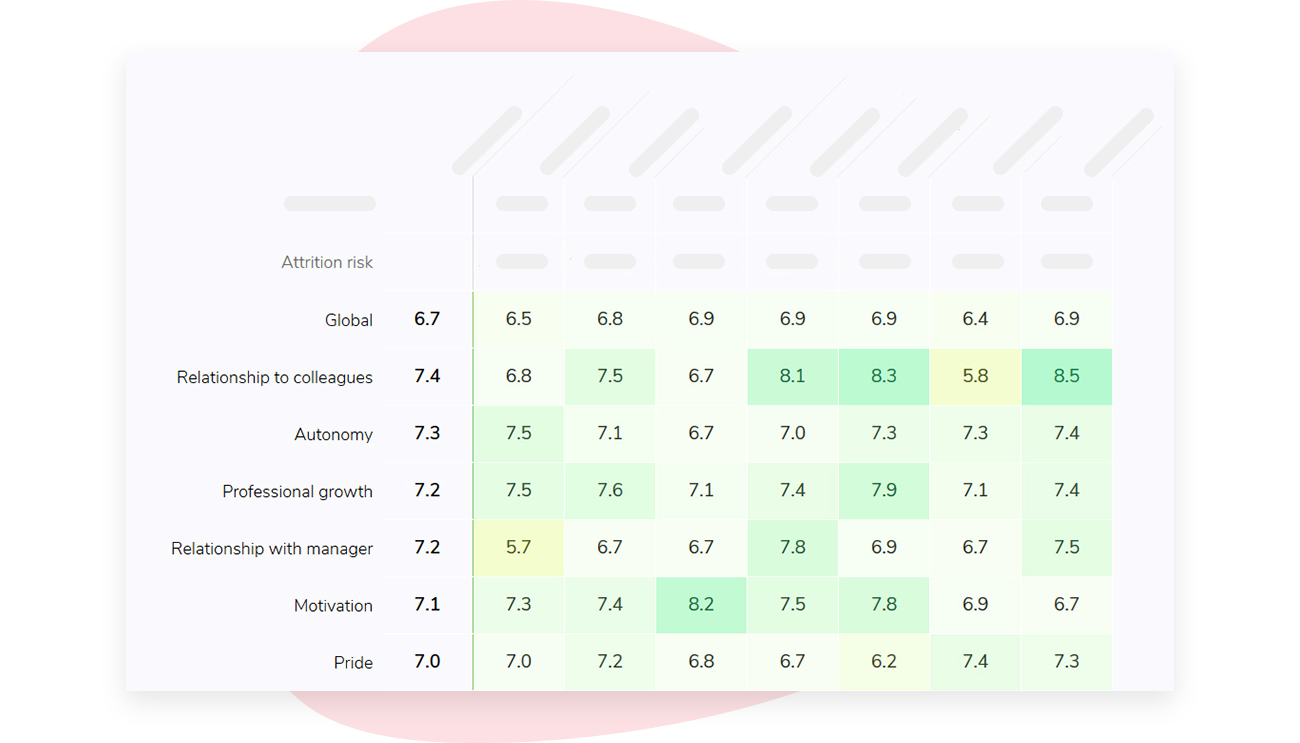
Access is automatically granted based on an organization's hierarchy, so each manager only sees results for their specific teams. Moreover, we hide responses that fall below a minimum response count (you can change this, but the default is 5).
When it comes to emotional safety surveys, it's essential to keep reporting confidential when it comes to small groups. Otherwise, you risk exposing specific individuals and people losing trust in your survey and its impact.
We are ISO 27001 certified, which is usually the first question your security and works council reviewers have about a survey with this kind of content.
If you're interested in learning how Sparkbay can help you build a more engaged workforce, you can click here for a demo.
A low score on the survey is not an indictment!
Receiving a low score can be frustrating and lead to defensiveness because leaders take it as a judgment on their character. Remember, this score is a measurement of how your employees repeatedly experience your organization, so it's important to help your leaders put this in perspective.
If you receive a low vulnerability score, understand that this may mean your managers handle routine questions well, but struggle when someone says "I can't keep up." This means there is a very specific and coachable vulnerability-focused failure that is not currently being handled well while other actions may be handled quite well.
If your repair capacity score is low, it could mean that your conflicts aren't being resolved on the project plan and they're not being resolved for the people involved.
Pay attention to if there are differences between your teams.
Research on engagement shows that there can be huge differences between teams within the same company and that managers are a big factor in this variation. If you find that there are dramatic differences in feelings of emotional safety for multiple teams that are doing similar work, it's worth investigating local behaviors. At the same time, avoid drawing causal conclusions immediately.
Consider that factors like your team's history, headcount fluctuations, client demands, or decisions made by a manager's manager can play a role. Sometimes what looks like a bad manager is an individual absorbing an unresolved resourcing decision two levels up.
In addition, beware of second-order effects. When a leader views a score as an indictment, they may take the cheapest available action: talking to their team about the score. This conversation can negatively impact the results of the next survey because it's happening from the perspective of people afraid of their leader.
They now know who is looking at their responses and how those responses are viewed. Providing coaching to your leaders on how to have that conversation or having that conversation for them is a key step to ensuring you aren't impacting your future results.
During the results conversations, use this opportunity to question why that is and revise explanations instead of simply defending them. Ask your managers what surprises them about the survey results. Then, ask what their employees may be experiencing that they may not have visibility into.
If your managers get exasperated by the results, that's okay -- express that exasperation up loud. But don't get caught up in debates about whether employees should feel unsafe at work because that doesn't change what they actually do feel and it wastes time you have for your real conversations.
Finally, look at the shape of the data as well as the level. Consider whether you're seeing a bimodal distribution within individual teams, which can signal a different problem. If half of your team feels like they're thriving and the other half feels like they're struggling, this is a different issue than generally okay or so-so team.
Remember, the average can mask both.
A bimodal distribution within a team can also be a red flag for job insecurity, especially if the low scores are coming from a view of permanent staff vs. contractors working in the same team.
From score to shift: what moves the needle
You can't build emotional safety by scanning for opportunities to do it and then throwing employees on a plane to attend an offsite.
If your score for expressive freedom is low, consider changing the structure of how decisions are made instead of simply encouraging people to speak up. For example, assign someone to be the designated devil's advocate. Ask employees to submit their concerns in writing before the meeting.
Ensure the most senior person in the room hears the concern last. Structural changes like this reduce the individual risk of being the "one who speaks up".
If your score for vulnerability tolerance is low, focus on giving managers the right tools to respond correctly when an employee asks for help within the first 30 seconds. How should they respond? By thanking the employee for bringing up the issue before it caused real damage.
By naming the size of the potential risk and what the team can do to address it. Simply telling employees to "be more resilient" while keeping their workload unchanged is not a long-term solution and everyone will see that.
Sometimes it makes sense for leaders to be vulnerable, but it's also a time to exercise good judgement. If a manager makes a mistake, acknowledges it, and then explains what they learned and how they'll adapt, it creates a positive example that being open doesn't have to be risky. On the other hand, a manager that constantly uses employees as a sounding board for their anxiety only adds to the emotional labour employees already do on the job.
If your score for response predictability is low, consider creating an explicit protocol for reporting bad news. What gets escalated? How quickly does it get escalated?
And what's the guarantee that reporting early signals will not lead to public shaming or a response typed out at 10pm into a group chat?
If your repair capacity score is low, conduct structured retrospectives after stressful events. Break them up into three parts: what happened, how did it affect people, and what needs to be changed. Many retrospectives address what happened and what needs to be changed but forget about the "how did it affect people" part.
This is the part that determines whether the team heals or not.
Organizations can be remorseful during a blameless retrospective while also holding individuals accountable. Weighing one person's decision too heavily is unfair when the process played a part too. There's extensive research in high-risk industries demonstrating an open error reporting culture increases organizational learning.
If an organization starts a blame game every time there's an error, people will avoid reporting weak signals.
You may also want to address your understanding of the three types of failures Edmondson describes: preventable deviations from a known process, complexity failures where one small incident teams up with others to cause problems and intelligent failures that happen on the frontiers of what's known. Treating all three failures the same way could lead to unfair blame or tolerated sloppiness. By helping teams recognize which kind of failure they're dealing with, they can be more comfortable upholding the highest standards in the first type of failure while not punishing teams during the third kind of failures.
If your score for belonging is low, conduct an audit to determine who gets interrupted, whose emotions are dismissed as "unprofessional", and who has to re-establish their credibility when they enter a new room. These three patterns can be spotted in any video recording of a leadership meeting and are more actionable than data collected through a training exercise.
Once you've conducted an audit, set one or two visible norms in your work environment. The number one or two norms is critical. If you present managers with a checklist of 14 items to address, they may not be able to "operationalize" that.
They may also perceive that none of those items are particularly emphasized by the organization.
A final thought: almost all of these activities will cost your organization a few hours of meeting time, delay a decision, or require some upward communication about workload. Are your leaders and managers willing to pay those costs?
Why you should include the emotional safety index on your people dashboard?
We recommend including the emotional safety score on your people dashboard next to your engagement score, retention risk score, or eNPS score.
Why? Because psychological safety is a leading indicator for lagging indicators like employee engagement.
When people feel less engaged, they are more likely to withdraw from the organization. They stop raising issues, disagreeing with others, or sharing their ideas. Instead, they keep their mouth shut and only share what they think leaders want to hear.
By the time they actually resign, they may have been silent for 6-9 months.
This means that your analyses of engagement scores, retention risk scores, or your analysis of turnover - "Do teams with low scores in this dimension have higher regret attrition rates within the next six months?" - are lagging analyses.
A useful starting point is to test whether your dimension scores in one quarter (on either your emotional safety or engagement indexes) are predictive of regretted attrition rates, absenteeism, or internal mobility applications two quarters later at the team level.
If you find that these scores are predictive of these outcomes within your data, then you have a powerful early-warning measure to help you in your strategic conversations and decision making. And it makes an easier conversation with your CFO!
If they aren't predictive, you can disregard that message and keep your index as a diagnostic tool rather than a predictive tool.
Research has already linked stronger levels of psychological safety to more learning behaviors, greater information sharing, and better team performance. Burnout research has shown that factors like workload, lack of control, insufficient reward, unfairness, and lack of community are main contributors to burnout.
This means it's healthier for an organization to focus on these factors rather than putting the blame on an individual's resilience.
This is why an emotional safety score that never leads to a workload management decision isn't doing much.
Clearly, your emotional safety index isn't the only place you should pour your energy. There are other important areas like compensation, career paths, and support through stress periods. And oftentimes these may be structural problems that leaders can easily focus on through a "soft" survey score.
It's important to watch out for leaders who want to discuss the less controversial topic of emotional safety rather than the more complicated topic of high vacancy rates.
At the same time, there's a potential social desirability risk for employees once they know this index is on their dashboard. Your leaders may view this as a way for them to be graded or evaluated. And once people are worried about being graded, rules of how to "survive the survey" start cropping up.
These might include circulating memos within the team on how to answer questions, quietly removing people from the distribution list, or reminders on how much the team has been through before completing the survey.
Your best defense against these social desirability behaviors is (a) not linking results from the emotional safety index to compensation and (b) monitoring your distribution data, your response rates, and the themes of your comments on the dashboard.
That way you can quickly flag social desirability edits if they happen.
On the whole, this index on the dashboard will help you see whether your employees feel they can speak up before they become flight risks.
It will also allow you to revisit it after your leaders take action. Instead of simply celebrating an overall 2-point increase on your organizations emotional safety index, you can be more granular by looking at changes in dimension scores, analyzing changes in the themes of your comments, or looking at differences among teams that existed before.
In short, this emotional safety index is something you measure, not something you win.
If everyone goes around the table at your next meeting and everyone silently agrees to something they're not that happy about, take a look at what's changed in that meeting since the last meeting.
If you're interested in learning how Sparkbay can help you build a more engaged workforce, you can click here for a demo.