Your teams meet their quarterly objectives. Your engagement scores look fine. But is this sustainable?
Or is your current success reliant on a few "rock" employees who could leave after one bad quarter? Your employee engagement survey can help you answer this question.
When a survey gets re-designed, it’s often the questions about workload, standards, and manager capability that are the first to go.
They make senior stakeholders uncomfortable, so they’re removed or toned down so they can’t receive a bad rating.
Meanwhile, the board wants to see evidence that people will perform better, and that the investment in AI will pay off.
Without those uncomfortable questions, there’s no credible evidence to show them.
Consider AI. If the stated goal was to free up capacity, then it’s important to know whether teams where it was rolled out, vs. teams where it wasn’t, feel differently about their workload and their confidence in the quality of their work.
This insight is more important than how happy people are with the training.
So how can you get an honest read on your performance culture without shelling out for a proprietary diagnostic?
You need: a few targeted questions, the ability to filter results by team, and the discipline to compare your survey results with your outcome data, rather than using the survey as a stand-in for outcome data.
And keep in mind: Your survey is not directly measuring your performance.
Learn how to measure performance culture through your engagement drivers and identify patterns at the team level
- What does a high performance culture mean beyond the buzzwords?
- What questions should you ask alongside an engagement score?
- Could "play, purpose and potential" explain the pattern?
- Which of the four profiles describes your team?
- Are your teams operating in a healthy state of drive or a state of fear?
- Why is it not helpful to look at company-wide averages?
- How Sparkbay can help you understand your performance culture by team
- Are your survey results aligned with your output metrics?
- How do you close the loop in a way that makes a difference?
What does a high performance culture mean beyond the buzzwords?
Every organization says they care about performance, so this doesn’t really help us differentiate.
A better way to think about a high performance culture is to look at a team’s resilience when the conditions aren’t in their favor. How well does your team perform when:
- Your two best people leave
- Your priorities radically change halfway through the quarter
- Your manager is out for a month
Why is it important to measure engagement and performance confidence together?
Measuring employee engagement and performance confidence individually can give you incomplete data. Employee engagement measures whether people want to be at your organization. Performance confidence measures whether people believe that, given the current team composition, they can perform.
A team could be highly engaged but worried they won’t perform. On the other hand, you could have a performance team that isn’t very engaged. You can also assess this performance confidence through conversations.
Suppose you ask your team, "What has to be true for us to hit next quarter’s targets?"
What questions should you ask alongside an engagement score?
Suppose you have an engagement score for your organization (or for each team within your organization) on a scale of 1 to 10, or percentage - whatever scale you’re using.
How do you make that number actionable?
Write survey items that allow you to identify specific drivers. Trying to figure out specific drivers based on abstract survey items is challenging. It’s much more helpful to understand specific moments that people face every week.
- Clarity: Most teams can tell you what "good" looks like when they’re by themselves. But it takes time away from their work when they have two conflicting priorities. Test this moment directly by asking your employees something like, "When I receive two conflicting priorities, I know which priority to put first."
- Autonomy: Do your people feel like they can do work in the way that makes the most sense? Or do they have to escalate every time they deviate from the process? Avoid abstract items like, "I feel empowered" or "I have autonomy" on your survey questions, as they’ll result in reflexive responses. Instead, ask your employees about decisions they make daily or weekly. For instance, "I can change the order of my work without approval from my manager."
- Growth: If you’re rolling out an AI upskilling initiative, you want to know if people are incorporating their new skills into their day-to-day jobs, or putting them on the shelf as soon as they leave the training room. Gauge this by asking your employees questions like, "I applied a new skill I learned to my work this quarter." Then, instead of comparing overall engagement scores, you can compare responses to this survey item between teams that went through the upskilling program and teams that didn’t.
- Support from manager: Asking how well employees are supported by their manager can be complicated. For starters, removing blockers that the team can’t remove themselves is one thing. Another thing is providing feedback that is specific and useful enough for employees to act on. These are two different skills. Consider writing two separate survey items. Often, managers are strong at one and weak at the other. Combining these two skills into one survey item could result in a middling score that doesn’t provide much insight.
Pro tip: Be cautious when evaluating driver correlations
Driver analysis with a few dozen teams is noisy.
A small change in who responds to the survey can alter the rankings.
Plus, there’s the halo effect. People who generally feel good about their work may rate all factors highly, inflating correlations and making it seem like all drivers are important.
Take driver rankings as hypothetical. Use them to have conversations with a handful of teams (high and low) to see if there’s anything to the narrative before acting on them. Driver rankings are not board-worthy findings.
If you receive a similar driver ranking in the next survey, and your comments highlight the same theme, then you’ve got something to act on.
If you don’t already have a performance-confidence item, consider adding one or both of these:
Our team has what it needs to meet its goals without lowering quality.
I’m confident that my team can deliver what the organization expects.
You might also want to add this item, even though most surveys omit it, because they don’t want to see the answers:
I can complete my portion of the work within normal working hours.
Could "play, purpose and potential" explain the pattern?
In the book Primed to Perform, Neel Doshi and Lindsay McGregor argue that not all work is created equal. Why people work is as important as how hard they work.
For instance, they note that pressure is good for keeping a team focused on today’s plan, what they call tactical performance. But this kind of pressure wears down a team’s adaptive performance, i.e. their ability to notice when the plan isn’t working and solve problems no one anticipated.
Why is this important for your survey?
Because your performance-confidence items mostly capture tactical performance: will we hit the plan?
So let’s put this all together:
If your team scores high on performance confidence, and also scores high on autonomy and growth, then they’re likely delivering for the right reasons.
Which of the four profiles describes your team?
If you plot your teams based on their average engagement scores and average performance confidence scores, most of them will fall into one of the four profiles below.
Thriving teams
These teams have both strong engagement and strong performance confidence. They understand what it means to perform at a high level on their specific team and projects, when to make decisions themselves, and when to escalate an issue.
They also feel comfortable escalating issues because they trust their manager to make the right decision.
These teams know how to set boundaries and when to say no to incoming requests.
If you want to create thriving teams by learning from the way these teams operate, it’s important to consider whether they are successful because of their operational style or because of the individuals on the team.
If the best people simply ended up on these teams, then their team rituals may not be easily transferable to other teams.
Additionally, it’s important to understand that teams in this profile can easily fall into a dangerous trap.
Project managers will notice these teams deliver and assign them more projects, team members may seek lateral moves into that team, or other team members may begin to pick up the slack. Tracking these teams over multiple rounds within the context of workload and hours items will allow you to understand whether these thriving teams are thriving because they are absorbing other teams’ work. This might show up as a slow transition to a pressured team over multiple rounds.
Comfortable teams
These teams enjoy their working environment, but they don’t expect to accomplish much. They are engaged, but their scores on the growth items have flatlined and their comments may mention frustrations with shifting priorities or slow decision making.
Another common reason comfortable teams exist is conflict avoidance. If a "laid back" manager refuses to address performance issues and underperformance, everyone on the team may stay "happy" while the top contributors on the team pick up the slack. Eventually, these added efforts lead to a diminished confidence in the team’s ability to perform.
You can use your survey results to understand which of these reasons explains the presence of comfortable teams by comparing your confidence items and clarity items.
If your teams report low confidence and low clarity, this suggests they don’t understand what they are trying to accomplish and this is likely due to challenges around priorities and decision making.
If your teams report high clarity but low confidence, this suggests they know what the team’s goal is but don’t trust others on the team to perform their fair share. This points to unresolved issues around underperformance.
In Doshi and McGregor’s words, these teams possess "play", but they don’t have "potential".
This means that moving comfortable teams into thriving teams requires raising the bar by introducing more challenging projects or explicit standards of quality. In the second case there may be a need to support managers to have difficult conversations with their teams.
Pressured teams
These teams strongly believe they will succeed, but they aren’t particularly engaged.
These teams share comments about their workload, and their responses to autonomy and intent to stay items are often below the organizational average.
Just because these teams know how to deliver under pressure doesn’t mean everything is fine. If you hear about challenges related to workload, ask whether those projects are spread out over the team or if they are currently handled by two or three team members. The team’s confidence in its ability to succeed is only as strong as those team members’ intention to remain on the team.
Before labeling pressured teams as high-performing teams, take a look at overtime, absence, and regretted attrition data.
To support pressured teams, it’s important to understand how to create structural change. Which projects can be dropped? Can deadlines be moved?
Can the number of parallel priorities be reduced?
Stuck teams
Teams in this profile report low engagement and low performance confidence. They don’t know what the "big rock" is and don’t expect that to change in the future.
It’s easy to look at these survey results and think the answer is more clarity and more support from managers. But it’s important to consider whether the manager is the source of the problem or another casualty of the same problem.
If an individual has recently been promoted to a team lead, but they don’t have any say over what the team works on, then your survey results will look the same as they would if there was a disengaged manager on the team.
One way of understanding the situation is to look at how all team leads reporting to the same director score on clarity and autonomy items, as a group (assuming your group has a sufficient number of team leads to remain anonymous). If this group of team leads themselves report low clarity items, then the problem exists at a higher level.
Even better is to have a conversation with your team to understand whether there are instances in which decision making is stalled one level above their team lead.
If this is the case, coaching a team lead may not impact your survey results. To impact your survey results, there will need to be an intervention at a higher level.
Keep in mind that you should use these profiles for understanding where to dig deeper rather than for understanding your managers. Teams will move in and out of these different profiles based on reorganization, product launches, or shifts in workload.
A team that falls under the comfortable team profile may appear like a stuck team for one round following a reorganization, and then be back to a comfortable team in the next round.
Making snap judgements about managers based on one survey snapshot is unfair.
Additionally, once these items are used for manager scorecards, it’s important to keep in mind that there will be attempts to lobby for the removal of "hard" items rather than attempts to improve performance on these items. If you do link survey results to scorecards, it’s important to lock down the item set well in advance and keep it the same for the entire year.
Are your teams operating in a healthy state of drive or a state of fear?
In the short term, fear and drive can produce similar delivery results.
But fear can be noticed if it is accompanied by one or more of the following:
- High levels of confidence that we will meet our goals, but low levels of feelings of autonomy
- High levels of confidence that we will meet our goals, but low scores on feeling safe to speak up with concerns
- High levels of confidence that we will meet our goals, but a declining intent to stay
- Large gap between "we can deliver" and "I can deliver within normal hours"
Why is it not helpful to look at company-wide averages?
Suppose your company-wide engagement score is 7.5. That 7.5 could mean:
- All of your teams have an engagement score of about 7.5
- Half of your teams have an engagement score of 9 while the other half have an engagement score of 6
Company-wide averages can also change for reasons unrelated to company culture.
So how can you avoid these potential issues?
How Sparkbay can help you understand your performance culture by team
At Sparkbay, we think it’s helpful for teams to have performance-confidence questions alongside the engagement score out of 10 that we normally collect.
This way, since you control the wording of the questions, you can ask a question that relates to what your teams consider "high performance" instead of that vague term.
You can also customize the language and content of your dashboards to reflect the language used within your organization.
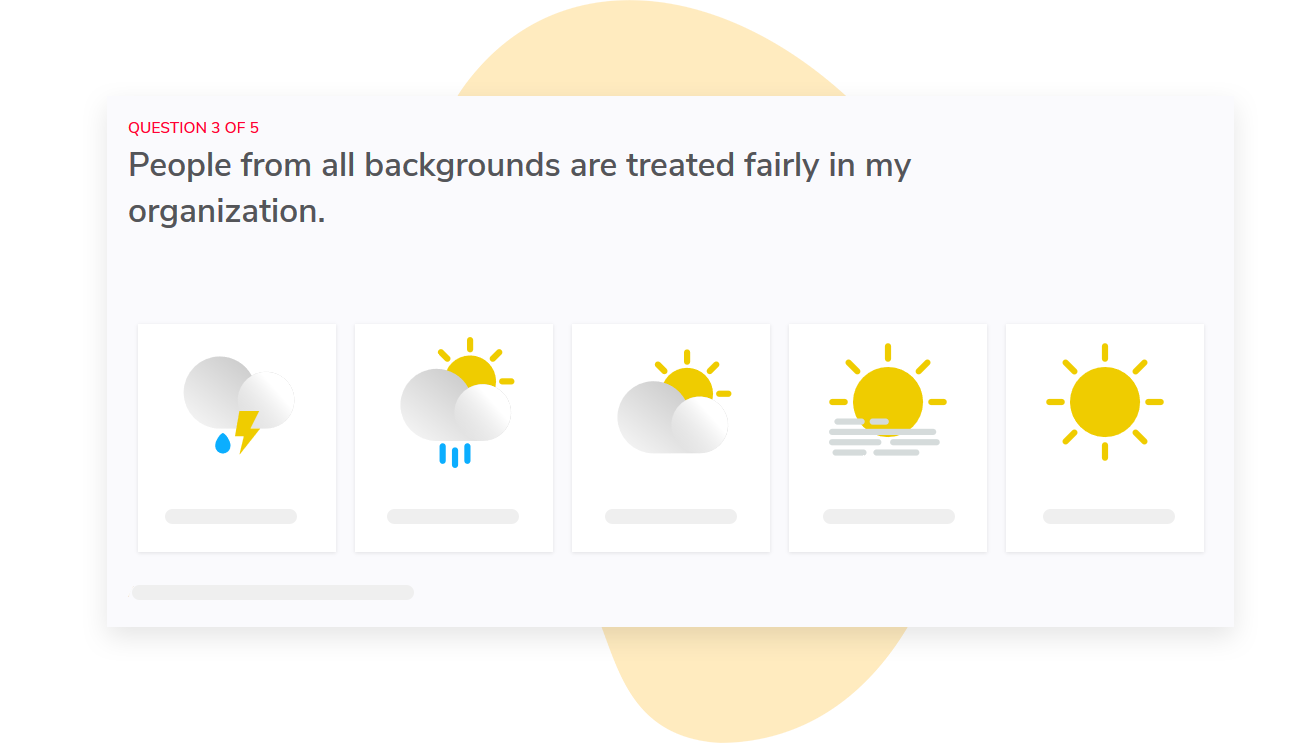
You can then compare results across teams, as well as track progress over time for each team.
This makes it easier to notice when a team’s questions about delivery confidence remain stable, but their engagement levels begin to decrease over several rounds, indicating they may be transitioning from a thriving team to a pressured team.
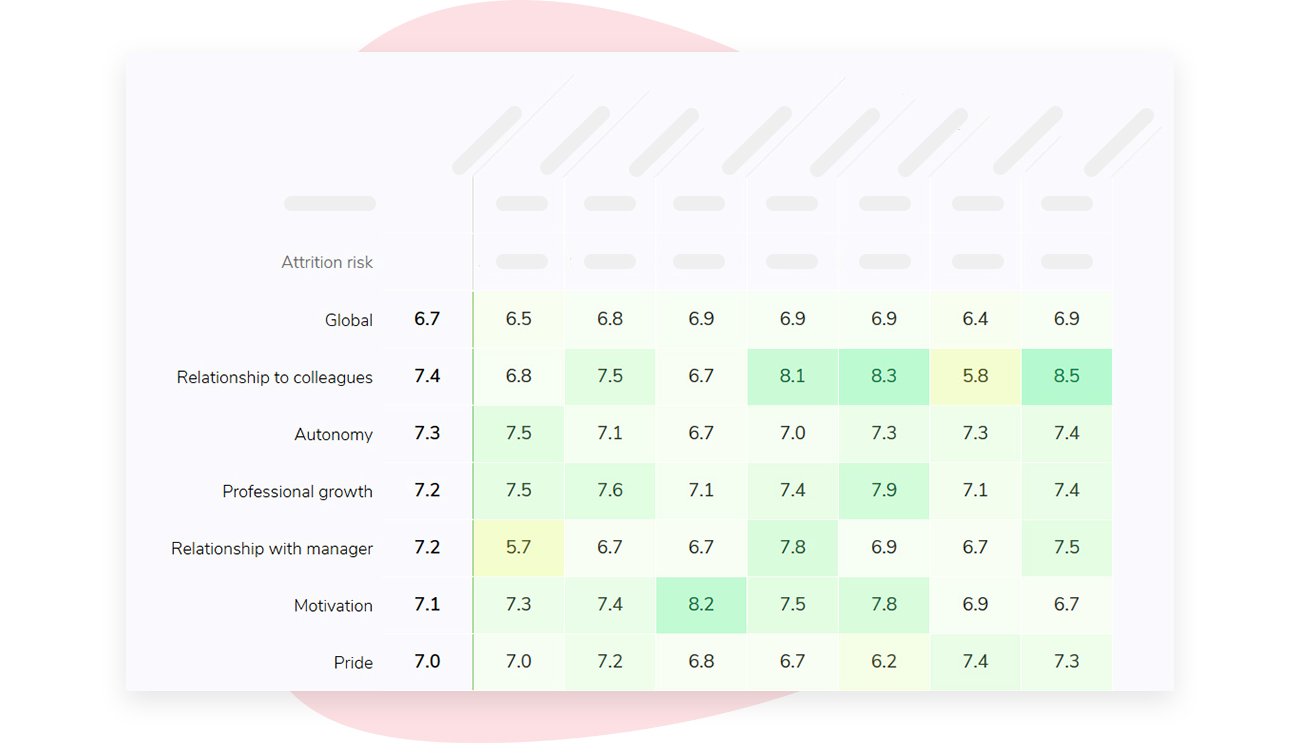
Sparkbay automatically assigns reports based on your organization’s hierarchy, so managers only see results for their teams.
To protect confidentiality, a team’s results will not be visible until a minimum number of responses have been submitted. The default number is 5, but you can change this number.
If you’re interested in learning how Sparkbay can help you build a more engaged workforce, you can click here for a demo.
Are your survey results aligned with your output metrics?
Compare survey results to delivery metrics, retention metrics, and customer outcome metrics.
While this is necessary, there are a couple of things to keep in mind:
- Delivery metrics, retention metrics, and customer outcome metrics are impacted by prior conditions. So while it is important to think about these metrics, consider your current survey results against future delivery metrics. For example, compare delivery metrics from the next quarter with the current quarter’s survey results.
- Your survey teams and metric owner teams may not align organizationally. Before drawing conclusions from your comparisons, understand your organizational structure. Due to changes in organizational structures, your survey results from one team may be compared to the output metrics of another team.
Your survey results may not align with your output metrics. There are several possible scenarios. For example, you could have:
- Positive survey results and negative output results: Your survey teams report high levels of engagement and confidence, but the team is regularly missing its targets or customer outcome metrics are poor. First, consider whether the team was involved in setting the targets. Were they given a chance to provide input? Is there an external factor not within the team’s control impacting these metrics? If not, then perhaps there’s a "nice" team environment with no accountability when employees don’t meet clear standards.
- Negative survey results and positive output results: Your teams are hitting every target, but negative survey results show a lack of engagement, autonomy, or desire to remain at the company. Investigate overtime, absenteeism, and attrition rates. This may be a team under pressure and deliverying - for now. But this team’s negative survey results may soon impact their output metrics.
Each of these scenarios creates a different opportunity for discussion:
If your survey results are good but your output results are not as good, you’ll want to have a conversation about what success looks like and who defines success.
How do you close the loop in a way that makes a difference?
As soon as the executive summary is complete, distribute team-level results to managers.
You don’t have to wait for the organization-wide release.
Every week that goes by, the feedback feels less relevant to the people who gave it.
Ask managers to share results with their teams and to select one or two drivers they’d like to work on.
Once you have these focus areas, help teams understand who has the power to make changes in that area.
Is it within the team’s power? The manager’s power? Someone higher up?
Or the organization as a whole?
A quick way to lose faith in surveys is selecting an item you can’t control to work on (e.g., headcount, cross-functional priorities) and then never hearing that it was escalated.
If items are escalated, track them separately and report back. And if the response is no, explain why to teams.
Above all, don’t create more work for already overstretched teams.
If a team is juggling a lot, asking them to create an action plan is the fastest way to prove no one read their answers. Instead, have the manager or HR create the action plan and simply share it with the team for their reaction.
Once you’ve given teams time to absorb the actions, re-ask the focus items in a pulse survey rather than waiting until the next full survey.
This shows you whether there’s been any movement.
How quickly should you expect to see change?
If you’re acting on items within the team’s power to change (e.g., how they set priorities), then clarity items could change within a quarter. Items relating to autonomy and growth may take longer - and you may need to wait through at least two pulses before concluding an action had no effect.
If an issue is that priorities change without notice, then a short, regular check-in on what’s in flight and what can be paused is likely to be more impactful than a company-wide communication campaign.
Gallup’s long-standing workplace research has consistently found that only a minority of employees strongly agree that their opinions count at work.
Don’t forget: Asking employees for their opinions is not enough to make them feel like their voice matters.
The best way to demonstrate that voice matters is to take visible action. And to measure that impact directly with an item like I’ve seen action taken on the results of our last survey.
If you notice this score stays flat, after a round of action, expect participation to drop within the next one or two rounds.
Want to increase participation in your next survey? Make sure you: - Tell people what changed based on their feedback - Tell people what didn’t change and why (even if it’s as simple as ‘not yet’) - Re-ask the same questions to see if there’s been a change
If you’re interested in learning how Sparkbay can help you build a more engaged workforce, you can click here for a demo.