
Your product team gathers on Tuesday morning to review a delayed software release. One engineer spotted a serious flaw three weeks ago, but she kept quiet after watching a manager dismiss a colleague’s earlier warning.
Now the company has to pause the launch, repair the code, and explain the delay to 12 major customers. The engineer had the answer.
The team just couldn’t hear it.
She’d made a rational calculation. The cost of raising the flaw felt higher to her than the cost of the delay, because the delay would fall on everyone while the embarrassment would fall on her alone.
Multiply that asymmetry across thousands of small decisions and you have the real price of silence.
Harvard Business School professor Amy Edmondson named this problem after studying clinical teams and stumbling on a strange result: better-led teams reported more errors, not fewer. They weren’t sloppier. They were simply more willing to put mistakes on the table.
Her work defined psychological safety as a shared belief that people can take interpersonal risks without fear of humiliation or punishment. It has nothing to do with avoiding conflict, softening standards, or shielding weak performers.
This guide walks through Edmondson’s framework, the four zones that safety and accountability produce together, and the part that will matter most to you-how to measure it in a way that holds up in front of a skeptical executive team instead of collapsing into another feel-good number.
Amy Edmondson’s psychological safety framework, the 7-item measurement scale, and how to build safer teams
- The silent killer of great ideas: why psychological safety matters
- Meet the mind behind the movement: amy edmondson’s accidental discovery
- What psychological safety really is, and what it is not
- The four pillars: edmondson’s framework explained
- The learning zone: where safety meets high standards
- The business case: why performance depends on speaking up
- Taking the temperature: how to measure psychological safety
- Reading the warning signs: symptoms of a low-safety culture
- From insight to action: building psychological safety on your team
The silent killer of great ideas: why psychological safety matters
Silence opens a gap between what employees know and what leaders hear. The dangerous part isn’t the gap.
It’s that leaders mistake the absence of objection for agreement, then act with more confidence than the evidence deserves.
The norms that produce silence set faster than most managers assume. One visible punishment-an interruption, a concern brushed aside, a public correction-tells everyone in the room what the real rules are.
A single moment like that outweighs months of "my door is always open."
People also silo their silence by subject. The same person who happily argues about architecture will clam up about workload, about a powerful stakeholder, or about an ethical grey area.
That’s how a team can look candid while hiding the exact risks that matter most.
Safety counts for most where the work is uncertain, tightly interdependent, and full of specialized knowledge-the conditions where no leader can personally spot the flaw, the hazard, or the customer signal before it’s too late.
Think of it as part of the organization’s operating system rather than a stand-in for employee happiness. It governs how information moves, how managers take bad news, and whether errors get caught before they compound.
Meet the mind behind the movement: amy edmondson’s accidental discovery
Edmondson’s early clinical-team research appeared to show that better teams made more medication errors. Rather than accept that, she dug into the reporting behavior behind the data and flipped the reading: strong teams caught and disclosed more, while weaker teams looked cleaner on paper because their problems stayed buried.
The practical lesson for HR is uncomfortable. Most of your "safety" signals are contaminated by the very thing you’re trying to measure.
Incident reports, whistleblower calls, quality complaints, flagged project risks-all of them rise and fall partly with willingness to report, not just with what’s actually happening.
So a jump in reported issues is genuinely ambiguous. Maybe the work is getting worse. Maybe people finally trust the channel. Read speak-up volume only alongside operational outcomes and what happens after a report gets filed. On its own, a count tells you next to nothing about culture.
Her deeper move was shifting the question away from individual courage and toward the conditions that make courage unnecessary. Don’t ask why someone failed to speak.
Ask what the team taught them to expect.
What psychological safety really is, and what it is not
The word that carries Edmondson’s definition is shared. Psychological safety belongs to a team’s climate; it isn’t a trait an individual carries from job to job. The same employee can be outspoken on one team and guarded on the next, which is why hiring for "courage" fixes very little.
It is not the absence of conflict. High-safety teams often argue harder, because people trust that disagreement won’t get them frozen out or punished. A conflict-free team is usually a suppressed one.
It isn’t the absence of accountability, and it isn’t job security. A leader can hold firm standards, discipline repeated negligence, even cut roles, and still welcome questions and refuse to punish honest warnings.
Confusing safety with comfort or tenure is the fastest way to lose executive buy-in for the whole idea.
It’s also not the same as trust, though the two get blurred constantly. Trust is your judgment about one person over time.
Psychological safety is your read on how the group will react in the moment you take a risk. That’s why you can trust a colleague in private and still stay silent in the meeting.
Because safety is topic-specific and team-specific, organization-wide averages bury the pattern you actually need. You want team-level evidence, plus enough qualitative texture to see which subjects trigger silence and where.
The four pillars: edmondson’s framework explained
Edmondson never published four named pillars. This is a working grouping of the themes in her scale-use it as a diagnostic lens, not something to quote back to her.
Attitudes toward risk and failure
People calibrate to what happened after the last mistake. The real discipline is telling intelligent failure apart from avoidable negligence-a sound decision made on incomplete information with the agreed safeguards followed, versus carelessness-and being seen to draw that line the same way every time.
Teams that blame both identically get neither learning nor control.
Open conversation
What matters is how the leader reacts to unwelcome news in real time, with other people watching. One hostile response wipes out a quarter of stated openness.
Watch the meeting, not the charter.
Willingness to ask for and offer help
When asking for help reads as weakness, capable people pour effort into protecting their image instead of solving the problem. The counter is treating a request for help as an early control.
Managers who ask "what support do you need?" before the delay is visible reset the norm.
Inclusion and respect for difference
Formal inclusion programs accomplish little if the mechanics of a meeting still reward one communication style. Audit the observable pattern instead: who speaks first, whose ideas get quietly re-attributed, who gets cut off, and whose objections face a higher burden of proof.
That data beats any values statement.
The learning zone: where safety meets high standards
Edmondson’s two-by-two crosses psychological safety with performance standards. Its value to HR is diagnostic-it pulls apart two very different problems that a single engagement number would smear together.
| Zone | Psychological safety | Performance standards | Likely team behavior |
|---|---|---|---|
| Apathy zone | Low | Low | Employees disengage, avoid responsibility, and contribute only what the role requires. |
| Comfort zone | High | Low | Relationships may feel pleasant, but the team tolerates weak execution and avoids demanding feedback. |
| Anxiety zone | Low | High | Employees protect themselves, conceal mistakes, and hesitate to test uncertain ideas. |
| Learning zone | High | High | Employees ask for help, challenge weak plans, test ideas, and take responsibility for results. |
The two failure modes need opposite fixes. A comfort-zone team-warm relationships, soft delivery-needs sharper standards and harder feedback, not another offsite.
An anxiety-zone team of high performers who hide their mistakes needs leaders to change how they respond to bad news, not new goals. Prescribe the wrong one and you make it worse, which is exactly why the diagnosis matters more than the label.
Watch for a common sequencing error. Leaders who crank up standards and safety at once usually get neither.
Push standards while people still fear what honesty costs them and you manufacture the anxiety zone. Prove that bad news is survivable first.
Then raise the bar.
The business case: why performance depends on speaking up
Psychological safety decides whether an organization can actually use the knowledge it’s already paying for. It’s a utilization problem.
Skilled hires generate nothing when the norms keep what they know off the table.
Google’s Project Aristotle looked at 180 teams and ranked psychological safety first among five dynamics of effective teams, alongside dependability, structure and clarity, meaning, and impact. The part leaders skip: it was necessary but not sufficient.
Safety without dependable execution and clear roles just gives you a pleasant, unproductive team.
Be disciplined about the causal chain when you brief executives. Don’t claim safety "drives profit." Claim the behaviors that sit between the two-earlier escalation, faster correction, disconfirming evidence surfacing before launch, sharper implementation feedback during change programs from the people closest to the work.
The retention link is specific as well. People rarely quit over one incident.
They leave after a run of watching concerns ignored, credit reassigned, or honest dissent punished. That makes it a slow drain, hard to trace, rather than a visible spike.
There’s a defensible way to size the cost without inventing figures: take a recent expensive failure, trace it backwards, and ask who knew, when, and why it never traveled. One well-documented "someone knew and didn’t say" story moves a skeptical board further than any benchmark, because it makes the invisible tax concrete in your own operation.
Taking the temperature: how to measure psychological safety
Before you launch anything, answer one question: what will you do differently at each possible result? If you can’t act on a low score-because the cause is untouchable, or the appetite for change isn’t there-measuring first can do harm.
Asking and then ignoring is itself a punishment, and it lowers safety.
Edmondson’s seven-item team scale is the defensible instrument. Adapt the wording to your context if you must, but keep the meaning of each item intact and validate any translation.
Several items are the whole point of the measure.
- If someone makes a mistake on this team, the team often holds it against them.
- Members of this team can raise problems and difficult issues.
- People on this team sometimes reject others for being different.
- It is safe to take a risk on this team.
- It is difficult to ask other members of this team for help.
- No one on this team would deliberately undermine another member’s efforts.
- Working with this team, people value and use my skills and talents.
Items one, three, and five are reverse-scored. Test adapted or translated versions carefully-negatively worded items are where careless responding and translation drift quietly corrupt your data.
Hold the core items constant from cycle to cycle. Rewrite the questions and you lose the ability to tell real movement from a measurement artifact, and trend is the only thing that makes this data actionable.
Measure at the team level whenever response counts allow it. An enterprise average routinely nets a genuinely fearful function against a genuinely open one and lands on a forgettable middle number-hiding the exact sites that need intervention.
Don’t lead with the mean. A team can average "fine" while a sizable minority reports that mistakes get punished, and that tail is often your early-warning population.
Watch the distribution, and watch how large the disagreeing group is.
Weight scores by participation. A high number from a small, self-selected group isn’t comparable to one built on broad response, and treating them as equal will point your support in the wrong direction.
Pair the survey with behavioral evidence: how often risks get raised before deadlines slip, how leaders react to failed work, who actually talks in meetings, whether help gets requested early. The survey gives you the belief.
The behavior gives you the truth.
And mind the paradox baked into the numbers. The first honest measurement in a fearful team can score lower, because awareness rises and people finally admit the problem. Warn leaders about this ahead of time, or an early dip gets read as failure and used to kill the work.
When you run follow-up sessions, never make employees defend low scores in front of the implicated manager. That one move confirms every fear the score was measuring.
Ask about situations and routines, not about who complained.
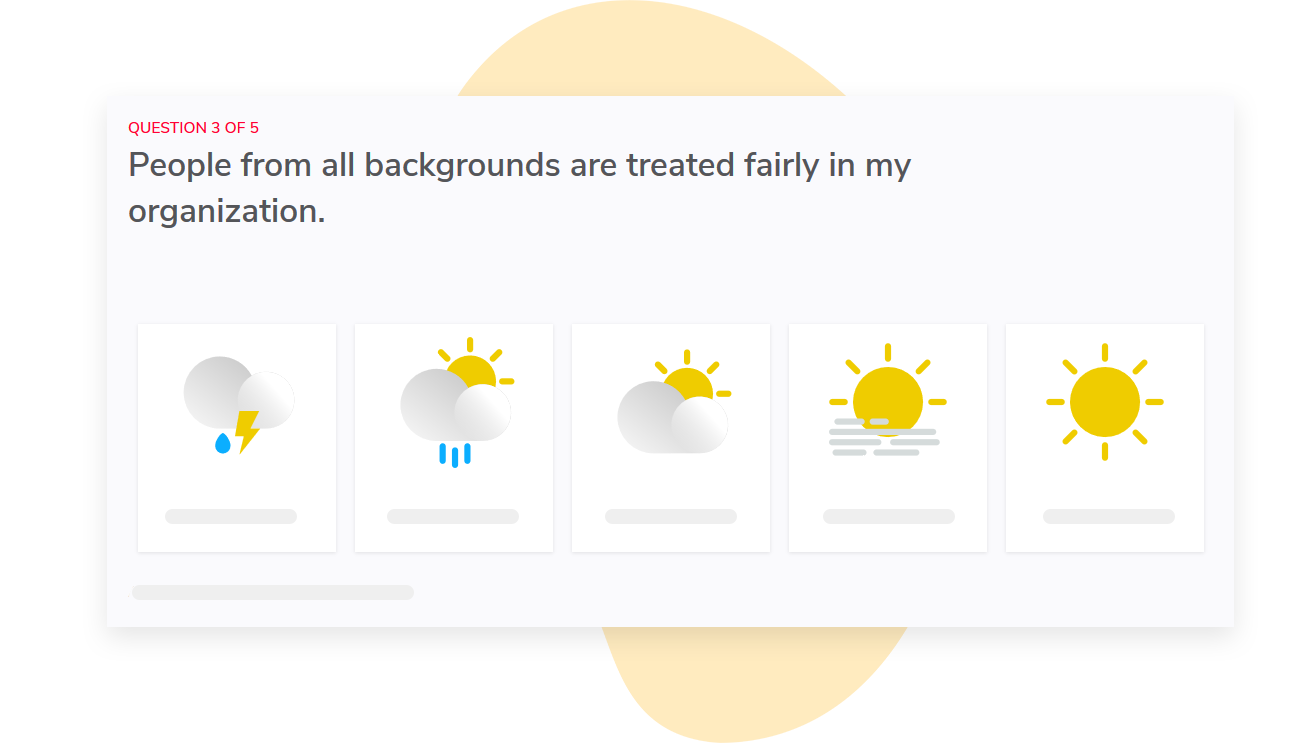
Sparkbay collects feedback at regular intervals, and many clients run monthly pulses. That cadence lets you catch the fast shifts in safety that follow a reorg or a leadership change, instead of discovering them in an annual survey a quarter too late.
You can embed focused psychological safety items and track them as their own trend.
Results report against a clear engagement score out of 10, so you can read the safety items in the context of overall engagement. eNPS is available as a secondary signal rather than the headline number.
You can segment by manager, department, tenure, and other attributes to find the pattern behind an average-so you can tell whether a problem sits with one leader or runs more widely across the organization.
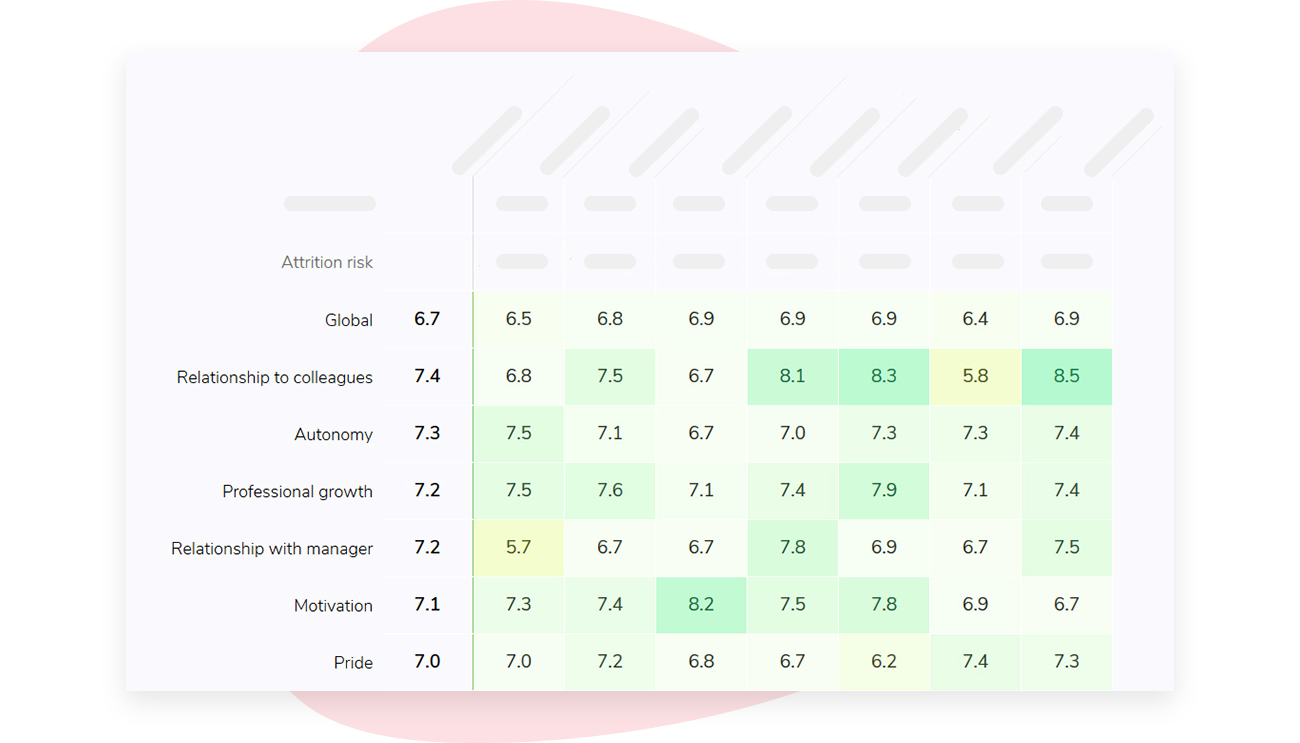
The platform is highly configurable, from the wording of surveys and dashboards to the content shown on each dashboard, so you can match your workforce’s language while keeping a stable question core for trend integrity. It is ISO 27001 certified.
For large enterprises, report access maps automatically to the org hierarchy: each manager sees only their own teams, and results stay hidden below a configurable minimum number of responses-five by default. That threshold is what makes managers trust that no one can reverse-engineer who said what, and that trust is the precondition for honest safety data.
Once managers have their results, Sparkbay offers a library of concrete actions-on meeting participation, responses to mistakes, help-seeking, or structured challenge-so the loop closes at the level of manager behavior and you can check the effect in the next pulse rather than assuming it.
If you’re interested in learning how Sparkbay can help you build a more engaged workforce, you can click here for a demo.
Reading the warning signs: symptoms of a low-safety culture
Low safety rarely announces itself. It shows up as a steady pattern of who speaks, what never makes the agenda, and how leaders take bad news.
So read the following as symptoms to correlate, not proof on their own.
- Artificial consensus: decisions look unanimous in the room, then unravel in the corridor and the one-to-ones afterward.
- Late escalation: risks surface only once the deadline is already gone, the customer has already complained, or the cost is already sunk.
- Blame-shaped post-mortems: reviews hunt for the responsible person instead of interrogating assumptions, handoffs, and controls.
- Information hoarding: people guard expertise because it buys status or cover, not because sharing is hard.
- Low help-seeking: employees work around problems alone and only admit they need support once recovery is expensive.
- Safe-only comments: open-text feedback praises company-wide values but never names anything concrete about local leadership-a tell that people doubt the anonymity.
Watch the gap between formal channels and real behavior. A company can run an ethics line, a suggestion box, and a survey while employees still believe using any of them marks their card.
The infrastructure existing proves nothing about whether it’s trusted.
Manager-level variance is usually your sharpest signal. When people in comparable roles report very different safety, the difference is almost always local leadership behavior, not enterprise policy-and that’s where to aim your support.
Resist the jump to intent. Workload, an active restructuring, role ambiguity, a recent bad event-any of these can depress scores with no deliberate intimidation behind them.
Establish the pattern before you assign the cause.
From insight to action: building psychological safety on your team
Frame the work as a learning problem
Leaders should name what’s uncertain out loud rather than perform certainty. "The customer need is clear, but we haven’t tested whether this scales"-that framing invites disconfirming evidence without lowering the bar, and it signals that finding the weaknesses is the job, not a betrayal of the plan.
Model bounded vulnerability
Admitting a mistake only works when it’s tied to a corrective action. Otherwise it becomes theater that hands the job of reassurance back to the team. "I approved that deadline without testing the dependency-I’ll rework those assumptions with the tech lead before we commit again" is useful.
A generic "I’m not perfect either" is not.
Engineer dissent instead of inviting it
"Does everyone agree?" manufactures silence. Ask "Which assumption here is weakest?" or "What would make this fail?"-and have the most junior people answer before executives state a view, so you strip out anchoring and rank pressure.
Structure the sequence. Don’t lean on people being brave.
Respond well in the first thirty seconds
Your first reaction to bad news teaches the room more than any policy. Thank the person, ask factual questions, name the immediate risk, state the next step.
Handle accountability later, once you understand what happened. Visible anger or instant blame just delays the next warning until it’s too late to act on.
Separate learning reviews from disciplinary processes
Keep the review on conditions, assumptions, handoffs, and controls. If real misconduct or repeated disregard for standards surfaces, route it through a separate fair process.
Fuse the two and every review turns into an investigation, and people hand you less to work with each time.
Make managers accountable for follow-through
Require one or two actions tied to results, with named owners and a review date-not a long list of vague intentions, which just reads as evasion. And have managers say plainly what will change and what won’t. Honest limits build more credibility than an unfundable promise to fix everything.
Know the limits of what a manager can do
A single manager can’t fully shield a team from an intimidating layer above them, or from a culture that punishes bad news at the top. Where the ceiling on safety is set higher up, say so honestly and escalate it.
Pretending a team-level fix will solve a structural problem quietly rebuilds the same cynicism you set out to cure.
The ongoing journey: sustaining safety in a changing workplace
Safety is volatile. A leadership change, a restructuring, a missed target, one public blow-up-any of them can reset a team’s norms within weeks.
A team that was candid under one manager can go quiet under the next, which is why point-in-time reassurance is worthless without cadence.
Hybrid work strips out the informal rehearsal space where people used to test a half-formed concern before committing to it in a formal meeting. Make up for it deliberately: written decision logs, clear escalation paths, private routes for sensitive feedback, and a rule that remote participants weigh in before the room converges.
Diverse teams need particular care, because the same invitation to challenge gets read against different histories of status, authority, and belonging-genuinely safe to one person, plainly risky to another. A single norm applied uniformly won’t land uniformly.
The real indicator of progress isn’t a rising survey score. It’s behavioral.
Difficult facts get raised earlier, mistakes get examined instead of buried, and important decisions get challenged by the people who still own the outcome.
If you’re interested in learning how Sparkbay can help you build a more engaged workforce, you can click here for a demo.