
How do you run an annual employee engagement survey that people will actually want to answer and that your organization will act on?
As an HR leader, you’ve probably seen what happens when the survey closes and the charts roll in.
Employees have shared their thoughts on what’s working and what isn’t, but now they’re waiting to see if anyone acts.
Sure, an annual survey can gather a lot of useful information about morale, but if those results just sit in a dashboard until next year’s survey, people will notice.
They may decide to put in less effort or stop answering questions altogether.
On this page
- Why most engagement surveys fail
- What’s the real ROI of an annual employee engagement survey?
- Before you ask, set crystal-clear objectives
- Crafting questions that get honest answers
- When, and how, do you get the best participation in employee surveys?
- How do you turn your data dump into aha moments?
- Turning insights into action plans that stick
- Keeping the momentum with pulse checks and continuous listening
Why most engagement surveys fail
Annual engagement surveys don’t fail because employees have nothing useful to say.
They fail because organizations treat the survey event itself as the work. In reality, the hard work starts only once the survey results come in.
Employees quickly learn the cycle: Leadership announces the survey, HR sends out reminders, dashboards are reviewed, a few themes are acknowledged, and then everyone’s attention goes back to their day-to-day priorities.
This creates survey cynicism which is even more dangerous than survey fatigue.
Survey fatigue is when employees are tired of being asked for their input.
Survey cynicism is when employees believe that the input being collected isn’t seriously going to be acted on.
Once cynicism sets in, response rates drop, written comments become more guarded or hostile, and middle managers have to defend a survey process that perhaps wasn’t designed for them to have an influence in the first place.
An annual employee engagement survey certainly still has value, but it must be designed as part of a larger operating rhythm.
The best organizations don’t ask, "How do we run the survey?"
They ask, "What decisions will this survey help us make and what actions are we prepared to take?"
What’s the real ROI of an annual employee engagement survey?
At enterprise scale, engagement surveys are a way to identify friction in the employee experience before that friction shows up as turnover, absenteeism, poor customer experience, weak execution, or leadership credibility issues.
For example, Gallup’s large-scale meta-analyses have reported that business units in the top quartile of engagement outperform bottom-quartile units on outcomes such as profitability, productivity, customer loyalty, turnover, absenteeism, and safety incidents.
Of course, the survey itself doesn’t generate these outcomes.
Instead, it gives leaders a structured way to see which conditions are supporting or constraining performance.
And it helps HR leaders turn their engagement data into better workforce decisions.
- Retention: Identify the groups most at risk before you only notice it in lagging metrics
- Manager effectiveness: Identify areas where manager capability, communication, recognition, or trust is impacting team outcomes
- Change management: Understand whether your employees have clarity, confidence, and capacity during transformations
- Productivity: Identify productivity roadblocks such as poor prioritization, weak cross-functional collaboration, or low psychological safety
- Leadership credibility: Assess whether your senior leaders are trusted to make the right decisions and communicate honestly
Before you ask, set crystal-clear objectives
During the planning phase, you should be able to clearly answer what you want to learn as an organization, why it’s important to know this now, and how your leaders will use the information gathered.
Why does this matter? Because setting vague objectives leads to vague analysis.
For instance, if your objective is simply to "measure engagement," then you’ll likely end up with survey results that lead to vague themes like communication, recognition, and career growth.
Instead, set objectives that relate back to your current business context.
For instance, if your company is in the process of integrating acquisitions, you may want to learn more about employee trust in leadership, cultural alignment, and perceived fairness across the different legacy employee groups.
If your company has experienced regrettable turnover of high performing employees, you may want to dig deeper on questions related to growth opportunities for employees, quality of managers, workload, and confidence in the company’s future direction.
Before initiating your survey, it’s important to align with senior leaders. Together, you should answer:
- What business decisions could this survey impact?
- Are there specific employee groups or experiences you want to get deeper visibility on?
- How much transparency and action are our leaders willing to commit to?
This is also an opportunity to make sure you have specific buy-in from your leaders.
It’s great to have a general sign off from your executive team, but it’s important to also get an agreement on the communication plan, decision rights, timelines, ownership model, and what kind of support managers will receive after the results are published.
Crafting questions that get honest answers
Experienced HR teams understand that a good employee engagement survey uses both scaled items and open-text questions. Nevertheless, it’s worth emphasizing that quality is more important than quantity for both types of questions.
Scaled questions are useful because they help you conduct team comparisons, trend analyses, and driver analyses.
Most organizations opt for a five-point or seven-point agreement scale, although some survey platforms help you convert the results into a clearer score, so you can interpret results more easily.
On the other hand, open-text questions help you gather the nuance you need, especially when employees want to explain why they chose a specific rating.
Generally, the best employee engagement surveys focus on measuring a specific set of dimensions.
| Dimension | What it helps reveal | Example survey item |
|---|---|---|
| Purpose and alignment | Do employees understand how their work connects to the organization’s goals? | I understand how my work contributes to the company’s success. |
| Manager effectiveness | Are managers creating clarity, supporting employee performance, and building trust with employees? | My manager gives me the guidance I need to do my job well. |
| Growth and development | Do employees see a future for themselves within the organization? | I have opportunities to learn and grow here. |
| Recognition | Are employees being noticed and positively reinforced? | I receive meaningful recognition for good work. |
| Belonging and inclusion | Do employees feel respected, heard, and like they have a space to contribute? | People from all backgrounds can succeed in this organization. |
| Workload and sustainability | Are employees and managers setting realistic performance expectations over time? | My workload is manageable over the long term. |
| Confidence in leadership | Do employees view senior leaders as credible and effective? | I have confidence in the decisions made by senior leadership. |
When you write questions, avoid combining two ideas in one question.
For example, "My manager communicates clearly and supports my career growth" is double-barreled because an employee may agree with one part and disagree with the other.
You should also avoid using leading language like "Our leadership team communicates effectively during change."
A better option would be: "I receive the information I need to understand major organizational changes."
You can gather high-quality data with about 30 to 50 scaled questions and a few open-text prompts for an annual employee engagement survey.
Any longer and the survey risks being rushed or abandoned, especially for longer open-text feedback towards the end of the survey.
When, and how, do you get the best participation in employee surveys?
HR teams often focus on one thing when trying to boost participation in employee surveys: reminders.
But reminders only work if your employees believe that the survey is worth doing in the first place.
Avoid sending your survey at a time when your employees will be focused on major deadlines, performance reviews, compensation cycles, holidays, or restructures (unless you want the impact of these events to be included in your measurement).
There’s no universally perfect month to send an employee survey, but it helps to be consistent so you can compare year-over-year results.
If you’re a global organization, you also need to consider local calendars and shift patterns as well as language accessibility.
All of this should be mapped out ahead of time.
You’ll also want to keep your survey open for as long as it needs to be. Two weeks is a common time frame, but if you have a deskless or distributed workforce, you may need to keep the survey open for longer.
You’ll also want to ensure it’s easy for employees to access the survey on mobile devices, that the survey is available in relevant languages, and that you have communications to and from senior leaders as well as local managers.
The most effective survey participation campaigns make it clear:
- Why the organization is asking: Tie the survey to current priorities and decisions.
- How confidentiality works: Explain reporting thresholds, anonymity protections, and who will see what.
- What will happen after the survey: Include the results communication timeline and action planning timeline.
If there’s a sense that people can see how responses are tied back to employees, you’ll skew your data towards positivity, neutrality, or people opting not to say anything.
This is especially true if teams are small, you have a high control culture, or there’s been a breach of trust within your organization in the past.
To avoid this, you’ll want to communicate confidentiality in a way that explains the operations of the survey rather than just giving vague reassurances.
For example, you can share that the organization will only show results for groups that meet a minimum response threshold, that open-text comments won’t be reported on in a way that identifies individuals, or that managers will only see aggregated results rather than individual responses.
Speaking of managers, ensure that they are encouraging employees to participate in the survey and that they reinforce that honest feedback is welcome. This is also a time for managers to avoid asking their employees what they said in the survey.
In addition, managers should be briefed before the survey is launched. They’ll want to be able to answer basic questions about the survey while avoiding sounding defensive or uninformed.
How do you turn your data dump into aha moments?
When you’re working with a large data dump from an extensive engagement survey, it’s easy to fall into the trap of reacting to what’s most prominent or loud instead of what’s most consequential.
This is why it’s important to tell the story at the enterprise level first:
What’s our overall level of engagement? What was our overall response rate? What were the top items? What were the lowest-scoring items? Were there any significant shifts compared to previous surveys?
Once you’ve identified this, you can move deeper to understand whether there are particular segments where the experience differs.
Does the experience, based on the survey, differ by department, function, region, type of manager, tenure, level within the company, type of role, demographics?
For example, you may find that while your overall engagement score is healthy, employees within the one to two year tenure bracket feel their career clarity is low and express a higher intent to leave.
Once you realize this, you can start focusing your efforts. Not all low scores are "urgent action" items. You can conduct driver analysis to understand which survey items have the strongest relationship with engagement, intent to stay, advocacy or discretionary effort.
This prevents you from prioritizing simply "loud annoyances" that are front of mind while missing more impactful levers for improving performance.
When you’re analyzing open-text comments, it’s important to be guided by - not driven by - your quantitative data.
While your comments often lead you to the "why" behind your engagement score, it’s also important to recognize that comments may overrepresent employees who are very emotional.
Look for recurring themes, the specificity of the comments and their alignment with the scaled result.
It’s also useful to identify the nature of each issue to understand its source:
- Are they systemic issues that fall under organizational design, policies, resourcing or decisions at the senior leadership level?
- Are they local issues concentrated within a specific team, location or manager group?
- Are they communication issues related to expectation setting, inconsistent messaging or lack of context?
- Are they capability issues that require upskilling of managers, leadership development or process reengineering?
Turning insights into action plans that stick
So you’ve got your insights, and you’re ready to turn them into actions.
A problem? You’ve got ten themes turned into a dozen and a half workstreams, but nothing’s really moving because ownership is ambiguous and the plans are too ambitious to be executed on top of day-to-day work.
The better approach is to ruthlessly prioritize.
At the enterprise level, HR and senior leaders should select a handful of priorities based on factors like strategic importance, impact on the employee experience, feasibility, and relation to key business outcomes like retention or performance.
At the team level, managers and teams should also focus on one or two themes, or topics, that they can genuinely affect.
What about those big issues that don’t sit with managers?
If your employees say they’re frustrated with the compensation philosophy, the lack of promotion architecture, or chronic understaffing, asking managers to "take ownership" of these issues sets them up for credibility issues.
Instead, manager-level action can focus on what is within their purview: improving feedback quality, improving recognition habits, improving role clarity, improving meeting effectiveness, or enhancing communication at their location.
When you’re creating an action plan, it’s helpful to have all of the information in one place:
| Action plan element | Weak version | Stronger version |
|---|---|---|
| Issue | We need to improve communication | Employees in customer operations don’t understand how quarterly priorities are set |
| Action | We need to communicate more often | We need to hold a monthly 30-minute priorities briefing and publish a written summary within 24 hours of the meeting |
| Owner | Leadership team | VP of customer operations with support from HR business partner |
| Measure | Better feedback next year | Pulse survey item on clarity of priorities improves by at least one point within three months |
Above all, it’s important to incorporate employees into the action process, especially at the team level.
What if you’re a manager?
Your job isn’t to return to your team after receiving your results and presenting a fully-formed action plan. Your job is to have a conversation, to validate what the data means, to ask, "What do you think we could do that would make the biggest difference?" and to come to an agreement about what’s possible to move forward with.
This creates shared ownership while still keeping accountability at the leader level.
Finally, the best action plans showcase progress in the flow of work.
If your team commits to doing better when it comes to recognizing each other, employees should start seeing that commitment come to life in how they talk about wins, how managers share feedback, and how leaders shout out contribution.
Regular progress check-ins are also valuable.
Senior leaders can check in on their enterprise-level priorities during operating reviews, HR business partners can follow up with managers, and employees can receive update communications on what’s happened.
Keeping the momentum with pulse checks and continuous listening
Annual employee engagement surveys are not meant to be the only time you listen to your employees.
Your organization moves too fast to wait twelve months to find out whether your actions are working.
Pulse surveys are helpful because they let you measure how you’re doing on certain priorities in between your yearly surveys.
The nice thing about pulse surveys is that they can be short, sweet, and specific. The key is to distribute them often enough to measure movement without overburdening your employees.
Many organizations distribute pulse surveys once a month or once a quarter to gauge how well employees feel their managers communicate with them, how ready they are for an upcoming change, their workload, how recognized they feel, or their level of confidence in the leadership team.
Of course, it’s important not to fall into the trap of endlessly asking new questions and never closing the loop.
You can make the most of continuous listening through pulse surveys by giving each pulse a purpose, reviewing the information quickly, and giving your employees insight into how their feedback impacts decisions.
At Sparkbay, we want to help you make the most of your annual engagement surveys.
Our platform automatically collects employee feedback at regular intervals (many of our clients use our platform to distribute monthly pulse surveys in conjunction with their annual engagement survey to gauge whether their action plans are working).
Sparkbay presents the results in intuitive reports with a clear score out of 10. This makes it easier for HR leaders, executives, and managers to understand where employee engagement is high and where they need to focus their attention.
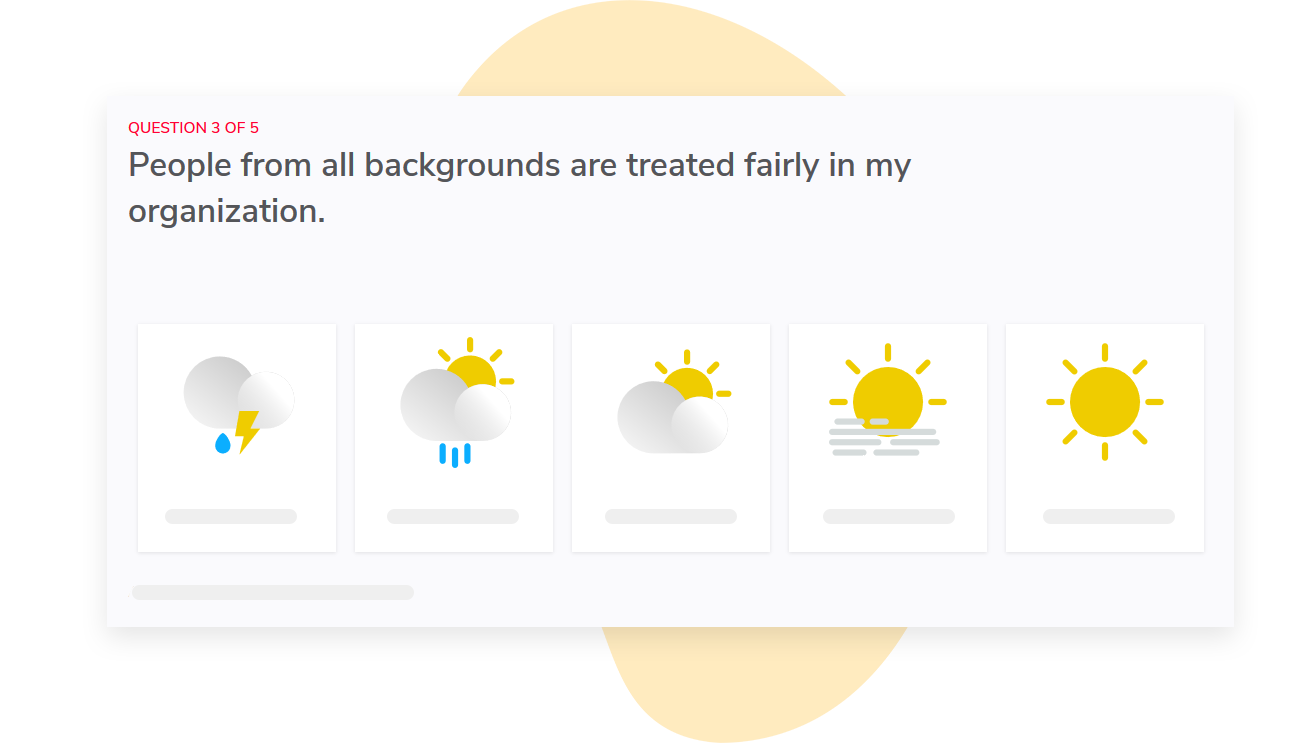
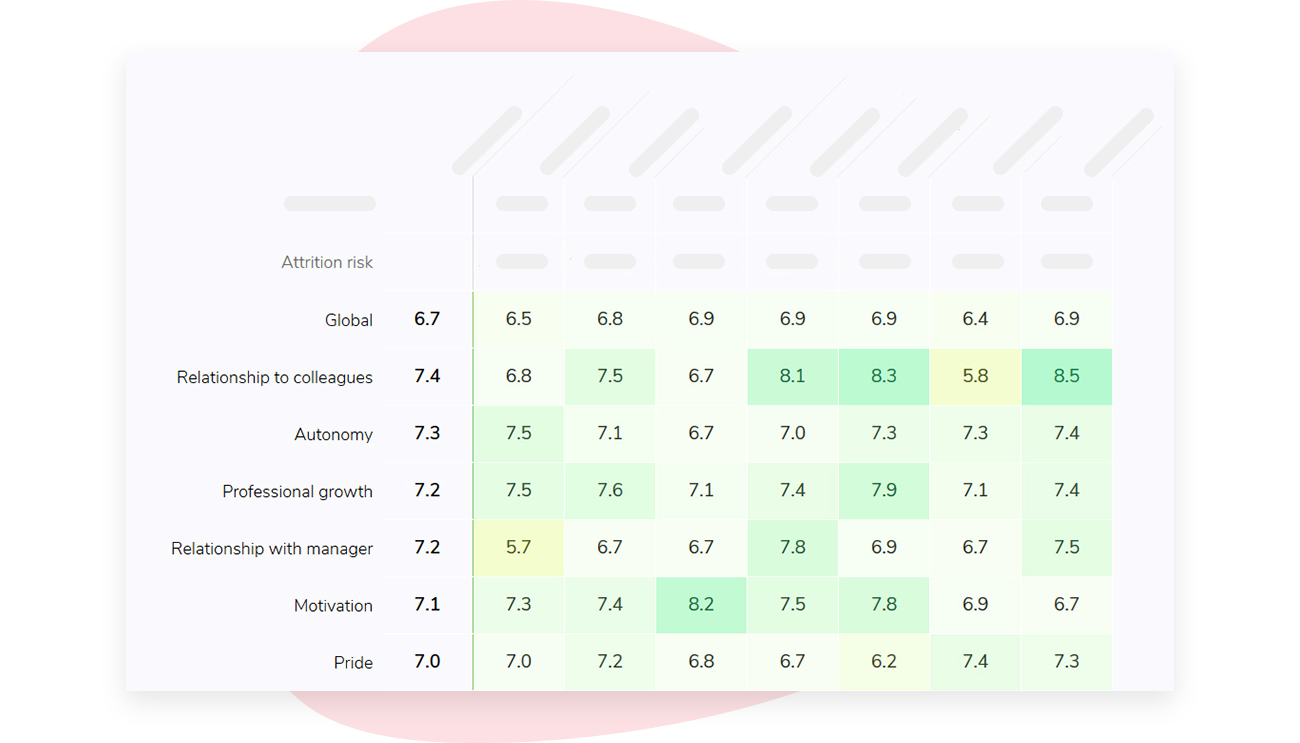
Sparkbay also gives you the power to segment your results based on manager, department, tenure and more, so you can understand where employee experiences differ within your organization.
You can also benchmark your segmented results against companies in the same industry as yours using Sparkbay’s proprietary dataset. This helps business leaders understand whether a score is an internal issue, a bigger trend in the market, or a standout strength.
Once you know what your priorities are, Sparkbay makes it easy for you to follow through. We offer a library of easy-to-implement actions that managers can use to improve employee engagement in their teams.
If you’re interested in learning how Sparkbay can help you build a more engaged workforce, you can click here for a demo.