
As W. Edwards Deming argues in Out of the Crisis, a change in a number doesn’t always mean something has changed at work.
We’ll help you understand how to compare results, determine which numbers matter, and identify trends instead of data blips.
Then, we’ll walk you through the process of creating dashboards to easily interpret your results, avoiding common mistakes, and what to do with your feedback once you’ve sorted it out.
On this page
- Introduction: why yesterday’s data is today’s goldmine
- What does "apples to apples" mean?
- Internal benchmarking: benchmarking against yourself
- External benchmarking: how do you stack up against the pack?
- Stop playing the numbers game: focus on metrics that actually matter
- "Read between the lines" to spot trends instead of blips
- Visualizing the journey: dashboards that tell a story
- From insights to action: closing the loop
- What are some common pitfalls you should avoid when interpreting data?
Introduction: why yesterday’s data is today’s goldmine
It’s Tuesday morning. Right between a budget meeting and a note from a manager worried about turnover on her team, you receive an email with survey results.
At first glance, everything seems to be okay. Employee engagement seems to be steady, participation is at a decent level, and a few scores have gone up or down by a point or two.
As an HR leader, you know that the real question is not, "What did employees say this time?"
But rather, "What’s different since the last time we asked?"
At a glance, a single snapshot of employee engagement through a single survey is only so useful. It’s meaningful to understand how people are feeling in the moment, but that moment can be influenced by everything from changes in leadership to workload spikes to the mood of the business that quarter.
A deeper story can be told when you have longitudinal data. It shows whether trust is building, whether burnout is spreading, whether managers are improving, or whether employees are slowly disconnecting before anyone says it out loud.
When you can compare and benchmark your survey results over time, you’re in a better position to make informed decisions by recognizing patterns, rather than reacting to isolated scores.
You can determine whether last year’s action plan worked, whether one department is out of sync with the rest of the organization, or if your engagement strategy isn’t keeping pace with employee expectations.
In this post, you’ll learn how to identify fair comparisons, benchmark against both your own historical data and external data, recognize meaningful trends, and turn these insights into focused action.
What does "apples to apples" mean?
When you’re conducting an engagement analysis over time, it’s important to make sure that you’re measuring the same thing in a similar way.
For example, if one year you ask your employees, "I receive useful feedback from my manager" and the next year you ask, "My manager gives me recognition and feedback", you’ve introduced a new variable. This new question combines two different constructs into one item. This makes it more difficult to assess your trend line for that question, since any movement could be attributed to changes in feedback, changes in recognition, or changes in the wording of the question.
When you’re doing an apples-to-apples comparison you want to make sure that you have:
- Question consistency - making sure that your core questions in your survey remain the same from one survey to another
- Scale consistency - ensuring that you don’t switch from a 5-point agree scale to a 7-point scale to a 10-point scale or eNPS scale without planning for a conversion
- Timing consistency - recognizing that sending a survey at a specific time (e.g., January, when employees have just received their year-end bonus) may impact how people respond to a survey, as opposed to sending a survey when employees are in the thick of a lot of work or experiencing a lot of change (e.g., restructuring)
- Population consistency - being aware that your workforce may have changed so much due to acquisitions, divestitures, or large hiring waves that it impacts your results
The best way to ensure an apples-to-apples comparison is to have a stable core survey that you can use as an anchor for your survey trend analysis. This stable core should also include the key engagement outcome measures as well as the key drivers that your organization expects to focus on for several years (e.g., manager effectiveness, enablement, belonging, recognition, workload, growth, confidence in leadership, etc.)
Of course, this doesn’t mean that you can’t evolve your surveys. Mature listening programs often have a stable core survey with a rotating module that can address emerging priorities like hybrid work, AI adoption, career pathways, or change readiness.
If you do need to switch up your survey questions, it’s best to maintain continuity by running them side by side for at least one cycle and making a note of the change, rather than representing the new survey item as a continuation of the old survey item unless they truly measure comparable constructs and use a comparable scale.
Internal benchmarking: benchmarking against yourself
Internal benchmarking compares your current engagement results to your organization’s past performance.
For large organizations, this is often more operationally useful than external benchmarking, since it accounts for the company’s own culture, structure, labor market, leadership model, and operating constraints.
Common internal benchmarks include previous survey cycles, annual baselines, business-unit averages, high-performing teams, and enterprise-wide norms.
Each benchmark helps you answer different questions, as shown in the table below.
| Internal benchmark | Question it answers | Best use case |
|---|---|---|
| Previous cycle | What has changed since the last time we measured this? | Pulse surveys or other short-term interventions |
| Same period last year | What has changed year over year? | Controlling for seasonality or annual business rhythms |
| Enterprise average | Which groups are performing above or below the organizational average? | Prioritizing support across different functions, regions, or leaders |
| Top-quartile internal teams | What does high employee engagement look like within our organization? | Identifying internal best practices worth scaling up |
| Pre-change baseline | What were the effects of a major restructuring, merger, or leadership change? | Evaluating the impact of organizational change |
Tracking your eNPS, participation rates, engagement index scores, and category scores over time also helps you establish a practical baseline. However, one of the most helpful signals HR departments can glean is how these trends look when broken down by department, manager, tenure, location, job family, work arrangement, or employee demographic groups (where legally and ethically appropriate).
Consider the following scenario. Your company’s average engagement score moves from 7.3 to 7.4.
On the surface, this might not seem like a big deal. But what if within that average score you have the following changes?
- Engagement among early-tenure engineers drops by 0.8 points
- Frontline managers’ engagement score rises sharply
- One region shows a sustained trend of decreasing trust
If you’re a large organization, you need to be careful about averages since they can hide polarization within your workplace.
You might think that your work to improve employee engagement isn’t necessary, when in reality you’re seeing a dynamic division between highly engaged employees and employees trending towards neutral or negative sentiment.
Determining what constitutes meaningful change is also important. What is considered a meaningful change for you? Would a small change be statistically significant but not practically significant? Or vice versa?
External benchmarking: how do you stack up against the pack?
External benchmarking compares your engagement results to other organizations.
Used correctly, external benchmarking helps HR leaders and executives understand whether their internal engagement scores are good, bad, or average based on market expectations.
You can obtain reliable external benchmarking data from survey vendors, industry consortiums, professional associations, academic data sets, or large-scale workforce research.
The most helpful external benchmarking data is recent, specific to your industry, relevant to your region, and based on survey items and scales similar to yours.
External benchmarking is helpful when your leaders need context. Consider the following example: You receive a score of 7.1 out of 10 on the survey item measuring "confidence in senior leadership". While this number doesn’t tell you much, it becomes more useful if you know that other companies comparable to yours are scoring around 6.5, 7.0, or 8.0.
External benchmarking helps you decide where to focus your priority too. If the company ranks low on items related to career development, but the industry also ranks low on these items, it may impact your decision to focus on this area.
External benchmarking has its limitations. Benchmarking performance against competitors may not account for differences in workforce composition, economic context, unionization levels, job design, geography, or organizational maturity.
Plus, over-obsessing about benchmarks can be dangerous as well. You could be well above benchmark and still have a people problem if your employee engagement scores are trending downwards, your attrition rates are increasing, or your qualitative data is telling a story of decreasing employee trust.
The best use of external benchmarking is to assess, not boast. Use them to sharpen your results interpretation, not as a reporting scoreboard that disconnects you from your internal reality.
Stop playing the numbers game: focus on metrics that actually matter
When HR teams measure employee engagement, they sometimes fall into the trap of measuring everything and valuing nothing.
A better approach is to develop a focused measurement architecture that helps you distinguish outcomes, drivers and diagnostic indicators.
Outcome metrics help you understand the overall state of employee engagement or attachment to the organization. Driver metrics help you understand what may be impacting the outcomes you see.
For instance, common outcome metrics include: engagement index scores, eNPS, intent to stay, pride, discretionary effort, and recommendation likelihood. Common drivers include manager quality, trust in leadership, role clarity, recognition, workload sustainability, career growth, inclusion, and enablement.
In addition, HR teams should consider how to interpret the response pattern within these metrics.
- Mean score: Useful for trend tracking and ranking, especially when using 5-point, 7-point, or 10-point scales
- Favorability: Shows the percentage of employees selecting positive responses, which is often easier for executives to interpret
- Neutral rate: Can indicate uncertainty, hesitation, or lack of conviction before an employee expresses a negative sentiment
- Unfavorability: Useful for identifying concentrated areas of risk, especially for items related to burnout, trust, or intent to stay
- Distribution movement: Reveals whether your scores are improving overall, or if all of a sudden changes are happening within certain groups
Plus, HR teams should be mindful about statistical significance, but not to the point where it becomes the only standard for taking action.
In very large enterprises, very small differences can become statistically significant, because the sample size is so high.
Instead, HR teams should consider practical significance: Is the change big enough to make a difference in terms of decision-making, employee experience, or even business outcomes?
While many organizations use internal rules of thumb - such as a 0.3 to 0.5 movement on a 10-point scale or a 5 percentage point movement in favorability - the threshold for practical significance depends on sample size, scale design, and survey history.
Finally, HR teams should pay close attention to the response rate on surveys.
A declining participation rate may be a sign of survey fatigue, a lack of trust that action will be taken, confusion around the anonymity of the survey, or simply poor timing to distribute the survey.
It’s worth reviewing participation trends within segments. If overall participation is stable, but one function, location, or tenure group stops responding, that silence may be just as important as any survey scores.
"Read between the lines" to spot trends instead of blips
It’s helpful for HR departments to differentiate between short-term volatility and long-term trends when evaluating their employee engagement data.
If the engagement index goes down once, it may be due to a recent event. But if it goes down for three consecutive survey cycles, there’s likely a deeper issue.
There are bound to be external and internal events that impact your employees’ sentiments within the survey window. These may include a reorganization, an acquisition, a return to the office mandate, a change in compensation, a leadership team change, a hiring freeze, or a publicly shared business upset.
Understand that the goal is not to invalidate your data, but to contextualize it so you can take commensurate, targeted action.
If you’re worried about volatility in your data, especially if you’re distributing monthly or quarterly pulse surveys, consider using rolling averages. Instead of overreacting to one low month, you can look at the average of the last three cycles or six cycles to understand the direction your employee engagement is moving.
You can also compare your results to different periods to understand whether something’s a blip, a seasonal trend, or tied to a specific action plan. For instance, you might compare the current results to:
- The previous pulse survey (to understand short-term change)
- The same quarter last year (to understand seasonal differences)
- The data you collected before a specific intervention or action plan (to understand the impact of an action plan)
There are also certain early warning signs that HR departments should pay special attention to, as they often result in more visible business impacts down the line:
- A gradual drop in confidence in the leadership team over several survey cycles
- Lower scores on questions about managing workload accompanied by stable or increased performance pressure
- Decreased intent to stay with the company among high tenure employees or employees in critical job families
- Increased disconnect between managers’ self-perceptions and their teams’ feedback
- Increased number of neutral responses to questions on topics like belonging, recognition, and career opportunity
- Decreased participation from groups with below average engagement levels
You can also use your text comments to better understand whether a movement in scores is due to specific irritants or an overall shift in employee sentiment. If your recognition scores drop, comments can help you understand whether employees are upset about manager behavior, compensation decisions, promotion practices, or lack of visibility from senior leaders.
In some large organizations, the most important trend may be the spread between different segments.
Visualizing the journey: dashboards that tell a story
When leaders look at your engagement dashboard, they should immediately know where to focus their attention instead of trying to make sense of a jumble of charts. The best dashboards combine trend direction, magnitude, segmentation, and context in a visual format that helps leaders make decisions.
For example, trend lines are great for showing movement over time while heat maps are useful for spotting differences across departments, managers, locations, or demographic groups.
Comparison tables are a great way to show leaders multiple pieces of information at once such as current score, previous score, change, benchmark, and sample size. This is helpful for executive teams that need to prioritize across many business units.
When creating a dashboard, make it easy to answer the following three questions:
- Where are we improving?
- Where are we declining?
- Where are we meaningfully different from our benchmark?
When designing your visuals, keep in mind that you’re competing for the attention of your leadership team. Use consistent colors, avoid excessive decimals, show sample sizes, and ensure leaders can distinguish between statistically meaningful movement and noise.
When communicating to employees, simplify the graphics even further. Usually, employees only need to know what we heard, what will change, who owns the action, and when they can expect a progress review.
Platforms like Sparkbay can help you reduce the manual work involved in trend tracking, by keeping your survey cadence, reporting, segmentation, and benchmarking all in one place.
How Sparkbay can help you compare and benchmark engagement results over time
Sparkbay helps you measure employee engagement over time by automatically collecting employee feedback at regular intervals. Many of our clients opt for monthly pulses, giving HR teams a happy medium - enough frequency to detect movement early, without relying on a single snapshot once a year.
After each survey, Sparkbay presents the results in intuitive reports with a clear score out of 10. Tracking whether engagement, manager effectiveness, recognition, workload, or any other key driver is improving, declining, or staying flat across different survey cycles becomes a breeze.
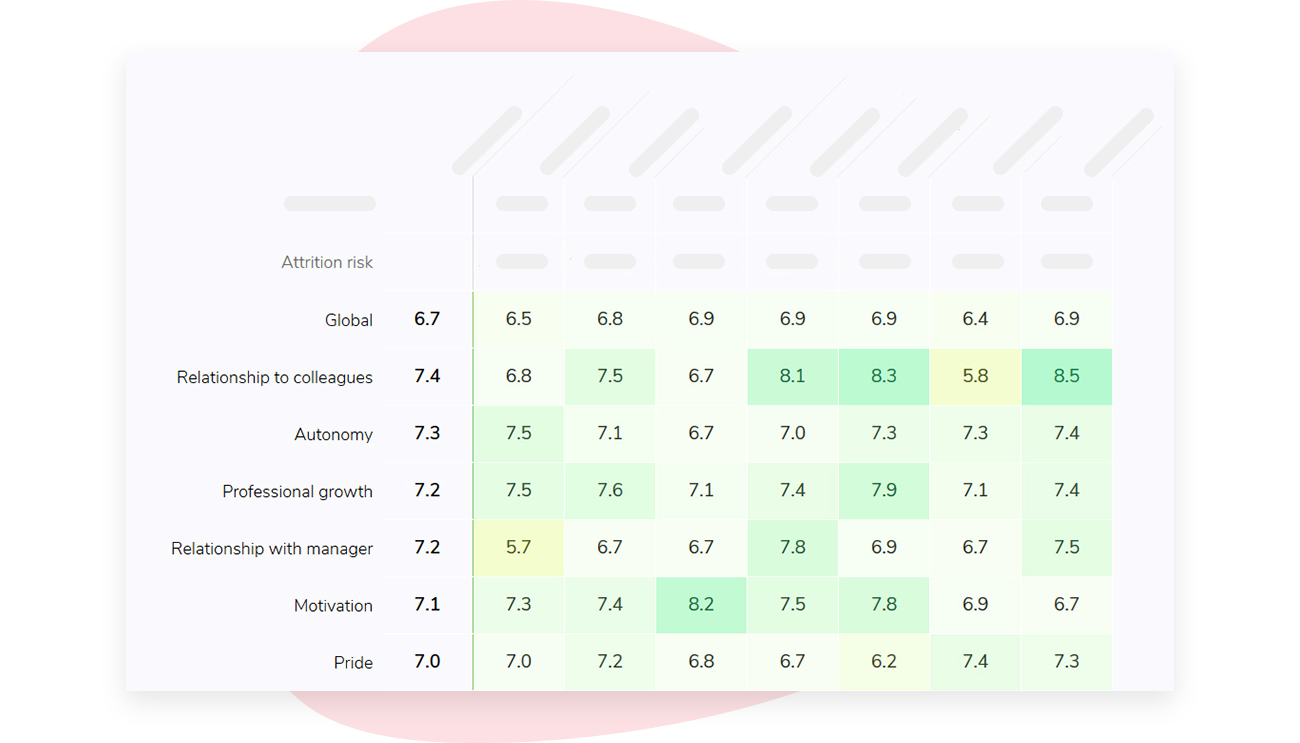
Sparkbay allows teams to segment results based on manager, department, tenure, and more. This gives HR teams the power to see whether a trend is happening across the organization or focused in a specific part of the organization. Moving beyond one organization-wide average to segmented benchmarking gives a richer understanding of your data.
Sparkbay also lets companies benchmark themselves against organizations in the same industry using Sparkbay’s proprietary dataset. This helps leadership teams understand whether they’re truly lagging behind, doing relatively well, or just in line with market norms.
Once it’s clear where the priority areas lie, Sparkbay offers a library of easy-to-implement actions that managers can use to improve. Receiving "scores" is frustrating for managers, so it’s important that they get practical steps they can take.
If HR teams are running repeated survey cycles, they can use the combination of regular feedback, trend reporting, segmentation, benchmarking, and action support to create a tighter measurement loop.
If you’re interested in learning how Sparkbay can help you build a more engaged workforce, you can click here for a demo.
From insights to action: closing the loop
At the end of the day, your trend analysis is only as great as the decisions it changes. So when your insights turn into actions, you want to make sure it’s a structured and visible process, and that the actions you set are appropriate given the volume of data you have.
For instance, think about what needs to be addressed on an enterprise-wide scale versus what’s a local priority. You may have a company-wide survey finding that says confidence in senior leadership has declined. This may call for a big communication from the executives, a recommitment to transparency around strategy, and an update on daily routines of your senior leadership team.
On the other hand, a localized survey finding that says employees aren’t happy with the feedback from their managers may require targeted coaching for a specific leadership group.
Similarly, when you work with your leadership team to create action plans, you want to ensure that you’re creating action plans based on the survey drivers that are more likely to move the needle.
For instance, if you notice that the intent to stay within your organization is decreasing among employees with two to five years of tenure, it may be worthwhile to focus on action items related to career development, opportunities for internal mobility, and career conversations with managers rather than embarking on a large-scale culture initiative.
At the same time, you want to be realistic in your goal setting. If your goal is to increase an engagement index from 6.8 to 8.5 in one quarter, you risk undermining your credibility. On the other hand, a focused effort to improve scores by 0.3 to 0.5 points on a priority driver may be more achievable depending on the scoring scale and baseline.
Finally, when you decide to start implementing changes, you want to start communicating. It’s important for employees to know that you hear them, that you’re interpreting survey results with honesty, and that you’re linking findings to actions.
A useful close-the-loop message includes:
- What you heard from the organization,
- What has improved since the last survey cycle,
- What you recognize still needs improvement,
- What actions you’re going to take,
- Who in the organization is responsible for those actions, and
- When employees can expect to hear another update on progress.
Finally, if you want to demonstrate your ROI, you can connect your employee engagement trend stories to other data sets. For example, you can show how you’ve impacted attrition, absence, internal mobility, safety incidents, customer experience, productivity, or even manager turnover. While it’s important not to overstate the correlation, it can be impactful to show repeated patterns over time that build a compelling business case.
What are some common pitfalls you should avoid when interpreting data?
Longitudinal benchmarking may not be credible if you change the measurement system too often or overinterpret minor movements in your data.
Survey fatigue is one common problem, especially if employees are frequently asked for their feedback and they don’t see any meaningful action being taken. If you’re using pulse surveys, make sure they’re short, relevant, and tied to visible decision-making.
Inconsistent timing of surveys can also distort results. If you conduct a survey while annual bonuses are being communicated, and then compare it to a survey conducted after a round of layoffs or during a period of peak workload, you may come to false interpretations. Make a note of the context.
Confounding factors are also important to document in your survey record. Changes in leadership, acquisitions, significant policy changes, labor disputes, system implementations, or external market shocks can all have an impact on your scores.
Small sample sizes, while they can be directionally helpful at a segment level, require caution. Your HR department should avoid naming a team when there are questions around anonymity or the reliability of a sample size.
Overreacting to small fluctuations can create churn within your workforce. If every minor dip on a survey results in new initiatives, managers and employees may start to view engagement work as a reactive, rather than rigorous, process.
Ignoring neutral responses is another missed opportunity. A rise in neutral responses may indicate hesitation or a lack of conviction before employees become openly unfavorable.
Turn trends into transformation
Comparing and benchmarking your engagement survey results over time helps HR teams understand how the employee experience is changing.
To get the best insights from your survey comparisons, ask the same questions, keep your scales consistent, thoughtfully segment your data, and use internal and external benchmarks.
Of course, you don’t want to chase every data point on your survey results. You want to identify important trends, understand the context of these trends, and focus your actions where they’ll have a measurable impact.
If you’re interested in learning how Sparkbay can help you build a more engaged workforce, you can click here for a demo.