
Your engagement survey results are up. Despite this, managers are reporting increased complaints about workloads, and regretted attrition has gone up compared to last year.
How can this happen?
When you see conflicting results like this, it’s often an indication that your engagement index is flawed.
You may not be aware that there are two types of engagement: "work engagement" and "employee engagement". Most enterprise-wide surveys combine the two to produce one overall engagement number.
As a result, it’s hard to understand what’s changed to impact your overall engagement score. Has the pride in a new strategy reported by your employees offset the exhaustion of your front-line staff? Or vice versa?
How work engagement and employee engagement differ and how to choose the metric for your survey
- How did "engagement" come to mean 2 different things?
- Work engagement asks how people experience the work
- Employee engagement includes questions about the company
- Work engagement vs employee engagement at a glance
- Measure the wrong thing and you may end up solving the wrong problem
- Choose the measure that will help you answer your business question
- You can measure both work engagement and employee engagement without making your survey longer than it needs to be
How did "engagement" come to mean 2 different things?
When William Kahn described personal engagement in 1990, he was writing about work roles: the moments when people bring their whole selves, physically, cognitively and emotionally, to the role they perform.
In his research, he came up with three conditions necessary for engagement: meaningfulness, safety, and availability.
You’ll notice that one of the conditions Kahn listed is safety. This is likely where a large portion of today’s interest in psychological safety stems from.
The concept of psychological safety is explored by Amy C. Edmondson in her book, The Fearless Organization. Edmondson discusses how individuals hold back their efforts and ideas when they feel that speaking up is risky. This links back to Kahn’s concept of safety being a condition for engagement.
Later on, researchers like Wilmar Schaufeli and colleagues started focusing on work engagement. They suggested that work engagement is the positive state opposite to burnout, which is also a state linked to work.
On the other hand, consulting firms took "employee engagement" in a different direction. They wanted to give employers the ability to predict important business outcomes like employee retention, advocacy, and discretionary effort.
As a result, many practitioner "employee engagement" indices now include these important outcomes as well as a lot of the conditions that are believed to lead to these outcomes.
What does this create?
Well, it creates two problems. The first is the "jingle" fallacy, where we think we’re measuring the same thing when we’re actually measuring different constructs. The second problem is the "jangle" fallacy, where we think we’re measuring a different construct, but we’re actually measuring the same thing.
For years, critics have argued that many "employee engagement" indices or inventories are nothing more than a repackaging of job satisfaction and organizational commitment under a different name.
According to a paper by the Institute for Employment Studies, these issues have led to the creation of two camps within the "engagement" conversation. While academics focus on work engagement, practitioners focus primarily on engagement with the organization.
And survey providers rarely make it clear which type of employee engagement their index refers to.
So what do you end up with?
You get a single engagement score that is created using items about workload, how proud someone is to work for their company, and how likely they are to stay with an organization.
In this single score, you may find that your "engagement" score goes up while your employees’ workload increases. On the other hand, your engagement score may drastically decrease because trust in the leadership team plummeted, even though people still like their jobs.
Work engagement asks how people experience the work
Schaufeli and Arnold Bakker, two leading work engagement researchers, describe work engagement as having 3 components.
- Vigor: having the energy to do the work and the persistence to overcome challenges
- Dedication: feeling that the work is meaningful and interesting
- Absorption: being engrossed in the work. This is the most contested component of work engagement. It overlaps with the compulsive component of workaholism, so high absorption levels in a strained team are not automatically good news.
The Utrecht Work Engagement Scale (UWES) exists in a 17-item, 9-item, and 3-item format. The authors have validated the shorter scales in a number of countries.
Because the three subscales correlate highly with each other, many researchers simply report a total score instead of using the vigor, dedication, and absorption scales as separate, diagnostic tools. This is to say, you shouldn’t read too much into a difference between subscales within the same study.
You should check the version of the UWES you’re using and see what the authors state about use. There are different terms for non-commercial use and commercial use. If you reword its items, your scale is no longer the validated UWES.
Schaufeli and other researchers typically interpret work engagement through the Job Demands-Resources (JD-R) model. According to this model, resources like autonomy, manager support, and feedback help people manage job demands. These resources are linked to higher work engagement.
Most employee surveys miss one important detail about job demands. Not all job demands are created equal. Research that separates challenge job demands (e.g. stretch opportunities and responsibility) from hindrance job demands (e.g. red tape, role conflict, constant interruption) finds that these job demands relate to work engagement in different ways.
A survey item like "My workload is manageable" mixes these demands.
This is important because it informs actions going forward. If you want to "reduce workload" by cutting back on challenge demands, you might undermine the energy you were trying to preserve. Usually, it’s safer to focus on reducing hindrance demands - and these are often easier (and cheaper!) to remove.
Work engagement doesn’t mean you’re immune to burnout. A nurse can be deeply dedicated to her work and still be burnt out due to an impossible caseload.
A useful way of understanding this comes from Christina Maslach and Michael P. Leiter’s book, The Truth About Burnout. They describe the problem of burnout as an erosion of work engagement. They also say that burnout is caused by mismatches between people and their work in areas like workload, control, reward, community, fairness, and values. This is a useful framing for understanding that burnout is not an individual problem - it’s a problem with the job and the organization.
There is still debate among experts and practitioners about whether engagement and burnout are two ends of a spectrum or two discrete states that can coexist. The latter claim is tempting given data from strained teams that report high dedication and high exhaustion in the same survey. Gallup’s workplace research also suggests that widespread burnout exists and that it’s not limited to disengaged employees.
You can use the work engagement measures when you want to assess whether people are drawing energy from their jobs. But it’s important to consider engagement levels in the context of job demands and resources - especially if you’re considering changes to your staffing, scheduling, or operating model.
Employee engagement includes questions about the company
Employee engagement is, in part, about feeling connected to your organization and a desire to contribute to its success.
The "Say, Stay, Strive" model developed by Aon Hewitt is a popular model among practitioners. It suggests that you measure whether employees will say good things about the company, whether they’ll stay with the company, and whether they’ll strive or go above and beyond.
Understandably, this "Strive" category overlaps significantly with the "vigor" category described above. So an engagement index that uses a combination of these items may be somewhat redundant.
Gallup’s Q12 items are often touted as an employee engagement measure. While many of the items in the Q12 are about what matters to employees (e.g. knowing what is expected of them, receiving recognition, having the chance to do their best work), they aren’t specifically about how connected they feel to their employer. This is something to keep in mind when comparing a Q12 index to an outcome-based index.
There is another big problem with creating engagement indices that combine outcomes and drivers. If you include something like intent to stay in your engagement index, then later claim that this index is a good predictor of attrition, you’ve already built part of that prediction into your engagement index. It becomes difficult to assess.
If you then do a key-driver analysis on that index, the problem intensifies since your key drivers are already included in the index itself.
Moreover, "attachment" isn’t a singular concept either. Research by John Meyer and Natalie Allen demonstrates that organizational commitment has different components including wanting to stay with the organization (affective commitment), needing to stay with the organization (continuance commitment), and feeling an obligation to stay with the organization (normative commitment).
If you include a general intent-to-stay item in your survey, you risk creating an index that mixes all of these groups together. An employee with unvested equity, who has a mortgage and lives in a town with a precarious job market, or has a visa that ties them to their current role may each report a high intent to stay while being truly detached from your organization. This is the "loyal but disengaged" group that has concerned practitioners, and this group can present a very healthy picture on most dashboards.
If a company wants to understand the quality of its retention, it should not rely on one intent-to-stay item. Ask a want-to-stay question such as "I want to still be working here in two years" and, separately, a need-to-stay question such as "It would be hard for me to leave right now", and report them apart. High need with low want is the loyal-but-disengaged group.
There is also a third element that employers should be aware of when assessing engagement: attachment to the chosen profession. The Institute for Employment Studies has noted that professionals, scientists, and academics often feel a high level of satisfaction with their work but a low level of engagement with their organization. They’re often more loyal to their profession, the patients they serve, or their research than they are to their organization.
In these situations, a low organizational engagement score may not be an alarm for improvement so much as a reality check based on professional identity. It only becomes an issue if attachment to the profession has no connection back to your organization. For instance, if another company offers better access to the work itself.
Finally, your intent-to-stay data based on employee self-report is likely to be noisy, so be mindful when using it. Understand how well the false-stay responses correspond to actual attrition by analyzing your attrition rates by segment before treating your intent-to-stay data as a real indicator for retention. Research from Gallup consistently shows that many employees are open to other jobs or are looking for other jobs.
Work engagement vs employee engagement at a glance
| Question | Work engagement | Employee engagement |
|---|---|---|
| What’s the focus? | The experience of doing the work | Attachment to and advocacy for the organization |
| Where did the measure develop? | Academic research, mainly the UWES and JD-R tradition | Consulting practice, mainly proprietary indices |
| How quickly may it change? | Fluctuates within a person from day to day and week to week with job conditions | More stable, but can shift sharply after restructures, leadership exits or pay decisions |
| What might you ask? | Energy, dedication and absorption in the work | Pride, advocacy and intent to stay |
| What is it useful for studying? | Job design, workload, well-being risk | Retention risk, change readiness, employer brand |
Imagine you have a specialist who loves their work but doesn’t see a future for themselves at your company. They are highly engaged in their work, but they aren’t highly engaged with the organization.
Now imagine a long-tenured employee who keeps showing up to work despite feeling exhausted from covering for the lack of resources due to staff turnover. They may still feel loyal to their organization, but they aren’t particularly engaged in their work.
You don’t want to average these two people out and consider them "engaged" in a blended engagement index.
Additionally, you want to think about the appropriate level for intervention for each of these metrics. Work engagement is something that line managers and operations leaders can have the most influence over, since they control things like workload, staffing, and processes.
Organizational attachment and advocacy are something that senior leadership and the organization’s reward and career architecture play a larger role in.
Measure the wrong thing and you may end up solving the wrong problem
Suppose you measure one of the previously mentioned examples. You receive an extremely high pride score, but a low energy score.
Do you jump into action and roll out a values campaign? If you do, you may find that your urgent requests each morning have nothing to do with your company values. They have to do with the number of demands on your teams.
What if you have a high energy score, but a low intent to stay score? You may need to revisit career architecture, compensation, or the level of trust in leadership.
In the meantime, you risk spending time on re-designing tasks, which won’t address any of those areas.
There’s also the problem of Goodhart’s law, or the tendency for people to "game" metrics.
Suppose you combine questions about recognition, feedback, and staffing into your headline survey score. It’s the recognition item that managers learn they can most easily improve. As a result, they focus all their energy on improving recognition scores, allowing you to quickly boost your survey results.
This may have less to do with improving employee engagement as a whole.
Jerry Z. Muller makes a related argument in The Tyranny of Metrics. He argues that once measures are tied to rewards or accountability, people focus their efforts on optimizing the things they can measure at the expense of things that matter but are harder to measure.
What does this mean for your engagement surveys? The more survey scores feed manager scorecards, the more these manager scorecards should be designed around outcome survey items that are difficult to game. Driver survey questions should remain driver questions only.
While you’re on the topic of correctly interpreting survey items, be aware that high loyalty scores in a strained team are not necessarily a good thing. Loyal employees will tolerate a lot of workload before they leave. When they do, they’ll take a lot of your survey data with them.
Choose the measure that will help you answer your business question
So, where do you start?
Start by thinking about what decision will be made based on the results.
If you’re trying to understand whether you need to address workload issues or redesign roles, your questions should focus on work engagement and levels of challenge demands, hindrance demands, and key resources.
If you’re trying to understand whether an organizational change will impact retention, you need to understand levels of attachment and intent to stay within your organization among your employees (keeping the want-to-stay and need-to-stay items separate). You also want to validate these responses with actual retention.
You may even decide that you need both, which justifies collecting different information. And that is why it is important not to shoehorn every business problem into the same framework.
Ask yourself questions like:
- Are we trying to understand people’s experience in their day-to-day work?
- Are we trying to understand how connected people feel to this employer?
- Which manager or leader will be able to act on the responses to this question?
- What would we do differently if the score to this question went down?
This last question is particularly important. If no one can come up with a likely response to this question, then this question is simply going to take up space in your survey for no good reason.
Similarly, you’ll want to think about how often you will measure certain things. Work engagement measurement questions can be more sensitive to measuring attitudes and feelings about the current job conditions. So if you want to know how temporary increases in staffing levels or deadline changes affect your employees, it’s worth asking them more frequently in short surveys (pulses).
On the other hand, feelings of attachment to an organization may not need to be measured every month unless you’re going through mergers, restructures, or other leadership decisions that may impact how people feel about the organization.
Even more importantly, short pulse surveys have to be tied to action. If employees are asked questions every month and do not notice any actions taken in response to surveys, it will feel like a waste of time and energy. This will impact the quality of responses given before it impacts the response rate, with more straight-lining, shorter comments, and more neutral answers.
A final note on benchmarks. If you decide to split a composite measure into two separate outcome variables, this will impact your trend line as well as your ability to compare against vendor benchmarks. You may want to consider running the old index alongside the new split scores for one cycle, so you can provide leadership with a transition view as opposed to an unexplained drop in scores.
You can measure both work engagement and employee engagement without making your survey longer than it needs to be
This kind of hybrid survey only makes sense if you keep the two outcomes separate when it comes to reporting and analysis.
Instead of combining your scores into one overall engagement figure, you want to report on work engagement and employee engagement separately.
To do this, use a short, focused set of questions targeting work engagement (there is a 3-item version of the UWES you can use).
Then, using the same survey, employees answer a short set of questions about overall employee engagement related to the organization (such as questions on pride or intent to stay).
In the same survey, you can also add different potential drivers of engagement based on what your worksite has decided to focus on.
If you’re interested in improving workload, then you might want to separate the item "I have enough time to do good work" from items related to interruptions or unnecessary processes.
If you’re interested in improving career paths, you might ask about growth opportunities at this company specifically, instead of learning and development in general.
Similarly, you can ask specific, targeted open text questions, rather than a general, "Any other comments?" question. For instance, you can say, "What would make your work more manageable?" to better identify job design challenges.
By keeping your core work engagement and employee engagement questions consistent throughout each survey and changing your potential driver questions when your priorities change, you can start to understand where there are differences between how employees feel about their work (work engagement) and how employees feel about the organization (employee engagement).
For example, you might have a team that scores high on work engagement, but low on employee engagement. This could lead to a meaningful conversation about career opportunities and trust with the organization.
Before acting on these insights, it’s important to check whether this trend is consistent across similar groups and across multiple survey rounds, or if it’s just an anomaly for a small team within one cycle of surveys.
Since small groups can have dramatic changes based on one changed answer, it’s wise to be cautious. It may be more worthwhile to look at trends you see twice rather than large differences that only appear once.
If it sounds like your surveys will have to be quite long to incorporate all of these questions, don’t worry. You don’t have to ask all of your potential driver questions in each survey round.
You can use the literature review on work engagement or the literature review on job resources (both of which pull together dozens of studies) to help you choose the most promising potential driver questions to test.
You should also make sure the data your survey generates can actually demonstrate a link to something leaders can meaningfully change.
Sparkbay can help you keep questions about work engagement and employee engagement separate, by allowing you to configure your surveys to better align with the question you actually want to answer.
For instance, you can group your work-focused items and your questions about staying with the company into separate custom indicators, instead of putting them all into one catch-all "engagement" category.
Each custom indicator gets its own score on the Dashboard.
So each result is reported under the label you chose, instead of disappearing into a single average.
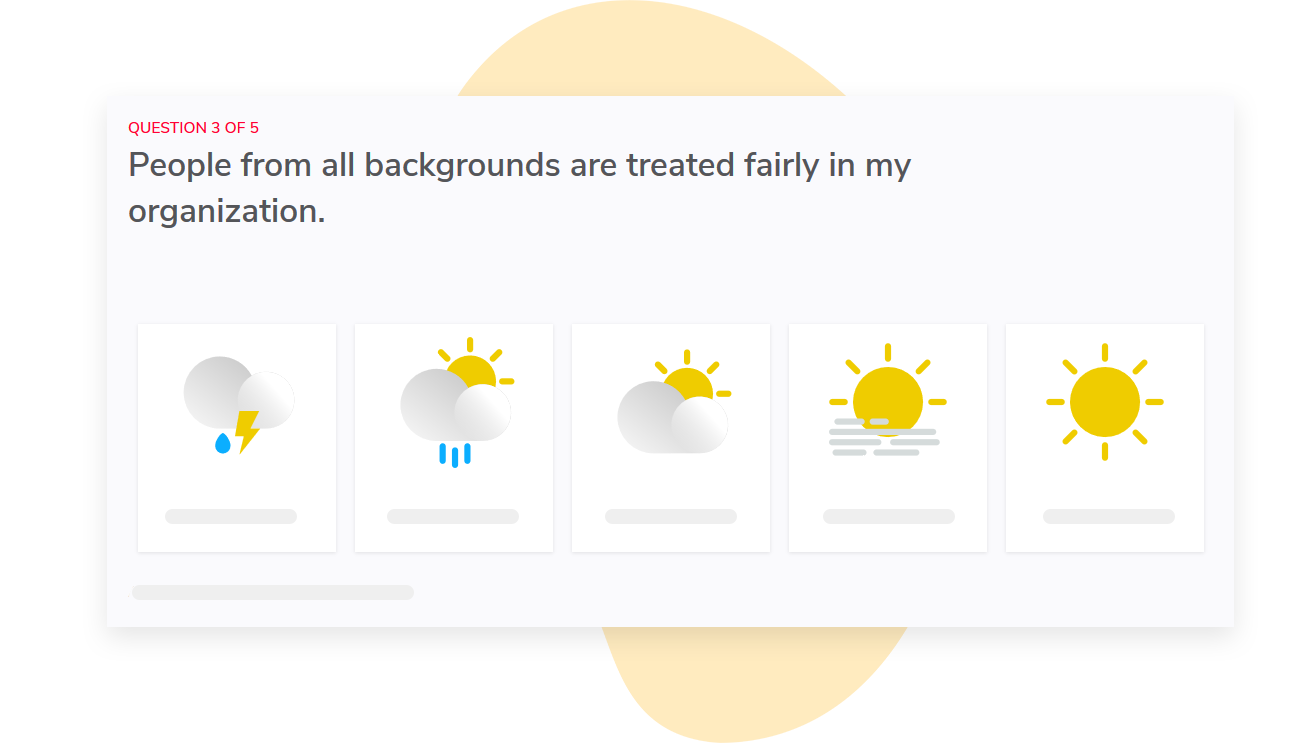
In a large organization, overall results can be overwhelming and hard to act on. Using Sparkbay, you can also break down results by team or department.
This allows you to see where people value their work (work engagement) but don’t feel as connected to the employer (employee engagement) and vice versa.
Sparkbay will automatically map survey result access to the organization hierarchy - so each manager only sees the results for their own teams.
Sparkbay also hides a score automatically when too few people have answered: 5 responses by default, and the minimum can be adjusted for your account.
This ensures that companies can protect employee privacy and avoid singling out small teams when there are notable differences in engagement scores.
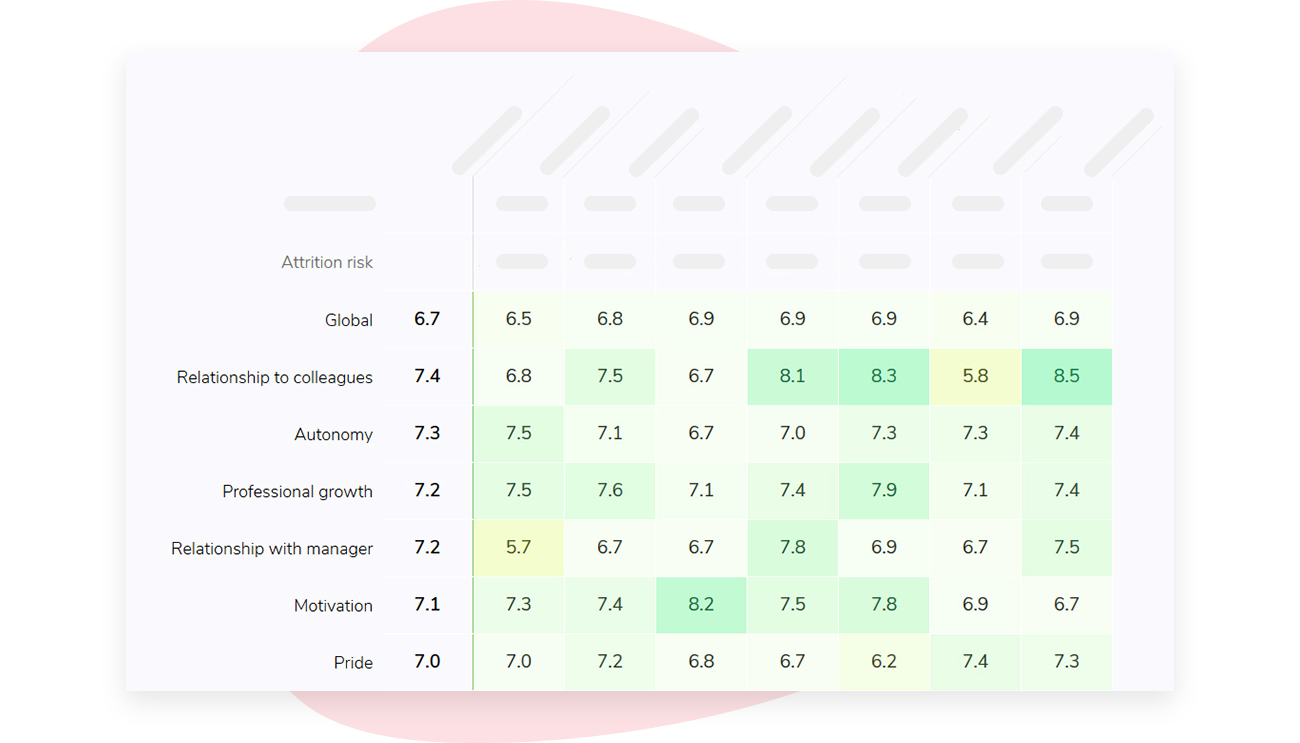
From here, you can decide what to include in your next pulse.
Watch for survey questions that blur the answer
Satisfaction questions have their place, but employee satisfaction is not the same as employee engagement. Employee satisfaction is about feeling content at work and is not a reliable measure of an employee’s intention to stay at a company. This highlights a problem in satisfaction questions included in an employee engagement index.
The same is true for eNPS questions (willingness to recommend). While this is a helpful indicator, the scoring methodology treats responses from 0 to 6 as equal detractors. This disregards data and may skew results, especially if your team is small.
One question cannot be the basis of your entire engagement measurement.
Plus, watch out for double-barreled items. An item like, "I am proud to work here and would recommend it to friends" combines two ideas into one survey question. If you receive a lower score for this item, it will be difficult to determine if the decline is due to the "pride factor" or the willingness to recommend.
Be wary of any composite average that includes such items. For instance, if your work engagement scores increase but intent to stay decreases, your overall average may not change much, hiding an important trend.
If you’re creating your own survey items, consider using validated survey scales as a guide. If you need to change the wording to suit your context, try not to assume that your newly worded item measures the exact same construct as the original item.
Before distributing your next survey, review your engagement items and label them as work, organization, or driver engagement items. Ask each recipient of your survey results from each work unit what they would do if the score from that item dropped. You’ll likely discover items that no one would act on.
If you’re interested in learning how Sparkbay can help you build a more engaged workforce, you can click here for a demo.