
Your top sales manager schedules a "quick chat" for Friday morning. Ten minutes later you learn she has accepted another offer, and her departure will take $1.2 million in client relationships and three years of product knowledge with her.
Gallup estimates that replacing an employee can cost between one-half and two times that person’s annual salary. The multiplier understates the damage in roles where relationship capital and undocumented process knowledge walk out the door.
Gallup’s 2025 workplace research found that half of employees worldwide were watching for or actively seeking a new job. At that baseline, retention becomes a portfolio problem rather than a handful of cases to manage as they surface.
Most retention advice arrives as a list of strategies. What follows is a set of real programs read for the mechanism underneath each one-and, more usefully, the supporting system that makes it work.
That’s the part organizations copy last and abandon first.
Structured employee retention programs and real company examples that measurably reduce turnover
- What makes an employee retention program work?
- Google: using data to improve management
- Salesforce: connecting culture with tangible support
- Costco: making employment worth keeping
- Netflix: retaining high performers through freedom and candour
- Adobe: replacing annual ratings with regular conversations
- Zappos: paying new hires to leave
- Hubspot: using transparency to build trust
- Patagonia: aligning work with a clear purpose
- Linkedin: helping employees grow without leaving
- American express: treating flexibility as a work design choice
- Marriott: building long careers from front-line roles
- Ikea: rewarding long service without focusing on rank
- The common threads across effective retention programs
What makes an employee retention program work?
Strong retention programs solve a specific, named source of unwanted turnover. They don’t begin with a list of fashionable perks.
Effective programs usually work on four parts of the employee experience:
- Work quality: Employees have clear priorities, manageable workloads, useful tools, and capable managers.
- Growth: People can build skills, move internally, and see a credible next step without changing employers.
- Recognition and rewards: Pay reflects the market, and managers notice valuable work while it still feels relevant.
- Control: Employees have reasonable say over when, where, and how they get their work done.
How much each one matters shifts by workforce. A predictable schedule beats remote work in hospitality; internal mobility beats both inside a global technology firm.
A program borrowed from the wrong context tends to fail quietly-not because it’s bad, but because it solves a problem your people don’t have while ignoring the one they do.
Sequence matters too. Fix the hygiene factors-pay, staffing, schedule stability, trustworthy promotion-before layering on engagement work, because recognition and purpose can’t offset a broken baseline.
Segment retention by manager, department, tenure, role, location, and hire cohort. Company-wide averages routinely hide a single team shedding experienced people at twice the organizational rate, and a healthy headline number is often exactly what delays the intervention.
Google: using data to improve management
Google runs its people practices through the same testing discipline it applies to products. Its People Analytics team studies workplace data, employee feedback, and business results to work out the conditions that support effective work.
Project Oxygen is the well-known example. Google set out to test whether managers mattered at all, half-expecting the answer to be no, and instead found manager quality predicted both team performance and attrition.
The value wasn’t the conclusion that managers matter. It was the translation of that into observable, teachable behaviours-coaches the team, communicates clearly, supports development, avoids micromanaging-that could be measured and fed back to individuals.
The transferable move is the method, not the model. Define effective management in your own context, then correlate specific manager behaviours against retention in that context before you build them into selection, onboarding, and development for every people leader.
Concretely: compare teams on role clarity, recognition, workload, growth conversations, and intent to stay. Where retention repeatedly co-occurs with particular behaviours in your data, those become the standard-not the ones a study of a different company happened to find.
Salesforce: connecting culture with tangible support
Salesforce uses the Hawaiian word Ohana, meaning family, to describe a culture built around employees, customers, partners, and communities. The idea gives the company shared language for belonging and mutual responsibility.
Salesforce backs that language with concrete programs. Its benefits have included paid volunteer time, charitable contribution matching, wellbeing support, and flexible ways of working, though eligibility and details vary by market.
Whether any of it aids retention depends on whether workload lets people use them. A volunteer allowance sits unused when staffing assumes nobody takes it, and the gap between the offered benefit and the usable one becomes its own source of cynicism.
The transferable test is whether stated values actually settle the hard decisions-promotions, workload, customer commitments, recognition. Employees read culture from which value wins when two collide, not from the poster.
Costco: making employment worth keeping
Costco’s retention approach starts with the employment offer itself: competitive pay, benefits for eligible employees, stable hours, and genuine advancement out of operational roles.
The company has reported that many of its warehouse managers began in hourly positions. In an industry that budgets for high turnover as a fixed cost, that visible path is what turns a job into a reason to stay.
Promoting from within also removes the external-hire premium for management roles and keeps operational knowledge in-house-store operations, customer expectations, how policies actually land on the floor-that an outside hire has to acquire from scratch.
Note the sequence. Costco fixed the economics before layering on engagement.
Recognition programs can’t offset pay compression, volatile schedules, or a promotion process employees don’t trust, and it’s worth checking which of those you’re quietly asking recognition to paper over.
Netflix: retaining high performers through freedom and candour
Netflix organizes its culture around freedom and responsibility, handing over broad decision authority and expecting judgment in place of approval layers.
Its compensation philosophy is explicitly top-of-personal-market: pay what it would cost to replace the person’s skills and what a competitor would offer them, rather than anchoring on internal bands.
The freedom is bounded by the "keeper test"-would a manager fight to retain someone who planned to leave? Applied carelessly, this breeds fear rather than trust, and it only works where goals are clear, feedback is candid, and managers are strong enough to make defensible calls.
For most organizations the exportable idea is narrower: strip out controls that don’t reduce a real risk. Every approval layer an experienced employee waits through is a small, recurring signal that you don’t trust their judgment, and those signals compound.
Adobe: replacing annual ratings with regular conversations
Adobe replaced its annual review with Check-In: ongoing conversations about expectations, feedback, and development instead of a single backward-looking rating.
Because priorities get revisited through the year, employees can correct course before a problem hardens into a rating or a stalled career.
Adobe reported a meaningful drop in voluntary departures after the change-though it also invested in manager capability and accountability, so the ritual alone doesn’t explain the result.
The real lever is feedback latency. An employee who learns in December that promotion criteria shifted in June has usually started interviewing by the time you tell them.
To make check-ins more than a compliance ritual, require a short agenda-priorities, obstacles, workload, recent feedback, career interests, agreed actions-and audit conversation quality through employee report-backs, not completion rates. Counting completed meetings measures the wrong thing.
Zappos: paying new hires to leave
Zappos became known for paying some new employees to resign after training, surfacing the ambivalent before either side sank more investment into a poor fit.
The sums have changed, but the mechanism holds: raise the immediate payoff of leaving and staying becomes a deliberate choice rather than inertia.
It doesn’t prove commitment among those who stay-financial pressure and thin job markets still shape the decision-so treat the retained population as self-selected, not validated.
The broader lesson is realistic job previews. Avoidable early exits fall when candidates see the schedule, workload, management style, and behavioural expectations before signing rather than after.
Trace first-90-day and first-180-day resignations back to specific recruitment promises. That analysis usually exposes a repeatable gap between the advertised job and the real one-often the same recruiter, the same overstatement.
Hubspot: using transparency to build trust
HubSpot made its Culture Code public, which creates accountability precisely because employees can hold leadership decisions against a documented standard.
It has also used flexible work and unlimited vacation. Unlimited leave predictably backfires without visible norms: absent a stated floor and leadership examples, people take less, not more, and reward the always-available.
Making it usable takes enforced minimums, coverage plans, and managers who model taking time. Otherwise the policy quietly transfers scheduling risk onto the employee.
The deeper mechanism is information access. When leaders explain decisions and name the trade-offs, employees stop spending energy interpreting silence-and silence is what they fill with worst-case assumptions.
Measure this with survey items on trust, communication, and confidence in leadership, then segment by department. The pattern usually shows exactly which management layer information stops moving through.
Patagonia: aligning work with a clear purpose
Patagonia’s environmental mission shows up in product decisions, activism, and public commitments, so employees can trace it to actual choices rather than a brand statement.
It has also provided on-site childcare at major locations. That’s a site-specific benefit, not a universal one, and treating it as portable is a common misread of the model.
Purpose retains people only when the organization holds the line when it costs money. The moment public commitment and internal behaviour diverge, purpose turns into a liability-it raises the standard employees measure you against.
The reusable question is which employee groups face the hardest structural barriers to staying. Childcare, predictable schedules, or caregiver flexibility usually retain more than a broad lifestyle allowance, because they remove a constraint that would otherwise force an exit.
Linkedin: helping employees grow without leaving
LinkedIn uses learning, internal mobility, and dedicated development time to keep careers inside the organization. Its monthly InDay reserves time for themes such as learning, wellbeing, relationships, or community work.
Combined with digital learning and active internal exploration, this targets a leading cause of regrettable turnover: people leave because they can’t see their next move, not because they’ve stopped growing.
A job board doesn’t create mobility. It fails wherever managers hoard talent, internal candidates get token consideration, or the career information needed to apply lives only in informal networks.
Track internal fill rate, internal applications, time between promotions, and cross-function moves-and separately track who gets stretch assignments, since those, not courses, tend to determine the next promotion.
Development retains people only when it converts into responsibility. Course completion with no change in scope produces credentials and a stronger external CV, not loyalty.
American express: treating flexibility as a work design choice
American Express has run flexible and remote programs for years, calibrated to how much on-site interaction each job actually requires rather than to a single company-wide rule.
Availability differs by role and country, which is the honest constraint of a global workforce. Flexibility is a work-design decision made job by job, not a benefit handed out uniformly.
The retention value comes from removing work-life conflict that serves no business purpose-the rigid schedule that adds nothing but friction.
The failure mode is proximity bias: managers steering better work to people they see. Compare promotion rates, performance outcomes, recognition, and attrition across work arrangements, because the bias shows up in outcomes long before anyone admits to it.
A serious program spells out when teams must co-locate, which outcomes count, and how to escalate problems-removing the discretion that lets each manager apply flexibility by personal preference.
Marriott: building long careers from front-line roles
Marriott frames its philosophy as taking care of associates so they can take care of guests, which makes employee experience part of the service model rather than a parallel HR project.
It supports movement from hotel operations into supervisory and leadership roles, and its history includes senior leaders who started front-line-evidence the path is real, not aspirational.
In hospitality this retains hard-to-document knowledge about properties, guests, safety, and service recovery that walks out with every experienced departure.
Pathways need infrastructure, not anecdotes: visible role requirements, expected experience, available training, typical next moves, and open positions.
Then check whether shift patterns and staffing actually let front-line staff attend development. If only office-based employees have the slack to take part, the program is quietly reserved for people who already had a head start.
Ikea: rewarding long service without focusing on rank
IKEA’s Tack! program directs employer contributions toward retirement-related savings for eligible employees after service requirements, subject to local rules.
Its distinctive feature is equal contributions within a country regardless of position or salary, rewarding collective contribution rather than routing the biggest reward to the highest earners-an unusual choice that signals what the company values.
IKEA also supports mobility across stores, functions, and countries, so a global employer can retain people through career and location changes that would otherwise mean resigning.
Deferred rewards only work if the years before the payout are worth living. A future contribution repairs nothing about poor management, weak schedules, or blocked advancement in the present.
Pair long-term recognition with visible mobility. Employees need both a reason to stay and proof that staying won’t leave their career standing still while the reward vests.
The common threads across effective retention programs
These companies operate in different industries, but their programs reuse a handful of mechanisms. Each one removes a concrete reason a valued employee might leave.
- They strengthen managers. Google and Adobe turn management into a set of behaviours that organizations can teach, observe, and measure.
- They make the employment offer competitive. Costco and Netflix address pay directly instead of expecting culture to compensate for weak rewards.
- They create credible career paths. LinkedIn, Marriott, Costco, and IKEA help employees move into new roles without changing employers.
- They give employees more control. Netflix, HubSpot, and American Express cut unnecessary rules around decisions, schedules, or work location.
- They connect purpose with action. Patagonia and Salesforce back social commitments with employee programs and operating choices.
- They expose mismatches early. Zappos uses a direct exit offer, while other employers can use realistic job previews and structured onboarding feedback.
Which mechanism to pick isn’t a matter of taste. Match it to what your exit data and engagement scores say is actually breaking, and to what your workforce values most.
Copying the visible policy without its supporting system is how these fail. Flexible work needs bias-checked performance measures, internal mobility needs managers rewarded for releasing talent, and frequent check-ins need managers capable of honest conversations.
Start from evidence-exit data, employee feedback, internal movement, absence patterns, and manager-level retention-then pick one workforce problem and name the specific result the program has to move.
For instance: increase qualified internal applications and reduce voluntary exits among employees with two to five years of tenure. That framing lets you judge results by department and manager instead of by participation totals, which measure effort rather than effect.
Sparkbay collects employee feedback automatically at regular intervals, and many clients run monthly pulse surveys. It presents the findings through intuitive reports with a clear engagement score out of 10, while eNPS stays available as a secondary measure.
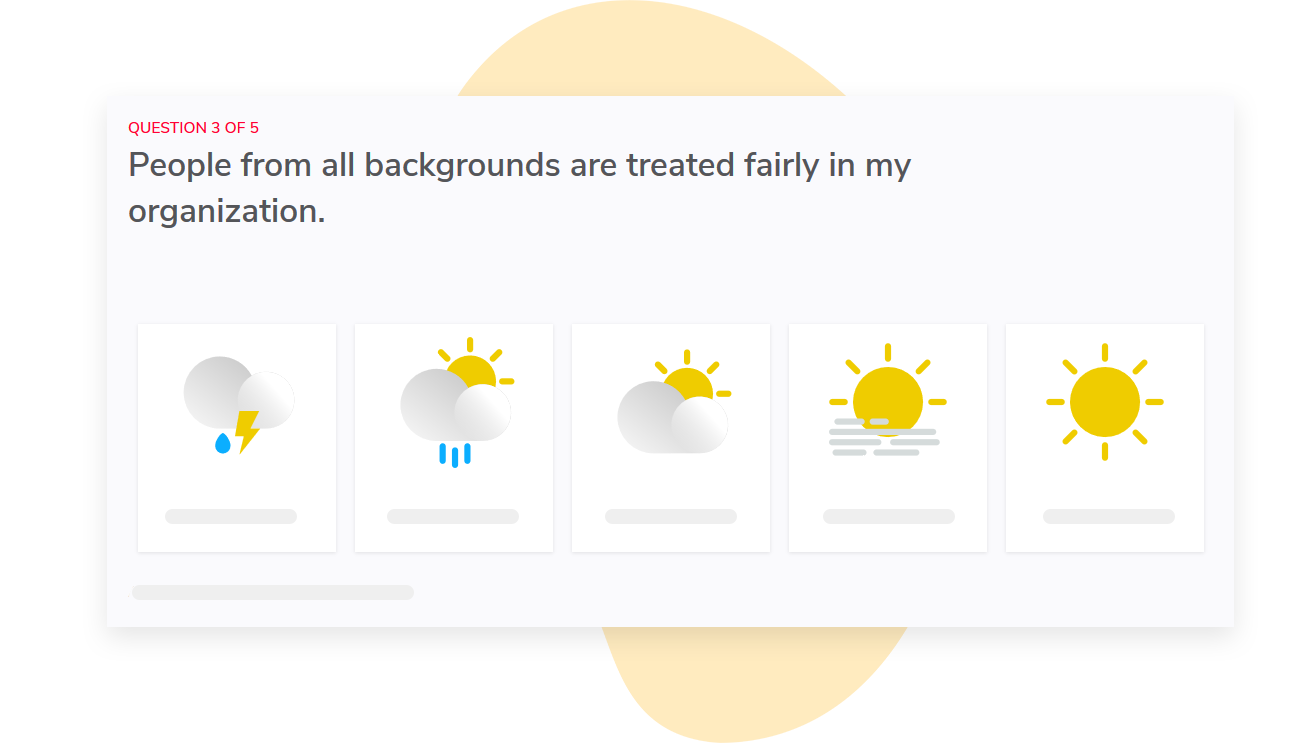
A monthly cadence is what lets you attribute change: it can show whether a new check-in process actually improved feedback quality, or whether a flexibility policy shifted workload pressure-instead of leaving you to argue causation from an annual snapshot.
Sparkbay lets teams segment results by manager, department, tenure, and other relevant employee characteristics, which adds context to internal trends.
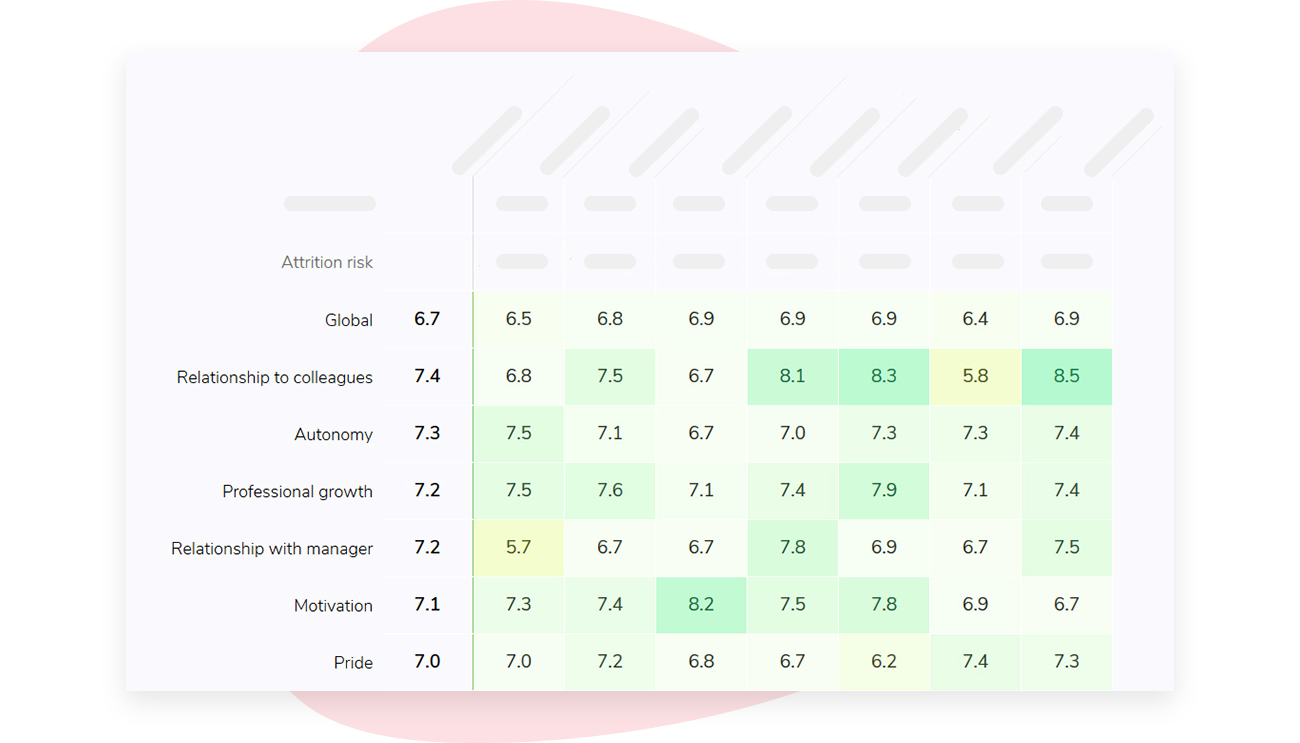
That detail matters because retention problems rarely hit the whole organization equally. A healthy company-wide engagement score can sit right alongside low scores among new hires, experienced specialists, or everyone reporting to a particular management layer.
Sparkbay is highly configurable, from the wording of surveys and dashboards to the content shown on each dashboard. You can align questions to a specific retention program rather than bending the program to fit a fixed template-and change the dashboard wording so managers read metrics in your language, not the vendor’s.
The platform also handles the access needs of large enterprises. Sparkbay maps report access automatically to the organization hierarchy, so each manager sees results for their own teams rather than data from unrelated groups.
Results stay hidden below a configurable minimum number of responses, set to five by default. That threshold protects anonymity and helps employees give candid feedback without implying the employer can identify individual responses.
Sparkbay is also ISO 27001 certified.
Once managers have their results, Sparkbay gives them a library of easy-to-implement actions. A manager with a low career-growth score can move from diagnosis to a focused team action instead of waiting for HR to design a separate plan-which is where most survey programs stall.
If you’re interested in learning how Sparkbay can help you build a more engaged workforce, you can click here for a demo.
A practical roadmap for keeping valued employees
Begin with one clearly defined retention risk-early-tenure departures, limited internal movement, weak manager feedback, or turnover in a critical role-and establish a baseline before you launch anything.
Assign an owner, set a review date, and choose a small group of measures: voluntary retention, engagement score, internal applications, manager behaviour scores, and employee comments about the targeted issue.
Test the program with a meaningful group and track its experience over time against a comparable one. A quasi-controlled pilot is the only way to separate what the program did from what the labour market or a good quarter did.
Keep what changes daily work, fix what employees can’t access, and stop activities that generate participation without moving the conditions that drive retention.
Expect the first read to point at management and workload rather than perks. That’s uncomfortable, but a program that flinches from the real cause will keep spending on the visible one.
The strongest retention strategy rarely rests on a single perk. It gives employees good managers, fair rewards, room to grow, and practical reasons to believe that staying supports both their work and their lives.
If you’re interested in learning how Sparkbay can help you build a more engaged workforce, you can click here for a demo.