
Nearly a decade ago, Iris Bohnet published What Works: Gender Equality by Design, a book that urged readers to improve outcomes by changing the decision environment instead of trying to change the decision-maker.
It's a compelling message, and one that's held up over the years.
And yet, when you look at DEI scorecards, they're still very much focused on the decision-makers.
Keep this in mind the next time you read a report that starts off with sentences like, "We're committed to fostering an inclusive environment where everyone belongs."
Think about all the key stakeholders that read that statement.
There's the works council, the claimant's counsel, not to mention the analyst who's reviewing your ESG disclosures for a comparability screen.
It's a great statement, but it's a statement that commits your organization to virtually nothing. And since it doesn't commit the organization to anything measurable, it likely passed legal review in record time.
Of course, a commitment statement without a number, a named owner, and a date is not a commitment at all.
When your organization re-opens its headcount planning midway through the fiscal year, working on a DEI goal with no specific deadline is something that can easily be cut from your to-do list.
When that happens, employees begin to doubt inclusive language executives use when speaking to the company, and leaders find it harder to distinguish meaningful progress from statistical noise.
Similarly, when DEI goals don't have specific owners, it becomes easy to come up with explanations for why a goal wasn't met.
What you want are DEI goals that can withstand scrutiny from a CFO conducting a cost review while also sounding meaningful to an employee listening to them in an ERG meeting.
How do you set such DEI goals? A meaningful goal has 4 main elements: a clear target, a reliable baseline, one accountable owner, and a hard deadline.
In this article, you'll learn how to develop each of these elements into a meaningful DEI goal.
Writing DEI Goals With Baselines, Targets, Owners, and Deadlines - Plus the Inclusion Metrics That Prove Progress
Start with the diagnosis
It's tempting to borrow a target from another company's ESG report and replace a few words.
But different companies have different recruitment funnels, labour markets, and may sit in different jurisdictions with different reporting requirements.
Setting a target without knowing your baseline is a bit like going into arm's length negotiations without knowing your starting position.
It's helpful to first understand different aspects of your recruitment function. This may mean looking at:
- representation by level and function
- 'flow rates' through the recruitment funnel (applicant → screen → interview → offer → accepted offer)
- promotion rate compared to eligible pool for promotions
- regretted attrition rates by tenure band
- unexplained pay gap after controlling for variables
- internal mobility opportunities
- individual questions around inclusion
You don't need to build the world's largest DEI dashboard. But you do want to identify your most important limitation.
Is your main challenge attracting candidates? Do they apply and fail to progress at the recruiter screen?
Do your data show that while application rates, and even interview rates, are fine, maybe there's an imbalance in offer rates that points to issues with interview panels or how interviewers debrief?
Do you see that attrition rates are matched for entry level employees, but there's a significant difference in attrition rates 12-24 months down the line based on who their manager is?
Each answer empowers your team to set different goals. Adding a recruitment goal would not help if your problem lies with retention.
Here's another important limitation that many companies overlook: allocation of opportunities. Even if entry, promotions, and exits are all fairly distributed, there may be a "stuck in the middle" phenomenon that happens to certain groups where they enter at, say, level 3 but don't move up. Meanwhile, other employees move through the lateral assignments that make them eligible for level 5 roles.
Your company assignment information, if you collect it, can show this. Who got assigned to the big revenue-generating project? Who landed the client-facing role?
Who got stuck with the internal role?
If you can't gather this info from your existing internal platform, you can add a simple, two-question item on your organization's engagement survey about access to more visible work opportunities.
Adverse impact can be a specific stage of your recruitment process. Your aggregate hire rate may pass the four-fifths' rule (a selection rate for one group that is less than 80% of the rate for the highest-selected group) but your candidate pool may have major disparities at one specific decision point.
Remember that if your company employs smaller demographic groups, you may want to suppress your data below an agreed upon threshold size. For instance, if you have nine eligible employees for a specific promotion and only one person gets promoted, your promotion rate goes up by over 10 percentage points.
A useful exercise before setting a goal is understanding how much an individual's outcome impacts your larger data set. For instance, if the presence of one person in your data set shifts your percentages more than the improvement you plan on making, it's a sign your data points are too granular and you should look at one level up.
Use input, process, and outcome metrics together
When developing DEI initiatives, it's tempting to focus on activity metrics since they are the most tangible for HR departments to influence.
For example, there are activity metrics that count the number of managers who've completed training. While this may seem like a straightforward way to measure a DEI program's success, it's not particularly helpful.
Researchers Frank Dobbin and Alexandra Kalev looked at decades-worth of data from the U.S. Equal Employment Opportunity Commission's EEO-1 reports and found that mandatory training and formal grievance procedures have had little to no positive impact on the number of managers from underrepresented groups.
In fact, they found that initiatives like task forces, mentoring programs, and targeted recruiting have been more successful at increasing diversity.
Dobbin and Kalev believe that DEI programs that tell managers what to think cause reactance. But if programs get managers involved or give them more opportunities or make them more accountable publicly, they're more likely to change behaviour.
This is why a focus on activity metrics (such as number of managers who completed training) is not very helpful.
On the other hand, input metrics tell us what organizations did. Process metrics tell us how the organization's decision processes changed. Outcome metrics tell us what changed for employees.
Surprisingly, organizations often skip process metrics, which are the most critical part of understanding why an initiative does or doesn't work.
Below are examples of input, process, and outcome metrics that organizations could use to measure a particular DEI goal's success.
| Input metric | Process metric | Outcome metric |
|---|---|---|
| Managers use a documented promotion rubric while conducting promotion calibration | Employees who are eligible for promotions are put forward for consideration for promotions at similar rates | The difference in promotion rates between different groups decreases |
| Sponsors receive specific information about their role and quarterly nudges | Program participants receive stretch assignments and P&L exposure that make them more eligible for promotions | Internal mobility and promotions improved for the specific population |
| Review job descriptions and interview guides using a structured process | Applicant to interview rates and interview to offer rates become more equitable | Increase in representation in these roles where there was a previously identified representation gap |
Ideally, each outcome metric would have at least two process metrics supporting it.
Otherwise, if your outcome metric stays flat, you have no way to tell whether your strategy failed or if there's simply a time lag. (For instance, changes in promotion outcomes may lag changes to process metrics by at least one full process cycle.)
When you set your goals, document how long you expect it will take to start seeing changes in your outcome metrics based on when process metrics change. This way, you can remind stakeholders of expected timelines if they grow impatient.
At the same time, activity or input metrics are valuable. Creating structured evaluation guides and interview questions, for instance, can be helpful for organizations to limit the amount of subjective decision-making. It's also useful to have a clear, documented method for how the interviewee was evaluated.
In fact, while meta-analytic research supports the value of structured interviews over free-form conversation, Sackett and colleagues' 2022 re-estimation of their numbers calls into question many of the validity rates used for the last 20 years. That said, the value of structured interviews to create an audit trail stands strong through this revision.
To determine whether a metric is a true process metric, ask yourself whether a manager could meet that metric without making any actual changes to their decision-making. If the answer's yes, then you're dealing with an input metric.
"Managers use a rubric" is an input metric. "Ratings for employees in pre- and post-calibration exercises should cluster differently" is a process metric.
Set targets that remove barriers
It's great to have representation targets, but you need to be careful about how you word them from a legal perspective. On the face of it, a fair representation target might sound like an instruction to hire specific employees in a particular way.
Remember, your business may be impacted by different legal and cultural factors. For instance, the EU is focused on gender inclusion on boards with targets for non-executive directors of 40% by 2026. France has restrictions on compiling ethnic statistics, and the US restricts creating specific quotas for private employers.
Where can you comfortably set representation targets?
Focus on goals around barriers your organization can identify, quantify, and change.
Your targets could focus on reducing the unexplained pay gap once you account for all legitimate factors. They could focus on reducing a promotion-review gap compared to the number of eligible employees for promotion. You could also have a target of increasing the number of qualified candidates applying for jobs or reducing gaps in interview pass-through rates.
These kinds of targets are forward-thinking. They encourage leaders to focus on the process that leads to outcomes, instead of simply focusing on individual employment decisions.
When a leader receives a target that says Hire 35% of employees from Group A it's very clear that they have to focus on that when making hiring decisions. This is also what an employee or external party would hear and interpret that instruction as.
On the other hand, if the target is Reduce the gap for interview pass-through rates from X to Y based on measured data by the end of the review period now the focus is on the entire process.
That said, focusing on process-oriented goals is not a silver bullet. If a manager is told to reduce a gap, but no process changes are allowed, they may be incentivized to change the makeup of their employees instead, generating a legal risk.
The way to mitigate this is to link the goal to a specific process change and explicitly forbid changing employee selection. For example, the instruction could be: "Reduce interview pass-through gap by implementing a shift from unstructured interviews to structured interviews using an approved rubric." This is a very different goal than simply "Reducing the interview pass-through gap" and it reinforces what a manager should focus on. This becomes much clearer in a later legal proceeding where it's clear what a manager knew they were supposed to do.
As you develop your representation goals, keep a clear record of the business problem, the data that led you to identify this problem, why a particular goal is helpful in eliminating business barriers, who keeps an eye on unintended consequences, and what a leader should never do to achieve the goals. You may also need to ensure your pay equity analyses are conducted under privilege, if advised by your legal counsel, from the start.
It's also important to ensure your representation goals don't have adverse second-order effects on the groups they're designed to help. If there's a highly-publicized representation goal, it may cause people to interpret promotions differently (e.g., they may think certain people were promoted to meet a goal, not because they're qualified.) This can create challenges for those individuals who are promoted. Emphasizing barrier-removal rather than specific representation goals can help mitigate this.
Legal note: This content is not legal advice.
Upgrade the smart test
You've probably heard of the SMART goal framework.
Specific. Measurable. Achievable.
Relevant. Time-bound.
But this framework was designed for individual managers' objectives.
At one time or another, you've probably watched a team member hold themselves to a goal that was measurable, but it made their work easier at the expense of the team's success.
Or perhaps the team's performance improved, but each sub-team's performance individually went down.
Consider the classic UC Berkeley graduate admissions case, where aggregate figures pointed to one conclusion and the department-by-department breakdown told a very different story.
Sub-team performance metrics can be skewed for a handful of reasons. But it's important to understand if these metrics are holding true when you breakdown your data.
Let's upgrade this SMART goal framework to be more equitable and representative.
We propose adjusting the framework to be:
Specific. Measurable. Achievable.
Equitable. Disaggregated. Time-bound.
What do we mean by equitable and disaggregated?
By equitable we mean a goal that ensures the benefits are shared across the board. For instance, elements like panel duty, directly leading an employee resource group (ERG), or being the face of the organization for specific events don't usually feed into individual team member productivity goals. But these duties can and do fall on underrepresented groups.
By disaggregated we mean a goal that holds true when you break it down into groups based on specific identifiers such as level, function, geography (if appropriate), and more.
Overall, your DEI goal should answer the following when you're constructing it:
"By [specific date], [goal owner] will increase [metric] from [baseline value] to [target value] for [population or segment of interest] as measured by [data source] and reviewed [desired frequency]."
"Improve manager inclusion." What is the baseline? Who exactly does "everyone" refer to? How do we know we've improved?
"By the end of the next 12-month planning period, the division president will increase the average employee inclusion survey metric for fair access to career opportunities from 6.4 to 7.2 out of 10 (based on current results) for employees at levels 3 through 5. Data will be reviewed on a quarterly basis."
Of course, the numbers 6.4 and 7.2 would be based on your organization's baseline data. You would use the above structure as a guideline for creating your goals.
Once you've created your goals, use the equity and disaggregation checks to ensure you're truly focusing on meeting your goals in a meaningful way.
Does your goal require underrepresented employees to sit on interview panels every time or lead time-consuming employee groups?
Does your goal appear to be holding true when we look at the average results, but there are areas within our organization where we haven't made any improvements?
Conduct a harder equity check once a year that considers the number of hours the employees leading your ERGs or serving as interview panellists will spend on these activities.
Then compare it to the number of hours their counterparts spend on billable or promotable work. Is your organization attempting to meet its advancement goals on the backs of the advancement of the very individuals named in the goals?
Finally, consider the work of Locke and Latham. Their program emphasized setting specific goals and providing specific feedback. But they also noted a potential downfall: receiving a goal tied to reward, but not tied to a specific method for achievement, might lead employees to choose the path of least resistance.
Things like reclassifying roles, waiting to exit the company until after a certain measurement date, changing a headcount from one cost centre to another.
How can you counter this?
When you receive a goal, think of three ways a savvy, time-pressed leader could meet this goal without making any meaningful changes. You then can add a monitoring measure to track on each of these scenarios.
If you can't think of three ways to undermine your goal, that means you don't understand the metric well enough and should take a closer look.
This is one specific area of value that Sparkbay can bring to your organization.
If you've conducted an inclusion survey, and you want to turn your diagnosed barriers into something you can measure and evaluate quarterly (rather than a one-off climate study), Sparkbay can help.
Since Sparkbay allows you to customize the wording of your survey items, you can write them based on the barriers you previously diagnosed.
For example, "I get a fair shot at the assignments that lead to promotion" looks very different than a generic belonging index. This item aligns with the specific advancement goal metric we highlighted earlier.
Some organizations conduct monthly pulse surveys while others wait for a cadence that best fits their operational rhythm.
At the end of each survey, Sparkbay will deliver your team a company-wide average engagement score out of 10.
This gives leaders an easy metric to evaluate overall progress or lack of progress over time.
Our tool also captures the company's progress on different survey items, including the specific items related to your DEI journey. This dashboard shows where you have the most and least progress, and where employee experiences diverge or differ.

You want to be particularly conscious of Simpson's paradox when analyzing your progress on DEI goals. Companies may believe they're improving overall when they aren't.
To avoid this, our dashboards allow you to compare department results, manager groups, tenure, and any other workforce segments you're interested in examining.
Our team also allows you to customize the content and wording for these dashboards. Therefore, you can ensure the data that each member of your leadership team sees aligns with the definitions on your scorecard.
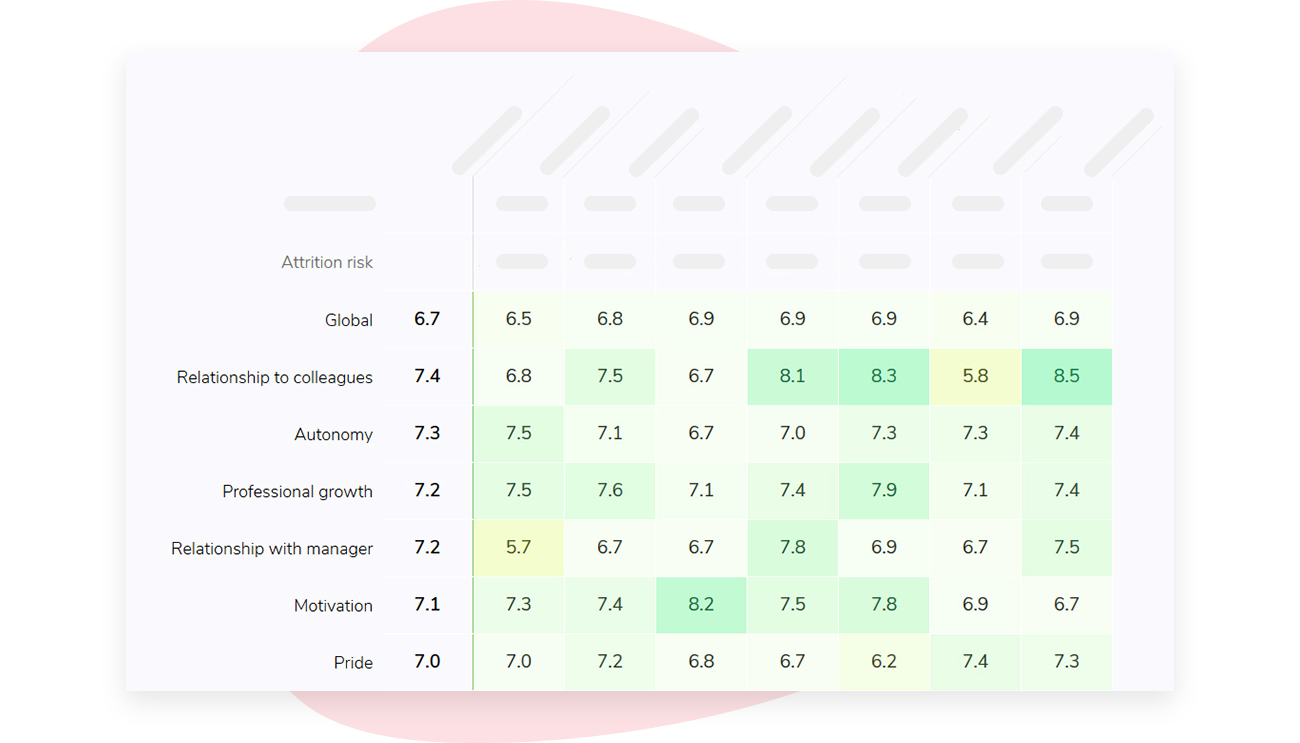
Our heatmap view makes it easy to showcase employee responses by department and manager group.
This tool can easily highlight if there's a gap limited to a specific function or manager level.
You'll also want to consider privacy concerns as you push your DEI data to more precise cuts.
Sparkbay hides results for any group that doesn't meet your minimum response threshold, which is configurable and set to 5 responses by default. You can't drill down to individual responses, and we recommend you put privacy first.
Sparkbay also automatically maps access to reports to your org hierarchy so that each manager sees only their own teams instead of all employee data.
This is a crucial consideration that can significantly impact your data disclosure rates.
Plus, Sparkbay is ISO 27001 certified - a security measure your company will want to see during your security review.
If you're interested in learning how Sparkbay can help you build a more engaged workforce, you can click here for a demo.
Give each goal one accountable owner
It's easy to launder accountability by writing "DEI Council" or "DEI Working Group" in the owner column.
DEI councils and working groups can ask tough questions and provide guidance, but they rarely have control over key pieces such as approving requisitions, setting pay bands, deciding promotions, or hiring into the business at all.
It's critical that the owner has control over the levers needed to make a goal's metrics move.
If the goal is to improve diversity in the hiring funnel, the accountable business executive owner is critical - even if the leader of the talent acquisition function is responsible for driving the work.
Whoever leads the calibration session should own the goal of promotion equity. The CHRO may own the pay equity goal, since their team may be responsible for the analysis and the DEI Council may have a larger role in providing guidance.
It doesn't matter what a person's title is. What matters is that as the goal owner, they have the ability to tell a hiring manager: "No, you're not bringing that requisition forward. We need to meet DEI objectives first."
A simplified model of DEI goal ownership includes:
- Owner: An individual who remains accountable for the outcome of the goal
- Driver: An individual or team responsible for managing goal activities and communicating progress toward the goal
- Contributors: Named teams who provide necessary data, expertise, and operational support
- Informed: Leaders and employee groups who receive agreed upon updates
Before you assign a DEI goal to someone, make sure they have what they need to be an effective owner:
- Do they have access to raw data they need to diagnose the organization's DEI gaps (not just summarized data delivered as a PowerPoint deck)?
- Do they have the ability to redirect budget or assign people to different tasks without constant approval?
- Do they have the ability to change the processes that lead to desired outcomes?
- Do they have the ability to challenge peer leaders if they aren't following through?
- Do they have the ability to own the number by communicating it to other employees and to the board?
If the answer is no for any of these questions, you either need to assign the goal to a different individual or get the necessary authority in writing.
When deciding on ownership, consider the organizational structure and turnover. A meaningful share of your critical goal owners may change roles within any given 18-month period. This isn't a surprising expectation given the level they're operating at.
To avoid goals being ignored due to a change in key personnel, you can write into the goal instructions that any successors will inherit the goal and its baseline metrics. You can also specify that the first review after any change in ownership will re-examine the goal and the metrics.
Without this rule, a major leadership change is a super-easy way to wipe away uncomfortable amber goals.
DEI leaders can ask that their DEI goals be included in the executive team's scorecards or performance discussions, but questions remain about whether incentive pay should be tied to specific goals.
There's a split of opinion among practitioners. Some feel that goals won't be taken seriously unless they're tied to incentive pay. Others prefer the ESG/DEI performance modifiers that committees can easily tweak.
My personal opinion is that it's cleaner to attach compensation to meeting verified milestones related to removing barriers and following processes as opposed to reaching certain headcount or representation goals.
That said, if your compensation committee has already established a representation goal, it's on you to make sure that goal is clearly defined and well-prepared for an assurance review.
Set deadlines on the work, not just the ambition
A 5-year ambition gives direction, but it also gives everyone 4 years to avoid making any hard decisions.
Break down your 5-year ambition into something more manageable by creating a 12-month commitment, setting quarterly milestones, and identifying actions for the next 90 days.
What does a milestone look like? It has to be a specific, verifiable deliverable.
"Complete the pay equity model and obtain review sign-off" is a milestone. "Make 60% progress on pay equity" is not.
Check in on the status of your milestones once a month for the team that's responsible for the work. Executive leaders should check in quarterly during business reviews. And externally, stakeholders should be informed once a year.
Make sure this external number is tied to the same data cut-off point as your internal quarterly results. You don't want to spend the entire external audit process trying to reconcile two versions of the same number.
Consider how you're aligning your quarterly milestones to your business calendar vs. your fiscal calendar. If you have a milestone related to offering promotions to more people, it'd be helpful to have that milestone due 3 weeks before you start your calibration process.
Research by Peter Gollwitzer and Paschal Sheeran shows that when people specify when and how they'll perform an action, they're more likely to follow through. This concept of implementation intentions can help you hold yourself accountable to your milestone commitment.
Don't forget to add a trigger date.
If you haven't moved the needle on closing the pass-through gap by your second quarterly review, it's time to make a decision. The business leader responsible for this commitment needs to decide whether to shake up the interview process, invest in more capacity, or revisit the diagnosis again.
Build a scorecard people can audit
The goal is to be able to fit your entire scorecard on a single page, even if the analysis that goes into it fills up a warehouse.
Each goal should have concrete metrics tied to it, including a baseline, current results, target, deadline, owner, trend, and status. There should also be a sentence that summarizes any blockers.
Goal: Reduce the promotion-rate gap for eligible employees.
Baseline: 7 percentage points
Current: 5 percentage points
Target: 3 percentage points or less
Deadline: End of 12-month planning period
Owner: Division president
Status: Amber
Blocker: Two departments aren't using the agreed upon eligibility definition.
Of course, these are illustrative figures. Your organization's baseline and legal review will help you set your actual target.
You'll probably spend more time determining your definitions than you will designing your dashboard. Does a level change during a re-org count as a promotion? Does an internal job transfer count as a new hire?
Does an employee who didn't renew their contract count as a voluntary exit? Do you count employees on parental leave in your overall eligible employee population?
Once you have answers to these questions, write them into a one-page document with your definitions, date it, and treat it as the official, controlled document. While the scorecard is the main output, it's helpful to have this ancillary document for audits, works councils, or even future leaders.
During the reporting period, lock in your methods. If you do adjust your definitions, restate the historical figures under the new definitions and demonstrate how the change impacts trends over time.
If you want your employees to volunteer demographic information, you'll need a plan for that as well. It's important to keep demographic collection voluntary (self-identification is encouraged but not mandatory) and for employees to know what the information will be used for, how long it will be kept, and who will have access to the information.
Disclosure rates may be higher or lower depending on the country and the characteristic you're collecting data for. For instance, rates may be lower for disability and LGBTQ+ status information disclosure. Rates may be even lower if employees believe their line manager will have access to the data.
This means your diversity gap metrics will only represent the diversity gap for a group of people who feel comfortable enough to disclose their data.
So it's important to keep track of your disclosure rates as a metric. Report it side-by-side with the diversity gap metric. If your diversity gap metric shows improvement, but your disclosure rate drops, that's usually a bad sign.
It means you're "losing" people in your sample, and the people who drop out of the sample are more likely to be individuals who weren't having the best experience.
This is related to what Amy C. Edmondson describes in her book The Fearless Organization. In an organization where it's not safe to speak up, the leadership doesn't get accurate data about how people are doing, and they may wrongly assume issues don't exist. Your DEI scorecard - especially if it relies on voluntary disclosure - may be vulnerable to the same problems.
You should also consider that local laws may prevent you from collecting the same categories everywhere. It may not make sense to use the same global scorecard for your entire organization when different jurisdictions have different policies and historical contexts. Your German and French co-determination policies may impact not just what you're allowed to collect but how frequently you're allowed to collect it.
Decide what to do when progress stalls
At some point, you may notice that a goal has turned red.
This doesn't necessarily mean you were wrong to set the goal. Instead, it means the goal owner needs to make a decision about what to do next.
Stalled goals usually fall into one of four categories:
- Bad goal: The metric does not align with the barrier you want to eliminate
- Bad plan: The activities you chose do not impact the mechanisms leading to the gap
- Bad execution: The goal owner does not have the time, budget, or resources to follow through on the plan
- Changed external factors: External factors such as freezes, restructurings, or market shifts impact the organization's original plan
When you notice a goal turning red, conduct a short retrospective immediately.
Did your key metric move, but your outcome metric lagged behind?
Did one department make improvements only to have another department undo those improvements?
Did the goal lead successfully execute on the planned activity, or did they complete the plan and delegate the rest of the work such that nothing actually happened?
Did something change underneath you, such as your baseline or how you define your data?
Once you've conducted this analysis, you'll decide whether to retire the goal (if the metric isn't useful), revise the goal (if your analysis leads you to set a different goal), or recommit to the goal (if you need to level up your execution).
Make sure to share this analysis with your broader organization. If you quietly delete goals, your people will think your overall scorecard was designed to look good on paper. And they'll notice, because the old scorecard exists somewhere on someone's computer.
Organizations that want to avoid punishment for missing goals are those that have regularly shared and discussed the mechanism for how they'll meet their goals.
Choose your first 2 goals
Avoid setting up a 12-metric programme just so managers can "work around" the metrics.
A simple way to choose which 2 goals to focus on is to look at your identified gap areas and select the one that impacts the largest number of people and has the shortest feedback loop.
You want to focus on the area that makes the biggest impact, but also prove that you have a system that works within a short period of time to avoid frustrating your stakeholders.
Below, you'll find sample goals that you can tailor to your chosen focus area once you've reviewed your baseline metrics and legal considerations:
- Hiring: Within the next 2 quarters, the talent acquisition leader will reduce the largest verified interview pass-through gap from the baseline metric to the approved target metric, with monthly reviews to assess progress.
- Advancement: Within the next planning period, the business unit president will close the promotion-review gap for eligible employees across identified job levels within the business unit or department.
- Pay: By the next annual compensation cycle, the CHRO will eliminate the unexplained pay differences identified through the approved pay equity method.
- Inclusion: By the fourth quarterly pulse, the division leader will increase the fair-access survey question score from the baseline metric to the agreed-upon score for the impacted employee population.
- Accessibility: Within 90 days, the operations leader will publish service standards for workplace adjustment requests and begin reporting on how quickly requests are completed.
Remember, these are simply sample goals. You'll need to plug in specific numbers, identify the appropriate owners, define your data points, and go through a legal review.
In your first 30 days, you should pull together your baseline metrics and identify the processes that create the largest verified gaps.
Select 2 goals, identify the appropriate owners for each goal (preferably in writing), and confirm they have the appropriate budget and decision-making power.
Ensure your legal and privacy teams review the language of your goal before you distribute it.
During your first 60 days, publish your first scorecard with a baseline metric, timeline for achieving the goal, and review schedule.
If you're interested in learning how Sparkbay can help you build a more engaged workforce, you can click here for a demo.