
"nice work" is free. how to build a system that keeps saying it isn't.
In The Progress Principle, Teresa Amabile and Steven Kramer share diary research that shows one of the most important factors affecting how people feel at work on a daily basis is making progress on meaningful work.
But this only holds true when people notice the progress.
And often, the people best positioned to notice meaningful progress aren't the ones reading the quarterly rollup.
They're the people who've witnessed you rewrite the client proposal, fix the broken report, or stay late to help QA get unstuck.
When your colleagues say "nice work", it means something different, because they know what it took to get that work done.
Now that you know how to start a peer-to-peer recognition program, it's time to think about how to keep it going in the second year without turning into a popularity contest, being jettisoned during a budget freeze, or becoming a compliance exercise that no one pays attention to.
In this guide, we're going to share 10 peer-to-peer recognition programs that are worth emulating.
We're also, mostly, going to focus on the design decisions you need to make to ensure people still use your program a year from now. We'll also discuss what you can't fix with a peer-to-peer recognition program, no matter how well you design it.
Designing a peer recognition program that does not fade after three months
- What is peer recognition?
- Why peer recognition works
- 10 peer-to-peer recognition programs worth copying
- The year-two problem
- Decide who can recognize whom
- Decide whether recognition should carry cash
- Keep recognition from becoming a popularity contest
- Read recognition data without shaming quiet teams
- Find your recognition deserts
- Know what peer recognition can't fix
- Run a 90-day program health check
What is peer recognition?
We won't bore you with a textbook definition of peer recognition. Instead, let's discuss what a peer recognition program is responsible for and what it isn't.
First, it's important to recognize that recognition from your peers can provide valuable benefits that a manager cannot.
For instance, your peers can recognize and validate efforts at a time when you need it most.
They are also able to offer meaningful recognition from the right people within your organization.
Your peers understand the importance of your efforts. They see the insightful solutions you come up with, the questions you ask that save the team from making bad assumptions, and the time you spend working behind the scenes to support your team's success.
Over the years, less glamorous workplace research has uncovered startling results about how companies operate.
Over the last week, most employees can't recall receiving specific, useful praise.
And the jobs with the biggest skills gap had the hardest time receiving positive feedback.
These were roles where the individual's contribution often went unnoticed or was taken for granted when everything went smoothly.
Of course, peer recognition programs have their limits. They don't eliminate the need for employee feedback from managers.
They don't eliminate the need for fair compensation, either.
And they don't replace overall performance management strategies within an organization.
In fact, the fastest way to undermine a peer recognition program is to roll it out at the same time your organization freezes merit increases.
That sends the message that the thank yous and recognition from a colleague are nice to have, but not that important.
While receiving a thank you from a fellow worker can be incredibly meaningful, it doesn't replace employee promotions or compensation.
Another key consideration is timing. If your company is on the brink of a massive restructuring, a hiring freeze, or rolling out massive changes to your work from home policy, it may be best to postpone launching your peer recognition program.
These big changes are on the horizon, and anything positive that enters the field could be seen as a distraction.
Why peer recognition works
It makes the recognition more meaningful by identifying specific behaviors and praising people for specific things they've done.
Instead of simply saying, "You're amazing!" Your recognition message says, "How you did X when you revised this handoff helped us get through the testing phase 2 days faster." Now that recipient has a specific story and piece of evidence that they can draw on when they're speaking with other people in their career.
Why are peers so helpful for recognition?
They are more likely to notice when their colleagues and employees are doing a great job. Plus, they can provide reputation-building information that managers cannot. This helps people understand how they're viewed by other people who they need to work with.
A peer recognition program may not have a greater impact than a manager recognition program in all situations. But it performs better in situations where speed and context are important. That said, it may not be as helpful in situations where individuals want to secure resources.
Research on feedback and praise shows that specific praise tied to a person's work encourages motivation. On the other hand, vague praise or solely evaluative praise can often be ineffective. In some cases, it can even be detrimental if it makes people feel like they're putting on a performance.
So be sure to collect information on: What specific behavior did the person display? Who did the behavior help (specific person or team)? How did this behavior help?
While it sounds obvious that this information would be included in recognition messages, it is often left out.
10 peer-to-peer recognition programs worth copying
- The peer bonus pool:
To encourage employees to recognize their peers, give them a small monetary bonus each month they can distribute to another employee.
Of course, don't allow these bonus credits to roll over to the next month. Otherwise, people may wait to use them for a grand recognition event instead of using them for everyday recognition.
Additionally, keep the value of each transaction bonus low enough that the finance team doesn't require an approval process for each recognition event.
This preserves the time-sensitivity and spontaneity that make peer recognition so effective.
- The travelling trophy:
Pass around a physical trophy from one employee to another. Each time the trophy changes hands, it comes with a short note explaining why the previous holder passed it on.
To avoid the trophy constantly rotating between the same team, ask employees to choose someone from outside their immediate pod.
- The structured shout-out channel:
Use your chat software or another internal tool to create a shout-out channel specific to your organization.
To ensure this channel isn't a stream of emojis, ask employees to post 2 mandatory pieces of information: what the person did and what impact it had.
Ideally, this channel should have a search function or some sort of saved archive, so these information-rich posts don't get lost in the stream of chat conversations.
This is also a good reason to create a channel that is separate from other chat activity. Otherwise, these posts may only be viewable for a day or two before returning to the stream.
- Cross-functional kudos:
Consider giving recognition rewards only to employees who receive kudos from someone in a different function.
This programs surfaces and rewards internal service activities while discouraging reciprocal recognition exchanges within tight pods.
- Feedback Fridays:
Give employees 15 minutes to share recognition for something useful a colleague did that week.
Make sure to rotate who runs this feedback session to keep it fresh.
And avoid adding an agenda and turning it into a status meeting. Otherwise, people won't prepare.
- The milestone yearbook:
Ask your employees to document career firsts, new project launches, and work anniversaries.
This is a great way to share peer stories that are more compelling and interesting than templated, generic HR anniversary posts.
However, be careful that this recognition event doesn't focus exclusively on tenure. If you have a quick turnover rate, this may exclude the majority of your workforce.
- A digital wall of fame:
Similar to the shout-out channel, this is an easily searchable and exportable archive of recognition events.
It's up to you to decide how long you want to keep these entries and whether they'll stay on the page even if the person who wrote them leaves the company.
- Coffee or small-perk credits:
Another option is to organize rewards that are small enough to be sent out without an approval process.
Non-cash rewards are taxable above certain de minimis thresholds in most jurisdictions, so make sure your payroll team has the reporting process down before you launch this program.
- Public praise:
Share public praise with your company community or on the employee's external professional network.
Make sure this sharing is strictly on an opt-in basis, that you create a record of employee consent if the content is distributed externally, and that there's a rule about mentioning client names.
- The progress log:
Ask each team to provide one concrete step forward they've made each week and give credit to the people who helped make the progress happen.
If your organization has a shop floor where most employees don't have regular access to a laptop, this kind of program is an effective choice, even if it's the program that's most directly linked to the overall process of recognition.
Choose one.
Launching multiple peer recognition formats at once can be confusing and overwhelming for employees and messes up data collection.
You want to be able to tell which format is reaching the most people, so you can decide which format to prioritize.
Plus, some employees prefer private recognition over public events either because of their personality or because they're in a highly competitive team environment where they don't want to stand out.
Creating a way to log that preference, allowing employees to update it, and creating the default option of private recognition for new hires who haven't shared their preference is a good option.
The year-two problem
In the first several months of your recognition program's launch, everything may look great. There's been a lot of commotion around the launch, managers are nudging their teams to participate, and the program's novelty keeps people interested.
But a few months in, you start to notice that the vast majority of your recognitions come from a small handful of people. By the time you're nine months in, people actively scroll past your recognition feed when they log into your communications platform. And maybe after that first annual budgeting review you find that the money you've set aside for perks is now set aside for something else.
Why does this happen?
There are a few reasons for this year-two problem:
- It's not clear who can participate in the program
- The reward is much more valuable than the message it's trying to convey
- People in more high-profile roles disproportionately dominate the recognition feed, making others feel like it's not for them
- No one owns checking in on the program to ensure it's still being prioritized after the launch manager moves on
There's also another possible reason for the year-two problem that's less discussed: praise inflation.
When every recognition message feels like a standing ovation, people don't feel like they can take them seriously. They start to view a heartwarming message about a hard save they pulled off the week before the holidays as equal to a quick three emoji response for rebooting someone's printer.
How do you fix this? Not by limiting the amount of appreciation you have, but by focusing on high details and specifics.
Why? Because when you focus on sharing specific details about contributions, these recognition messages naturally scale with the size of a person's contribution or impact while the adjectives used to describe the impact remain the same.
By focusing on the details in your recognition messages, you create a more meaningful experience for users.
Furthermore, most recognition programs don't spend enough time thinking about the details within their recognition messages. They spend most of their design time trying to figure out what kinds of prizes they're going to offer.
Decide who can recognize whom
In an "open" recognition program, any employee can recognize any employee. This is the simplest approach to explain and offers the greatest number of opportunities for recognition. Plus, it allows colleagues within a "clique" to have friendly back and forth recognition.
At the other extreme, some organizations only allow recognition across teams. This breaks down silos by giving employees opportunities to recognize others outside their immediate team.
Finally, you could adopt a "tiered" approach. In this approach, perhaps no one can offer a monetary award, but free recognition is available across all teams. Then there's a minimal approval process for monetary rewards that go to someone outside your team.
For most large organizations, a tiered approach is a smart way to start. That said, it's important to clearly define what constitutes a "team boundary" within the recognition system, based on the HRIS reporting structure. In a matrixed organization, you may have a lot of recognition happening across dotted lines, leading to a lot of initial debate about whether that counts as a "cross team" recognition.
There are two policies worth prioritizing. One is to avoid monetary rewards for upward recognition. The other is to figure out what to do with contractors and agency employees.
It may make sense to exclude them from the recognition program, but you want to know that before you launch.
Finally, you'll want to ensure that employees can thank their managers.
Recognition programs create a power dynamic, so it's better to figure that out up front.
Some other key issues to address are:
Works councils and employee representatives. In some European countries, employee representatives have a right to be consulted on processes that store personally identifiable data about employees. A recognition platform is exactly this, so be aware.
Retention and discoverability. Recognition messages and notes form part of an employee record. They may need to be accessed if that employee submits a grievance, gets involved in a dispute related to termination, or needs to submit an appeal for promotion.
Portability. Who owns and has access to the recognition system archive if you change vendors? Will you be able to export the data in a format you can easily read?
Decide whether recognition should carry cash
In Drive, Daniel Pink distinguishes between "if-then" rewards and "now-that" rewards.
But think about what happens when you do an "if-then" exercise and come up with a rate card for your freelance services.
Suddenly, your clients have a price point for what a "quick turnaround over the weekend" is worth. Some may wind down their efforts to match the price. Others may only pay attention to the price, not the favour.
In Predictably Irrational, Dan Ariely discusses this point further. Social norms and market norms are very different.
Your colleagues happily do you a favour for free, all day long, within social norms.
But if they know they'll be charged for that favour, they start thinking about whether it's a fair price.
Social norms and market norms are different and switching from social to market norms is hard to reverse.
When you switch from social norms to market norms, it's very obvious. But switching back to social norms is viewed as a "pay cut".
Research on reward crowding doesn't show a blanket rule.
Contingent incentives work well for straightforward, routine tasks that are easily measured. They're harder to manage when the work requires judgment, learning, and innovative problem-solving.
This is potentially the focus of a lot of your peer-recognition efforts.
You're better off keeping the social layer of your recognition program free and unlimited.
Your financial rewards should be small and occasional and not part of any published price list.
If your organization suddenly freezes its budget for the program, you can watch the impact on your program.
Does the program slow down considerably? You've built a rewards program instead.
One smart strategy is to distribute small rewards that are not worth enough to cause a behaviour change, but that are big enough to make the sender of the reward feel like they're spending something.
A good lunch may be a sufficient price point to start with in many markets.
Keep recognition from becoming a popularity contest
Make the recognition messages meaningful.
"Sam is awesome" doesn't tell your organization much. "Sam rebuilt the migration guide so support could easily answer client questions" does.
Limit the number of messages a user can send per month, so they think carefully about who they want to recognize.
Instead, consider rotating which messages are front and center.
A leader board may unfairly favor teams that have high visibility within the organization such as sales, marketing, or senior leadership.
Teams like infrastructure, payroll, compliance, or night-shift teams can contribute tremendous amounts of value, but their work isn't highly visible.
On the topic of demographics, consider that recognition messages are often based on proximity, communication style, and speaking opportunities.
This means part-time employees, non-native speakers, employees who alternate between working and parental leave, and people who aren't in the same time zone as the HQ may not get recognized.
Your program should address this during quarterly reviews and prompt reviewers in various languages to do so.
You don't want your recognition messages to lose credibility by turning into a points game where people feel like they're in a popularity contest.
At the same time, avoid integrating recognition messages into performance ratings processes.
You want recognition to help employees prepare for career conversations, but you don't want recognition to turn into a numerical performance review metric.
If you can't guarantee this, don't share recognition message counts with managers at all.
Read recognition data without shaming quiet teams
Recognition data helps you understand whether your recognition program is reaching people, but it's not helpful for understanding who's doing well.
There are five key recognition metrics you should be tracking: Giver participation rate, Receiver coverage (the share of people who received at least one recognition message), Share of recognition messages crossing a boundary (i.e. between departments), Time-to-first-recognition for new hires, and Concentration (what share of recognition messages are received by the top 10% of recipients).
Time-to-first-recognition is an underrated metric. If a new employee goes through their entire onboarding period without receiving a single positive recognition message from a peer, it can indicate that they haven't been properly integrated into the team. This is often a leading indicator for early turnover.
You can also include a reciprocity metric if you think people might be gaming the system by giving and receiving recognition from the same peer.
Your quieter teams may have a preference for thank you messages sent by direct messages or verbal thank yous. If their overall engagement survey results or belonging survey results are strong, receiving fewer recognition messages on the platform isn't necessarily a bad thing.
Instead, look for divergences within your data.
If the amount of recognition messages is low and your other metrics indicate low engagement, poor manager support, or low sense of belonging, then it's worth having a conversation with that team.
Recognition data often correlates with retention data within most employee datasets. The causality can go both ways - healthy teams are already more likely to work well together and therefore recognize each other more - so use this insight as a prompt to dive deeper rather than an opportunity to make big promises to your CFO.
Use this data in your program's own spirit. Share these insights within a private setting with your managers and let them share context for why the data might look a certain way.
At Sparkbay, we help organizations compare recognition trends with how employees are feeling, based on their responses to our engagement surveys.
This is important. A low kudos count isn't always a bad thing, and your teams might not need to be overly concerned about it. One team could consistently receive recognition through direct messages or verbal thank yous while another team feels like they're overlooked by the rest of the organization.
Our engagement surveys, delivered on a cadence of your choosing, include an engagement score out of 10. You can customize the questions, the wording in our dashboards, and the content of these dashboards, so you're measuring the success of the program you put in place.
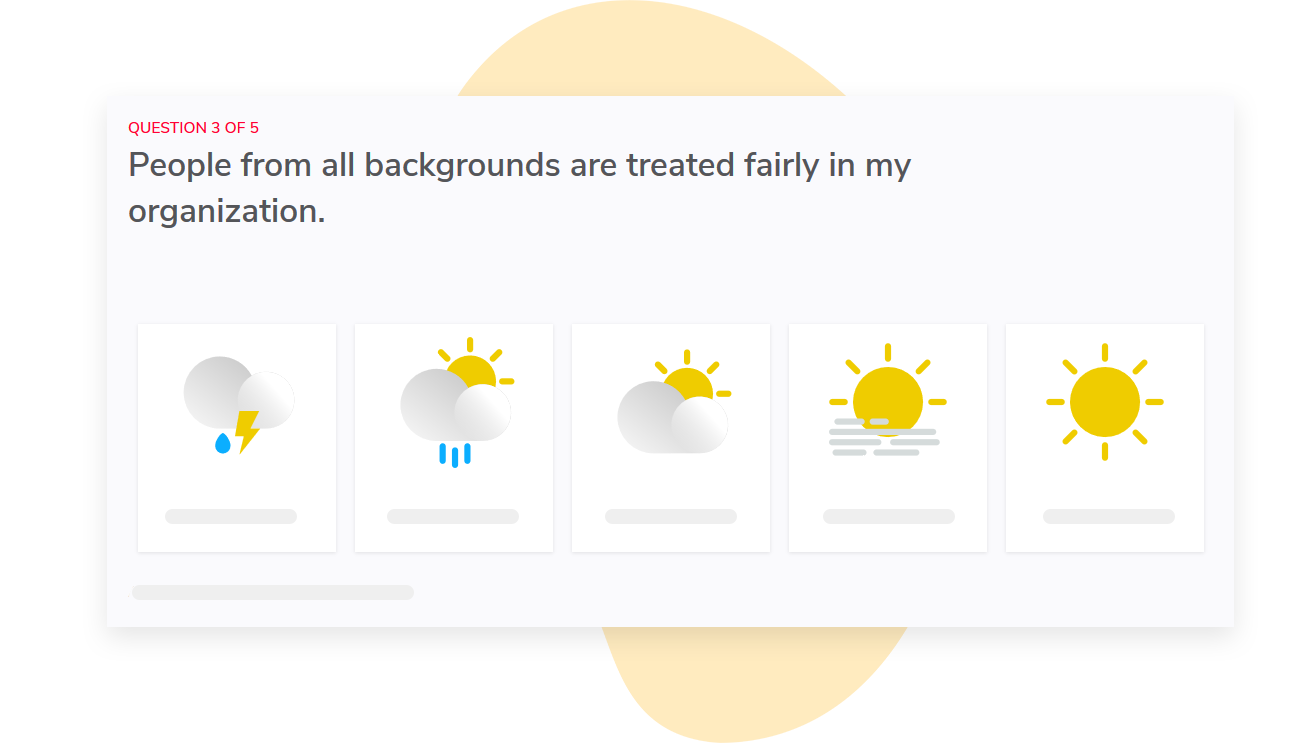
You can then filter your results based on manager, department, tenure, and another important groupings.
In other words, if you have a function with low peer-recognition but high engagement, you know you probably don't have to prioritize that team. But if you have a group with a low recognition rate and a decline in their sense of belonging scores, you know you want to prioritize checking in with them.
The tool automatically accounts for your organizational hierarchy, so data can only be viewed by managers up to their level. This means managers can only see the data for the teams they manage.
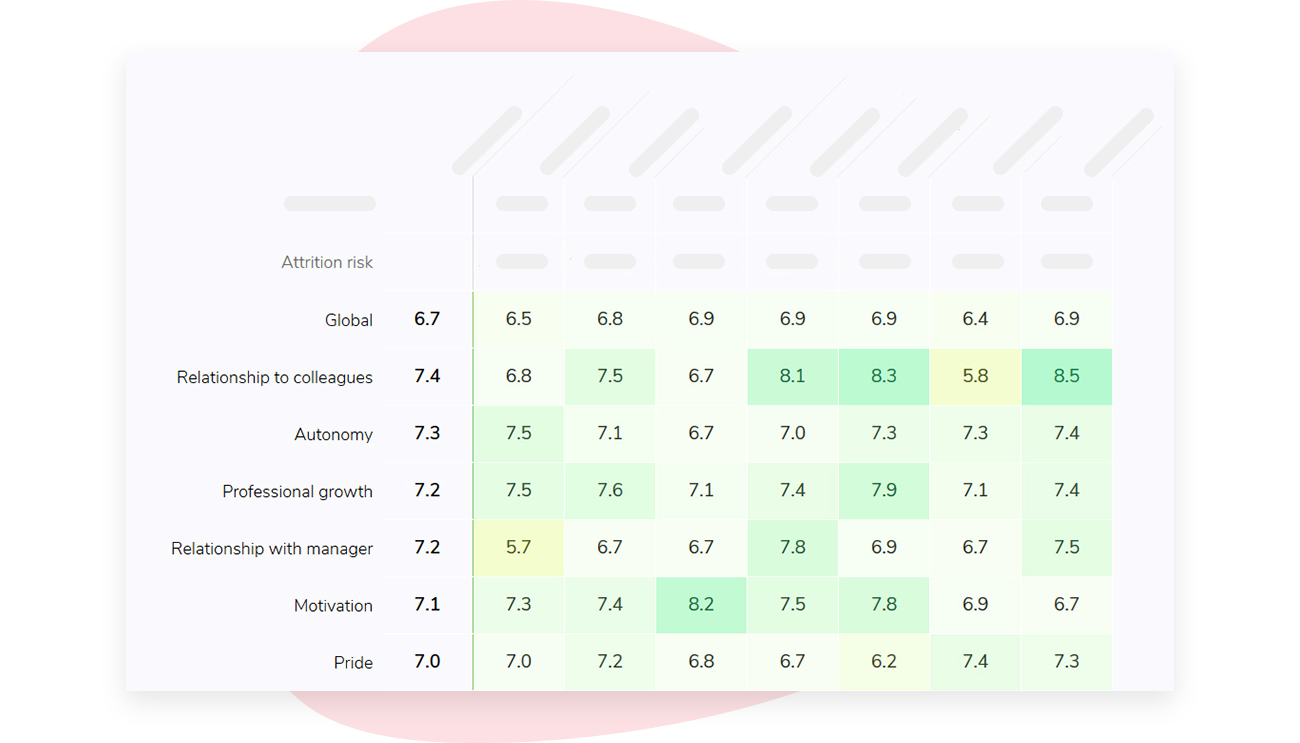
We also hide results if the number of respondents is below a minimum threshold, which you can configure (5 by default). This protects the anonymity of employee responses while still allowing HR teams to analyze trends.
If you're interested in learning how Sparkbay can help you build a more engaged workforce, you can click here for a demo.
Find your recognition deserts
A "recognition desert" is an area of your organization where very few people receive recognition through your recognition program.
Before you undertake a culture diagnosis, make sure you're not looking through the wrong lens. If your recognition program is tied to corporate SSO and laptops, you may be shutting out frontline workers or night shift employees.
They may not have easy access to your recognition program. This is inconvenient and leads to uneven recognition.
How do you solve this problem? It may be something as simple as putting a QR code on a poster in the breakroom, putting a kiosk near the clock in station, or having supervisors read the week's messages aloud at the shift change.
Overall, it's less elegant than a beautiful platform, but it's the right solution if 40% of your workforce can't easily access that platform.
Run a recognition coverage map at least once per quarter.
Organize your recognition recipients by team, location, shift, or tenure. Flag any groups where no one has been recognized in the last 90 days.
You'll likely find that your night shifts, satellite offices, contractors, and back office teams aren't often recognized.
It's easy to overlook recognition in an organization. You tend to focus on compliance, security, or maintenance.
But when those areas function well, it's because an incident didn't make it to your team.
So ask your employees questions like:
Who kept a problem from reaching your team?
Who answered a question before it became a delay?
Who made your work easier without making it to the final presentation?
Hybrid and remote workers can exacerbate recognition deserts or gaps. Informal feedback loops can happen in person through the physical office space or through interactions people have during their coffee breaks.
Even if companies adopt the same formal review feedback processes, employees working outside the building may not benefit from the same level of feedback.
A quarterly "who unblocked you?" campaign helps bring some of that work to light without asking your employees to put more work into being recognized.
One word of caution: If you undertake a recognition desert fix only to leave these newly recognized groups in the dust for another three quarters, you run the risk of reinforcing the belief that they're being ignored.
Know what peer recognition can't fix
Your peers can help you validate your work, but they can't fix everything.
For instance, your peers can't make up for a manager who controls your work priorities, the resources you have access to, and your access to career opportunities.
In fact, this is an important point. A thriving feed for peer recognition can mask a poor manager who isn't providing specific feedback.
This is something you should be aware of at your organization. You don't want a great peer recognition system to mask poor manager interactions.
Peer recognition also can't make up for compensation problems.
A stream of positive messages and praise can feel like salt in the wound if your workload has increased but your compensation hasn't.
This is a common theme we've seen when speaking to organizations or studying why employees consider leaving companies. Compensation, manager quality, and career growth opportunities are all important factors to consider when retaining employees.
Lastly, there's a risk of over-engineering your peer recognition strategy. Each addition - points, badges, tiers, approval rules, campaigns - introduces complexity to the process.
The more complex the process, the less timely peer recognition will be.
This raises another important question to consider when designing your peer recognition strategy. When you conduct your engagement surveys, ask your employees this question:
If they receive recognition, do they also feel like their work matters?
If these two factors move in opposite directions, then your employees may feel like they are being rewarded for "checking tasks off".
Run a 90-day program health check
Assign an owner to review the following items on a quarterly basis (every 90 days):
- Has at least 40% of employees given recognition?
- Has anyone not been recognized at all in the last 90 days?
- Has approximately one-third of the recognition crossed team boundaries?
- Are the same 5 people dominating the visible feed of recognition?
- Did the level of activity drop during a period when you paused your reward budget?
- Can you spot any gaps in recognition based on location, function, shift, or tenure?
- Are the messages describing a specific behavior and its positive impact?
- Have employees used the saved up recognition for career conversations?
Keep in mind that the numbers I've mentioned (e.g. 40%) are based on my own opinion of what constitutes a healthy program. They are not meant to be taken as hard and fast rules.
Use these figures as a guide to help you think through your program. It makes sense to adjust them based on other factors.
For instance, the numbers generated by a manufacturing facility may be very different from a smaller knowledge worker unit. Setting a goal of 40% participation in employee recognition in a manufacturing facility, where workers share access to terminals, may not be a useful goal.
It's worth noting that the last bullet point on the above list is the only one that shows that the recognition program has done something impactful and positive over the long term.
Finally, it's smart to start out using a specific recognition format or focusing on a specific population of employees (e.g. your customer service team).
After 90 days, run a health check to make sure everything's working as expected.
Frequently asked questions
- How should peer recognition work for remote or hybrid teams? Asynchronous, written peer recognition is helpful for remote or hybrid teams, since people can complete the recognition at a convenient time and the recognition is saved in a searchable location. Make sure that your recognition prompts are staggered at different times to accommodate different time zones, so your recognition software doesn't inadvertently favour employees who do the most overlapping hours with headquarters.
- How often is too often? Too often is when employees don't say what they're thankful for or what they appreciate about another employee, or when someone posts recognition just to tick a box. There's no harm in sharing sincere peer recognition that names a coworker's specific actions.
- Should peer recognition be anonymous? Usually, no. The relationship between the recognition giver and the recipient makes the recognition more meaningful, and your recognition feed can become a rumor mill if people are posting anonymously. However, you can direct employees through confidential surveys if they have concerns or want to share sensitive feedback.
- Should managers be required to post? No. If employees think managers must post a recognition, they'll quickly spot a forced message once they read a few lines. Then they'll discount all posts from that manager, even their genuine posts. Instead, encourage managers to be aware of their team's accomplishments.
- What should HR do if they notice someone gaming the system? Address it privately by reviewing the person's activity, applying the rules, and if necessary reversing any traded rewards. Don't address it publicly on the feed, otherwise you'll discourage others from participating.
- Who should own a peer recognition program? HR should oversee the rules, data, and fairness of the peer recognition program. Within individual teams, managers and team leaders can decide how peer recognition fits into their teams' week. There is a split opinion on whether the communications department or HR should oversee the overall, public-facing mechanism of a peer recognition program. Either way, there should be a dedicated owner of the peer recognition program to review quarterly participation levels.
- When should you discontinue a peer recognition program? If there's been no noticeable change in participation levels over the course of a year, and there's nothing in the repository of recognitions that someone would be proud of sharing for their careers, it may be time to discontinue it. A careful sunset of a program that includes recognition of the entire organization's participation is better for your company's credibility than quietly letting the program become irrelevant on a public-facing platform.
Even if your peer recognition program is small, it can continue catching real progress.
Every quarter, you can review eligibility, reward budget, and participation levels, and shift the focus of your recognition prompts towards those areas that tend to get missed.
If you're interested in learning how Sparkbay can help you build a more engaged workforce, you can click here for a demo.