
Your CEO wants a five-year view of employee engagement before Friday’s board meeting. You open the survey platform and find that the first three years of results vanished when your company changed vendors.
You call the former provider. Your account closed 60 days after the contract ended.
The vendor still holds the raw responses, but it will only release a basic PDF report, and restoring access will cost $18,000.
Most HR leaders assume the company owns every response employees submit. The contract usually says otherwise.
It grants the vendor broad rights to store, combine, anonymize, and reuse that data, while giving you only time-boxed access through the interface.
Ownership and access are separate rights, and the space between them is where organizational memory disappears. Even airtight ownership language does not guarantee a usable export.
A proprietary file format, unlicensed benchmark data, or an undisclosed scoring model can leave you with files no other system can reconstruct.
The risk concentrates when a vendor is acquired, sunsets a product, or hits financial trouble-the same moments when notice periods shrink and cooperation weakens. Meanwhile the GDPR and CCPA obligations attached to that employee data outlive the platform, and they land on you rather than the vendor.
This article covers what to lock down before signing and how to retrieve data when the relationship ends: export and retention terms that hold up under pressure, and a vendor-exit process you can run in weeks instead of negotiating under duress.
Data ownership, export formats, and retention when a contract ends
- The question nobody asks until it is too late
- "ownership" and "access" are different rights
- What the survey vendor contract actually says
- The anonymity paradox
- Your data can remain trapped in the vendor’s format
- Export rights need to produce usable data
- Set retention by data type and purpose
- Plan for vendor exit before implementation
- Data ownership does not replace privacy compliance
- Use a data ownership checklist during selection
- Negotiate terms that work under pressure
The question nobody asks until it is too late
Selection teams optimize for questionnaire design, participation, reporting, security, and implementation. Portability shows up, if at all, as a single yes/no procurement line: Can we export our data?
A "yes" tells you almost nothing. The export may cover only the current cycle, drop comments, strip organizational attributes, or arrive as a PDF.
The questions that actually matter-what content, at what level of detail, in what format, with which identifiers and documentation-rarely reach the scorecard.
Ownership turns urgent the moment the business needs a trend that spans two platforms, or when the vendor gets acquired, retires a product, pushes fees past your threshold, or drops below your security bar. By then your leverage is gone.
Treat survey data as a long-lived corporate record rather than a feature inside one platform. That record includes far more than individual answers:
- Survey wording, response scales, translations, and question identifiers
- Response dates and survey-cycle identifiers
- Organizational attributes used for analysis
- Aggregated scores and historical trends
- Open-text comments, subject to confidentiality controls
- Rules used to calculate engagement and other measures
- Data-quality notes, exclusions, and suppression settings
Get procurement, HR, privacy, security, legal, and people analytics to agree on the required record before you evaluate vendors. Skip that step and each function negotiates against a different definition of "our data"-and the narrowest one usually wins by default.
"ownership" and "access" are different rights
A contract can confirm that you own employee responses while limiting access to the subscription term. Once the agreement ends, that ownership clause is worth little if you cannot pull a complete, structured copy.
The reverse is more common: broad platform access alongside vendor-reserved ownership of scoring methods, benchmark datasets, report structures, and derived measures-the layer that turns raw answers into insight.
Push the contract to distinguish at least five categories, because a single term like "platform data" lets the vendor sweep all of them under its own rights:
- Customer-provided data: employee files, organizational structures, demographics, survey wording, and translations supplied by the employer.
- Response data: ratings, selections, comments, submission dates, and related survey records.
- Customer-specific outputs: scores, heatmaps, reports, action plans, and analyses produced from one company’s data.
- Vendor materials: software, standard question libraries, report designs, scoring methods, and documentation created independently by the vendor.
- Aggregated or de-identified data: information combined across customers or altered so it no longer identifies a person or organization.
For each category, the contract should state who can use it, for what purpose, and for how long-including after termination.
What the survey vendor contract actually says
Data rights are deliberately scattered across the master agreement, DPA, privacy notice, security schedule, product documentation, and order form. Reading the ownership clause on its own tells you next to nothing.
Start at the ownership provision, then trace every carve-out. Language like "subject to the vendor’s rights below" routinely hands substantial reuse rights to a clause three documents away.
Aggregation and reuse rights
A vendor legitimately needs rights to process responses to run the service. The overreach hides in the neighboring grant covering product development, commercial research, model training, or benchmark creation-often perpetual, irrevocable, and worded to survive termination.
That clause is where your data leaves the building. Ask whether the vendor combines your data with other customers’ data, and pin down exactly what prevents identification of individuals, small teams, sensitive job families, and your organization as a named entity in a benchmark.
De-identification standards
Stripping names does not anonymize a dataset. Location, department, tenure, level, language, and survey date, taken together, frequently resolve to one person-especially in a 12-person function with one woman on the leadership track.
The agreement should specify the de-identification controls and expressly bar the vendor and its subprocessors from attempting re-identification.
Ask the vendor to commit to a stated standard-k-anonymity, where every combination of quasi-identifiers maps to at least a set number of people-instead of a vague promise that data is "anonymized." A concrete threshold is testable. A marketing adjective is not.
Derived data
"Derived data" typically covers calculated scores, classifications, comment themes, predictive indicators, and transformed variables. Left broad, it lets the vendor claim exclusive rights over outputs built almost entirely from your responses, then license those outputs back to you as part of the platform.
Enumerate which derived outputs you can export and keep using after exit, and hold that line separate from the vendor’s genuine IP.
The anonymity paradox
Corporate ownership of the dataset does not mean every executive, administrator, or manager should see every record. The stewardship model matters as much as the ownership clause.
Most enterprise programs run on confidentiality rather than true anonymity, because the platform still needs to deduplicate submissions, send targeted reminders, and attach approved org attributes. Identifiers therefore exist somewhere, so the real control is the wall between identity management and reporting access.
Suppression thresholds are the visible defense, but they tend to fail through subtraction. A manager who runs a department report with and without one small site can back out the excluded group.
Test whether overlapping cuts, filter combinations, and period-over-period comparisons can reconstruct suppressed cells. A threshold that holds on a single report can leak across several.
Exports carry the same exposure. Handing a wide group of analysts a row-level file with detailed attributes breaks the confidentiality promise even after names and emails are gone, because the attribute combination is the identifier.
As Amy C. Edmondson argues in The Fearless Organization, people speak up when interpersonal risk feels manageable. Technical controls create the conditions. They do not survive the first time leadership visibly traces a critical comment back to its author.
Document distinct access rules for administrators, HR analysts, executives, managers, and external advisers, and make sure export rights inherit those same limits instead of routing around them.
Your data can remain trapped in the vendor’s format
A vendor can return every response and still leave you unable to rebuild your history. Structure, not completeness, decides whether an export is usable elsewhere.
You need stable, persistent identifiers for survey cycles, questions, response options, org units, and approved attributes. Labels alone break the moment wording is revised, a question is reworded across cycles, or a department is renamed in a reorg.
Joins fail silently and trends fracture.
Insist on a data dictionary covering field names, formats, permitted values, missing-value codes, time zones, weighting rules, and the relationships between files. Without it, an export is a pile of columns nobody can safely interpret in two years.
Scoring is the deeper trap. If the platform collapses several items into an engagement score without disclosing the method, no successor system can reproduce your historical numbers, and your trend line resets to zero on migration.
Demand enough documentation to reconstruct each score:
- The questions included in each measure
- The treatment of missing answers
- Any weighting or normalization rules
- Rounding methods
- Changes to the model over time
- The minimum response rules applied to reports
The model-change history matters more than teams expect. If a vendor quietly re-weights or adds items between cycles, a "drop" in your score may be a scoring artifact rather than a real change-and without version notes you cannot tell which.
Benchmarks are a separate matter again. A vendor may let you view comparisons without licensing the underlying benchmark for export or continued use.
That restriction is defensible when the benchmark is proprietary, but recognize that your historical percentile ranks and comparison values can vanish at exit. Export every licensed benchmark result you are entitled to keep before you terminate, not after.
Export rights need to produce usable data
Negotiate export terms during selection, while competing bids are still on the table. "Standard exports" hands the definition of standard entirely to the vendor at the worst possible moment.
Grant exports during the subscription, at contract end, and across a defined transition window. Make them apply to vendor-driven events-acquisition, product discontinuation, insolvency-not only to termination you initiate.
Define the export package
A real exit package is several linked files, not one spreadsheet. Require machine-readable, non-proprietary formats where practical-CSV or JSON-with Unicode so multilingual comments survive intact.
- Survey definitions, wording, translations, and response scales
- Question and survey-cycle identifiers
- Response records at the contractually permitted level of detail
- Open-text comments with agreed confidentiality safeguards
- Organizational hierarchy and attribute files
- Aggregated reports and historical trend values
- Score definitions and calculation documentation
- Suppression, exclusion, and weighting rules
- A data dictionary and file relationship map
- Action plans or follow-up records stored in the platform
Run a full test export during implementation, then repeat it on a schedule. An untested export right routinely fails the first time it is exercised-when you have three weeks to migrate and no leverage left.
Validate record counts, identifiers, character encoding, date formats, missing fields, and score reproduction against the live platform. Keep the reconciliation script so the team can rerun identical checks on the final delivery.
Specify delivery security: encryption in transit, an approved transfer method, restricted access, and written confirmation that temporary transfer copies were deleted.
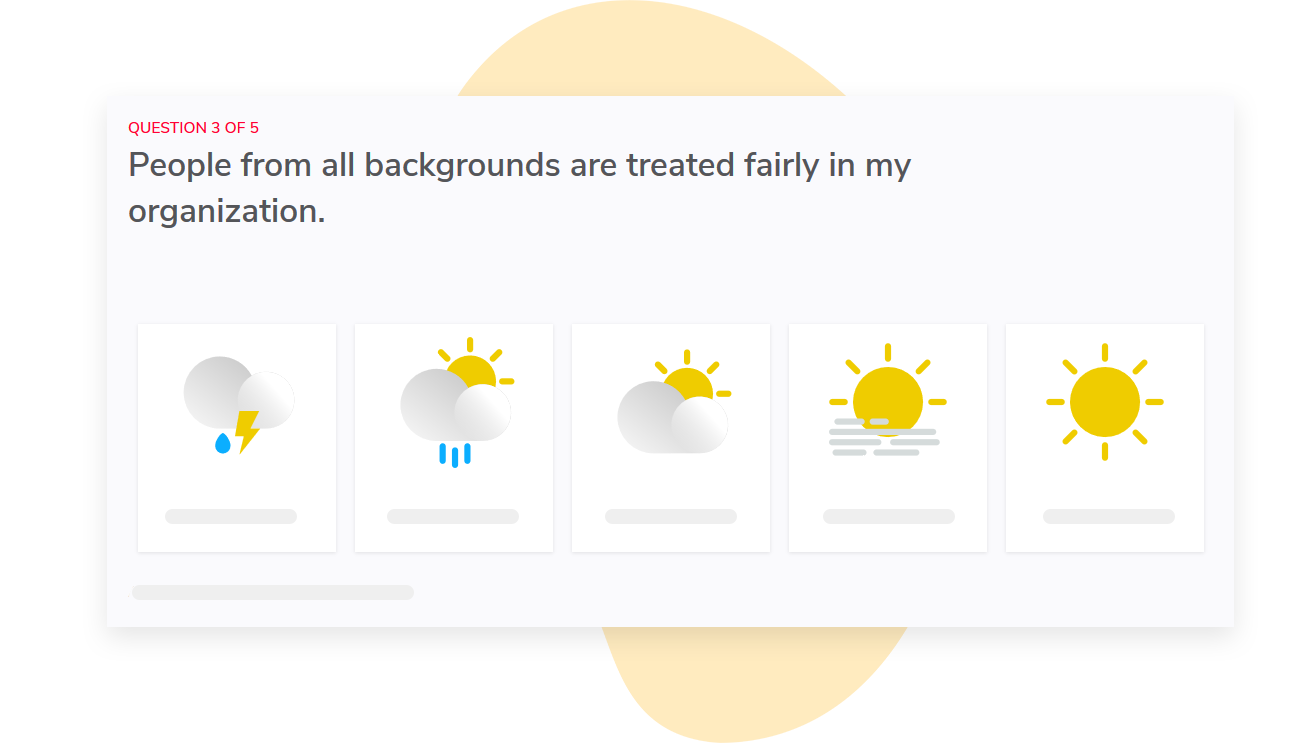
Sparkbay automatically collects employee feedback at regular intervals, and many clients run monthly pulse surveys. It presents the findings in intuitive reports built around a clear engagement score out of 10, with eNPS available as a secondary measure.
Teams can segment results by manager, department, tenure, and other approved attributes. They can also compare results with companies in their industry, which helps HR tell a local issue apart from a broader pattern.
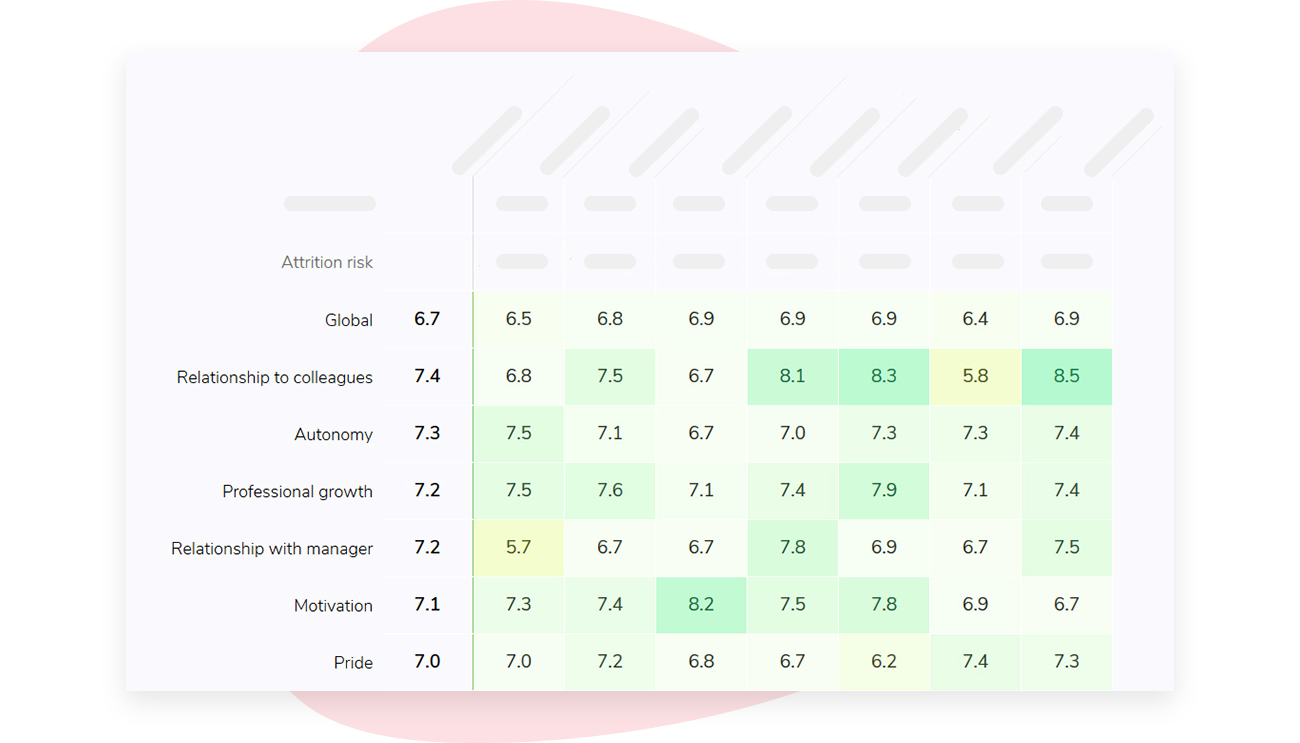
Sparkbay is highly configurable, from survey wording and dashboard wording to the content shown on each dashboard. That flexibility lets large organizations standardize measures across business units without forcing every group into a reporting structure that does not fit how it operates.
Report access maps automatically to the organizational hierarchy, so each manager sees only their own teams. Results stay hidden below a configurable minimum number of responses-five by default-which keeps day-to-day reporting confidential instead of relying on manager discretion.
Managers then work from Sparkbay’s library of easy-to-implement actions to respond to what their reports surface. That closes a common governance gap: controlled access should drive action, not tempt teams to widen distribution of raw comments to "get context."
Sparkbay holds ISO 27001 certification, giving procurement and security teams an established control framework to examine alongside your contractual retention, access, and exit terms.
If you’re interested in learning how Sparkbay can help you build a more engaged workforce, you can click here for a demo.
Set retention by data type and purpose
A single retention period never fits a survey program. Raw responses, comments, identity-management records, org attributes, aggregated trends, and backups carry different risk and different analytical value, and they should expire on different clocks.
Long retention of aggregates is what lets you separate a durable shift from a temporary swing after a reorg, leadership change, or multi-year initiative. Long retention of detailed records is mostly liability, since old attributes re-identify respondents long after the business purpose ends.
Build the schedule by layer:
- Contact and invitation data: keep only as long as needed to administer the survey and resolve delivery issues.
- Identity links: delete or separate them once the operational purpose ends, unless a documented need requires longer retention.
- Raw responses: retain for a defined analytical period tied to your survey cadence and privacy assessment.
- Open-text comments: keep for a shorter period-they routinely contain names, health details, and allegations.
- Aggregated trends: retain longer where aggregation prevents practical identification and supports workforce planning.
- Backups: apply a documented expiry cycle and block routine restoration of records past their deletion date.
One design pattern works well: freeze aggregates into immutable, dated snapshots at each cycle and let the underlying detail expire behind them. You keep the trend line for years while shrinking the identifiable footprint on schedule.
The decisive test is whether the vendor’s schedule matches yours across every copy. Deleting a survey in the interface achieves nothing if live databases, archives, and backups retain it indefinitely.
Confirm that deletion propagates to all of them, with a defined backup-expiry lag.
Define the legal-hold path in advance: how litigation or an investigation suspends deletion for the affected records only, without freezing your entire survey history forever.
Plan for vendor exit before implementation
Vendor exit is an operating runbook, not a contract sentence. Name an owner, a timeline, the required files, the validation steps, and the deletion evidence before the first survey launches.
Plan for the full set of triggers, because each one changes your notice and cooperation:
- You choose another provider.
- The vendor ends the agreement.
- A buyer acquires the vendor or product.
- The vendor retires the platform.
- A security event makes continued use unacceptable.
- Financial distress disrupts service or support.
Require advance notice where the vendor can give it, and bar suspension of access over an ordinary billing or contractual dispute, reserving suspension for genuine security or legal risk. Insolvency defeats most exit clauses: a trustee is not bound by your transition-assistance promises, which is the argument for holding your own recent exports.
Specify transition assistance with numbers, not adjectives-named deliverables, response times, duration, and a pricing method fixed now instead of negotiated when you have no alternative.
Periodic customer-held exports beat any emergency-request clause. Store them in an approved, encrypted, access-restricted environment under the same retention rules as platform data.
They are the only copy fully within your control.
Source-code escrow rarely solves a SaaS data problem. Code without the infrastructure, dependencies, and operational knowledge to run it is not a recovery plan.
Data escrow or scheduled, verified exports address the actual risk: getting your records back in usable form even if you never touch the vendor’s software again.
Data ownership does not replace privacy compliance
Ownership does not extinguish employee privacy rights, and the obligations follow you as controller or business while the vendor sits as processor or service provider. Confirm those roles in writing.
Vendors that quietly act as controllers for benchmark or model-training purposes change your entire compliance posture.
GDPR still demands a lawful basis, defined purpose, minimization, security, and a defensible retention period, plus support for access, rectification, restriction, objection, and erasure where they apply. Do not assume every right reaches anonymized survey data; the answer turns on whether identification remains possible.
The CCPA, as amended, now reaches employee information for in-scope organizations, and its mechanics differ from GDPR. A single global rights process that ignores local rules will misfire in one direction or the other.
Map the cross-border flows created by the vendor, its subprocessors, support teams, and hosting locations, and put the required transfer mechanisms and technical safeguards in place before go-live.
The DPA should address:
- Documented processing instructions
- Confidentiality and security duties
- Approved subprocessors and change notifications
- Cross-border transfer mechanisms where required
- Support for employee rights requests
- Security incident notification
- Deletion or return at the end of service
- Audit information and evidence of control operation
Rights requests collide directly with anonymity promises. If the system genuinely cannot tie a response to a person, do not defeat your own confidentiality guarantee by inferring identity from indirect clues just to satisfy an access or deletion request.
Decide and document that position with legal and privacy before a request arrives, so your response reflects what you can actually identify without exposing other respondents, rather than improvising under a statutory deadline.
Use a data ownership checklist during selection
Turn portability and exit into weighted, scored criteria. Left as unscored legal questions handled after you pick a favorite, they get conceded to close the deal every time.
Ownership and permitted use
- Who owns employee files, responses, comments, customer-specific scores, and action plans?
- What does the vendor classify as derived data?
- Can the vendor use data for benchmarks, research, product development, or model training?
- How does the vendor prevent customer or employee re-identification?
- Do reuse rights continue after the contract ends?
Export and portability
- Which records can the customer export during the contract?
- Does the export include all survey cycles, comments, attributes, and score definitions?
- Which machine-readable formats are available?
- Will the vendor provide a data dictionary and stable identifiers?
- Can the customer test a full export before signing and during the contract?
- Which benchmark results can remain in historical customer records?
Anonymity and access
- What minimum response threshold applies, and can it vary by survey?
- How does the platform block deduction through overlapping reports?
- Who can access raw, aggregated, and open-text data?
- Does report access follow the organizational hierarchy?
- Do exported files retain the platform’s confidentiality safeguards?
Retention, security, and exit
- How long does the vendor retain each type of data?
- When do deleted records leave active systems, archives, and backups?
- Which security certifications and independent evidence can the vendor provide?
- What happens after termination, acquisition, insolvency, or product closure?
- How long does post-termination access remain available?
- When will the vendor certify deletion?
Make finalists demonstrate these on a realistic dataset. A live export and access-control test tells you more than any RFP cell marked "supported."
Negotiate terms that work under pressure
Requirements only hold if they are measurable. Strike "reasonable assistance" and "industry-standard format" in favor of named deliverables, deadlines, formats, and responsibilities-the words that survive a hostile change of control.
Counsel adapts the drafting to your jurisdiction. The commercial spine below is what you brief them to protect.
Define customer data broadly
Cover data you supply, data collected from employees on your behalf, and data generated specifically from it: responses, comments, attributes, customer-specific reports, calculated scores, and action records.
Limit the processing purpose
Confine the vendor to providing, securing, supporting, and improving the contracted service. Address benchmark creation and AI or model training explicitly, because silence reads as permission.
Create an enforceable export duty
Fix formats, content, delivery method, and timing, and require the vendor to remediate incomplete or corrupted exports and to supply enough documentation for a successor system to interpret them.
Protect the transition period
Set a post-termination window for export and validation, and state plainly whether normal platform access continues during it and when additional fees apply.
Require deletion evidence
After you accept the export, require deletion on an agreed schedule, subject to documented legal holds and backup cycles, and demand written confirmation that names the systems covered rather than a note that the account was closed.
Keep the signed agreement, schedules, product commitments, and approved changes. Turnover on either side should never erase the record of what was promised.
Owning the insight requires operational control
Survey data compounds in value across leadership changes, restructures, and business cycles, which is exactly why a platform switch that resets the trend line costs so much. The organizational memory, not the tool, is the asset.
Legal ownership is one piece of it. Control also requires reliable access, reusable formats, documented scoring, layered retention, protected confidentiality, and a tested exit-and each of those can fail on its own.
As Thomas H. Davenport and Jeanne G. Harris argue in Competing on Analytics, durable advantage comes from repeatable capabilities around data and decisions, not from any one report. A stack of inaccessible PDFs is not a capability.
Assign lifecycle accountability for survey data and review export quality, access permissions, retention settings, benchmark rights, and exit readiness on a fixed cadence, not only when a renewal or an incident forces the question.
The aim is not to keep everything forever. It is to retain the right data for a defined purpose, protect the employees who gave it, and keep learning uninterrupted when the technology underneath changes.
If you’re interested in learning how Sparkbay can help you build a more engaged workforce, you can click here for a demo.