
The hidden risk in your feedback loop
Your engagement survey closes at 5 p.m., and the results land minutes later. Hundreds of employees have written blunt comments about their managers, pay, health, workplace conflicts, and plans to leave.
You open the dashboard, and then legal asks a question you can’t answer: where does the vendor store this, and who inside their organization can read the raw comments? Plenty of HR leaders know their response rates and scores cold but couldn’t tell you where the data physically sits, how the vendor’s own staff reach it, or what happens to the dataset once the contract ends.
That gap matters because open-text feedback behaves like special-category data. It surfaces medical disclosures, harassment allegations, union activity, and named conflicts-material that becomes discoverable in litigation and reportable under privacy law if it leaks.
A breach, an over-broad vendor sharing clause, or a filter that de-anonymizes a single respondent can trigger regulatory action and, worse, kill the candor your whole program runs on.
Before you buy, look past the demo dashboards and templates. Interrogate encryption and key management, the anonymity architecture, internal access controls, data residency and subprocessors, retention and deletion, and breach terms-and demand documentation for every claim.
ISO 27001 certification, encryption, and access controls that protect survey responses
- What is really at stake when survey data is exposed?
- Encryption is table stakes; key management is the real question
- Anonymous and confidential surveys are not the same
- Compliance credentials need evidence and scope
- Find out where the data-and every copy-actually live
- Data ownership and exit terms belong in the contract
- Use a structured vendor security checklist
- Red flags that should stop the purchase
What is really at stake when survey data is exposed?
Even without a name field, indirect identifiers combine to unmask people. Job title plus location plus tenure band plus language plus age range plus a small department frequently resolves to a single employee-the classic k-anonymity problem that most buyers never test against their own org structure.
A breach creates several exposures at once:
- Privacy exposure: Employees learn that sensitive comments or demographic detail reached people who should never have seen them.
- Regulatory action: Authorities investigate control failures, data minimization, access rights, and breach-notification timelines.
- Employment claims: Comments become evidence in discrimination, retaliation, harassment, or working-conditions disputes.
- Reputational damage: Employees, candidates, and worker representatives lose confidence in how you handle confidential information.
- Lower participation: Employees skip later surveys or replace candid answers with safe, empty ones.
That last one outlasts the technical fix. As Amy C. Edmondson argues in The Fearless Organization, people speak up only when they believe they can take an interpersonal risk without being punished for it. A privacy failure doesn’t merely leak data; it quietly bends every future dataset toward the answers people think are safe to give.
Response rates usually recover first. Comment quality and rating honesty recover last, and you can’t see the damage in your metrics because the bias itself is invisible.
Encryption is table stakes; key management is the real question
Any serious vendor encrypts in transit and at rest. TLS and AES-256 are the answers you’ll get, and on their own they tell you very little.
What separates vendors is who controls the keys.
Ask how keys are generated, stored, rotated, and access-controlled-and specifically whether the same operators or service accounts that can reach production data can also reach the keys. If they can, encryption at rest is a compliance checkbox rather than a control.
Ask whether keys sit in a dedicated KMS/HSM with duties separated from the application administrators.
Check the controls surrounding encryption
The questions that actually separate vendors:
- Privileged access: Which named roles can touch production data, under what approval and just-in-time access model, and is MFA enforced for that access-not merely offered to customers?
- Role-based permissions: Do HR leaders, local admins, executives, and line managers get genuinely distinct scopes, or does "admin" collapse into one all-seeing role?
- Logging: Are exports, permission changes, and anomalous logins logged immutably-and can you receive those logs?
- Vulnerability management: What are the committed remediation SLAs by severity?
- Independent testing: Frequency and scope of pen tests, tester independence, and how findings are tracked to closure.
- Secure development: Dependency scanning, code review, and hard separation between development and production data.
A pen test is a point-in-time snapshot against a defined scope, not a standing certificate. Demand the executive summary, the scope exclusions, and evidence that material findings were fixed. "We can’t share it for security reasons" is acceptable only if the vendor offers controlled or redacted access under NDA-never as a reason to show you nothing.
Anonymous and confidential surveys are not the same
In a confidential survey, the platform can link answers to a person but restricts who sees the link. It enables follow-up workflows, but the protection is only as strong as your permissions and your policy. In an anonymous survey, no report path-admin, manager, export, or vendor support-should reconnect a response to a named employee. Promise anonymity while quietly running a confidential design and you’ve misled your workforce.
Neither is universally "better," and the honest choice depends on what the survey is for. A recurring engagement pulse should almost always be anonymous, because you want unfiltered signal and no reason for anyone to self-censor.
A confidential design is defensible only where follow-up is the whole point-an exit interview, a safety report, or a disclosure that legally requires a response-and even then, employees must be told plainly that their answers are attributable. The failure mode is running a confidential system while using the language of anonymity; that erodes trust faster than having no survey at all.
Response thresholds matter-and thresholds alone don’t protect anyone
Suppression below a minimum group size is standard, but a single threshold is no defense against re-identification. Here’s the attack most buyers never test: a department has six respondents, and the dashboard lets a manager filter by location, tenure, level, and demographic group.
By toggling filters and comparing subtotals, they can isolate one person’s answer-a differencing attack.
Ask specifically how the vendor blocks it. Does suppression apply to every derived slice?
Are filter combinations restricted below a minimum? Does the system prevent inferring a hidden cell from adjacent visible reports?
A vendor that only quotes you a threshold number hasn’t thought about this.
Thresholds also carry a trade-off you should decide deliberately rather than by default. Set it too low and you invite re-identification.
Set it too high and the smallest teams-often the ones with the most acute problems-vanish from every report, so the areas that most need attention become the invisible ones.
The answer is rarely a single number. Consider a higher threshold for demographic and free-text views than for headline scores, and give managers of small teams a narrative or roll-up view rather than nothing at all.
Free-text carries the highest exposure, because employees identify themselves through the events they describe and the way they phrase them, whatever the threshold. Ask whether comment reporting has its own threshold, whether respondents are warned against self-identifying detail, and how comment access is scoped by role.
Questions that test a vendor’s anonymity design
- Can any customer administrator retrieve respondent-level answers?
- Can vendor employees connect an identity with a response?
- What is the default threshold, and can we raise it per survey or per question?
- Does the threshold apply separately to scores, comments, filters, exports, and trend reports?
- How do you stop re-identification through overlapping filters?
- What happens to a team’s data when a reorg drops it below the threshold mid-cycle?
- Can managers export comments or underlying records?
- How do invitations track completion without exposing answers?
Whatever you land on, describe it accurately in the employee-facing communications. The word "anonymous" is a promise with legal and cultural weight.
Compliance credentials need evidence and scope
"We follow industry best practices" is worth nothing without documents. Certifications help only when you read the scope statement-which is exactly where most of the gaps hide.
| Credential or requirement | What it can demonstrate | What HR should verify |
|---|---|---|
| ISO 27001 | The organization operates a certified information security management system. | Certificate validity, certification body, and-critically-the covered legal entities, locations, services, and Statement of Applicability exclusions. |
| SOC 2 Type II report | An independent auditor tested controls over a stated period. | The review period, system boundary, exceptions, management responses, subservice organizations, and complementary user-entity controls you must operate. |
| Privacy compliance | Processes intended to support applicable privacy duties. | Controller/processor roles, DSAR handling, subprocessors, transfer mechanism, retention, and breach-notice terms. |
| Penetration testing | Defined systems tested for exploitable weaknesses. | Date, scope, tester independence, finding severity, and remediation status. |
ISO 27001 and SOC 2 are different assurance instruments; one does not substitute for the other, and neither guarantees that the specific product module or entity you’re buying sits inside the assessed boundary. Read the scope, not the logo.
Be precise in your own language too: organizations are certified to ISO 27001, whereas a service provider undergoes a SOC 2 examination and issues a report-there is no "SOC 2 certification."
Privacy is a contract review, not a badge. Put the DPA, security schedule, subprocessor list, transfer terms, and the vendor’s assistance obligations for access and deletion requests in front of your privacy team.
Sparkbay, for example, is ISO 27001 certified. Confirm the certificate’s scope covers the service you’re deploying, and pair it with your own review of the contractual and product controls that apply to your program-the same discipline you’d apply to any vendor.
Find out where the data-and every copy-actually live
"Hosted in the cloud" answers nothing. The primary database may sit in your requested region while support, logging, email delivery, backups, and disaster recovery process the data elsewhere-each one a potential cross-border transfer your legal team never accounted for.
Get a current subprocessor list naming each provider, its purpose, and its processing locations, plus the contractual notice period before a subprocessor is added or replaced. Then map every flow: roster upload, invitation delivery, responses, comments, dashboard access, exports, backups, support tickets, and deletion.
That map does double duty. Privacy uses it to assess transfer mechanisms; security uses it to spot concentrations of risk and any system sitting outside the vendor’s certification boundary.
And don’t confuse the cloud host’s certifications with the application’s security. The infrastructure provider secures the facility and platform services under a shared-responsibility model; the survey vendor still owns user permissions, application code, database configuration, retention, and incident handling.
A vendor that points to AWS or Azure attestations as proof its own app is secure has misunderstood who is accountable for what.
Data ownership and exit terms belong in the contract
The agreement must confirm you retain rights over your employee data and content, and it must fence the vendor’s processing to defined purposes. Scrutinize any clause granting broad rights to use, combine, analyze, commercialize, or retain your data.
If the vendor builds benchmarks from customer data, require a written explanation of how identifying elements are stripped and how a single customer or employee cannot be singled out from the aggregate.
Set retention rules before the first survey
Retention should differ by record type: trend-level scores may justify a long horizon, but raw open-text describing sensitive personal events rarely does. Decide the schedule for roster data, responses, comments, reports, exports, audit logs, and backups before launch-long default retention is pure downside exposure.
There’s a genuine tension here that a good policy has to resolve. Longer retention gives you richer trend lines and defensible records; shorter retention shrinks the blast radius of any future breach and simplifies your obligations under access and deletion requests.
Resolve it per data category rather than with one blanket rule: keep aggregated, de-identified scores long enough to see multi-year patterns, and delete raw comments on a much shorter clock once they’ve been reviewed and acted on.
The contract must answer the exit:
- How long do you have to export, and in which formats?
- When is user and admin access disabled?
- When is production data deleted, and how long does it persist in backups?
- Will you get written confirmation of deletion?
- Which records are retained for legal or security reasons?
- Do deletion obligations flow down to every subprocessor?
Control exports during the term, not just at the end. A meticulously suppressed dashboard is meaningless if a manager can dump thousands of comments into an unencrypted spreadsheet and email it onward.
Define who can export, what each role can export, and whether exports are logged-and govern the downstream handling of those files internally.
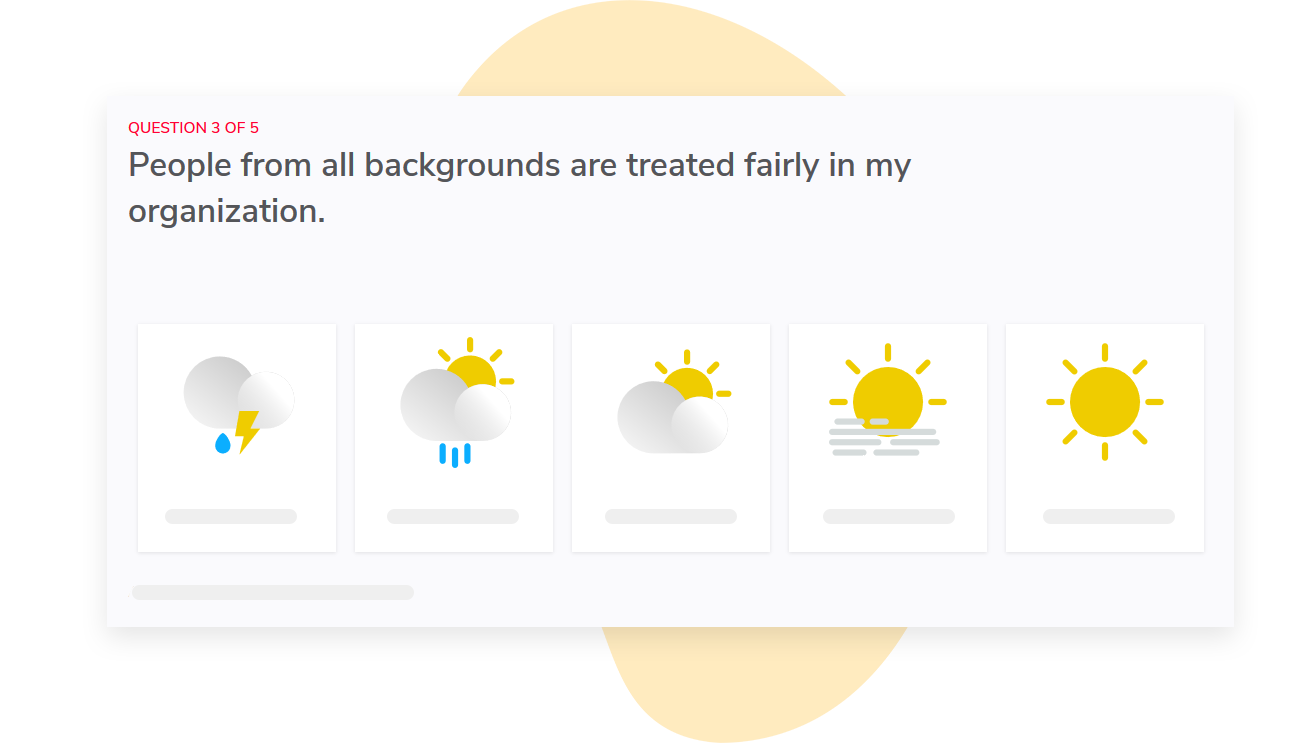
Sparkbay collects feedback at regular intervals-many clients run monthly pulses-and reports around a clear engagement score out of 10, with eNPS available as a secondary measure.
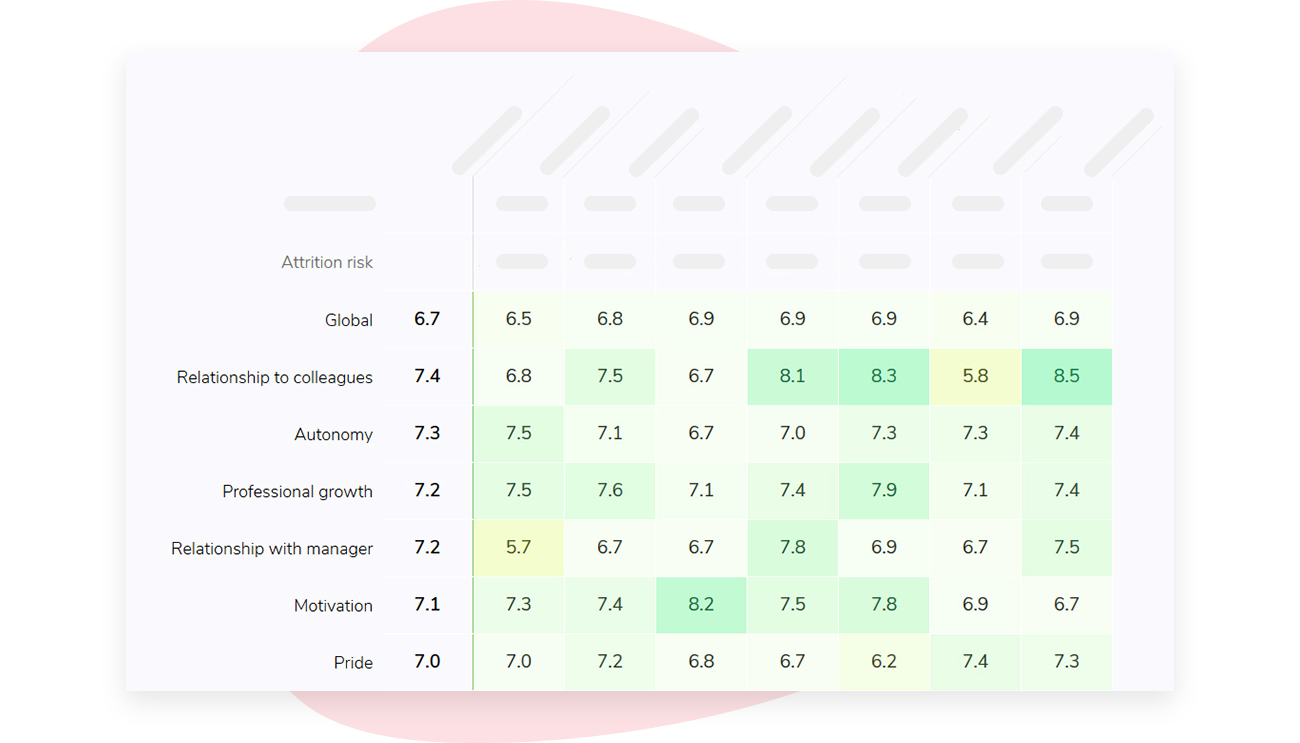
Teams can segment by manager, department, tenure, and other attributes, and benchmark against companies in their industry-context for reading a score, not a target to chase in isolation.
For large organizations, the wording of both surveys and dashboards, and the dashboard content itself, are configurable-so you can align questions, terminology, reporting views, and anonymity messaging to the workforce and the purpose of each survey.
Report access maps automatically to the org hierarchy, so each manager sees only their own teams. Results stay hidden below a configurable minimum number of responses-five by default-and employers cannot see who submitted a given response.
Those controls make safer reporting possible, but they don’t replace governance. Set a threshold that fits your team sizes, constrain sensitive filters, validate the hierarchy feed before launch, and explain anonymity in language employees actually believe.
When managers get their results, Sparkbay offers a library of concrete actions to work on-a controlled path from feedback to action, rather than an incentive to export raw data or hunt for who said what.
Sparkbay is ISO 27001 certified, which gives security and procurement a recognized starting point. Combine that with your own review of the contract, data-processing terms, access design, retention needs, and intended configuration.
If you’re interested in learning how Sparkbay can help you build a more engaged workforce, you can click here for a demo.
Use a structured vendor security checklist
Send every vendor the same questions and require written answers. A standard rubric neutralizes the effect of a slick demo and keeps unresolved risks visible when the team is being charmed.
Security architecture and access
- How are keys managed, and can the operators who reach production data also reach the keys?
- Is MFA enforced for privileged internal access, not just offered to customers?
- Which named roles can access production data, and under what approval process?
- Are exports and permission changes logged immutably, and can we receive those logs?
- What are your remediation SLAs by vulnerability severity?
- How often are independent pen tests run, and how are findings tracked to closure?
Anonymity and reporting
- What is the default threshold, and can we configure it per survey and per question?
- Does suppression apply to comments, exports, filtered views, and trends-not just scores?
- How do you block re-identification through overlapping filters?
- Can any administrator access respondent-level records?
- How does access change when an employee moves teams or a reorg drops a group below threshold?
Privacy, location, and retention
- Where do production, backup, and DR copies reside-and where do support and logging occur?
- Name every subprocessor, its purpose, and its location.
- Will you sign our DPA, and what is the subprocessor-change notice period?
- How do you support access, correction, export, and deletion requests?
- What is the retention schedule per data category?
- What happens to data-including backups and subprocessor copies-after termination?
- Do you use customer data to train models, build products, or create benchmarks?
Incident response and evidence
- What events trigger customer notification, and what notification window will you commit to contractually?
- Will you share the nature, scope, affected records, and corrective actions?
- Can you provide the ISO certificate with scope, assurance reports, and pen-test remediation evidence?
- Have you tested your incident plan through exercises?
Assign each question an owner across security, privacy, legal, procurement, and HR, and classify every requirement as mandatory, preferred, or informational before you read the answers-so nobody quietly lowers the bar late in the deal.
Red flags that should stop the purchase
Some gaps you can fix through configuration or contract language. These you can’t:
- Vague assurances with a refusal to provide evidence even under NDA.
- A certification that has expired, excludes the survey service, or covers a different legal entity.
- An inability to say which named roles can reach production data.
- Administrators who can reveal individual answers in an "anonymous" survey.
- Suppression that silently disappears in exports, comments, trends, or filtered views.
- No documented breach process, or a refusal to commit to a notification window.
- A subprocessor list missing processing purposes or locations.
- Contract rights to sell, share, or reuse employee data.
- Deletion terms that cover the active database but ignore backups and subprocessors.
- Treating the cloud host’s certifications as proof the vendor’s own application is secure.
Protecting sensitive security documentation from attackers is legitimate-it justifies redaction, controlled access, or an NDA. It never justifies showing you nothing.
Make security part of survey quality
Survey security isn’t a procurement afterthought once HR has picked a tool. It decides who participates, what they disclose, and whether the resulting data is trustworthy enough to act on.
Evaluate the whole chain-invitation data, collection, anonymity rules, filters, comments, manager permissions, exports, backups, subprocessors, deletion. One weak link nullifies strong controls everywhere else.
Require evidence over promises: certifications read for scope, the reporting experience tested against your smallest teams, ownership and deletion terms in writing, breach duties made contractual.
Then tell employees the truth about what’s collected, why, who sees reports, which threshold applies, and how long the data lives. A secure platform protects more than records; it protects the conditions that make honest feedback possible, so you can act on the evidence without exposing the people who gave it.
If you’re interested in learning how Sparkbay can help you build a more engaged workforce, you can click here for a demo.