
The rollout looked clean on the slide deck.
Leadership had aligned on the business case, the project team had built a detailed timeline, and the all-hands announcement landed with just the right amount of optimism. For a moment, it felt like the hardest part was behind you.
Then the quiet resistance began.
Managers kept using the old process "just for now." Employees joined training sessions but left unsure how the change applied to their actual work, and Slack channels filled with side conversations that never made it back to the steering committee.
By the time adoption numbers started to lag, the warning signs had been there for weeks.
This is how change initiatives often lose momentum: not with open rebellion, but with confusion, hesitation, workarounds, and silence. It helps explain why so many studies and industry conversations point to a familiar statistic: roughly 70% of change efforts fail to fully achieve their goals.
That number is sobering, but it is not surprising.
Most organizations do not fail at change because their strategy is completely wrong. They fail because leaders mistake communication for understanding, attendance for readiness, and compliance for commitment.
As an HR leader, you are often close enough to see the gap before anyone else names it.
You hear the careful questions from managers, the frustration from employees, and the polite skepticism after town halls. You know that what leadership intends and what employees experience are not always the same thing.
Change management surveys give you a way to measure that gap before it becomes a problem you can no longer ignore.
They turn hallway sentiment into usable data, reveal where adoption is stalling, and show whether employees actually understand, support, and feel equipped for the change. In other words, they help you stop guessing how people feel and start seeing what they need.
The right questions do more than measure morale.
They tell you whether employees believe in the direction, whether they trust leadership to guide the transition, whether they have the tools to succeed, and whether the new behavior is becoming part of daily work. That is the difference between a change that is announced and a change that is adopted.
In this guide, we will walk through 12 change management survey questions designed to measure both employee adoption and buy-in. Use them to listen earlier, respond faster, and give your next transformation a better chance of lasting.
On this page
- Why change fails when employees are not heard
- The hidden cost of skipping the survey
- Adoption vs. buy-in: knowing the difference
- Timing is everything: when to send your surveys
- The 12 questions that reveal the truth
- Open-ended vs. scaled: choosing your question format
- Reading between the lines: making sense of your results
- Turning feedback into action
- Avoiding the survey traps everyone falls into
Why change fails when employees are not heard
Change failure is rarely a single event. It is usually an accumulation of small mismatches between the formal change plan and the informal reality of how work gets done.
Leaders may believe they have explained the case for change, while employees are still trying to reconcile the new direction with customer commitments, legacy systems, manager expectations, and local team norms. That is where resistance becomes difficult to detect because it often looks like caution, delay, or selective compliance.
From an organizational behavior perspective, this is the difference between espoused change and enacted change. The organization says the change is happening, but the daily routines, incentives, and peer expectations still reward the old behavior.
Surveys are valuable because they expose the friction before it hardens into opposition. They give HR and transformation leaders a structured way to identify where understanding is weak, where confidence is low, and where employees are improvising because the change has not been translated into practical work routines.
The hidden cost of skipping the survey
Poor adoption carries a financial cost long before it appears in the project dashboard. Employees spend time clarifying decisions, recreating work, maintaining parallel processes, and compensating for incomplete handoffs.
That drag is often absorbed quietly by teams, which makes it easy to underestimate. Productivity may decline without showing up as a direct line item, while managers explain the slowdown as a temporary transition cost.
The intangible costs can be just as damaging. If employees experience repeated changes as poorly explained or poorly supported, they begin to conserve effort, wait out initiatives, and discount leadership communication.
This is the mechanism behind change fatigue. It is less about the number of initiatives and more about the perceived gap between what the organization asks of employees and what it gives them to succeed.
A change management survey turns generalized anxiety into more precise evidence. Instead of hearing that "people are frustrated," HR can see whether the issue is unclear rationale, low manager alignment, insufficient training, technology barriers, or a credibility problem with leadership.
That precision protects transformation ROI. It allows leaders to focus resources where they will shift adoption rather than adding more communication to an issue that may actually require workflow redesign or manager coaching.
Adoption vs. buy-in: knowing the difference
Adoption is behavioral. It answers the question: are employees actually using the new process, system, structure, or way of working?
Buy-in is cognitive and emotional. It answers a different question: do employees understand the change, believe it is worthwhile, and feel willing to support it?
Both matter because they do not always move together. An employee may adopt a new workflow because it is mandatory while privately believing it adds no value, which creates brittle compliance.
The reverse can also happen. Employees may support the direction in principle but fail to adopt because the training is insufficient, the system is difficult to use, or their manager has not clarified what "good" looks like.
| Signal | What it tells you | Risk if ignored |
|---|---|---|
| High buy-in, low adoption | Employees believe in the change but cannot execute it consistently. | Capability gaps, process friction, and resource constraints slow momentum. |
| Low buy-in, high adoption | Employees are complying without commitment. | Workarounds, cynicism, and regression to old habits after oversight fades. |
| Low buy-in, low adoption | The change lacks both belief and behavioral traction. | The initiative may require reframing, sponsorship repair, or scope adjustment. |
| High buy-in, high adoption | The change is becoming credible and operational. | The main risk is complacency before reinforcement systems are in place. |
The most useful survey design separates these two dimensions. If every question asks whether employees "support the change," HR may miss the operational barriers preventing adoption.
Timing is everything: when to send your surveys
The best survey cadence follows the change curve rather than the communications calendar. Employees need different questions before, during, and after implementation because their psychological contract with the change evolves over time.
Before launch, use a baseline survey to assess awareness, trust, perceived urgency, and readiness. This helps identify whether the organization has enough social license to move forward or whether leaders are launching into a credibility deficit.
During rollout, use short pulse surveys tied to project milestones. These should measure comprehension, manager support, training effectiveness, and early barriers while there is still time to intervene.
After implementation, shift toward behavioral adoption and sustainability. The key question is no longer whether employees have heard the message, but whether the new way of working has become the default.
Surveying too early can produce vague responses because employees do not yet know how the change will affect them. Surveying too late turns the process into a post-mortem, when resistance has already become embedded.
Surveying too often creates a different problem. If every pulse feels disconnected from visible action, employees learn that feedback is a ritual rather than a mechanism for influence.
- Pre-change baseline: 4 to 8 weeks before launch for major transformations, or earlier for enterprise-wide restructuring.
- Early rollout pulse: 1 to 2 weeks after communication or training begins.
- Mid-implementation pulse: At the first major adoption milestone, such as system go-live or process cutover.
- Post-implementation survey: 30 to 90 days after the change becomes operational.
- Sustainability check: Quarterly or at agreed business milestones for high-impact changes.
The 12 questions that reveal the truth
A strong change management survey does not overload employees with every possible concern. It focuses on the few signals that predict whether the change will be understood, believed, supported, and used.
The following questions can be asked on a 1 to 5 or 1 to 10 agreement scale, with one or two open-text follow-ups. For enterprise change programs, keep wording consistent across pulses so trend data remains comparable.
Awareness and understanding
| Question | What it reveals |
|---|---|
| 1. Do you clearly understand the reasons behind this change? | This tests whether the strategic rationale has translated beyond executive language. Low scores often signal that leaders have explained the business case but not the employee-relevant "why." |
| 2. How well do you understand how this change affects your daily work? | This separates general awareness from role-level clarity. A team can understand the change at a conceptual level and still be unsure how priorities, handoffs, approvals, or customer interactions will change. |
| 3. Do you know where to go for support during this transition? | This measures navigation confidence. Low scores suggest that support channels exist on paper but are not memorable, trusted, or accessible at the moment employees need help. |
Buy-in and belief
| Question | What it reveals |
|---|---|
| 4. Do you believe this change will benefit the organization? | This captures perceived organizational value. If employees do not see a credible business benefit, they may interpret the change as executive preference, cost pressure, or symbolic activity. |
| 5. Do you personally support the direction we are heading? | This identifies affective commitment. Employees may accept that a change benefits the organization while still feeling personally alienated by the way it affects their work, identity, or future prospects. |
| 6. How confident are you in leadership's ability to guide this change? | This measures trust in execution, not just trust in intent. Low confidence can reflect past failed initiatives, inconsistent sponsorship, weak middle management alignment, or unclear decision rights. |
Readiness and capability
| Question | What it reveals |
|---|---|
| 7. Do you feel adequately trained and equipped for the change? | This assesses capability transfer. It helps HR distinguish between communication completion and actual competence, especially when training attendance is being treated as readiness. |
| 8. Do you have the resources you need to succeed? | This surfaces structural constraints. Employees may understand and support the change but lack time, staffing, system access, documentation, or decision authority. |
| 9. How prepared do you feel to adopt the new way of working? | This gives a broader readiness signal that combines clarity, confidence, capability, and perceived feasibility. It is especially useful as a trend question across multiple pulses. |
Adoption and commitment
| Question | What it reveals |
|---|---|
| 10. How frequently are you using the new tools or processes? | This moves the survey from sentiment to behavior. Pairing this with system usage data can reveal whether employees overestimate adoption or whether usage data misses offline workarounds. |
| 11. How likely are you to recommend this change to a colleague? | This adapts advocacy logic to change adoption. Recommendation intent signals whether employees see enough value to influence peers, which is critical because informal networks often determine the speed of diffusion. |
| 12. What barriers, if any, are preventing you from fully adopting the change? | This open-text question exposes obstacles that scaled questions cannot anticipate. It is often where HR finds the practical details that explain a stalled metric. |
For major changes, consider adding an optional manager-specific item: My manager helps our team understand and apply this change. Manager sensemaking is one of the strongest levers in adoption because employees often interpret enterprise change through the behavior of their direct leader.
Open-ended vs. scaled: choosing your question format
Scaled questions are best when HR needs comparability. They allow teams to track movement over time, compare groups, correlate adoption with operational data, and identify where intervention is most urgent.
A 1 to 10 scale is useful when leaders want a clear score that can be tracked across business units. A 5-point Likert scale can work well for shorter surveys, especially when the audience is accustomed to agreement-based questions.
Open-ended questions are better for diagnosis. They reveal the language employees use, the specific barriers they face, and the informal narratives spreading through teams.
The strongest design uses both, but sparingly. A practical pattern is 8 to 12 scaled questions and 1 to 2 open-text prompts, with routing logic for employees who give low scores.
- Use scaled questions to measure clarity, confidence, readiness, support, and frequency of adoption.
- Use multiple choice to classify known barriers, such as training, workload, systems, manager support, or unclear priorities.
- Use open text when leaders need to understand the underlying cause behind a low score.
- Use follow-up prompts for critical items, such as low confidence in leadership or low preparedness.
Avoid forcing every concern into a number. If an adoption score drops, leaders need to know whether employees are resisting the idea, struggling with the workflow, or waiting for managers to stop rewarding the old behavior.
Reading between the lines: making sense of your results
The first mistake in survey analysis is treating the overall average as the story. Enterprise change rarely fails evenly across the organization.
A corporate function may show high confidence because it helped design the change, while frontline teams score low because they inherit the operational complexity. A recently hired cohort may adapt quickly, while long-tenured employees experience the change as a loss of expertise, status, or autonomy.
Segmentation is essential. Cut the data by department, manager, tenure, location, role type, and exposure to the change so the organization can see where adoption is accelerating and where it is fragile.
Look for score patterns, not isolated scores. Low understanding paired with high support suggests a communication and translation issue, while high understanding paired with low support suggests disagreement, mistrust, or perceived harm.
Benchmarking can also help, provided it is interpreted carefully. External benchmarks show whether scores are unusually low compared with similar organizations, while internal benchmarks show whether a specific business unit is lagging behind the rest of the company.
Qualitative comments should be coded by theme rather than read as anecdotes. This reduces the risk of overreacting to a vocal minority while still taking emotionally intense feedback seriously.
Change surveys become more useful when they are easy to run repeatedly and simple for managers to interpret. Sparkbay automatically collects employee feedback at regular intervals, and many clients run monthly pulse surveys during periods of transformation.
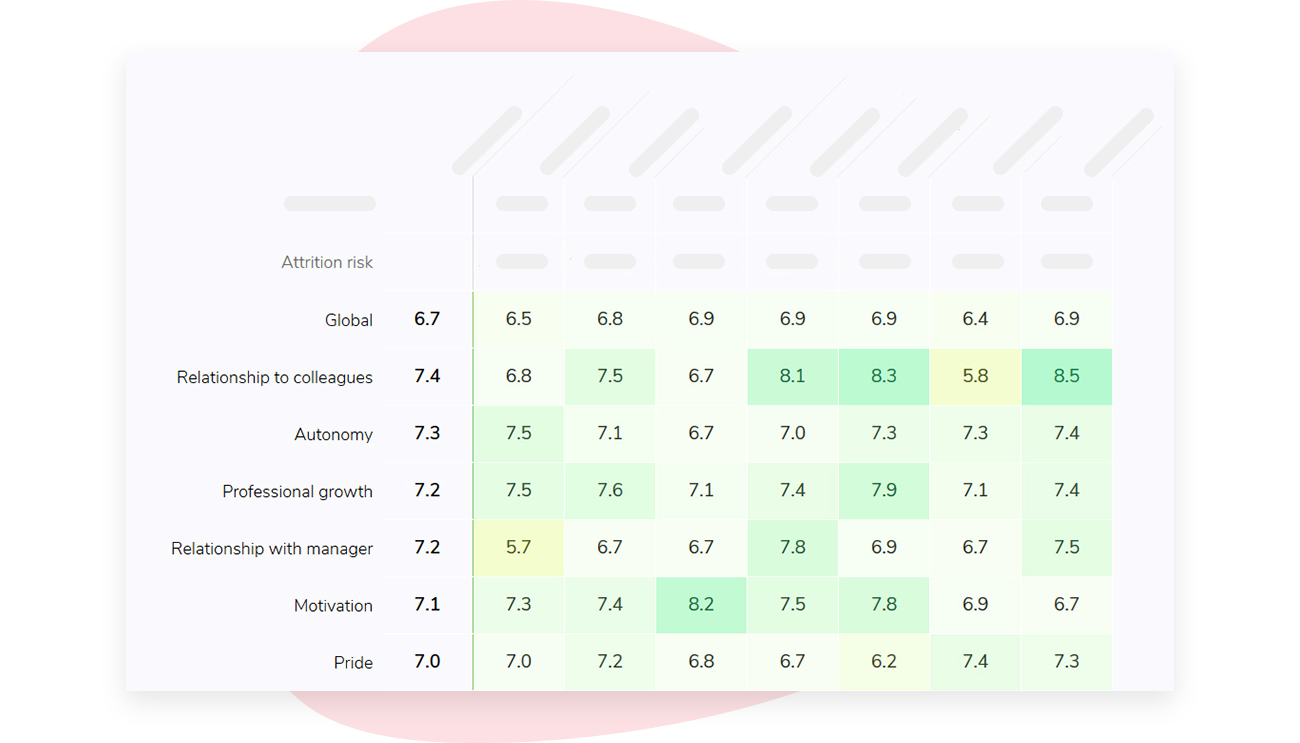
For change management, that cadence helps HR track whether understanding, readiness, confidence, and adoption are improving as the rollout progresses. Sparkbay presents results in intuitive reports with a clear score out of 10, making it easier to communicate progress to leaders without burying them in raw survey files.
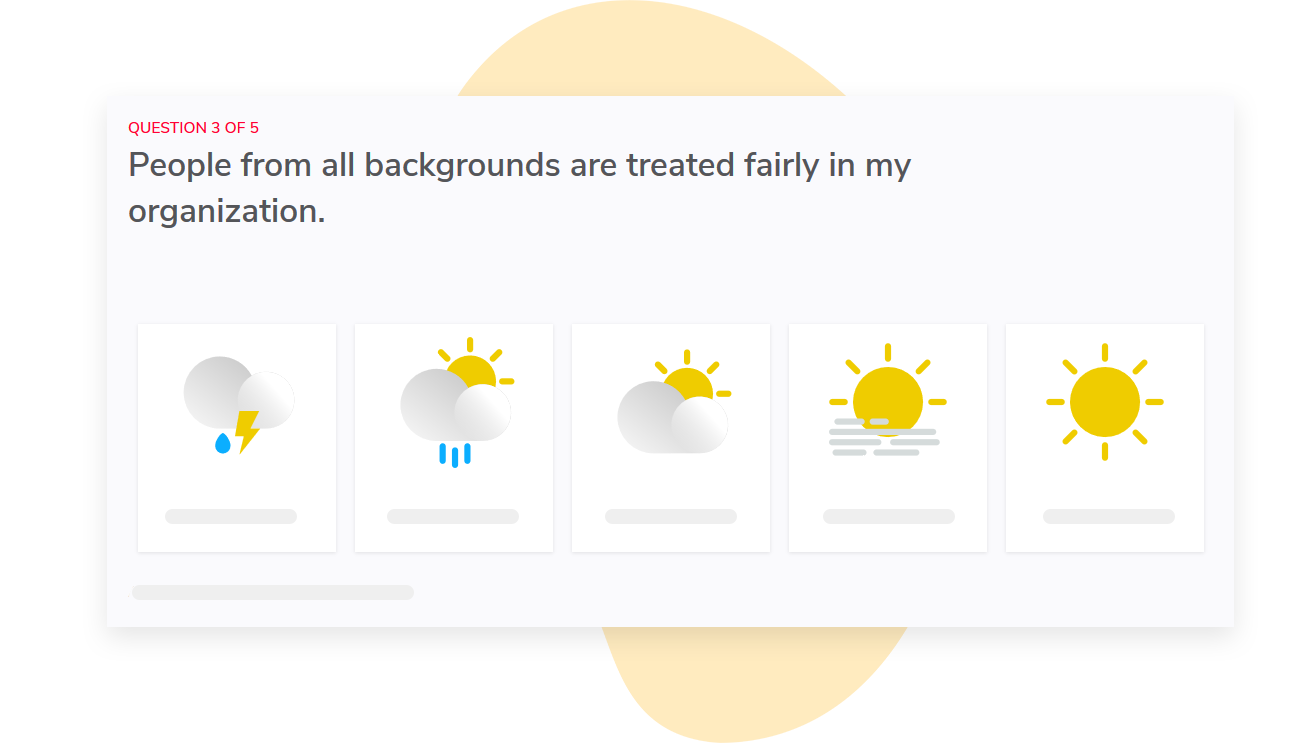
The platform also helps HR move beyond the enterprise average. Results can be segmented by manager, department, tenure, location, and other attributes, which is especially valuable when adoption depends on local leadership and role-specific workflows.
Sparkbay also allows teams to benchmark results against companies in their industry using Sparkbay's proprietary dataset. That context helps leaders understand whether a score reflects a normal transition dip or a more serious adoption risk compared with similar organizations.
Once the data is clear, the next challenge is action. Sparkbay includes a library of easy-to-implement actions that managers can use to improve results, such as clarifying expectations, addressing team concerns, reinforcing new behaviors, or improving the quality of follow-up conversations.
That manager-level action layer matters because change adoption is rarely solved by HR communication alone. Employees need local reinforcement, practical support, and visible evidence that feedback is shaping the rollout.
If you're interested in learning how Sparkbay can help you build a more engaged workforce, you can click here for a demo.
Turning feedback into action
Surveys backfire when employees experience them as extraction. Asking for feedback raises the expectation that leaders will listen, interpret, and respond.
If no visible action follows, the next survey becomes harder to trust. Employees may still respond, but the quality of candor declines.
A strong close-the-loop process has three parts: share what was heard, explain what will happen, and clarify what will not change. The third part is often skipped, but it is essential for credibility.
- Share the main findings: Summarize the strongest themes, including uncomfortable ones, in plain language.
- Name the priority actions: Choose a small number of changes that directly respond to the data.
- Assign ownership: Clarify which actions sit with executives, HR, project teams, managers, or local functions.
- Set a timeline: Tell employees when they will see changes or receive another update.
- Measure again: Use the next pulse to show whether the intervention improved the relevant scores.
For example, if employees score high on organizational belief but low on daily work clarity, the response should not be another executive town hall. The better intervention may be manager-led role mapping, workflow examples, or team-level decision guides.
If confidence in leadership is low, a training refresh will not solve the root issue. Leaders may need to acknowledge trade-offs, explain decision criteria, and show consistency between stated priorities and resource allocation.
Avoiding the survey traps everyone falls into
Even well-intentioned change surveys can produce misleading data. The most common problems usually come from question design, trust, and interpretation.
| Trap | Why it matters | Better approach |
|---|---|---|
| Leading questions | Questions such as "Do you agree this exciting change will improve performance?" pressure employees toward approval. | Use neutral wording, such as "Do you believe this change will benefit the organization?" |
| Survey fatigue | Too many surveys with no visible action reduce response quality. | Use short pulses tied to clear milestones and communicate what changed because of feedback. |
| Anonymity concerns | Employees may withhold concerns if they believe responses can be traced back to them. | State confidentiality rules clearly, use minimum reporting thresholds, and avoid over-segmenting small groups. |
| Low response rates | A small or skewed response pool can distort the perceived level of support. | Ask managers to make time for completion, explain why the survey matters, and keep it brief. |
| Confirmation bias | Leaders may search for evidence that validates the rollout plan and discount warning signs. | Review dissenting data deliberately and compare survey results with behavioral adoption metrics. |
| Overreliance on averages | A healthy enterprise score can hide serious pockets of resistance or confusion. | Segment results and examine variance across teams, tenure groups, and manager populations. |
Another subtle trap is measuring sentiment when the real issue is system design. If employees say they support the change but cannot complete the new workflow without duplicate entry, the adoption barrier is operational.
HR can add rigor by triangulating survey data with usage analytics, performance indicators, help desk tickets, training completion, manager feedback, and attrition signals. The goal is not to make the survey carry the entire diagnostic burden, but to make it the employee voice layer within a broader change measurement system.
From data to adoption: putting it all together
Change management surveys are most powerful when they are treated as part of the operating rhythm of transformation. They should inform communication, training, manager enablement, resource allocation, and reinforcement.
The central discipline is continuous listening. A single survey can identify a problem, but repeated measurement shows whether the organization is learning fast enough to keep adoption moving.
For HR leaders, the value is strategic as well as diagnostic. Survey data gives the organization a clearer view of whether the change is being absorbed by the people expected to deliver it.
When employees understand the reason for change, believe the direction is credible, feel equipped to act, and see leaders respond to feedback, adoption becomes less dependent on pressure. It becomes a shared pattern of behavior that can last after the launch energy fades.
Start with a focused set of questions, measure at the right moments, segment the results, and close the loop visibly. That is how feedback becomes a lever for durable change rather than another activity on the project plan.
If you're interested in learning how Sparkbay can help you build a more engaged workforce, you can click here for a demo.