
A career development survey is not going to stop people from quitting.
But it can help you understand why they’re looking elsewhere while you still have time to do something about it.
Consider the employee who wants to lead a team, but they don’t see a path to a manager position, so they start applying for jobs outside your company.
As an HR leader, you may only find out about this desire during an exit interview.
That’s an expensive way to learn what someone wanted from their career.
A good career development survey asks employees questions about where they want to grow, what skills they need, and whether their manager or a mentor helps them move towards that goal.
On this page
- Introduction: why career development surveys are your secret retention weapon
- Questions that uncover growth aspirations
- Questions that reveal skill gaps and learning needs
- Questions on manager and mentorship support
- Questions that gauge internal mobility and advancement clarity
- Turning survey responses into real action
- Timing and frequency: when to send career development surveys
- Measuring success: KPIs to track after implementation
Introduction: why career development surveys are your secret retention weapon
Employee career growth has become one of the strongest predictors of whether employees stay or leave.
When employees feel stuck, they may not stay no matter how good their manager is, how competitive their pay is, or how positive the culture is.
Remember: It can cost anywhere from one-half to two times an employee’s annual salary to replace them, accounting for the cost of recruiting, onboarding, and the lost productivity and institutional knowledge.
Stagnation in their career is consistently ranked as one of the top reasons employees consider leaving their organization.
Questions that uncover growth aspirations
These questions are especially useful when analyzed alongside tenure, performance, job family, level, and critical role status.
| Survey question | Recommended format | What it reveals |
|---|---|---|
| Where would you like your career to be in the next 2 to 3 years? | Open-ended | Career direction, mobility interests, leadership aspirations, specialist ambitions, or uncertainty. |
| I can see a future for my career at this organization. | 1 to 10 scale | Strength of internal career commitment and retention risk. |
| My current role helps me build skills that are relevant to my long-term career goals. | 1 to 10 scale | Alignment between current work and future value expectancy. |
| Which type of growth opportunity would be most valuable to you right now? | Multiple choice with "other" | Demand for promotion, lateral movement, stretch projects, leadership exposure, technical depth, mentoring, or formal learning. |
| What kind of work would you like to do more of in the next year? | Open-ended | Preferred tasks, latent strengths, underused capabilities, and potential project matching opportunities. |
| What kind of work would you like to do less of in the next year? | Open-ended | Sources of role fatigue, misalignment, or low-value work that may be reducing engagement. |
These questions can reveal whether employees are oriented toward vertical advancement, lateral breadth, technical mastery, or portfolio careers.
That distinction matters because many organizations still over-index on promotions as the primary growth mechanism.
In flatter structures, career development must often be designed as a lattice rather than a ladder.
If many employees in a critical function want to move out of that function, HR has a future capability risk.
If high-potential employees repeatedly express interest in leadership but do not see a path, succession pipelines may be weaker than leadership dashboards suggest.
Advanced interpretation tips
- Compare aspirations by demographic and career stage. Differences may reveal inequitable access to development conversations or role models.
- Identify "uncertain" employees. Employees who cannot articulate a future path may need career coaching, not just training.
- Separate ambition from readiness. Surveys show interest, while performance data, skills assessment, and manager input help determine readiness.
Questions that reveal skill gaps and learning needs
Learning needs are often misdiagnosed because organizations ask managers what teams need but fail to ask employees where they feel blocked.
Here’s one key reason why this happens: You ask managers what their teams need, but you don’t ask employees where they feel blocked.
Skill gaps are easily viewed through existing performance gaps.
But employees may see holes in terms of systems, tools, confidence, exposure, and opportunities for hands-on practice.
When you’re trying to assess skill gaps or determine learning needs, it’s important to ask questions based on three characteristics:
Capability: Do you have the skills?
Opportunity to apply capability: Do you have the opportunity to use these skills?
Access to development resources: Can you access the learning resources you need?
For example, an employee may have the skill, but not have the chance to use it.
| Survey question | Recommended format | Best use |
|---|---|---|
|
What skills are you most eager to develop over the next 12 months? |
Open-ended or multi select | L&D demand signals for planning or talent marketplace design |
|
I have access to the learning resources I need to grow in my career. |
1 to 10 scale | Gauge adequacy of perceived learning infrastructure |
|
I have enough time in my regular workload to participate in meaningful development. |
1 to 10 scale | Understand if workload impedes growth, even if meaningful programs exist |
|
Which skills do you feel are underutilized in your current role? |
Open-ended | Identify hidden capability, potential to re-deploy |
|
What training, coaching or experience would help you perform better in your current role? |
Open-ended | Understand how near-term job performance relates to learning needs |
|
Which development format is most effective for you? |
Multiple choice | Optimize program mix: coaching, peer learning, courses, stretch work, rotation, certifications |
|
I have opportunities to apply newly learned skills on the job. |
1 to 10 scale | Test transfer of learning. This is often the weak point of L&D ROI |
What’s the most important insight for an experienced HR team?
It’s not the list of requested courses from a learning and development wish list.
It’s the size of the gap between learning consumption and learning transfer.
If employees are participating in training but they aren’t getting a chance to use these new skills, the problem may lie in job design, how managers delegate work, project allocation, or risk tolerance.
When you align your business strategy with your learning needs survey questions, you can also understand whether employees are trying to build capabilities you’ll need as an organization.
These may include AI fluency, data literacy, consultative selling, enterprise leadership, cyber awareness, or change management.
How to avoid turning the learning needs survey into a wish list
To avoid turning your skill gap survey into a wish list, include questions like, "What capability would help you deliver stronger results in your role?" instead of, "What training do you want?"
Questions on manager and mentorship support
For most employees, their manager is the one who makes career opportunities available.
They decide who gets stretch assignments, who gets feedback, who gets introduced to powerful stakeholders, and who gets encouraged to apply for internal roles.
If managers avoid development conversations, employees may interpret a lack of communication as a lack of care, when in reality a manager may simply be overworked or undertrained.
| Survey question | Recommended format | What it helps diagnose |
|---|---|---|
| My manager actively supports my career growth. | 1 to 10 scale | Overall perception of manager advocacy |
| In the past six months, I’ve had a meaningful conversation about my career goals with my manager. | Yes or no, with optional comment | Whether development conversations are actually happening |
| My manager gives me feedback that helps me grow. | 1 to 10 scale | Quality of developmental feedback beyond performance evaluation |
| My manager helps me identify opportunities to build new skills. | 1 to 10 scale | Manager capability in connecting employees to experiences |
| I feel comfortable discussing my long-term career goals with my manager. | 1 to 10 scale | Psychological safety in career conversations |
| I have access to a mentor, sponsor, or role model that supports my development. | 1 to 10 scale | Strength of developmental networks outside of direct manager |
| What could your manager do differently to better support your growth? | Open-ended | Specific coaching, feedback, delegation, advocacy or communication improvements |
It’s also helpful to assess mentoring vs. sponsorship.
Mentors provide guidance, perspective, and advice.
Sponsors use their political capital to create visibility, advocate for opportunities, and get employees into decision-making rooms they may not be able to access on their own.
Employees from underrepresented groups may receive advice from mentors but not the same level of sponsorship, which can hinder their advancement despite great performance.
Managers may need support in the form of practical career conversation guides, development plan expectations, insights into internal opportunities, and incentives that reward "talent development" rather than "talent hoarding".
Questions that gauge internal mobility and advancement clarity
Employees don’t need a guaranteed promotion to stay.
They need a credible understanding of what their potential growth could look like and how promotion decisions are made.
Internal mobility is a huge factor in employee retention, especially in large organizations where there may be opportunities elsewhere in the enterprise that don’t exist on their immediate team.
When employees don’t have visibility into these opportunities, it’s easier to view the external market than to look for opportunities internally.
This is a preventable source of attrition.
| Survey question | Recommended format | What it reveals |
|---|---|---|
| I understand the career paths available to me in this organization. | 1 to 10 scale | How clearly job architecture and career paths are communicated to employees. |
| I understand what is required to advance to the next level in my role or function. | 1 to 10 scale | How transparent the organization is about readiness expectations or promotion criteria. |
| I’m aware of internal job opportunities that match my skills and interests. | 1 to 10 scale | Effectiveness of internal mobility communication and platforms. |
| I believe promotions are handled fairly in this organization. | 1 to 10 scale | How fair employees believe advancement procedures are. |
| I believe employees can move across teams or departments without negative consequences. | 1 to 10 scale | Whether there’s talent hoarding or resistance from managers that prevents mobility. |
| What makes it difficult to pursue internal opportunities? | Multiple choice plus comment | Identifies barriers such as lack of visibility, norms around manager approval, unclear eligibility, workload, location constraints, or fear of reputational risk. |
| If you were ready for a new challenge, would you look internally first? | Yes, no, unsure, optional comment | How confident employees feel about the internal labor market. |
Receiving low scores on these questions does not necessarily mean that promotion decisions are objectively unfair.
It may mean that promotion criteria are not well communicated, there is no visibility into calibration processes, feedback is not given after rejection, or there aren’t enough visible examples of fair promotions.
Internal mobility questions for large organizations
- Policy barrier: "Eligibility requirements for internal moves are clear to me."
- Manager barrier: "My manager would support me if I applied for an internal opportunity."
- System barrier: "It’s easy to find internal roles that match my skills."
- Network barrier: "I know who to speak with to learn more about opportunities in other parts of the organization."
- Reputation barrier: "I can explore internal opportunities without worrying it will harm my standing on my current team."
Turning survey responses into real action
The last thing you want is for your career development survey to become the great deceiver that inspires hope but fails to deliver any real change.
While employees may understand slow progress if leaders are transparent about their efforts, it’s a different story if they’re the ones sharing candid feedback and hearing nothing back.
How you manage and organize your survey responses is crucial.
In fact, human resources should already have a disciplined action process in place even before the survey is launched. This includes setting guidelines for ownership, how data will be analyzed, where decisions will be made, how soon data will be communicated to employees, and the level at which managers are expected to take action.
Use a structured analysis framework
When analyzing your survey feedback, it’s helpful to segment results by department, manager, level, tenure, location, job family, critical role status, and demographic groups, so that you can better see where your growth systems are working and where they’re not.
Prioritize based on impact and feasibility
When prioritizing issues to address, it’s helpful to consider factors like retention risk, strategic skill needs, the number of employees affected, equity implications, and implementation complexity.
For instance, if there is low awareness of internal roles, it may be better to focus on improving communication and giving managers scripts rather than working on a new platform.
If employees express low confidence in the fairness of promotions, you may need to focus on clarifying promotion criteria, improving governance around calibration processes, and delivering better feedback to employees after promotion decisions.
If employees feel they don’t receive enough time to focus on their development, you may need to focus on workload planning rather than creating new learning content.
Close the feedback loop visibly
Let your employees know what you’ve learned from the survey, what the organization plans to do as a result, and what it won’t be able to do for now (and why!).
- Within two weeks of survey close: Thank employees for their participation in the survey, share the participation rates, and communicate when you’ll be able to share survey findings with them
- Within one month of survey close: Share the top themes across the enterprise as well as any areas where you’ll need to conduct a deeper review
- Within six to eight weeks of survey close: Communicate prioritized actions, action owners, and an expected timing for implementation
- Every quarter provide an update on progress against listed actions and share other ways employee feedback has informed organizational decision-making.
Keep in mind that your survey questions may ask managers to share feedback about how career development is supported, and that some managers may feel defensive or exposed if they receive low scores in this area.
You can help reduce defensiveness by framing the survey results as development data for managers and providing them with practical next steps.
Here’s how Sparkbay helps:
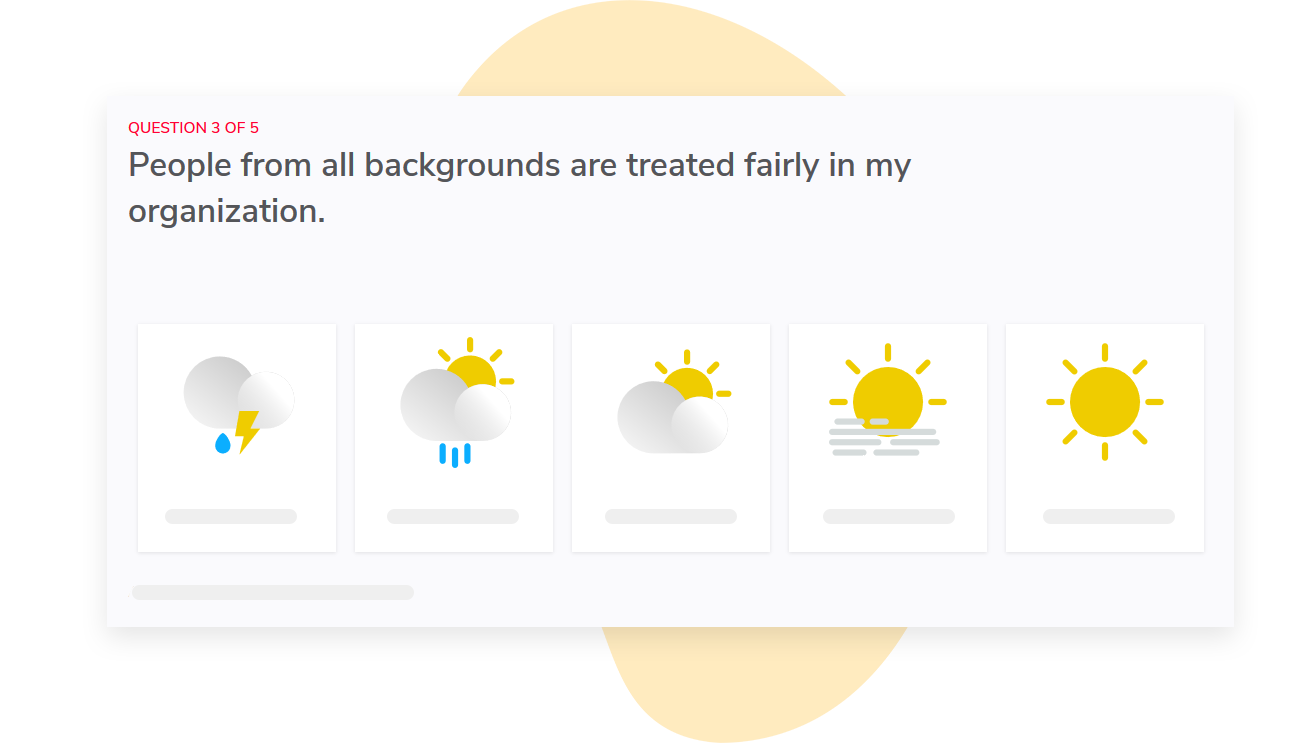
Sparkbay automatically collects employee feedback at regular intervals (many of our clients use monthly pulse surveys), so you can monitor employee growth, engagement, and retention risk over time.
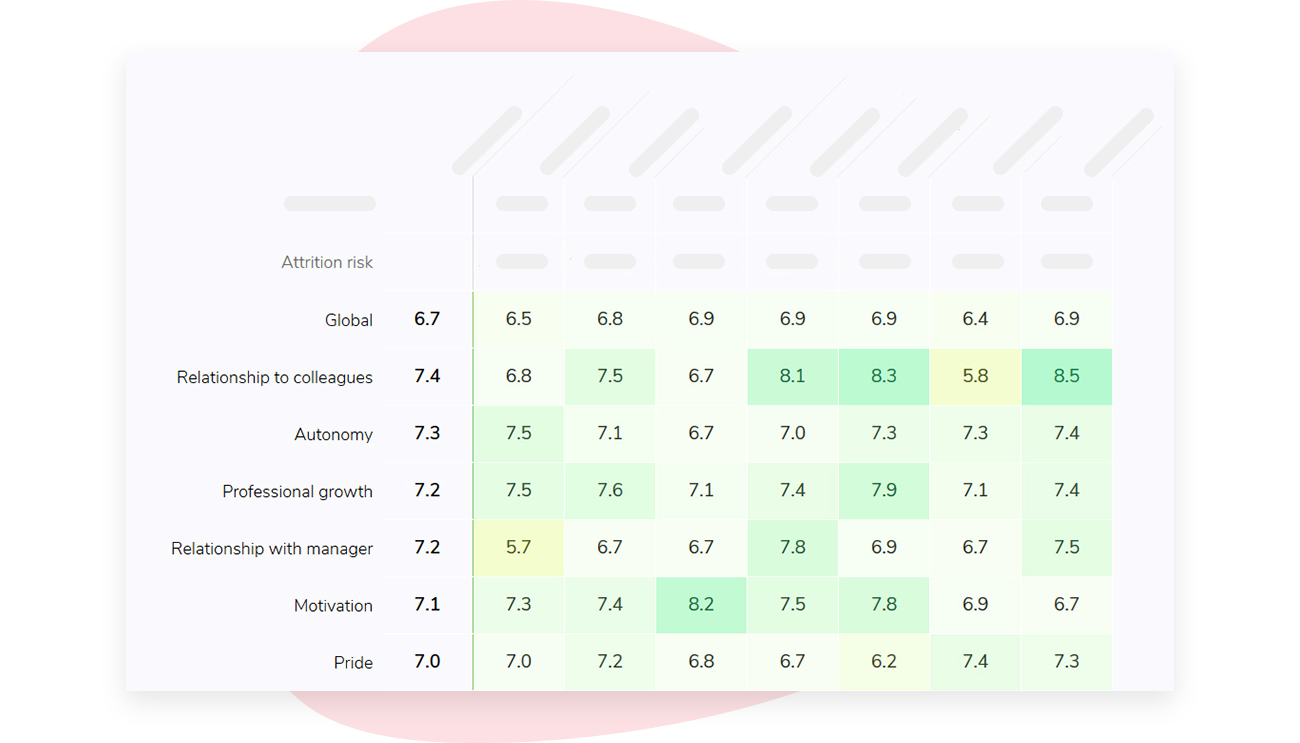
Sparkbay then presents the results in intuitive reports with a clear score out of 10, so HR leaders and managers can easily understand where career development is strong and where employees may be losing confidence.
Sparkbay also allows teams to segment results based on manager, department, tenure, and more.
Plus, HR teams can benchmark their results against companies in the same industry using Sparkbay’s proprietary dataset.
Benchmarking is especially helpful when you need to make the case for investment in areas like manager enablement, learning pathways, or internal mobility infrastructure.
Once the data is clear, Sparkbay helps teams take action by providing a library of easy-to-implement recommendations for managers to use.
For instance, if a manager receives lower scores in the career conversations category, they can take advantage of this program to get practical tips for holding better development conversations, clarifying growth expectations, or connecting employees to stretch opportunities.
If you’re interested in learning how Sparkbay can help you build a more engaged workforce, you can click here for a demo.
Timing and frequency: when to send career development surveys
Growth perceptions change after reorganizations, performance reviews, compensation cycles, promotion decisions, manager changes, and major business shifts.
| Survey timing | Best for | Watchouts |
|---|---|---|
| Annual career development survey | Deep diagnosis, strategic planning, enterprise-wide benchmarking, and L&D roadmap input. | Too infrequent to detect fast-moving retention risk on its own. |
| Quarterly pulse survey | Tracking priority career themes such as manager support, internal mobility, and advancement clarity. | Requires disciplined action planning to avoid repeated measurement without progress. |
| Monthly pulse survey | Monitoring high-change environments, critical talent groups, or ongoing engagement trends. | Questions must be short, focused, and easy to act on. |
| Onboarding milestone survey | Understanding whether new hires see early growth and role alignment after 30, 60, 90, or 180 days. | New employees may still be forming impressions, so trend interpretation should be cautious. |
| Post-promotion or post-move survey | Evaluating whether internal mobility experiences are effective and equitable. | Response confidentiality matters when populations are small. |
| Work anniversary check-in | Identifying mid-tenure stagnation and prompting career conversations. | Needs integration with manager routines to create action. |
Use a deeper annual or semiannual survey to understand the full career development system, then pulse a small number of high-signal questions more frequently.
For example, an organization might pulse three questions monthly or quarterly: future confidence, manager support, and advancement clarity.
Reducing survey fatigue
Survey fatigue is often a response to low perceived value, not frequency alone.
The most effective way to reduce fatigue is to ask fewer questions, communicate results faster, and show visible progress.
- Keep pulse surveys short, ideally under five minutes.
- Rotate secondary topics while keeping core trend items stable.
- Coordinate survey calendars across HR functions to prevent overlapping requests.
Measuring success: KPIs to track after implementation
Measure career development on two sides: perception and behavior.
Perception tells you whether employees feel like growth is possible at your organization.
If you’re on the behavior side, you’re gauging whether your organization is actually creating movement, increasing capability, and boosting retention.
| KPI | What it measures | How to interpret it |
|---|---|---|
| Career development score | Measures employee perception about career development opportunities, learning, growth, manager support, and opportunities for the future. | Track this score by different segments and over time, especially after introducing new interventions. |
| Regrettable attrition rate | The rate at which high performers, critical roles, or employees you wanted to keep are leaving. | Compare groups with strong career development scores and weaker ones. |
| Internal promotion rate | The rate at which people are moving into higher level roles within your organization. | Analyze this rate by different functions, demographic groups, or under different managers to identify equity patterns. |
| Lateral mobility rate | The rate at which employees move across teams, functions, geographies, or jobs within the same family. | This is useful for organizations that are flatter and not focused on vertical growth. |
| Internal fill rate | The percentage of open roles filled by internal candidates. | Measures how effectively your internal talent markets are functioning. |
| Participation in development programs | Number of employees enrolled in, completing, and engaging with development programs such as learning courses, mentoring, or leadership programs. | Pair it with measures of how those skills are applied and what they change. This indicator should not be used in isolation. |
| Skill acquisition and application | Whether employees are acquiring and applying prioritized skills within your organization. | This could be measured through assessments, manager validations, application in project teams, or credential attainments. |
| Employee Net Promoter Score | The extent to which employees would recommend your organization as a great place to work. | Analyze this score as well as career development items in your survey to understand whether growth opportunities make employees more likely to advocate for your organization. |
| Manager career conversation completion | Whether managers are holding career development conversations with employees as expected (e.g., every quarter). | Use quality checks rather than simply a completion rate to avoid compliance-based responses. |
The strongest measurement approach connects survey scores to downstream outcomes.
For instance, you may want to see if teams with a higher manager support score also have higher retention rates, more internal movement, or better engagement trends.
While there may be a correlation between career development scores and retention, there will also be other factors at play such as pay, workload, trust in leaders, and the labor market demand.
As a result, it’s important to take a holistic approach to understanding your data by combining your survey data, your HRIS data, exit interview themes, performance data, internal mobility data, and qualitative listening data.
If you’re interested in learning how Sparkbay can help you build a more engaged workforce, you can click here for a demo.