
The quarterly business review is running exactly as expected until the CFO pauses on one slide. Revenue is steady, hiring is moving, customer demand is healthy, but productivity has flattened and voluntary turnover is quietly eating into the margin.
Then someone mentions burnout, and the room shifts. What used to sound like an HR concern suddenly looks like a business risk with a very real price tag.
As an HR leader, you have probably felt this change firsthand. Employee well-being is no longer a soft benefit tucked between gym discounts and meditation apps; it has become a strategic lever that affects how people show up, how long they stay, and how well they perform.
The workforce has changed, too. After years of disruption, employees are asking sharper questions about workload, flexibility, psychological safety, manager support, and whether their job allows them to have a sustainable life outside of work.
Leaders are paying attention because the consequences are measurable. When well-being is neglected, organizations see higher absenteeism, lower engagement, more turnover, increased healthcare costs, and teams that are busy but not truly productive.
When well-being is treated as a business priority, the opposite begins to happen. People have more energy, managers build stronger trust, teams collaborate with less friction, and employees are more willing to invest discretionary effort in the organization's success.
This is why employee well-being has moved from the benefits brochure to the boardroom agenda. It is not about making work comfortable at the expense of performance; it is about creating the conditions where performance can actually last.
On this page
- Beyond the buzzword: why well-being is now a boardroom priority
- The hidden price tag of burnout and disengagement
- Engaged employees, engaged bottom line: the performance connection
- The revolving door problem: how well-being keeps your best people
- Healthy minds, higher output: unlocking peak productivity
- The ripple effect: well-being as a culture and brand multiplier
- From perks to strategy: building a well-being program that actually works
Beyond the buzzword: why well-being is now a boardroom priority
Employee well-being has become a boardroom issue because it now sits at the intersection of workforce risk, operating performance, and organizational resilience. The most mature organizations are treating it less like a benefits category and more like a leading indicator of whether their talent model is sustainable.
That shift matters because the old separation between "work issues" and "life issues" has largely broken down. Workload intensity, manager quality, autonomy, flexibility, inclusion, financial pressure, and psychological safety all shape whether employees can perform consistently without depleting themselves.
For CEOs and CFOs, the business case is no longer abstract. Poor well-being shows up in replacement costs, absence patterns, delayed decisions, weak collaboration, customer experience issues, and leadership pipelines that thin out because high performers decide the trade-off is no longer worth it.
The strongest business case starts with a simple premise: well-being is a condition for sustained performance. An organization can extract short-term output from exhausted teams, but it cannot build durable productivity, innovation, and commitment on chronic depletion.
This is also why superficial wellness programs often disappoint. A meditation app will not offset an impossible workload, a toxic manager, unclear priorities, or a culture where employees are penalized for using flexibility policies.
At the enterprise level, well-being strategy requires the same discipline as any other operating priority. It needs executive ownership, measurable outcomes, manager accountability, and a feedback loop that shows where the employee experience is enabling performance and where it is eroding it.
The hidden price tag of burnout and disengagement
Burnout rarely appears as a single line item in a financial report, which is one reason organizations underestimate its cost. It is distributed across absence, presenteeism, turnover, healthcare claims, performance variability, conflict, rework, and reduced customer responsiveness.
The clearest costs are often the easiest to track. Absenteeism rises when employees lack recovery time, experience chronic stress, or disengage from work they no longer perceive as manageable or meaningful.
Presenteeism is harder to quantify and often more expensive. Employees are technically present, but cognitive bandwidth, decision quality, energy, and collaboration capacity are reduced, creating a productivity drag that managers may misread as capability or motivation problems.
Turnover adds another layer. Replacement costs vary widely by role, seniority, labor market, and ramp time, but many HR teams use a working estimate ranging from roughly one-half to two times annual salary for professional and managerial roles, depending on complexity.
That estimate often excludes hidden costs such as lost institutional knowledge, delayed projects, team instability, recruiter time, manager interview time, and lower morale among employees who absorb extra work while the role remains open.
Healthcare and disability costs are also part of the equation, especially in large organizations with self-insured plans. Chronic stress is associated with higher risk across several health conditions, and even where causality is difficult to isolate, the pattern is commercially relevant enough to warrant executive attention.
| Cost area | How poor well-being shows up | Business impact |
|---|---|---|
| Absenteeism | More sick days, stress leave, unplanned absence | Coverage gaps, overtime, service disruption |
| Presenteeism | Lower focus, slower decisions, reduced energy | Lower output despite stable headcount |
| Turnover | Higher resignations among exhausted or unsupported employees | Recruiting cost, lost knowledge, ramp-up delays |
| Healthcare and disability | Stress-related claims, mental health needs, leave utilization | Higher plan costs and workforce availability risk |
| Team performance | Conflict, rework, low trust, weak collaboration | Reduced execution quality and slower delivery |
The commercial issue is not whether every cost can be perfectly attributed to well-being. The issue is whether leadership can afford to ignore a pattern that repeatedly weakens capacity, retention, and performance at the same time.
Engaged employees, engaged bottom line: the performance connection
Well-being and engagement are distinct constructs, but in practice they are tightly connected. Engagement reflects commitment, energy, advocacy, and willingness to invest discretionary effort, while well-being determines whether that energy is renewable.
An employee can be highly engaged and still burn out when demands consistently exceed resources. That is why sophisticated engagement strategies now look beyond enthusiasm and measure whether employees have the conditions needed to keep contributing at a high level.
The job demands-resources model is useful here. High job demands, such as workload, emotional labor, ambiguity, or time pressure, are less damaging when employees also have meaningful resources, such as autonomy, supportive managers, role clarity, social support, and recovery opportunities.
When resources are weak, engagement becomes fragile. Employees may care deeply about the work, but sustained pressure without support eventually converts commitment into exhaustion, cynicism, or withdrawal.
Psychological safety is another critical mechanism. Teams perform better when employees can raise risks, ask for help, challenge assumptions, and admit mistakes without fear of embarrassment or punishment.
That safety has a direct well-being effect because employees do not spend as much cognitive and emotional energy managing impressions or avoiding blame. It also has a performance effect because information flows faster and problems surface earlier.
Purpose also matters, but it should be handled carefully. Purpose can energize employees, yet it can also be exploited when organizations use mission language to justify unsustainable demands.
A healthy performance culture pairs purpose with boundaries, prioritization, and adequate resourcing. Employees are more willing to go the extra mile when they trust that the organization will not make the extra mile the default operating model.
For HR leaders, the implication is clear: engagement cannot be managed through sentiment alone. It must be connected to workload, manager behavior, team climate, recognition, autonomy, and the practical friction employees experience in getting work done.
The revolving door problem: how well-being keeps your best people
Retention is one of the strongest arguments for investing in well-being because employees often leave when the employment deal feels psychologically or practically unsustainable. Compensation still matters, but employees are increasingly evaluating the total cost of staying.
That total cost includes workload intensity, commute expectations, flexibility, manager support, career growth, emotional strain, and whether the organization respects life outside of work. When those factors deteriorate, even strong pay may only delay a resignation.
High performers are especially sensitive to this equation. They are often given more complex work, asked to support struggling colleagues, pulled into urgent priorities, and rewarded with visibility rather than capacity.
Over time, that dynamic creates a retention risk hidden behind strong performance ratings. The employee looks successful until they suddenly become a flight risk, and by then the organization has already consumed much of their trust.
Well-being strengthens retention when it changes the lived experience of work. Employees are more likely to stay when they believe leaders listen, managers respond constructively, workloads are discussed honestly, and flexibility is applied fairly rather than treated as an exception.
Manager capability is central. In many organizations, employees do not leave "the company" in an abstract sense; they leave a local climate shaped by their manager's expectations, communication style, fairness, and ability to manage priorities.
Retention strategies should therefore identify well-being risks at the team level, not only at the enterprise level. A company-wide average can look healthy while specific departments, job families, or tenure groups are experiencing a level of strain that predicts future exits.
Exit interviews often reveal these issues too late. Stay interviews, pulse surveys, manager check-ins, and workload reviews provide earlier signals, especially when they are treated as operating intelligence rather than HR administration.
The goal is not to remove all pressure from work. The goal is to create a credible environment where employees can handle demanding periods because they trust the organization to prioritize, support, and recover rather than normalize continuous overload.
Healthy minds, higher output: unlocking peak productivity
Productivity discussions often focus on process, technology, and headcount, but employee well-being determines how effectively those inputs are converted into output. A team with depleted attention, low trust, and high stress will not perform at its potential, regardless of how efficient the workflow looks on paper.
The science of sustained performance is clear on one point: human attention is finite. Chronic stress narrows cognition, reduces working memory, increases threat sensitivity, and makes it harder for employees to switch from reactive task completion to creative problem-solving.
This matters most in knowledge-intensive environments where value depends on judgment, innovation, collaboration, and prioritization. Employees who are constantly interrupted, overloaded, or anxious may remain busy, but busyness is not the same as productive contribution.
Recovery is also a productivity mechanism. Sleep, downtime, detachment from work, and predictable boundaries support cognitive restoration, emotional regulation, and better decision-making.
Organizations that glorify the "always-on" model often confuse availability with effectiveness. The result is a culture where employees respond quickly but think shallowly, attend more meetings but make fewer decisions, and work longer while producing less meaningful progress.
Well-being strategy should therefore be connected to work design. That includes meeting load, role clarity, decision rights, staffing assumptions, prioritization routines, and how often teams are expected to absorb urgent work without trade-offs.
There is also a social dimension to productivity. Teams with stronger well-being typically have fewer interpersonal frictions, more trust, and greater willingness to share information before small issues become expensive problems.
For HR, this creates an opportunity to shift the conversation from wellness participation rates to operational performance. The central question becomes: What aspects of work are draining capacity, and what changes would release it?
The ripple effect: well-being as a culture and brand multiplier
Well-being shapes culture because employees infer organizational values from what is tolerated, rewarded, and repeated. A company may publish a compelling values statement, but employees will judge the culture by workload norms, manager behavior, flexibility practices, and how leaders respond when teams are under pressure.
When well-being is credible, it reinforces trust. Employees see that the organization is willing to address root causes rather than place the burden entirely on individual resilience.
That trust compounds over time. It improves collaboration, strengthens advocacy, and makes employees more likely to recommend the organization to peers, former colleagues, and professional networks.
Employer brand is increasingly shaped by this informal market intelligence. Candidates can quickly access employee reviews, social posts, and network feedback about whether a company's culture matches its public messaging.
A strong well-being reputation can improve recruiting efficiency, especially for roles where candidates have options. It signals that the organization understands performance in a modern workforce rather than clinging to outdated assumptions about sacrifice and loyalty.
The reverse is also true. If employees experience "wellness washing," where the organization promotes well-being externally while ignoring internal strain, the credibility gap can damage engagement and brand perception.
Culture, retention, and brand are therefore linked. A serious well-being strategy does more than reduce negative outcomes; it creates a positive identity that helps employees feel proud to stay and candidates feel confident joining.
From perks to strategy: building a well-being program that actually works
A mature well-being strategy starts by separating symptoms from root causes. Low utilization of a mental health benefit may be a communications issue, but it may also reflect stigma, lack of time, poor manager support, or employee skepticism that the organization is serious about change.
Effective programs begin with diagnosis. HR teams need to understand where pressure is coming from, which employee segments are most affected, and whether the issue is workload, manager behavior, flexibility, recognition, inclusion, role clarity, or career stagnation.
Leadership alignment is the next requirement. Well-being initiatives fail when senior leaders endorse them rhetorically while continuing to reward unsustainable behavior, such as excessive hours, constant urgency, or managers who deliver numbers through fear.
The strongest programs connect well-being to business rhythms. They appear in workforce planning, operating reviews, manager scorecards, engagement reporting, health plan analysis, and leadership development rather than sitting as a standalone HR campaign.
Measurement should include both leading and lagging indicators. Leading indicators reveal current risk, while lagging indicators show business impact over time.
| Measurement category | Examples | Why it matters |
|---|---|---|
| Employee sentiment | Stress, energy, belonging, psychological safety, manager support | Identifies early warning signals before turnover or absence rises |
| Work design | Workload, meeting load, role clarity, autonomy, prioritization | Shows whether the work system is enabling sustainable performance |
| Behavioral outcomes | Absence, internal mobility, turnover, leave usage | Connects well-being to workforce stability and capacity |
| Performance outcomes | Productivity, quality, customer metrics, project delivery | Links employee experience to operating results |
| Manager effectiveness | Team-level engagement, trust, feedback quality, fairness | Pinpoints local climate differences that enterprise averages hide |
HR should also be cautious with ROI claims. Some impacts can be estimated through reduced turnover, lower absence, or productivity improvements, but other gains, such as trust, resilience, and employer reputation, are harder to isolate with precision.
A credible business case can still be built by combining financial estimates with risk analysis and trend data. For example, if burnout scores are worsening in a critical job family and voluntary turnover is rising six months later, leaders do not need perfect causality to act.
Well-being programs should also be tailored rather than universal. A call center, engineering group, retail workforce, and corporate finance team may have entirely different stressors, even when their average engagement score looks similar.
That means governance matters. HR can set the enterprise framework, but managers and business leaders need enough local insight to choose interventions that match the actual employee experience.
Practical actions often include:
- Workload calibration: reviewing whether goals, staffing, and timelines are realistic.
- Manager enablement: training leaders to spot strain, prioritize work, and create psychological safety.
- Flexibility discipline: making flexible work predictable, equitable, and compatible with team performance.
- Meeting and communication norms: reducing avoidable interruptions and clarifying decision ownership.
- Career sustainability: ensuring growth paths do not depend on chronic overextension.
- Recognition systems: rewarding sustainable impact, collaboration, and good leadership behavior.
The test of a well-being strategy is whether employees experience a different workplace because of it. If the initiative produces awareness without changing workload, management behavior, or decision-making, it will struggle to earn trust.
Employee well-being becomes easier to manage when HR can turn sentiment into reliable operating data. Sparkbay helps organizations automatically collect employee feedback at regular intervals, and many clients run monthly pulse surveys to track how well-being, engagement, manager support, workload, and related drivers are changing over time.
The platform presents results in intuitive reports with a clear score out of 10, making it easier for HR and business leaders to discuss employee experience with the same discipline they bring to other performance metrics.
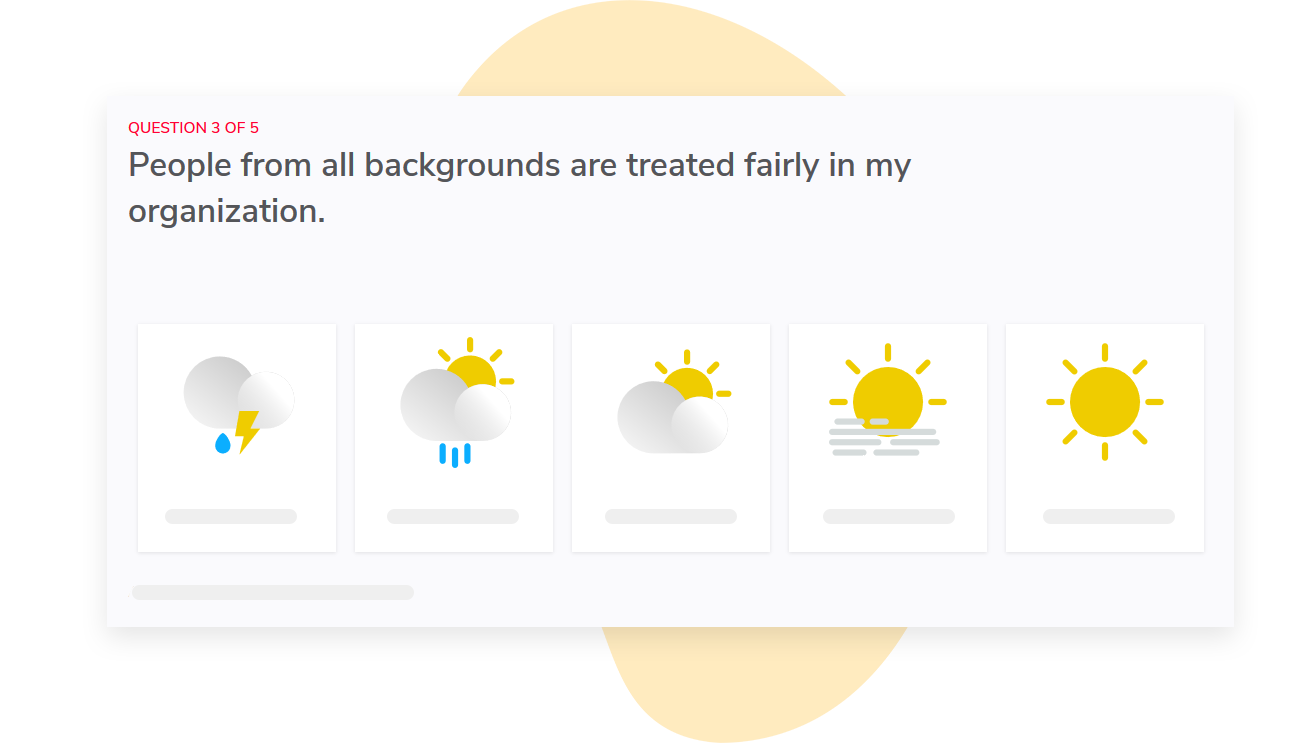
That cadence matters because well-being risk is dynamic. A team may be healthy after a hiring round, then deteriorate quickly after a restructuring, system implementation, leadership change, or sustained surge in demand.
Sparkbay also allows HR teams to segment results by manager, department, tenure, location, and other relevant groups. This helps uncover whether well-being concerns are concentrated in specific parts of the organization rather than spread evenly across the workforce.
Those segmented insights can be benchmarked against companies in the same industry using Sparkbay's proprietary dataset, giving leaders a more grounded view of whether their scores are competitive, concerning, or improving at the right pace.
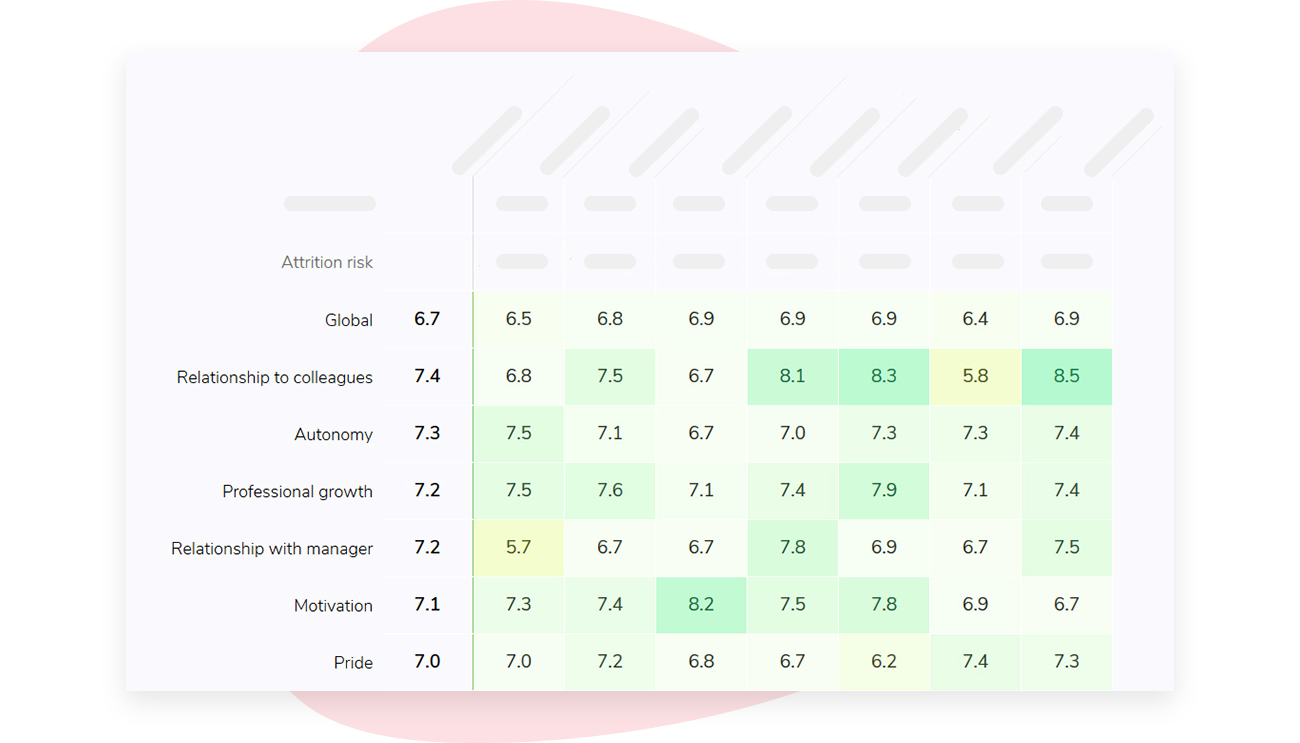
For large organizations, this is especially valuable because enterprise averages often conceal pockets of risk. A company may have a respectable overall well-being score while a high-growth department, newly acquired business unit, or early-tenure population is showing signs of exhaustion and declining trust.
Sparkbay also offers a library of easy-to-implement actions that managers can use to improve results. That helps move the organization from measurement to behavior change, which is where well-being strategies often succeed or stall.
For example, if a team scores low on workload sustainability, the recommended actions might prompt managers to clarify priorities, discuss capacity openly, or adjust meeting norms. If psychological safety is the issue, managers can receive practical guidance on feedback routines, listening behaviors, and follow-through.
Used well, Sparkbay gives HR a continuous feedback loop for the business case: where well-being is strongest, where risk is emerging, which managers need support, and whether interventions are translating into better employee experience over time.
If you're interested in learning how Sparkbay can help you build a more engaged workforce, you can click here for a demo.
The future is well: making the investment that pays for itself
Employee well-being is no longer peripheral to business performance. It is a core part of how organizations protect capacity, retain talent, strengthen engagement, and sustain productivity in an environment where employees have higher expectations and more willingness to act on them.
The organizations that gain an advantage will be those that treat well-being as a management discipline. They will measure it consistently, connect it to business outcomes, hold leaders accountable, and address the work conditions that shape daily employee experience.
The investment case is strongest when well-being is framed as a performance enabler rather than a cost center. Healthier employees are better equipped to focus, collaborate, solve problems, serve customers, and remain committed through change.
For HR leaders, the mandate is to make the invisible visible. Burnout, distrust, overload, and disengagement often build quietly before they appear in turnover reports or productivity metrics.
Organizations that listen early and act decisively are better positioned to keep their best people and protect the performance they depend on. Well-being pays for itself when it helps employees do strong work in a way they can sustain.
If you're interested in learning how Sparkbay can help you build a more engaged workforce, you can click here for a demo.