
Your best customer success manager stops by your office with the kind of look that makes your stomach drop. She is grateful, she says, but she has accepted another offer with better flexibility, clearer growth, and a manager who already mapped out her first year.
By lunchtime, her team lead is asking how quickly the role can be backfilled, two colleagues are wondering whether they should start looking too, and your finance partner is calculating what the vacancy will cost. What looked like one resignation has suddenly become a productivity problem, a morale problem, and a leadership problem.
Turnover is expensive in ways that rarely fit neatly into a spreadsheet. Replacing an employee can cost anywhere from 50% to 200% of their annual salary once you factor in recruiting, onboarding, lost productivity, ramp time, and the institutional knowledge that walks out the door with them.
But the cultural cost can be even harder to repair. When good people leave, the people who stay often absorb extra work, question the company's direction, and quietly update their resumes.
That is why retention can't sit in the background as an HR afterthought or a paragraph buried in an employee handbook. As an HR leader, you need a staff retention policy that operates like a practical roadmap for keeping talented people engaged, growing, recognized, and committed.
The goal is not to create another document that gets approved, uploaded, and forgotten. The goal is to build a policy that shows managers what to do, tells employees what they can expect, and turns retention from a reactive scramble into a daily part of how your organization works.
On this page
- What a retention policy actually is and what it is not
- Diagnose why people leave before writing the policy
- The core pillars of a retention policy that sticks
- Build career pathways employees can actually see
- Design recognition that feels meaningful rather than mechanical
- Write modern work policies that signal trust
- Put the policy on paper with a practical framework
- Move from document to daily practice
- Measure whether the policy is actually keeping people
What a retention policy actually is and what it is not
A staff retention policy is a structured commitment to the conditions that make employees want to stay, contribute, and grow inside the organization. It defines the practices, responsibilities, measures, and governance that shape retention across the employee lifecycle.
It is not a generic handbook clause that says the company values its people. It is also not a compensation policy with a few engagement initiatives attached.
A strong retention policy connects several systems that often operate separately: workforce planning, manager capability, career architecture, recognition, flexibility, employee listening, and organizational culture. The policy should make clear what employees can expect and what leaders are accountable for delivering.
For large organizations, the policy also needs enough structure to create consistency without removing local judgment. A sales function, shared services team, engineering group, and frontline operations unit may all need different retention interventions, but they should operate from the same principles.
The most common mistake is treating retention as a salary problem. Compensation matters, especially when employees are materially under market, but many resignations happen because of stalled growth, poor management, low trust, weak recognition, workload pressure, or a lack of belonging.
A useful retention policy should answer five practical questions:
- What are the organization's retention priorities? For example, critical roles, high-potential employees, new hires, scarce skills, or underrepresented groups.
- Which practices support retention? For example, career pathways, stay interviews, internal mobility, manager check-ins, flexibility, and recognition.
- Who owns execution? HR may design the policy, but managers create much of the daily experience that determines whether employees stay.
- How will the organization measure progress? Retention rate alone is too blunt, so the policy should include leading and lagging indicators.
- How often will the policy be reviewed? A retention policy should evolve as labor markets, employee expectations, and business priorities change.
Diagnose why people leave before writing the policy
Retention policies fail when they are built from assumptions. Before drafting anything, HR needs a clear view of where turnover is concentrated, which employee groups are most at risk, and which workplace experiences are pushing people out.
The diagnosis should combine quantitative turnover analysis with qualitative employee listening. Exit interviews can reveal themes, but they often arrive too late and may be filtered by an employee's desire to preserve relationships.
Stay interviews are especially useful because they surface retention risks while there is still time to act. They work best when managers are trained to listen without defending, promising what they cannot deliver, or turning the conversation into a performance discussion.
Sample stay-interview question set
- What part of your work gives you the strongest reason to stay here?
- What part of your work makes you consider leaving?
- When was the last time you felt genuinely recognized for your contribution?
- Do you see a realistic path for growth here over the next 12 to 24 months?
- What skills would you like to build that are not being used today?
- What does your manager do that helps you do your best work?
- What is one thing your manager or the organization could change that would make staying easier?
- Are there barriers here that make it harder for certain employees to succeed?
Engagement surveys and pulse surveys add another layer by identifying patterns across teams, locations, tenure groups, and demographics. This matters because turnover is rarely evenly distributed.
A company-wide retention rate can look healthy while one function loses experienced specialists at an unsustainable pace. A first-year turnover spike may point to hiring misalignment, onboarding gaps, workload shock, or poor manager integration.
HR should also examine regrettable turnover, internal mobility, promotion velocity, absenteeism, performance distribution, and employee relations data. When several data sources point to the same issue, the retention policy can target the real problem instead of applying generic fixes.
| Data source | What it reveals | How it shapes the policy |
|---|---|---|
| Exit interviews | Reasons employees give after deciding to leave | Highlights recurring pain points and gaps in the employee value proposition |
| Stay interviews | What keeps employees engaged and what may cause them to leave | Guides manager actions and proactive retention commitments |
| Engagement surveys | Team-level patterns in motivation, trust, recognition, and belonging | Identifies where interventions should be prioritized |
| Turnover analytics | Who leaves, when they leave, and from which parts of the organization | Defines target populations, risk groups, and measurable retention goals |
| Internal mobility data | Whether employees can realistically grow without leaving | Informs career pathway and promotion policy design |
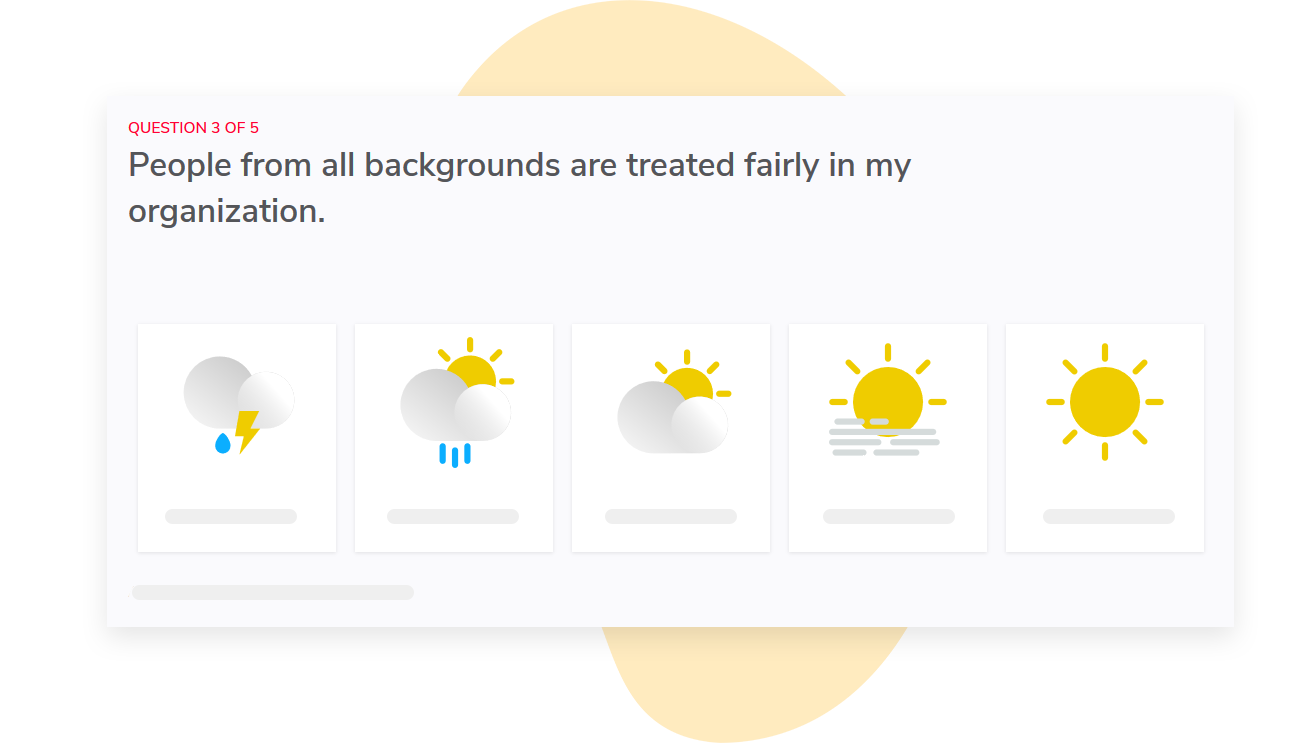
A retention policy becomes stronger when it is grounded in current employee feedback rather than annual anecdotes. Sparkbay automatically collects employee feedback at regular intervals, and many clients run monthly pulse surveys to keep a close read on engagement, manager effectiveness, recognition, growth, and workload.
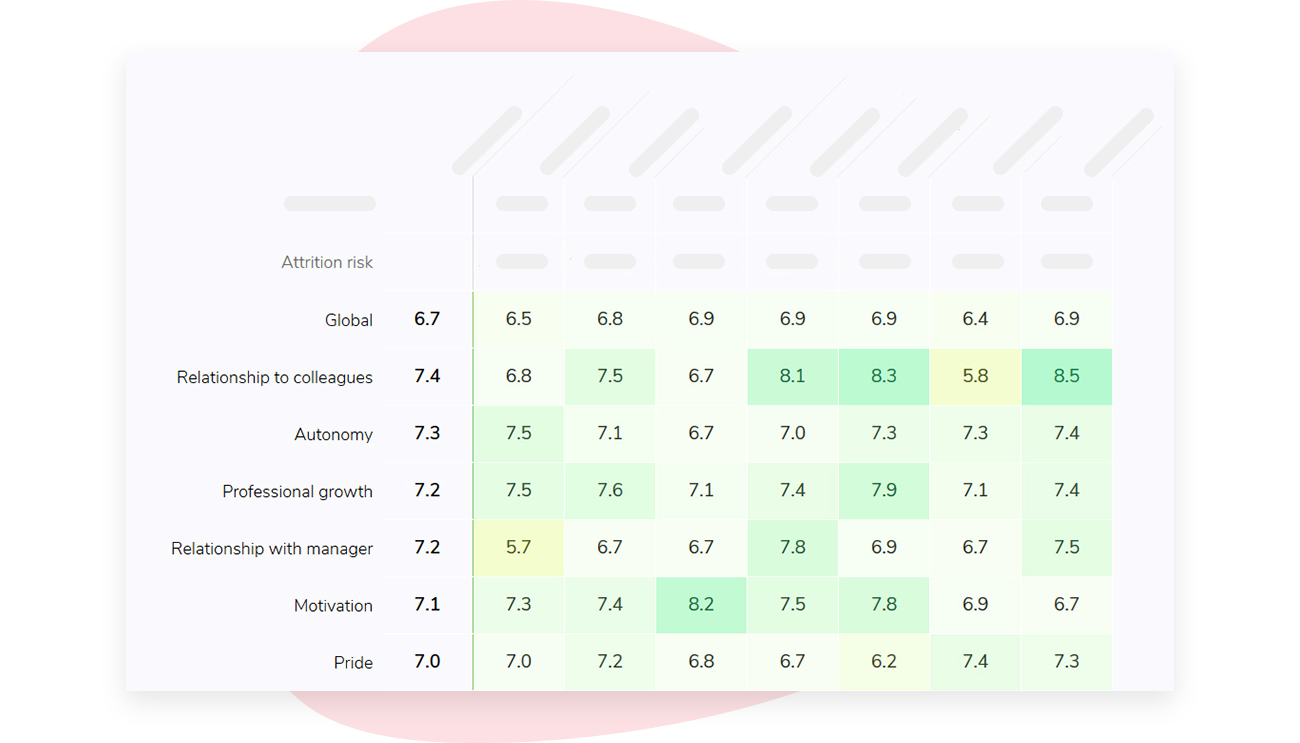
Results are presented in intuitive reports with a clear score out of 10, making it easier for HR and leaders to understand where retention risk is building. That score gives executives and managers a shared language for discussing employee experience without reducing the conversation to turnover numbers after people have already left.
For a retention policy, the value is in turning broad signals into specific action. If employees in their first six months score onboarding clarity lower than the rest of the organization, the policy can include structured manager check-ins, buddy programs, and early stay conversations.
Sparkbay also lets HR segment results by manager, department, tenure, and more, which is essential in large organizations where averages can hide local problems. Teams can benchmark against companies in their industry using Sparkbay's proprietary dataset, helping leaders distinguish between internal issues and broader market pressures.
Once the priority areas are clear, Sparkbay offers a library of easy-to-implement actions to help managers improve. This is particularly useful when a retention policy assigns managers responsibility for engagement but they need practical guidance on what to do differently in one-on-ones, team rituals, recognition, workload planning, and feedback conversations.
That makes Sparkbay a useful operating layer for retention governance. HR can monitor whether policy commitments are translating into better employee experience, while managers receive specific, timely prompts that move retention from intent to habit.
If you're interested in learning how Sparkbay can help you build a more engaged workforce, you can click here for a demo.
The core pillars of a retention policy that sticks
A retention policy should be organized around the experiences that influence whether employees see a future with the organization. The pillars below are interconnected, so weak execution in one area can undermine progress elsewhere.
| Pillar | Policy commitment | Retention logic |
|---|---|---|
| Competitive compensation and benefits | Maintain market-informed pay practices, transparent salary ranges where appropriate, and benefits aligned with workforce needs | Removes avoidable dissatisfaction and signals fairness |
| Career development and growth | Provide visible pathways, skill-building support, internal mobility, and promotion criteria | Reduces the need to leave for progression |
| Recognition and feedback | Create regular, specific recognition practices and high-quality feedback loops | Strengthens perceived value, belonging, and discretionary effort |
| Flexibility and sustainable work | Define modern work arrangements, workload review practices, and boundaries for availability | Builds trust and lowers burnout-related attrition |
| Inclusive, healthy culture | Support psychological safety, equitable opportunity, respectful conduct, and manager accountability | Improves attachment to the organization and reduces exclusion-driven turnover |
Compensation and benefits should be treated as the foundation, not the whole policy. If employees believe pay practices are inequitable or opaque, recognition programs and career development investments may be interpreted as distractions from a fairness issue.
For large organizations, compensation commitments should include a cadence for market reviews, pay equity analysis, and governance around counteroffers. A retention policy should not rely on counteroffers as a primary tactic because they can reward resignation threats and create internal inequity.
Career development is often the strongest long-term retention lever for ambitious employees. The policy should define how employees learn about opportunities, how managers support development, and how internal candidates are considered before external hiring proceeds.
Recognition and feedback help employees connect their work to impact. The policy should distinguish between frequent informal recognition, manager-led feedback, peer acknowledgment, and formal awards.
Flexibility should be written with enough clarity to reduce inconsistency. Employees may accept different arrangements across roles, but they are less likely to accept unexplained differences across managers.
Culture and inclusion should be treated as retention infrastructure. Employees are more likely to stay where they have voice, trust decision-making, see fair access to opportunity, and believe poor behavior is addressed regardless of seniority.
Build career pathways employees can actually see
Career development retains employees when it is specific enough to guide decisions. Broad promises about growth lose credibility when employees cannot see what the next role looks like, which capabilities matter, or how promotion decisions are made.
A mature retention policy should include career architecture that combines job families, levels, skills, experiences, and mobility principles. This allows employees to compare vertical progression, lateral movement, and specialist tracks without relying entirely on manager interpretation.
Mentorship programs can support retention, but only when they are designed with clear goals. Pairing employees casually may create a pleasant relationship, but targeted mentoring around promotion readiness, leadership transition, technical mastery, or organizational navigation produces stronger outcomes.
Skill-building budgets should also be tied to business-critical capabilities and employee aspirations. A policy can specify annual development planning, learning allowances, certification support, conference access, and protected learning time.
Example career ladder for a marketing coordinator
| Stage | Typical timeline | Milestones | Retention policy support |
|---|---|---|---|
| Marketing coordinator | 0 to 18 months | Executes campaigns, maintains calendars, coordinates assets, reports basic performance data | Structured onboarding, campaign shadowing, monthly manager check-ins |
| Senior marketing coordinator | 12 to 30 months | Owns smaller campaigns, improves workflows, analyzes channel performance, mentors new coordinators | Skill budget, stretch assignments, peer recognition, promotion readiness review |
| Marketing specialist | 24 to 42 months | Leads channel initiatives, recommends optimization, manages vendor relationships, contributes to strategy | Formal learning path, internal mobility visibility, cross-functional project access |
| Marketing manager | 36 months and beyond | Owns campaign strategy, manages budget, develops team members, reports business impact | Leadership development, mentorship, succession planning discussion |
The exact timelines will vary by organization, role complexity, and market conditions. The important principle is transparency: employees should understand what progress looks like before they decide they need to leave to find it.
Internal mobility should be protected in the policy, especially in organizations where managers are reluctant to lose strong performers. A retention policy can state that managers are expected to support internal movement and that talent hoarding will be reviewed as a leadership behavior.
Design recognition that feels meaningful rather than mechanical
Recognition affects retention because it answers a basic employee question: "Does my contribution matter here?" When recognition is absent, vague, or reserved for a narrow group of visible roles, employees may assume their effort is taken for granted.
Effective recognition is specific, timely, and connected to values or outcomes. "Great job" is pleasant but weak; "Your work resolving the renewal escalation protected a strategic account and helped the new CSM learn how to handle pressure" is memorable.
A retention policy should define recognition at multiple levels. Formal programs create consistency, while informal practices make appreciation part of daily work.
Recognition in action
| Recognition level | Example | Best use | Governance consideration |
|---|---|---|---|
| Everyday recognition | Manager shout-out in team meeting or written praise in a collaboration channel | Reinforcing helpful behaviors quickly | Train managers to make recognition specific and inclusive |
| Peer-to-peer recognition | Employees nominate colleagues for living company values | Surfacing invisible work across teams | Monitor participation patterns to avoid popularity bias |
| Spot reward | Small bonus, gift card, or additional paid time for exceptional contribution | Recognizing above-and-beyond effort or critical delivery | Set budget guardrails and approval criteria |
| Milestone recognition | Anniversary award, career achievement celebration, project completion recognition | Marking loyalty, growth, and sustained contribution | Ensure part-time, remote, and frontline employees are included |
| Strategic recognition | Executive acknowledgment for work tied to business priorities | Connecting employee impact to organizational direction | Avoid over-indexing on high-visibility functions |
Recognition systems can unintentionally reinforce inequity if the same employees are always visible to senior leaders. HR should review recognition data by department, level, location, manager, gender, race where legally and ethically appropriate, and work arrangement.
The policy should also clarify the relationship between recognition and performance management. Recognition should not replace fair pay, promotions, or constructive feedback, but it can strengthen the emotional contract that keeps employees committed.
Write modern work policies that signal trust
Flexibility has moved from differentiator to expectation for many roles. Even where remote or hybrid work is not operationally possible, employees still look for flexibility in scheduling, shift design, time-off practices, and autonomy over how work gets done.
A retention policy should distinguish between role-based flexibility and manager-based preference. Employees can understand why a laboratory role, retail role, or client-facing role has constraints, but they lose trust when two similar teams operate under different rules because one manager dislikes flexibility.
Modern work policies should address availability norms, meeting discipline, core collaboration hours, location expectations, equipment support, and escalation procedures. For hybrid work, the policy should explain why in-office time exists, such as collaboration, onboarding, client delivery, or team cohesion.
Workload sustainability also belongs in the retention policy. Flexibility loses value if employees are free to choose where they work while carrying a volume of work that regularly requires nights and weekends.
Sample flexible-work clause
Employees in eligible roles may request flexible work arrangements, including hybrid schedules, adjusted start and end times, compressed workweeks, or remote work, subject to business requirements, client commitments, role responsibilities, and team collaboration needs.
Managers are expected to evaluate requests consistently using documented criteria and to review arrangements at least twice per year. Flexible work decisions should be based on role requirements and performance expectations, rather than personal preference or assumptions about employee commitment.
Where a requested arrangement cannot be approved, the manager must provide a clear business rationale and, where possible, explore alternative flexibility options.
This type of clause balances employee autonomy with operational discipline. It also reduces the risk that flexibility becomes a privilege granted unevenly through informal negotiation.
Put the policy on paper with a practical framework
Once the diagnosis and policy pillars are clear, HR can move into drafting. The writing process should be collaborative because retention depends on decisions owned by HR, finance, business leaders, managers, and employees themselves.
- Assemble a cross-functional team. Include HR business partners, talent acquisition, compensation, learning and development, DEI, finance, legal, communications, and business leaders from high-turnover or critical-skill areas.
- Set measurable retention goals. Define the employee populations that matter most and the outcomes the policy should influence, such as reducing first-year turnover, improving internal mobility, or increasing engagement in specific teams.
- Draft the policy sections. Use clear language that describes commitments, eligibility, ownership, cadence, escalation routes, and measurement.
- Pilot and gather feedback. Test the policy in a function or location where retention risk is visible and managers are willing to participate.
- Formalize and communicate. Translate the policy into employee-facing materials, manager guides, intranet pages, onboarding content, and leadership talking points.
- Train managers to execute. Give managers scripts, decision rules, conversation guides, and dashboards so the policy becomes behavior.
Policy template structure
| Policy section | What to include |
|---|---|
| Purpose | Why retention matters to the organization and how the policy supports business strategy and employee experience |
| Scope | Who the policy applies to, including any distinctions by role type, location, contract type, or regulatory environment |
| Retention principles | Core beliefs, such as fairness, growth, inclusion, transparency, and manager accountability |
| Compensation and rewards | Market review cadence, pay equity principles, benefits review, recognition approach, and counteroffer philosophy |
| Career development | Career pathways, learning support, mentorship, internal mobility, succession planning, and promotion criteria |
| Employee listening | Survey cadence, stay interviews, exit interviews, action planning, and feedback governance |
| Flexible work and wellbeing | Role-based flexibility, workload review, PTO expectations, and manager responsibilities |
| Manager responsibilities | One-on-ones, recognition, development planning, team climate, escalation, and retention risk management |
| Measurement and review | Metrics, reporting cadence, accountable owners, and policy refresh timelines |
The policy should be written in operational language, not aspirational slogans. Every commitment should be clear enough that an employee can recognize whether it is happening and a manager can understand what action is required.
Move from document to daily practice
A retention policy has little value if managers treat it as an HR document. Employees experience retention through everyday interactions: the quality of their one-on-ones, the fairness of work allocation, the credibility of career conversations, and the way leaders respond to feedback.
Manager enablement should be a formal part of rollout. Managers need to know how to conduct stay interviews, discuss career paths, recognize contributions, handle flexibility requests, identify retention risk, and escalate issues before resignation becomes likely.
Communication should also be layered. Executives can explain why retention matters to the business, HR can explain how the policy works, and managers can translate the commitments into team-level expectations.
Embedding retention into existing talent moments makes the policy more durable. Add retention prompts to onboarding, probation reviews, performance cycles, succession planning, engagement action planning, and manager performance assessments.
For example, an onboarding process can include a 30-day fit conversation, a 60-day workload and clarity check, and a 90-day stay conversation. These touchpoints help identify early friction before it becomes first-year turnover.
The rollout should also create feedback channels for employees and managers. If the policy is too complex, inconsistently applied, or misaligned with operational realities, HR needs to know quickly.
Measure whether the policy is actually keeping people
Retention measurement should combine lagging indicators, leading indicators, and diagnostic cuts. A declining turnover rate is useful, but it does not tell HR whether the right people are staying or whether employees are staying while disengaged.
Start with retention rate and turnover rate, then separate voluntary, involuntary, regrettable, non-regrettable, and retirement-related exits. In large organizations, segmenting by tenure, level, function, location, manager, demographic group where appropriate, and critical role category is essential.
Employee Net Promoter Score, engagement scores, intent-to-stay items, manager effectiveness scores, internal mobility rates, promotion rates, absenteeism, and time-to-productivity can reveal whether the policy is influencing the employee experience before turnover changes. Sparkbay can support this type of measurement by giving HR a regular read on engagement drivers and team-level hotspots.
Simple retention metrics dashboard
| Metric | Why it matters | Suggested review cadence |
|---|---|---|
| Overall retention rate | Shows broad workforce stability | Monthly and quarterly |
| Voluntary turnover rate | Tracks employee-initiated exits | Monthly and quarterly |
| Regrettable turnover | Highlights loss of high performers, critical skills, or high-potential employees | Monthly |
| First-year turnover | Identifies hiring, onboarding, or early manager integration issues | Monthly and quarterly |
| Engagement score | Measures the employee experience conditions that influence retention | Monthly or quarterly |
| Intent to stay | Acts as a leading indicator of future voluntary turnover | Monthly or quarterly |
| Internal mobility rate | Shows whether employees can grow without leaving | Quarterly |
| Manager effectiveness score | Connects retention risk to local leadership experience | Monthly or quarterly |
Reviewing metrics quarterly is usually frequent enough for strategic governance, while monthly reviews may be appropriate for high-turnover populations. Annual review alone is often too slow because resignation patterns can accelerate quickly after leadership changes, restructures, workload spikes, or market shifts.
The governance model should specify who reviews the data, who approves interventions, and how progress is communicated. Retention work loses momentum when insights are shared without decision rights or accountability.
Qualitative data should remain part of the review. Survey comments, stay-interview themes, manager feedback, and exit narratives can explain why a metric moved and whether the policy needs refinement.
Start with the moments that most influence staying
A staff retention policy should make staying feel like a rational and rewarding choice. That requires more than competitive pay; it requires credible growth, capable managers, fair systems, meaningful recognition, flexibility that reflects trust, and a culture where employees can see a future.
The most effective approach is to start with the highest-impact moments. For many organizations, that means first-year experience, manager quality, career progression, workload sustainability, and recognition.
Build the policy from evidence, pilot it where the risk is clear, measure what changes, and refine it as employee expectations evolve. Retention is culture-building work expressed through policy, systems, and everyday leadership behavior.
If you're interested in learning how Sparkbay can help you build a more engaged workforce, you can click here for a demo.