
What you’ll read tonight at 11 p.m.
An anonymous employee just threw your department under the bus. What do you do?
We get it. It’s 11 p.m., the review is specific enough to recognise the issue, and CHROs are supposed to have seen it by 7 a.m.
Your report says managers play favourites, workloads are crushing people, and senior leaders don’t listen.
Then you find a Blind thread that says the same thing. Blind verifies users’ work email, so you know this is coming from current employees, not disgruntled alumni.
Your first reaction is to want to find out who wrote this.
Who are you? And why didn’t they come to you?
Let’s put this response in perspective.
The real problem isn’t that an employee criticised your culture online - it’s that they felt safer telling strangers than telling you.
So what do you do? Do three things over the next few hours, and then put the review on the back burner.
First, save a copy of the post with a timestamp. You’ll want to refer back to the original wording when you start a conversation with the execs, since online platforms let users edit and delete posts.
Next, figure out whether the review is a claim about a system or about an identifiable person.
This is important, and teams often overlook the distinction.
If it’s a systemic claim, it goes into your listening pipeline. If it’s a claim about harassment, discrimination, or safety that involves a specific leader, you may have an ethical obligation to investigate further, even if there’s no internal complainant or the issue was anonymous. Check with your employment counsel to make sure your company is in the clear.
Finally, don’t respond publicly for at least 24 hours. Almost all response regrets come from writing something up in the heat of the moment.
Avoid also trying to find out who wrote the review. In the United States, discussing pay, workload, and working conditions with co-workers is a protected concerted activity under Section 7, and trying to find out who wrote a review could lead to a far more serious unfair labor practices accusation.
In the EU, it’s also bad news. Repurposing survey or HRIS data to identify a respondent is classic data repurposing, which is also a no-no for your works council.
You should think about how to change things, though, like your employees’ calculus when it comes to choosing a communication channel.
This means addressing concerns about being identified, offering multiple options to reach out depending on the severity of the issue, and publicly displaying examples of change after previous outreach efforts.
Conducting surveys and then going radio silent doesn’t just waste your time and money. It also reinforces the theory that internal communication channels are for show and that nothing will ever change.
Why Employees Vent About Culture on External Anonymous Platforms and How to Build a Trusted Internal Channel
- The feedback iceberg
- Why they told the internet instead of their manager
- Stop playing whack-a-mole with your reviews
- Read reviews like a researcher
- Build anonymous channels that people will use
- Your first response decides whether people come back
- Train the managers who receive the feedback
- Watch for signals before they become reviews
The feedback iceberg
Public reviews are published on websites such as Glassdoor, Indeed, and Comparably.
This is the most "top of the iceberg" or "tip of the iceberg" way to gather reviews because emotional moments or events tend to spur some of the most reviews. Think: the onboarding process, promotion processes, times of layoffs, or leaving the company.
Anybody can access these public reviews.
And this is also why they may not be the most accurate. They can be easily influenced by the incentives given to job candidates to write a positive, five-star review. Or the departure of an employee incentivizing them to write a one-star review.
There’s also a semi-private way for candidates to share reviews and experiences.
Websites like Blind and Fishbowl give users the chance to write reviews. Companies and users can verify themselves, so these reviews are often checked and moderated by the users’ peers within the network.
Users may also belong to invite-only Slack or Discord groups. These are private spaces where employer-brand managers could potentially develop relationships with employees.
There are also less public places users can discuss their experiences with employers. Users can create throwaway accounts on Reddit, access alumni Slack groups, or talk in private group chats with someone’s best engineers while comparing offers.
It’s worth keeping in mind that these public reviews are often lagging indicators of where your company is at. A review published on Glassdoor might be one of the final steps of a conversation an employee had with a peer about your employer that started months prior, maybe when they updated their LinkedIn headline.
Employees also don’t always wish to share what they think publicly. In fact, researchers have found that there are two reasons employees choose not to share their feedback.
One is fear - employees fear the consequences of providing feedback (which may or may not be anonymous).
The other is futility - employees think providing feedback is futile.
In mature organizations, futility is the much greater cause for silence. This means that no amount of reassurance around anonymity and privacy will eliminate this trend.
In short: Take the external reviews outside your organization with a grain of salt.
For instance, one negative review may represent one person’s terrible week.
On the other hand, if you find three negative comments from independent sources that all say something about the same manager or the same bottleneck for approval processes or the same group up for promotions, then you’ve got a real insight on an area of improvement, regardless of the delivery.
By independent sources we mean instances from different platforms, during different months, where it’s hard to imagine coordination among reviewers.
For example, 5 reviews within a week of a major reorganization announcement is likely one event, not five independent sources.
Surveys from job platforms consistently find that a large majority of candidates reads company reviews before applying for the company or accepting an offer.
Contrary to popular thinking, experienced candidates often don’t just look at the overall review average.
They tend to read 2 and 3-star reviews, as well as look at the trend of reviews for the past 6 months.
In other words, a company with a Glassdoor average rating of 4.4 but a downwards review trend over the last six months may have a harder time recruiting senior talent than a company with a stable average rating of 3.8.
Why they told the internet instead of their manager
People circumvent internal communication channels for a number of reasonable and often rational reasons.
First, there’s the risk of retaliation.
If an employee witnesses a colleague suffer negative consequences for speaking up (e.g., being quietly taken off a high-profile project after publicly challenging leadership during a town hall meeting), then they have a clear warning not to rock the boat.
Then there’s the matter of perception. Even if a comment process is truly anonymous, if employees receive the message that the person running the platform can cross-reference comments to company data (which, on most platforms, is possible on a technical level), they might not feel comfortable using the platform.
How does your organization stand up to a skeptical senior engineer’s scrutiny? If they can see that your company’s access model holds the same weight as an online privacy statement they would laugh at, then your platform may not be trusted.
Third, there’s the issue of futility.
A person tells you there’s too much on their plate in your pulse surveys, during a one-on-one meeting, or thanks to a former employee’s exit interview. But nothing changes.
So when they’re on the internet, they post it somewhere publicly where there’s a greater chance they’ll get a response. For example, they might wait for a reply for hours rather than weeks.
Sometimes, the issue is that their manager is the problem.
In such instances, how do employees "raise it with their manager first" when that manager is responsible for performance reviews or providing them with opportunities with their own manager? Employees need access to skip-level conversations with leaders.
Moreover, your organization’s cadence for collecting feedback matters too. If you only conduct temperature checks twice a year, you’re unlikely to discover an issue stemming from the recent announcement of a massive reorganization or new initiatives. And issues related to reorgs are often the issues that grow most quickly.
Finally, public forums are a great way for employees to receive support and corroboration from peers outside their reporting structure. This can help employees realize that their feelings are not just personal frustrations but that they’re reflective of how the organization operates.
As Amy C. Edmondson writes in The Fearless Organization, people speak up when they feel like they can take interpersonal risks without facing punishment or humiliation.
Moreover, in Exit, Voice, and Loyalty, Albert O. Hirschman argues that dissatisfied members of an organization only have two options: complaining or leaving.
What’s more, they only choose the option of complaining (or "voice") if they believe their complaints will have some impact and they have some attachment to the organization worth protecting.
What does this mean for talent teams?
In your organization, the most marketable employees have the easiest way out, so they are the least likely to use their "voice". As a result, your high-performing teams may not be very vocal (or interactive) yet they may be quietly looking for opportunities elsewhere.
This means your talent team should pay attention when your strongest groups aren’t communicating as much as others.
So, how should talent teams view anonymous posts?
Stop playing whack-a-mole with your reviews
Each time you get a bad review, and you jump into action, it looks something like this:
Someone tries to drum up more positive reviews within the next 48 hours. Your legal team reviews the bad reviews to see what they can do about them. Someone in your communications team looks at the phrasing of the reviews to compare it to internal emails
Your leadership team member may ask their trusted employees to post reviews. Your legal team may try to take the reviews down or subpoena the poster’s identity.
Your team may even try to kick off a volume campaign to increase the number of positive reviews to boost your average star rating and hold up for the next quarter. But all of these efforts ignore the underlying issue. And since most platforms weigh recent reviews more heavily, the fresh bad reviews will wash away all your efforts.
Meanwhile, your employees will hear about this. Someone will pass the word along.
And if your employees think their leaders spent more time trying to figure out who said something they shouldn’t have, rather than looking into whether it’s true, that’s a problem. They’ll think twice about being honest in your future three employee surveys.
The other problem with trying to suppress reviews is that it can amplify the reviews and lead to a Streisand effect.
The story suddenly becomes not just a story about workload - but a story about a company that tried to suppress any complaints about workload. And this storyline spreads faster and further.
There’s one legit way to handle reviews:
If you see content that breaches the terms of the platform, shares confidential information, or discloses someone’s identity by name, document that you’ve flagged it, why you’ve flagged it, and when you flagged it.
Other than that, you need to keep everything else up there, whether you don’t like the tone of the review, whether you think it’s unfair, whether you think the person posting is forgetting some key details, or whether you’re just plain offended as a manager.
Generally speaking, providing unattractive or negative information about a company is not defamation. Expressing opinions about work conditions are protected both in the US and Canada. If you’re in England or Australia, your legal team may tell you those countries have a lower threshold for defamation claims, but again, business teams should consider this carefully.
Whenever you’re considering an escalation or another action, think about its second-order effects: If the world sees that you are taking an action, does it make the original complaint seem more or less legitimate?
In almost all cases, entering legal action makes a complaint seem more legitimate.
And it’s worth checking in with yourself to make sure that your reputation management efforts or your "win" is NOT tied to your pay or performance reviews.
Read reviews like a researcher
Avoid the temptation to argue whether a review is fair or not. This will quickly derail your review analysis process.
Instead, focus on what themes or complaints keep popping up.
First, make sure you’re analyzing the right unit of analysis. Reviews often discuss multiple claims. One 3-paragraph review might mention pay equity, scope of responsibilities, and a personal complaint.
When you label that entire review under one tag, you lose valuable data.
Remove identifying information and emotional language, and focus on coding what the underlying mechanism is. Consider how a second person would code the review. If you’re both interpreting it differently over 20% of the time, the issue is with your categories.
You could start with a taxonomy that includes:
- Leadership: trust, communication and followthrough
- Workload: staffing, hours and scope of role
- Pay equity: pay gaps, raises, access to bonuses
- Growth: promotions, learning and career paths
- Inclusion: belonging, fairness, whose voice carries weight
- Process: approvals, tools, unclear ownership
Along with each review, you should also note the date of the review, the possible business unit, and whether or not it’s from a current or former employee. Avoid going overboard and trying to determine exact tenure by combining information from various reviews. This could cross a privacy line and create issues with your works council.
One random review with one complaint might not be that big of a deal. But if your coding of reviews uncovers the same mechanism described in five different reviews across three platforms by people who likely never discussed their reviews with one another, you have a theme that can be presented to an executive team.
Before you seek confirmation, write down disconfirming evidence for your theme. This is crucial for effective review analysis and helps avoid biases.
For instance, if your identified claim is "Promotions go to favourites." Your disconfirming analysis might include looking at promotion rates by manager and by demographic group or how many promotions went to people who have never worked with members of the calibration panel.
You’ll also want to see how your data overlays with your operational calendar. Did you have any reorgs or changes to managers’ span of control? What were the outcomes of your calibration sessions?
Did you have any regretted exits by specific managers?
If you see a sudden surge in workload eight weeks after a hiring freeze, this isn’t a culture issue. It’s an unfunded scope of work problem masquerading as a culture problem. And no amount of culture training will fix it.
Acknowledging these differences is an important insight to give an executive team. Why? Because different strategies require different budgets and different owners for each strategy.
Your review analysis isn’t just about identifying areas of edit. There’s also value in using it to identify other trends. For instance, large sets of employer reviews have been used to identify a clear connection between toxicity culture themes and employee turnover.
Research from MIT Sloan has explored this.
And don’t forget to interrogate the 5-star reviews.
If the 5-star reviews consistently praise their colleagues or flexibility, but rarely mention how much they like their leaders, how much they’ve advanced, or how they like the quality of their team’s decisions, this might suggest employees like working at their work place, but they don’t necessarily have high expectations for their career from their work place. This could explain a high mid-tenure attrition rate.
You can also analyze the language in your 5-star reviews for interesting insights. If you notice a change in the use of "we" to "they" in reviews from a certain business unit over the course of two quarters, this could be a sign that the team doesn’t feel a sense of identity with the company or their division.
Build anonymous channels that people will use
People have different concerns, and don’t always want to access those concerns through the same channels.
Concerns about workload and process friction may be addressed through a pulse survey. Concerns about harassment, safety, and financial misconduct may require an ombuds or speak-up channels that have specific case management, investigation requirements, and if you fall within the scope of the EU Whistleblower Directive, acknowledgement and feedback deadlines you’re legally obligated to meet.
Build a small network of channels rather than forcing every concern through one annual survey.
Ensure you’ve labelled channels correctly, because employees will recognize the difference even if your policies don’t clearly state the difference.
Anonymous means no one, including the vendor’s admin, can link each response to an individual.
Confidential means the company knows who the concern comes from, but there’s a restricted distribution list. In some cases the info must be escalated, even if the employee prefers it not be, depending on the category.
Nothing sabotages promising one thing and delivering another faster than a mismatch in how you frame your channels.
Make sure you clearly communicate the limitations of confidentiality or anonymity through the channel’s invitation message, not by linking to a more detailed policy somewhere else. It’s better to say, "We cannot keep a safety allegation confidential and here’s why," than to promise 100% confidentiality across the board when that’s not realistic.
A lot of programs focus on protecting people above the reporting threshold, but they overlook smaller units managers can combine to identify respondents.
For instance, a respondent may view a department as 40 people, and a team as 35. That leaves 5 people. A manager can use exports to play with data and reveal which individual someone is.
Before launching your channel, review your dashboard design with a critical eye. Give a skeptical analyst administrator access and the task of identifying one respondent based on what a manager can see.
Address these issues before you launch your first survey or channel, not after you receive complaints.
While 5 is a good baseline, it’s important to remember that within the anonymous feedback best practices community there are genuine debates on what the optimal minimum response threshold is. Many enterprise teams opt for 8 or 10 once demographic filters are considered. Consider the ideal minimum response size as a helpful guideline.
However, make this decision before your first survey or channel launch to avoid the perception of burying issues.
We also recommend creating alternative options for teams that will never meet the threshold.
Small offices, small teams within specific functions, or newly formed teams may routinely fall below the minimum response-sized deliverable. Offering these teams "No results available" twice a year may cause them to disengage altogether. Consider combining their data into the next level up team’s department while also providing an option to participate in facilitated listening sessions.
These qualitative sessions would be documented in meeting minutes and include the same action-oriented approach.
Addressing anonymous feedback channels also requires confronting free-text responses. For example, verbatims may reference specific projects, clients, or meetings. Publishing these verbatims would disregard the response threshold rules.
Decide on whether comments will be summarized, redacted, or only see the light of day when in departments above a certain size. And inform respondents which option will be used.
One efficient approach is to deliver managers a summary with themes while giving a central team access to raw verbatims while keeping a documented, logged record of who accessed the data. Your team can filter the raw comments based on whether they include info that identifies someone, and remove those comments from the survey channel.
You should also build a channel for people to express concerns outside of your typical cadence.
An always-open feedback form is one option, so long as there’s someone responsible for triaging those concerns within a specific SLA. Another anonymous channel is an upvoted anonymous town-hall style question that gives employees the opportunity to input their questions and concerns and ensures the top three questions are answered whether or not they’re popular. Other options include skip levels and manager-free listening sessions.
Ignoring a top voted question risks undermining your entire anonymous feedback enterprise, because people will stop upvoting.
Ensure your investigation-ready channels are architecturally distinct. If your pulse survey suddenly collects harassment reports, you’ve created an unmanaged legal liability.
How do you do that? Include a sentence somewhere in your comments section fields that guides respondents to the speak-up channel or omitted investigation section. And if you do receive bunches of comments through these channels, have a triage rule for what to do.
Yes, this may look redundant anonymous feedback best practices on your process map. But it’s worth the redundancy.
Why? Because a single, streamlined process looks great during a governance review, but it isn’t as comforting for someone weighing the risks of using a channel at 11 p.m. that has potentially unrelated legal liabilities.
At Sparkbay, we want to help large organizations check in with their employees regularly instead of once a year through a survey.
Many teams conduct pulse surveys every month. Since both the survey wording and what goes into the dashboard can be configured, it’s possible to ask the exact question employees need to answer, including the awkward question that appeared on Blind last week.
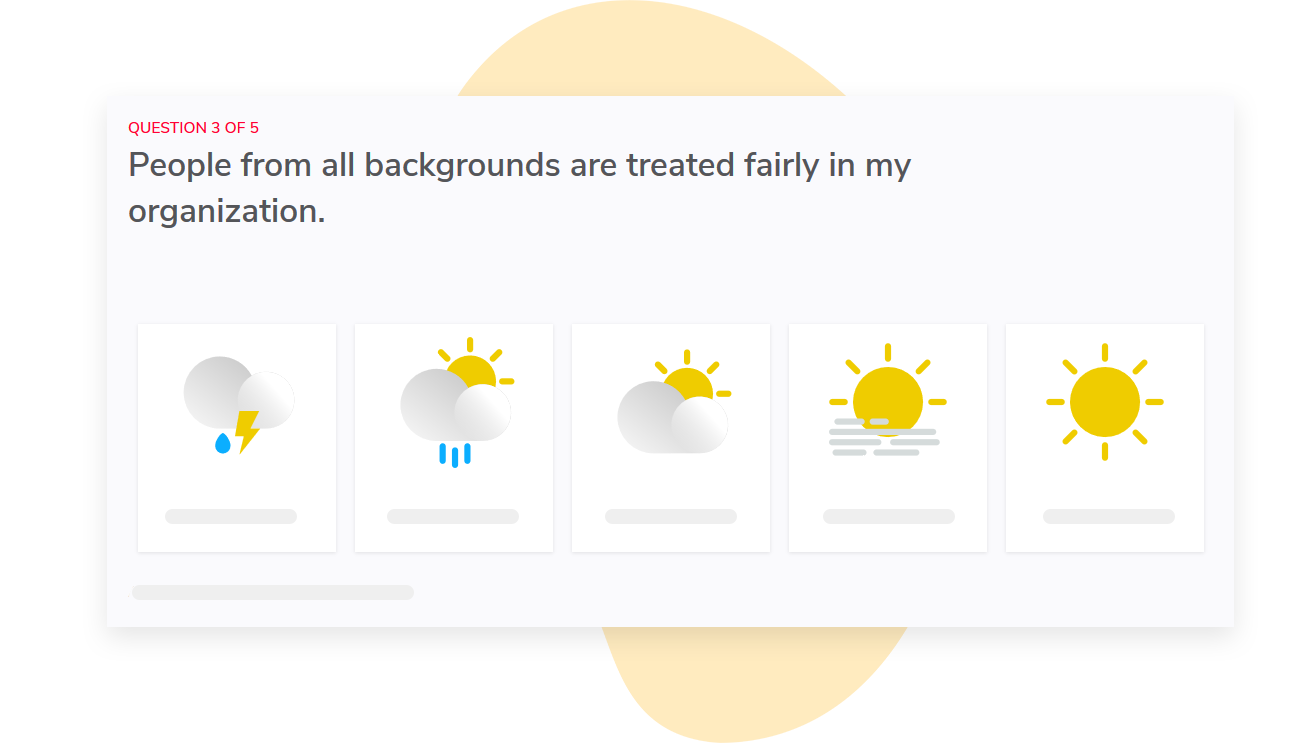
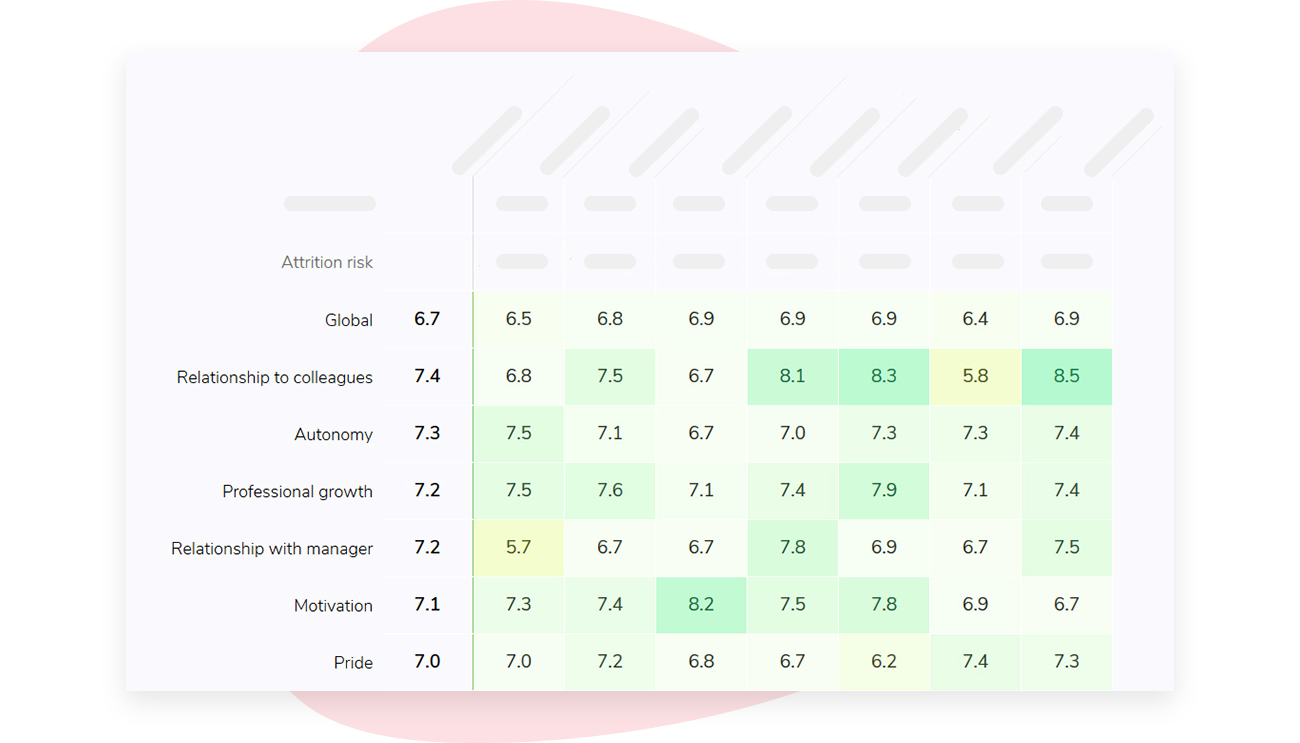
We produce an engagement report with a 10-point score, and the ability to drill down on specific criteria like manager, department, tenure and more. eNPS is included as well, but it’s not the primary metric as it can be hard to understand which levers need to be changed based on a single willingness-to-recommend score.
The heatmap is designed to give you a quick answer to the question executives often have: Is this an issue within one team, under one leader, or across the entire function?
As for anonymity, Sparkbay automatically hides results for teams below a customizable response threshold (5 by default). With our ISO 27001 certification, we make it easy for you to breeze through your security review.
With our tool, access to reports follows the org hierarchy, so that each manager only sees reports for their teams. This eliminates the need for manual permissioning and worrying about a reorganization. It also avoids the problem of accidental cross-department visibility.
This is important, especially for the employee who may assume their immediate manager can figure out what they said with all the data.
If you’re interested in learning how Sparkbay can help you build a more engaged workforce, you can click here for a demo.
Your first response decides whether people come back
Once you’ve accomplished the hard work of collecting feedback, don’t let your employee feedback programmes fizzle out by under-resourcing the all-important feedback response process.
In fact, a useful way to budget your survey work is to assume that for every hour spent designing and fielding a survey, you’ll need to commit three hours to interpreting the results, debriefing with the business, and taking follow-up action.
Remember those comments about your workload problems?
About how it wasn’t clear how promotion decisions were made?
About how questions asked during the town hall felt like they disappeared into a black hole?
How do you respond?
First, publish the key themes from the survey, using the language employees used to communicate them. People will appreciate reading their feedback framed this way rather than in fancy HR terms.
For each key theme, state what the business has decided to do, who is responsible for making sure it gets done, and when it will be done.
Limit yourself to a maximum of three commitments. If the list of key commitments is long, people won’t take any of them seriously.
There will be topics that you don’t take action on, like something related to pay bands or return to office plans or a recent reorganization.
Be sure to share that these items won’t be acted on and why.
This way, you gain credibility by closing the loop, because there’s a real reason behind the inaction, rather than promising to "explore" several topics and then failing to do so. This also prevents you from reviewing the same themes over and over for a couple of years.
Also, it’s better to address topics quickly than to wait until you have a full plan to act. You don’t need to have a full plan in place to acknowledge that you’ve heard people’s concerns.
For instance, you can send a more human note within a week, and make sure decisions get made within the month, and then ensure there’s proof that changes have been made by the next survey/review cycle. (If your governance cycle is so slow that you can’t send a response until the next pulse, you need to re-think your cadence.)
Research on organizational justice shows that people’s perception of fairness is shaped by how they view the entire decision-making process.
This means that how people perceive they have a voice in the process, view the process as consistent, and see a credible rationale/explanation for decisions are all factors that determine whether they view a decision as fair.
This also means that a poorly implemented fix that’s confidently presented is worse than not implementing a fix at all. If you position a wellbeing webinar as a response to a workload problem theme, it’ll signal that you didn’t understand the problem in the first place.
Finally, never share your employees’ identities from surveys just to speed up a process.
Train the managers who receive the feedback
At the end of the day, employees’ experience of company culture is filtered through what happens at the manager level.
Studies show that managers account for 70% of the variance in engagement levels between teams within the same company.
When employees receive feedback from surveys, managers must be prepared to handle the situation.
When managers conduct follow-up conversations with employees, they need to understand how to effectively receive and process that feedback.
In fact, managers should be trained to simply acknowledge the feedback, ensure they’ve heard it properly, and commit to addressing it by a certain date.
You can do this by providing them with a script for what to say during the first half hour after receiving survey results.
This script would walk them through reading the employee’s lowest-scored item aloud, sharing what they think it means, and asking the employee to clarify what they’ve heard wrong. During this time, the manager should write down one thing they’re going to change and when they’re going to change it.
In fact, managers should avoid simply asking, "Any feedback for me?" Employees have learned to respond to this question with "No, all good."
Instead, managers should ask specific questions, such as: What slowed us down this month? Which of my decisions made your work harder? What should I stop doing?
These specific questions help employees provide at least one specific piece of feedback.
What’s more, managers can model good engagement behavior by providing feedback themselves.
For instance, a manager could share feedback they received from someone else or explain how they incorporated certain feedback into their work.
One major exception is when a manager receives feedback but they themselves are the subject of the feedback.
In this case, it’s best to handle the team debrief through a manager’s manager or through an HR business partner that isn’t involved in their performance evaluation.
Plus, keep your managers accountable for their action loops. Are they sharing their survey results? Have they committed to a specific deliverable by a certain date?
Did they participate in the next survey cycle?
On the other hand, avoid keeping engagement scores in a manager’s bonus calculation. This may encourage managers to "game" results by altering the way they present information ahead of a survey to putting undue pressure on employees who are skeptical of the process.
Finally, pay attention to teams who don’t raise issues.
If their engagement scores are good, they have no comments, and their participation levels are dropping, it may be a sign that they no longer care.
Watch for signals before they become reviews
By the time you see negative reviews on Glassdoor, you may have already missed several warning signs (up to two quarters’ worth!).
Prior to a negative review, you may notice changes in your employee engagement survey results. Your average participation rate may drop, your average words per respondent may decrease, or your team’s average ratings may creep towards the mid-point on the scale.
That’s because people don’t necessarily participate in employee engagement surveys just for fun. They want to see results. If they think the survey results won’t lead to any meaningful changes, they’ll find the easiest route to get the survey over with.
Keep an eye on the proportion of responses that fall on the exact midpoint of the survey response options, for each team. If the overall average score stays the same, but the proportion of responses at the midpoint increase, it may be a sign that a team is trying to go ‘under the radar’ while still producing an acceptable average score.
Your exit interview process may also suffer from the same ‘going through the motions’ approach.
If every departing employee gives the same cookie-cutter response of "a new opportunity", it may be time to rethink who conducts those interviews. If HR Business Partners (HRBP) conduct those interviews, but they are closely aligned to the manager that employees plan to criticize, they may not get honest answers from exiting employees. Consider a third party or a phone call 60 days after departure.
Segment your regretted attrition based on manager or job family, not just function. At the function level, signals may get diluted and that’s often where a warning is missed.
Internal transfer requests are one of the most underutilized employee engagement signals.
Already have an HRIS in place? Use that to uncover more potentially useful metrics.
Referral rates are a helpful early indicator since employees may stop referring companies before they actually stop working for them. You can also analyze offer decline reasons (from candidates who have already interacted with your team) to uncover insights as to whether candidates experience issues that your current employees may not know to share.
Don’t over-interpret collaboration data or channel activity. Your quieter teams may simply be very focused, remote, or using collaboration tools that you haven’t prioritized measuring.
Use these signals as a reason to start a conversation, not to make a decision about talent.
And once you start receiving multiple alerts from different signals around the same time for a specific manager, dedicate some time to a deeper dive.
Answer public reviews like a human
Even if you improve your internal communication channels, you may still have public reviews on your Glassdoor page. And while an empty page is not ideal either, you also want to avoid the occasional one-star review.
When you hire a lot of people, some level of criticism is inevitable. And some issues will only be raised publicly once their time with your company is up.
Respond to thoughtful reviews within a week or so and sign off with a name and role (instead of using something generic like "The Talent Team").
Your response should be a few sentences that acknowledge what you heard, share what you’ve decided or what you’re looking into, and provide information for how the reviewer can get in touch to learn more
Address the specific challenge the reviewer raised. Don’t contest how they recalled their experience if you weren’t there.
If a reviewer shares that they have concerns about workload, then share what you’re doing to address those work issues. Providing a generic statement about how much you value employee feedback is not helpful for current or future employees.
If you’ve implemented changes, share what they are and when they started (e.g. "We started a new employee coverage review in March" or "We implemented new manager training on effective team management in September").
But don’t share that something’s been "fixed" unless you’ve actually done another review to verify that’s true. You don’t want candidates to join your company based on the promise of change.
Provide a way for reviewers to follow up without asking them to share their identity: e.g. "Please reach out if you’d like to discuss this further at [email protected]".
Why? Because asking reviewers to share their identity can make people weary that you’re trying to retroactively attach specific reviews to specific people.
Never write things like "We’re sorry you feel that way.", "This is not a reflection of our values here.", "We’d love to discuss this further. Please email us your details." or anything that addresses the reviewer’s identity or backstory.
Why? Because your responses should sound human and authentic. These canned responses will make a potential candidate or reviewer reconsider whether they want to work at your company.
It’s fine to ask for reviews during positive moments (end of onboarding, after switching to a project, after work anniversaries).
But planning a public review campaign because you noticed a dip in your overall rating or just finished paying out bonuses is a bad look. It’s obvious to anyone who works in recruiting and receives public reviews to see a bunch of undated, vague five star reviews.
Research from recruiting and review platforms suggest that most candidates expect to see some negative feedback on your site. So a perfect rating may actually look less believable than a mixed bag of detailed reviews. And a well-constructed two-star review with a detailed and non-defensive response can boost your credibility much more than 10 five-star reviews.
Success means internal signals reach you before external public reviews.
So pick one number you want to hit each year: Your total average time gap between the first internal communication of a theme and its first public review.
If that number is negative, your internal listening system needs a bit of work.
Once you have a theme (e.g. "Consistent team building activities") that’s popped up in three consecutive listening cycles, turn it into a report with an assigned action owner and a target completion date.
This allows employees to see what happens when things get escalated and become a project.
If you’re interested in learning how Sparkbay can help you build a more engaged workforce, you can click here for a demo.