
Two weeks after an acquisition deal closes, Maya learns that an engineer at the parent company is earning 22% more than they are, despite holding the same job title, working in the same product area, and having the same level of experience (six years).
Her manager can't explain the difference, so Maya takes it a step further by discussing it with her colleagues through Slack and even considering the recruiter's calls.
The problem isn't the salary difference itself. The problem is that no one in the newly formed organization can explain the salary difference why - because of different markets, different scopes of work, different levels, or because the two companies never had to justify their salaries to one another.
The number of employees leaving a company often increases during the 12 to 24 months following an acquisition, and unexplained discrepancies in compensation accelerate this trend.
Your integration management office may want to wait until the operating model is finalized before addressing compensation discrepancies. But this is frustrating for employees who can already see different job postings with different salaries.
At the same time, your options may be limited: you can't raise everyone's salary to the higher amount, and lowering pay is a last resort - and in some cases, not legally possible.
Harmonizing Compensation After a Deal: Pay Equity Reviews, Communication Timing, and Tracking Fairness Perceptions Before People Quit
- Why matching salaries too fast creates another problem
- Audit your compensation systems before modifying them
- Choose how the 2 structures will come together
- Create a level job ladder prior to determining salary ranges
- Model the cost of fixing the gaps
- Tell employees what happens before rumours take over
- Protect the people who carry the deal value
Why matching salaries too fast creates another problem
At the other extreme, an acquired company can choose to immediately align the salaries of the acquired employees to the buyer's salary ranges.
This is the fastest, cleanest, but also most expensive option. Keep in mind, things like base salaries increases have a cascade effect on other expenses. Target incentive bonuses, employer contributions to retirement benefits, exposure to notice and severance payments - all of these areas are impacted by higher base salaries.
Not to mention subsequent merit increases which will be based on the higher base salary as well.
According to Mark L. Sirower, author of The Synergy Trap, any amount a buyer pays over the seller's market price for a company is money they have to earn back through the performance of the combined business. When an acquiring company spends a lot of money to harmonize compensation right off the bat, it's limiting its ability to justify that initial investment with strong post-combination performance.
This is why a CFO may be hesitant to immediately harmonize compensation. He or she wants to understand the cost and consider other options.
This same process can create a problem through matching compensation by accident. For instance, harmonizing "to the better of the two" could lead to an immediate increase in salary, vacation days, or even retirement benefits.
This may inadvertently result in a rather plush compensation package.
On the other hand, the acquired company might want to reduce salaries to avoid incurring a combined company with expensive salaries.
But this may not be possible. Employment agreements may limit an employee's ability to reduce their salary. Similarly, "acquired rights" rules might invalidate changes to the transfer scenario.
Collective agreements may also dictate that an employee has to be consulted on all changes.
Furthermore, a "material reduction" in an employee's compensation, or a change in their compensation that can be interpreted as a demotion, may give them grounds to claim "good reason" and receive a severance.
Your organization may consider a "freeze" to be a smart compromise. It eliminates the need to send a memo to employees while avoiding all the other problems we just discussed.
But a freeze isn't necessarily a good idea.
A salary freeze doesn't keep things status quo. All your acquired employees will know what a fair market wage is based on what they see on job boards. If your company is in a jurisdiction where you have to provide salary ranges in job postings, your job postings will allow acquired employees to constantly compare themselves to where they'll be for the foreseeable future, whether you're ready or not.
Another problem with implementing a salary freeze is the added restriction on employees moving to different roles in the combined operation. Because people don't want employees moving from one company to the other while matters are being assessed, this may restrict internal mobility opportunities for your best employees.
How much would replacing a high-level or specialized employee cost you? It's hard to say. You can probably get a ballpark figure by looking at half the cost of their annual salary for an easier-to-fill role up to twice their salary for a highly specialized or senior job.
Audit your compensation systems before modifying them
Getting a payroll export tells you what your people get paid. It doesn't tell you what you can and can't modify.
Your next step is to pull all the instruments that create an entitlement or expectation, including:
- Employment terms: Information about guaranteed increases, change-of-control clauses, and (somewhat overlooked) the definition of "good reason" and whether it triggers changes based on pay, title, reporting line, location, or scope
- Variable pay: Open performance periods, accelerators, quota relief on transferred accounts, and any plan where the buyer's fiscal calendar doesn't align with the target's
- Long-term awards: Single- versus double-trigger acceleration, assumption versus cash-out terms, escrow holdbacks on unvested value, and jurisdiction-specific tax consequences of converting awards
- Collective terms: Union agreements, works council information and consultation duties, and whether these duties impact the timing of your announcements
- Retention promises: Whether there are signed agreements or promises leaders made during due diligence or all-hands meetings
- Benefits: Seniority-based vacation accrual, 13th-month or jubilee payments, car and allowance schemes, or other elements where employer contribution rates could impact a total reward comparison
- Transition arrangements: Any transition services agreement that keeps acquired employees on the selling company's payroll, which could impact the timing and scope of changes
Even if your legal counsel thinks they're not enforceable, keep track of any handshake agreements. For example, "Our former CEO told our team we'd be looked after." A promise like this could create trust issues even if it's not legally enforceable, so it's best to identify it and consciously decide whether to honor it or not rather than be blindsided halfway through the integration.
Two particular areas where it's very important to conduct an audit are areas where you could experience higher-than-average turnover after the acquisition:
Differences in bonus distribution periods or timelines. If the target closes its fiscal year in December and distributes bonuses in March, and the buyer closes its fiscal year in June, you may have some employees who feel like they've worked 14 months for a bonus or no bonus at all. It's worth mapping this out in your financial planning and identifying if you need any stub period bonuses to support a smooth transition. This is a relatively cheap expenditure compared to the number of employees it can prevent you from losing.
Differences in long-term awards or financial incentives. Suppose unvested awards are cashed out at closing. Your acquired employees are suddenly left with no incentive to hang around because they don't have any equity-based compensation to look forward to while their peers have annual refresh grants.
Don't forget to scrutinize your sales compensation separately.
Changes in territory assignments, resetting quotas in the middle of a performance period, or changing an employee's accelerator curve can have an even greater impact on their anticipated earnings than changing their base salary.
Next, conduct an audit of the job content in the companies you're acquiring.
For instance, a "Director" at a 70-person software company may not have direct reports, budget authority, or P&L responsibility. At your organization, a Director may be responsible for four teams across three countries. Similarly, a company may view employees' titles one way while another considers them something else.
Title inflation may be the easiest way for private companies to quickly scale their perceived stature.
Your companies may also have different approaches to geographic salary differences. One may base salaries on where employees live. Another may base them on the office market where the employee works.
Another may have a single national salary set. You may uncover glaring issues where companies have different rules for remote employees, and those remote employees happen to live in the same city.
Create a dossier for each company's employees that includes the following information: base salary, target incentive, any recurring allowances, assessable value of any equity compensation, and employer-paid benefits. Make sure each is tagged up by its origin point and whether you have a lot or a little confidence in that number.
While this may sound like busy work, this information is critical to keep on hand. Suppose you have to explain to a works council or an arbitrator where a certain value on a benefit package comes from. You don't want to say, "That was from a slide in the diligence."
Once you have this information, conduct a pay equity analysis. This should come before you decide on your harmonization model. If you can keep the pay equity analysis privileged, do so.
This is an area where people drop the ball. When combining two companies, you can wind up with a statistically-significant difference that didn't exist when the companies were separate, based on the different demographic tendencies of the target's engineering organization (for example) and where salaries may skim the bottom end of the buyer's organization.
Research on pay setting has demonstrated time and time again that when an employee starts a job with a higher or lower pay rate for no explained reason, that difference follows them for years through their percentage-based raises. Your harmonization process may be one of the few opportunities to break that pattern.
Choose how the 2 structures will come together
Leadership should decide on an overall compensation integration model before HR considers individual employee recommendations. This prevents replacing "compensation = hard case" with "compensation = lots of hard cases". The result would be a patchwork of compensation precedents instead of a coherent approach to compensation integration.
A helpful way to think through compensation integration is to answer these questions:
- Will employees from the two companies report to the same manager within 18 months?
- Will employees from both companies be considered in the same internal job postings or promotion job evaluations?
- Do employees from both companies compete for the same external candidates or exist in the same geographic locations?
- Is there a legal, regulatory, or works council structure that requires separate consideration?
The absorber approach
Compensation for employees of the acquired company aligns with the buyer's compensation ranges, grade levels, and overall policies.
This approach is suitable if there's an intention to fully integrate the companies and phase out the acquired company's brand. Employees will eventually work in teams and under managers from the buyer organization.
One potential risk for the acquiring company is the cost of this approach. Another less obvious risk is that the buyer company's job framework and architecture may not properly accommodate the specialized roles they acquired the company for.
The preservationist approach
Leave the existing compensation structure and schedules in place for the acquired company.
This approach is appropriate if the acquired company is meant to be a portfolio holding, operates in an extremely unique labor market, or is a regulated organization with a unique compensation governance structure.
At least one management expert questions this approach, pointing out that extended use of the preservationist approach can unnecessarily drain capital through redundant processes. And it's especially problematic once internal transfers happen, providing a natural opportunity to review the compensation structures of the different companies. Fortunately, this approach is less costly in the short-term and in some cases can preserve a deal's value for the long-term.
If this approach is chosen, it's important to identify specific events or conditions that will trigger integration into the larger company's structure. These triggers could be reaching a specific number of employees, producing a specific product, or adopting a new enterprise resource planning (ERP) system.
The bridge approach
Both companies gradually move towards a shared compensation framework over a specified timeframe. Often, companies will choose a timeframe of 18 to 36 months, depending on the size of the compensation integration gap, but it's best not to view this as a set commitment well past the halfway point of the process.
It may make sense to align compensation for employees up to the equity point or a key point of change sooner, but smaller integration gaps can wait the normal cycle.
The blank-slate approach
Both companies adopt an entirely new compensation structure.
This approach makes sense in "mergers of equals" or in situations where neither existing compensation structures comfortably support the combined operation's business model.
This approach requires the most work and has a potential political cost that companies don't always anticipate: Acquirer employees may have always viewed their organization as the acquiring organization and now find their compensation structure up for review as well. Leadership and communication teams should be prepared to manage this conversation.
Deloitte M&A research has found that talent and culture are two critical risks during integration. Compensation touches on both, since it's one of the first places employees judge whether the declared culture is genuine and not just window dressing.
Create a level job ladder prior to determining salary ranges
Before you can successfully harmonize your pay, you need to understand what jobs are truly comparable.
Start by selecting a few benchmark jobs from each job family and placing other jobs in relation to them. Of course, the benchmark jobs are rarely contested. The hot button issue is where other jobs are placed in relation to these benchmarks.
You should determine level criteria based on factors such as:
- Scope of decisions
- Business or customer impact
- Required expertise
- Autonomy
- People leadership
- Complexity of problems
Apply these criteria to both companies simultaneously. If the acquiring company does this exercise first, it uses its existing structure as a control group and may never test whether it's the right structure.
To resolve disagreements about where jobs should be slotted, you may want to create a job slating cross-company calibration panel, chaired by HR, with business leaders to weigh in on the nature of the work. One helpful addition to this process is asking managers to describe the job without naming the incumbent. Many leaders will realize that what they believed was a Director-level job description is not that demanding when they no longer describe the job through the lens of a specific, perhaps high-maintenance, employee.
It's important to create a written record for each job slating decision. This includes why certain jobs were not slotted at a certain level. This way, if a manager considers something a precedent 12 months later, you have a record rather than a negotiation.
Once you've established leveled jobs, you can price them based on market data for the market(s) you actually hire in.
Market data sources vary in their survey methodology, sample, and assumptions about how quickly data goes stale. Credible sources will differ by a meaningful amount when it comes to the same job. Don't get trapped using them as gospel.
Use them as a guide.
Finally, as you design your salary ranges, be mindful of the width of your salary bands. If you have deep expertise tracks where people spend long periods of time growing without changing levels, wider salary bands are preferable. If the roles your organization hires for have quick learning curves and clear progression steps, you can have narrower salary bands.
You want to avoid a scenario where promotions cost you money, so pay attention to the overlap of adjacent levels within the pay bands.
Lastly, you may need a red-circled employee policy. Employees who are "red circled" are those who are paid a higher rate of pay than what the market demands for their level. These individuals, who are often long tenured, may be at risk of getting a pay cut.
It's worth putting thought into an appropriate red circled employee policy Instead of a direct pay cut, future increases can be adjusted so they are no longer compounding. Before implementing a red-circle policy, also consider its possible implications. Your red circled employee group may skew to an older organization demographic.
Consider whether a red-circled policy could create an adverse impact before implementing it.
It's also important to determine how red circling employees can exit that status, since people will have questions. Typically, an employee either levels up when their job scope changes putting them in a higher-level role; they remain in that role until the market catches up to their level; or they choose a different role within the organization.
Model the cost of fixing the gaps
Present your leadership team with three budget breakouts: a. what it would cost to bring the entire company into alignment all at once (all effective-dated at the same time), b. what it would cost to do so over a number of performance cycles, and c. what it would cost to bring the highest risk areas into alignment first (new hires, replacement costs, time to fill, etc.)
Each budget breakout should be based on the following parameters:
- Your company's annual fixed payroll base
- Your target incentive costs
- Employer paid contributions tied to salary
- Your company's compa-ratio distribution
- Your company's penetration of pay ranges
- The cost to bring your company into alignment as a % of payroll
- Your payroll as a percentage of overall revenue
Then, factor in costs for year two of the program (since you will be applying your standard merit budget on top of your adjusted base salaries). Revisit your notices and severance calculations since your numbers have changed.
Choose your year-one costs carefully since this is the figure you'll get sign-off on. But don't underestimate your year-two costs - you don't want to be called back into the CFO's office to explain a shortfall.
You may also want to create a budget for a fourth, unrequested scenario: the cost of doing nothing. From your replacement cost estimates, you can model the impact of doing nothing and potentially losing important roles.
Finally, review the potential for exceptions or "special treats" in your alignment program. Designate a specific amount of budget to handle exceptions based on a special approval process. Use the exception budget prudently, or it can quickly deplete your allotted funding and cause a 40%+ overrun!
Throughout this entire process, carefully separate your equity correction budget from your merit increase budget.
At first glance, some compensation leaders may disagree and argue that it's smarter to combine equity fixes into their normal cycle increases to avoid flagging their risks and liabilities. While we understand the logic of this argument, we think this is the wrong approach to take.
When you combine equity correction with your regular cycle increases, employees receive one overall percentage increase and may believe they've been rewarded for their performance. The real purpose of your investment - to fix a structural problem and address inequity - is invisible. Without showing it explicitly, you can't really demonstrate to your employees that you've done an equity correction.
You can't also demonstrate your equity corrections externally, either, if you're asked to.
If you can't fix everything at once, consider phasing changes instead. But give affected employees a written schedule that details how much they will receive, when they will receive it, and what factors could change their schedule. This way, they have something they can show their partner (or anyone else) as reassurance, so they don't have to worry about calling you back all the time to confirm details.
You could choose to do off-cycle increases for those that need bigger increases to get them within their target pay range, and mess with your regular cycle for others.
Finally, avoid using variable pay (e.g. equity, incentive bonuses) to mask an increase in base pay. Employees heavily discount variable pay (and rightly so) so they'll continue to feel undervalued if their base pay doesn't adequately reflect their worth.
Research from Edward E. Lawler III, a leading expert on compensation and employee pay satisfaction, reinforces this point. He found that people evaluate their pay in relation to what they think they should be earning.
Their "pay reference point" is influenced by comparisons they make with their peers as well as how they perceive the pay process they've gone through.
Tell employees what happens before rumours take over
You don't need to wait for final decisions to communicate your pay harmonization plan.
Instead, publish timelines, e.g. when you expect to finish mapping roles across your business, when managers can expect to receive decisions about salary adjustments, and when these adjustments will come into effect. If you need to push timelines back, communicate this before the expected deadline.
Give managers talking points before you communicate to all employees. We recommend giving managers a specific person they can go to if something comes up they can't answer. This way, managers don't feel pressure to make up answers or commit to changes that haven't been finalized.
Your managers will likely face questions about how decision will be made regarding what their peers are receiving. You don't want them to simply say "that's confidential" and brush off employees. Instead, provide managers with language on how to explain the factors that go into determining pay (e.g., scope, role, location, what kind of total rewards package you can offer, etc.) and also how to acknowledge the employee's question as legitimate without talking about someone else's confidential information.
Differing pay harmonization strategies will require different conversations, so it's unlikely that you can produce a single script to help in all scenarios. Some of your conversations might be about employees moving up because they currently fall below a newly raised pay range. Other conversations might be about employees who fall within the new pay range, but won't be getting any specific pay adjustments.
And you might need conversations with "red-circled" employees to explain how future increases will be in the form of lump sums.
Practice specific conversations for managers around different scenarios. This is especially important for interactions that managers will find challenging and which may go viral within your organization.
For example, a conversation with employees that fall within a new pay range, but who won't be getting any specific pay increase, should be addressed with a clear script that explains how the employee's job was leveled, what their position in the pay range is and why that makes sense, and what factors would cause them to move up the pay range. Managers should be trained to resist the urge to apologize since an apology could be interpreted as an invitation for negotiation.
While personalized total-rewards statements are a good way to help employees see their benefits, they're not a good band-aid solution for a large gap in base pay. If an employee has been underpaid by 15%, they'll have a hard time ignoring that while looking at their detailed information on benefits and pensions.
When it comes to pay transparency, the research shows that employees respond better when they have an understanding of how decisions work, even if they don't like the results. Whether it's a good idea to disclose pay ranges to an acquired population in the middle of a compensation review is up for debate. Different organizations and countries will have different opinions on that, based on their legal and cultural factors.
To assess the effectiveness of your pay communication efforts, use a metric that reflects how well employees understand how their individual pay is determined. A metric of employee satisfaction is not enough. Your pay harmonization communication might be popular, but if employees can't correctly explain how their pay is determined, you haven't done a great job.
Remember to give managers the reasons behind the decisions in addition to just their pay level. If managers are defending decisions they didn't make, they should at least be aware of why those decisions were made.
Once you've announced a company decision about pay harmonization or changes, it's hard to understand whether managers delivered that message to their teams, and if it was received well.
With Sparkbay, you can easily create short pulses focused on key pay harmonization milestones (e.g., completion of role mapping, distribution of decisions about salary adjustments, or effective date of pay adjustments). These pulses allow you to customize the questions in the survey, so you can insert appropriate questions that refer to the specific pay harmonization impact for each employee group instead of general questions about fairness.
You could ask employees whether they clearly understand how the new pay framework will work, whether they feel like the new pay framework was applied consistently, and where they can raise any concerns they might have.
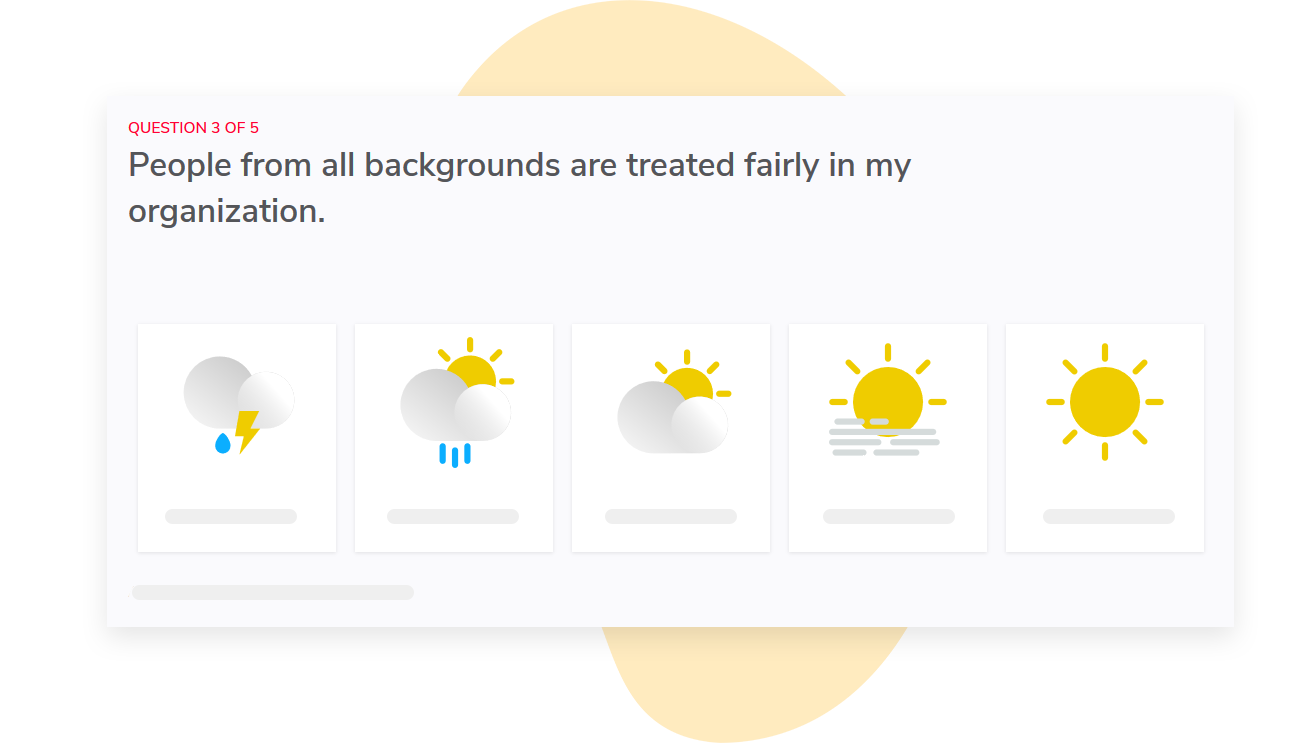
This pulse will give you a pulse score (1 to 10) that you can track over the duration of your pay harmonization while also giving you eNPS results if you're already trending that metric to your board.
Averaging your results across the entire company could be misleading. Your overall score could remain stable while an acquired entity sees a sharp positive or negative movement in their score.
Sparkbay breaks down your results based on department, manager, time at the company and other categories you define. It automatically provides access to reports based on your organization's hierarchy. This is critical for companies at an enterprise level, since a divisional leader within a legacy entity should be able to view reports specific to their teams rather than across the entire merged business.
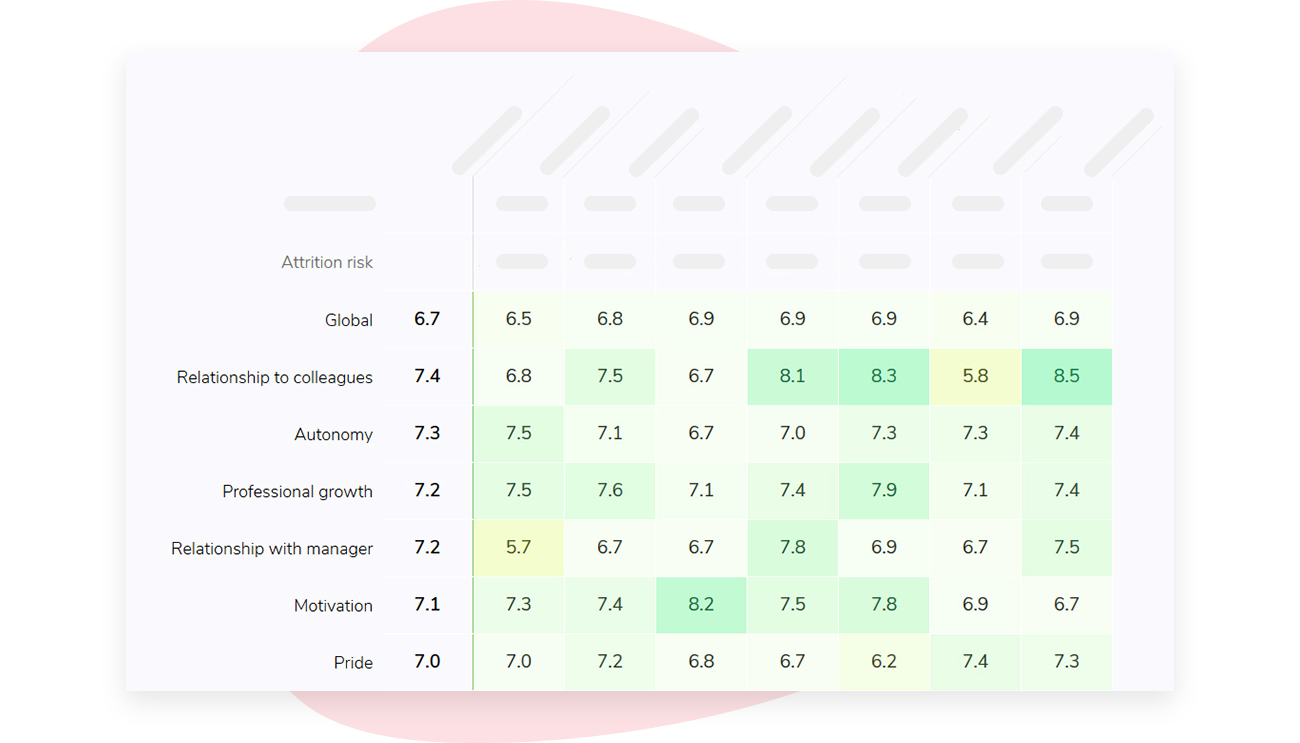
Another great comparison to include in your dashboard is a legacy-entity to legacy-entity comparison within the same function. This helps pay harmonization leaders understand whether the pay harmonization was successful within specific areas of the business while also ensuring that these comparisons are valid and meaningful by staying within the same function. You can configure the questions and content of your dashboard to create the most helpful visualization for your pay harmonization leader team.
Receiving employee feedback about pay is uncomfortable for organizations, which is why it's important to ensure people remain anonymous.
Sparkbay keeps your results anonymous by hiding them if there isn't a minimum number of responses (5 by default, but configurable based on your works council or your own risk assessment). Plus, Sparkbay is an ISO 27001 certified company, which simplifies the security review process when two massive IT organizations are still debating which tools to use.
If you're interested in learning how Sparkbay can help you build a more engaged workforce, you can click here for a demo.
Protect the people who carry the deal value
Harmonization and retention are two exercises that share inputs, but should be kept as separate decisions.
Paying an employee a higher salary to correct a pay problem is a good thing. But giving them retention awards so they stay for a certain amount of time is also smart. And you don't want to confuse those two things.
Before you start offering your desired salary, make sure it's not in conflict with the terms of a retention bonus or severance agreement. You don't want to offer someone a retention bonus in month two only for it to trigger a good reason to leave that kicks in month five.
At this stage, you'll also want to start mapping out your employees based on their level of criticality and flight risk factors.
Criticality refers to how critical it'll be for your company to lose that employee. Employe criticality factors might include ownership of customers, undocumented knowledge of systems, holding specific licenses or certifications, and more. This should not involve personal feelings or the amount of years an employee has been at your company.
Flight risk factors might include an employee's recent interest in internal mobility, decreasing engagement survey scores, decreased on-site meetings with their manager, and more. It's important to understand that no one flight risk factor is sufficient on its own to predict risk of flight. Also, employers should not rely on a manager's "gut feeling" to identify flight risk.
Gut feelings about flight risk are often overly based on how much an employee complains, which can cause you to overlook other flight risks.
Pay special attention to the employees that contributed to the success of the deal whether it was through their role as a technical lead, their ownership of a key account, their role as a founder, or their role as an informal leader within the organization.
Focusing on employee retention doesn't necessarily mean an employee cash retention award. Talking to employees about what matters to them and whether a specific project, a robust and consistent promotion review process with clear criteria, protected flexibility, or ownership of a newly created team would be more impactful than a check is a valuable conversation to have.
In The Human Equation, Jeffrey Pfeffer brings up an interesting idea that managers often think that because pay is the most obvious tool they have at their disposal, they overestimate how important it is for an employee to stay at their company. A person's job or project, for example, might have a greater impact on their decision to leave than their pay.
If you do decide to offer retention awards in cash, make sure those dates are aligned with the integration milestones that are most important to your deal.
Finally, keep in mind that a retention bonus creates a "danger zone" where a bunch of employees hit their retention bonuses and suddenly have the option to leave. You don't want a competitor to know they have a year to re-recruit these employees. Consider engaging in re-recruitment conversations 3-6 months before the end of the retention period by offering these employees new opportunities within the organization, offering a new retention bonus, or giving any other reason for these employees to stay.
Finally, pay attention to your legacy employees. If your legacy employees see their counterparts in the acquired company receive pay adjustments and retention awards while they know you still have other critical employees that need attention, they may form a negative opinion on the company. According to surveys of M&A leaders, retention of key talent was one of the most challenging people management issues faced during a merger or acquisition.
Use a 100-day compensation integration plan
When you create a 100-day plan, it doesn't mean you expect your integration to be done in 100 days. What it does mean is that you want to have a clear game plan, secured resources, and key milestones that extend beyond the 100-day plan.
Before closing
Go through final contract diligence to understand terms that may impact your ability to change compensation arrangements (e.g., good reason triggers, guaranteed increases, consultation obligations).
Identify the key retention targets and work to sign them up before the deal becomes public, so the conversation is still about exciting opportunities.
Draft your employee communications timeline and manager toolkits, including key pieces of information that you're still waiting on.
Days 1 to 30
Freeze any individual salary adjustments, level changes, or title changes. Make it clear who can grant exceptions to this rule (e.g., on day 7 a regional leader approves a change for one employee - you inadvertently set a precedent).
Gather your payroll, job, and benefits data into one centrally controlled dataset with a designated data owner for each field.
Tell your employees what the compensation review process will look like and when they can expect to hear back regarding their individual compensation.
Conduct listening sessions with employees from both legacy organizations. Specifically ask for feedback on where there were discrepancies between written policies and actual practices.
Days 31 to 60
Conduct job families and job level mappings for both legacy organizations simultaneously.
Compare existing total rewards offerings for each legacy organization and conduct your first compensation pay equity analysis.
Develop the three potential cost scenarios, including year-two costs.
Review and reconcile incentive calendars for each organization and decide how to handle situations where someone may have an atypical incentive payout window.
Obtain leadership sign-off on the compensation harmonization model before entertaining requests for exceptions.
Days 61 to 90
Finalize your compensation ranges and the geographic pay rule (see section 5 above). Consider the rule that applies to remote employees who were hired under the legacy organization's approach.
Make individual decisions and manage outliers through a collective conversation instead of manager-by-manager conversations.
Complete all legal and employee representative processes, if applicable. Be mindful of scheduled timing requirements and complete activities in the most appropriate order.
Provide managers with their individual employee communications, FAQs, and points of contact for escalation, giving them time to review everything.
Days 91 to 100
Conduct individual employee conversations first and then send out broad communications. It's important that individual employees hear from you first.
Confirm the effective dates of changes and provide written documentation of any phase-in promises.
Open a feedback and pay review channel, and support it so that people's questions don't go unanswered.
Reopen internal mobility opportunities so employees from both organizations can start exploring lateral positions right away, even if there are still tentative mappings. Your prior internal mobility freeze was a bigger retention risk.
After that initial phase, once you've phased in pay increases according to the schedules you've provided, conduct pay equity analyses again once you have all the necessary corrections, refresh your market data on your normal schedule, and get employees of both legacy organizations on a unified governance calendar.
If you're interested in learning how Sparkbay can help you build a more engaged workforce, you can click here for a demo.