
The CEO announces a new operating model and a new technology platform, and promises they’ll make work faster, smarter and more efficient.
People leave the meeting sounding excited, but your operations manager catches you in the hallway.
"What does this mean for my team? When are we supposed to learn the new system? Did anyone ask the managers who’ll have to roll it out?"
Those questions aren’t resistance. They’re the first sign that the plan on the conference room screen may not match the work people do every day.
Leaders may have a sound strategy and still move ahead before people are ready to carry it out.
As an HR leader, you can pick up on things a project plan won’t show you - whether employees trust the people leading the change, whether managers have time to help and whether teams are already worn out.
A change readiness assessment helps you check those things before the rollout begins.
On this page
- What exactly is a change readiness assessment?
- What is the cost of not performing a readiness check?
- The 5 pillars of organizational readiness you must measure
- Your step-by-step change readiness assessment roadmap
- What questions should you ask in a readiness assessment?
- Reading the signals: how to interpret your results
What exactly is a change readiness assessment?
A change readiness assessment evaluates whether your organization has the willingness, capacity, alignment, and capability to adopt a specific change.
In other words, a change readiness assessment helps you determine how ready your organization is to implement a specific change.
At first, this might sound like an exercise in asking, "Do people like change?" But that’s not what a change readiness assessment is.
A change readiness assessment helps determine questions like, "How likely is it for us to successfully adopt this change, given the change to be implemented, in our present context, with our current leaders and with the existing level of constraints?"
Your organization may be really ready to implement a new benefits platform, moderately ready to roll out a hybrid work schedule redesign, and poorly ready to undergo an operating model transformation.
To understand this, you need to conduct a change readiness assessment that considers the actual change to be implemented, the value people think the change will deliver, the level of disruption the change will cause, and the credibility of the people leading the change.
In addition, a change readiness assessment is not a needs assessment.
While a needs assessment identifies what your organization needs, a change readiness assessment evaluates whether your organization can absorb and act on a fresh shift.
Finally, a change readiness assessment is not a general engagement survey.
While your employee engagement data may tell you information about levels of trust, morale, and manager effectiveness within your organization, a change readiness assessment requires more focused questions to assess employee understanding, commitment, capability, capacity, sponsorship, and perceived impact.
Generally speaking, a great change readiness assessment reviews three connected levels within an organization:
- Organizational readiness: Whether the organization’s structures, processes, culture, resources, and governance allow for the successful adoption of the proposed change
- Leadership readiness: Whether executives and managers are aligned with each other, credible and visible to people, and equipped to lead people through uncertainty
- Employee readiness: Whether employees understand the purpose of the change, see its relevance to them, believe in the organization’s ability to succeed, and have the skills and capacity required to adopt this change
One useful lens you can filter your change readiness assessment through is the organizational readiness theory. This is especially helpful for understanding the difference between change commitment and change efficacy.
Change commitment is the degree to which people want to see the change happen.
On the other hand, change efficacy refers to whether people believe the organization can get the change done.
Your change readiness assessment should evaluate both of these things. High commitment and low efficacy equals frustration. High efficacy and low commitment equals compliance without energy.
What is the cost of not performing a readiness check?
When organizations skip readiness work, they often pay twice.
They pay once to undertake the formal initiative (e.g., consultants, technology, project teams, communications, training, implementation, etc.).
Then they pay again in terms of rework, delays in adoption, manager overload, informal resistance, loss of trust, and more.
Often, the most expensive readiness gaps are not obvious when a change initiative launches.
These "unexpected" issues rear their heads later as teams continue to use legacy processes, managers interpret the change differently, employees wait for clearer communication, and business leaders express frustration at the slower than anticipated rate of adoption.
Imagine you’re beginning to roll out a new workforce planning platform.
The business case is solid, the vendor is reputable, and the executive sponsor is enthusiastic. But there are a few things that may undermine your rollout success.
The HR business partners are already stretched supporting a restructuring effort. The finance department has yet to align on reporting definitions. And frontline managers have not yet been informed how this new platform will impact their workforce planning responsibilities.
Despite these bumps in the road, you move forward with the rollout. But you soon notice your level of confidence dropping.
Employees see it as just another system being forced onto their already overloaded teams. Managers avoid using the new system altogether. And your transformation office team begins adding new remediation work that should have happened prior to launch.
Would a readiness assessment have eliminated all problems and points of friction? No.
But it would have helped you identify areas where you could expect some friction, areas where you could contain this friction, and areas where the level of friction could require you to delay or rework your rollout plan.
This awareness and insight enables you to make different decisions earlier in your change management process.
Your team can recommend introducing changes in a different order, giving managers the tools they need before you start communicating with employees, prioritizing previously known trust issues, or even piloting the program in business units that have demonstrated greater readiness before attempting an enterprise-wide rollout.
The 5 pillars of organizational readiness you must measure
|
Pillar |
What ready looks like |
What not ready looks like |
|---|---|---|
| Leadership alignment and sponsorship |
Senior leaders tell the same story, act in line with expectations, and openly demonstrate trade-offs in support of the change |
Publicly, executives say the same thing, but private conversations, resource allocation, or discussions with managers lead to different messages |
| Culture and mindset |
Company culture supports taking risks, learning, ownership, and cross-functional collaboration |
Employees expect changes to be temporary, don’t want to take risks, or think leaders will punish them for providing honest feedback |
| Capacity and resources |
Teams have the time, people, decision-making abilities, money, and practical support to do the work |
The change initiative is an ‘add-on’ to existing priorities with no ability to de-prioritize tasks or re-allocate bandwidth |
| Past change history |
Previous change initiatives helped build credibility, learn lessons, and garner belief that the "higher-ups" follow through |
Employees remember abandoned initiatives, unclear roles and responsibilities, or promises that weren’t kept |
| Communication channels |
Content is communicated through trusted leaders, managers, employee forums, and feedback channels |
Employees hear about changes through rumour mills before hearing it from the company |
Leadership alignment is often the first issue teams encounter during change management planning exercises.
If your company’s executive leaders are not aligned on the reasons for change, the sequencing of different steps, non-negotiables, and trade-offs, it won’t take long for the rest of the organization to sense the ambiguity.
Your organization’s culture and mindset is another important aspect to assess. Do your employees view your company’s changes as a sign of progress or a source of anxiety? Are they a distraction or an exciting time?
When you have a less than ideal culture with a low degree of psychological safety within your team, your organizational readiness scores may be higher than they should be.
To combat this issue, protect employee confidentiality when conducting organizational readiness assessments and ask questions focused on employees’ behaviors.
Capacity and resources is an important topic, especially in massive organizations with huge transformation portfolios.
Your employees may very well understand the change and support the transformation efforts, but they may not have the bandwidth required to participate in workshops, learn new systems, or re-design team processes.
Past change history shapes current credibility.
Even if you have an excellent, well-designed, and thought-out initiative, if people associate change with events like layoffs, executive turnover, poor communication, or incomplete programs, it will have an impact.
Finally, consider communication channels.
Companies don’t often think about this until after the change has been rolled out.
In reality, managers are the real interpreters of change for employees.
Measuring manager readiness on a specific scale is important.
Your step-by-step change readiness assessment roadmap
Step 1: define the change and its scope
Start by making the change concrete. "Digital transformation" is too broad to assess because different employees will imagine different impacts.
Define what is changing, who is affected, what behaviors must shift, what processes will be redesigned, what decisions will move, and what will stay the same. HR should push leaders to clarify the practical implications before asking employees whether they feel ready.
A useful scope statement should cover:
- The business problem the change is meant to solve
- The employee groups affected directly and indirectly
- The expected behavior changes by role
- The timeline and critical milestones
- The level of disruption to jobs, workflows, reporting lines, skills, or identity
Step 2: identify your stakeholders
Stakeholder mapping should go beyond the formal organization chart. In large organizations, influence often sits with long-tenured employees, respected technical experts, frontline supervisors, works councils, regional leaders, and informal connectors.
Segment stakeholders by impact and influence. High-impact, high-influence groups need early involvement because they can accelerate adoption or legitimize resistance.
HR can add particular value by identifying groups that transformation teams may overlook. These often include middle managers, shared services teams, employees in recently restructured units, and teams already experiencing high workload or attrition.
Step 3: choose your assessment methods
For enterprise transformations, a mixed-method approach is usually strongest:
- Readiness survey: measures awareness, understanding, commitment, confidence, manager support, capacity, and perceived risk across large populations.
- Leader interviews: test sponsorship quality, alignment, decision clarity, and competing priorities.
- Manager focus groups: surface operational friction, employee concerns, and likely adoption barriers.
- Existing people data: adds context from engagement scores, attrition, absenteeism, internal mobility, employee relations cases, and workload indicators.
- Change portfolio review: identifies overlapping initiatives that may reduce capacity.
The assessment design should also account for confidentiality.
Step 4: gather and analyze the data
Analysis should compare readiness dimensions across functions, regions, tenure groups, manager populations, and employee levels. For example, senior leaders may score high on understanding and commitment, while frontline employees score low on clarity and capacity.
Pay close attention to contradictions. If employees say they understand the change but cannot explain what will change in their day-to-day work, the issue is probably message penetration rather than agreement.
Step 5: score and segment readiness
A readiness score helps leaders make decisions, but it should be supported by dimensional detail. A single number without explanation can create false confidence.
Many HR teams use a red, amber, green model or a numerical maturity scale. The key is to define what each level means behaviorally.
| Readiness level | Typical indicators | Recommended response |
|---|---|---|
| High readiness | Clear understanding, visible sponsorship, strong manager confidence, sufficient capacity, positive change history. | Use as pilot groups, involve as champions, and capture practices that can transfer elsewhere. |
| Moderate readiness | General support exists, but gaps remain in capability, communication, workload, or manager consistency. | Proceed with targeted interventions before major adoption milestones. |
| Low readiness | Low trust, unclear rationale, weak sponsorship, poor capacity, active skepticism, or unresolved operational barriers. | Pause, redesign, sequence differently, or invest in intensive preparation before rollout. |
Segmentation is where the assessment becomes actionable.
Step 6: build your action plan
HR should resist producing a long diagnostic report without clear ownership, timing, and decision implications.
Each readiness gap should map to a practical response. Low awareness requires clearer communication. Low capability requires training or coaching.
Low trust requires leader visibility, listening forums, and proof that feedback changes decisions.
A strong action plan includes:
- The readiness risk being addressed
- The affected employee segments
- The intervention owner
- The timing relative to change milestones
- The success indicator or follow-up measurement
The assessment should also inform the rollout strategy. Sometimes the right decision is to launch with a ready pilot population, learn quickly, and then expand.
What questions should you ask in a readiness assessment?
Good readiness questions are specific, behavior-based, and tied to the actual change you’re undergoing.
Why? Asking employees whether they "support transformation" in the abstract will give you vague data and socially desirable answers.
You want a mix of scaled questions and open-text prompts.
Your scaled questions can be based on a five-point or seven-point Likert scale, so that you’re able to quantify patterns, while your qualitative questions help you understand why those patterns exist.
| Readiness dimension | Sample questions |
|---|---|
| Awareness and understanding | I understand why this change is happening. I understand what will change for my team. I know what is expected of me during the transition. |
| Commitment and perceived value | I believe that this change is addressing an important business need. I believe that the benefits of this change are worth the disruption. I am willing to support this change. |
| Change efficacy | I believe that our organization can successfully implement this change. I believe that my team has the skills required to implement this change successfully. I believe that my manager can help us navigate this transition. |
| Capacity | My team has enough time to participate in this change. We have adjusted our current priorities to make room for this work. I feel that the timeline is realistic. |
| Trust and sponsorship | I believe that senior leaders are communicating honestly about the change. I believe that leaders are acting consistently with the priorities they’ve stated. I feel comfortable raising concerns about this change. |
| Manager readiness | I believe that my manager can clearly communicate what this change means. My manager is open to questions. I believe my manager has the information they need to support our team. |
For your open-text prompts, try to come up with questions that are direct enough to surface risk.
Examples of open-text questions include: "What is the biggest barrier that could prevent this change from succeeding?" and "What would make you more confident about this change on your team’s rollout?"
You can also use established frameworks to help you structure your assessment.
ADKAR is a helpful method for understanding where individuals are in the process of awareness, desire, knowledge, ability and reinforcement.
You can also use Prosci-style readiness assessments to understand how different sponsorship, impact, communication, and capability factors compare.
Reading the signals: how to interpret your results
It’s tempting to skim through your findings to look for something that supports your planned timeline. Your budget is set. Your board of directors have been given their timeline.
You’ve got a vendor cut off point.
As the HR leader, it’s your responsibility to protect the integrity of the signal. This means keeping the optimism out of your hopeful evidence search and instead asking questions about whether you’ve truly demonstrated the necessary conditions for adoption within your organization.
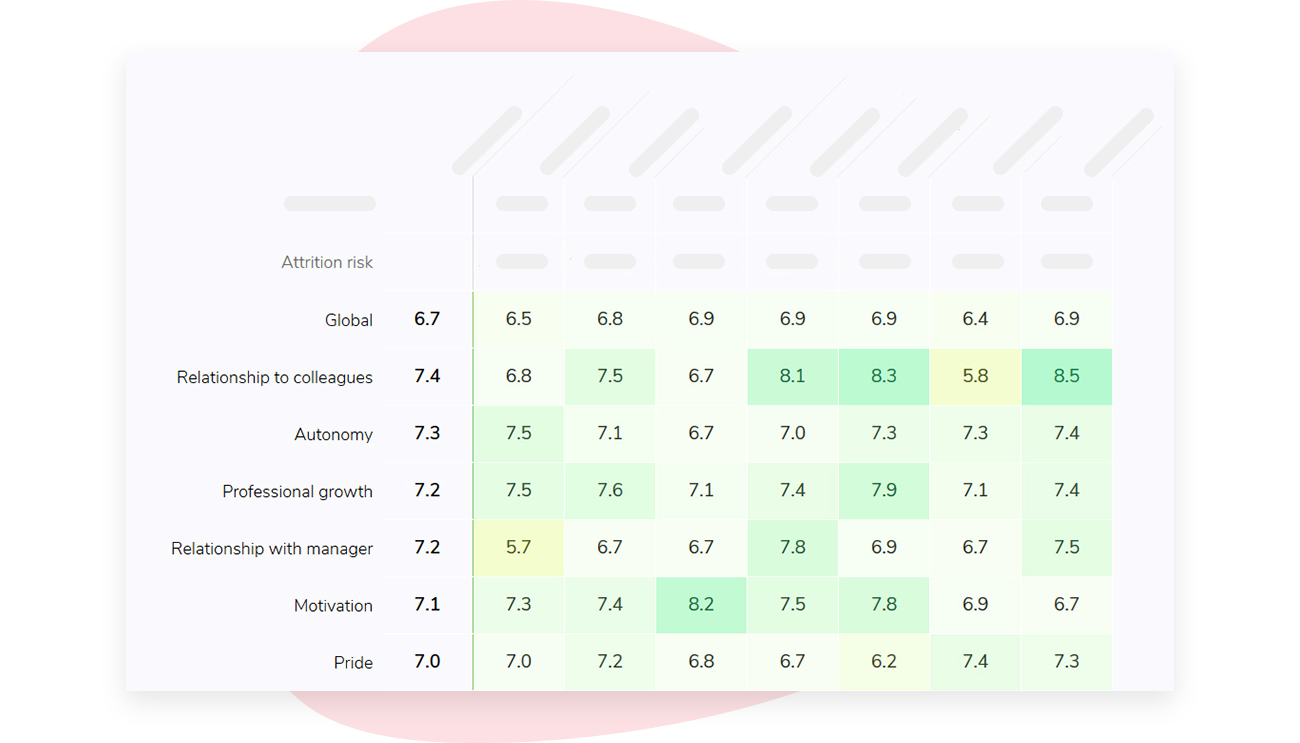
The best way to do this is often to create a heat map of readiness questions that clearly shows the state of readiness by department, region, leader, tenure group, or employee population within specific dimensions like awareness, commitment, capability, trust, and capacity.
Using this approach, you’ll be able to identify three critical signals from your results:
- Readiness gaps: Are there pockets of employees who don’t seem to understand, feel confident, or possess the capability or time to adapt?
- Pockets of resistance: Are there groups of employees that are showing low levels of trust, low levels of perceived value, or high levels of anxiety or concern about impact?
- Hidden champions: Are there teams or managers that have high levels of credibility within your organization and possess positive, constructive energy that can be leveraged for peer-to-peer adoption?
It’s important to pay attention to patterns rather than isolated opinions within your survey results. A few negative reviews may be normal given the uncertainty that accompanies change. But if many critical groups express concerns, that’s a sign of a possible change readiness risk.
It’s also critical to be wary of averages. If your company wide readiness score is 7 out of 10, it may seem acceptable on the surface. But if your operations score is only 4 out of 10, and operations is responsible for carrying your new process, you’ve got a big risk on your hands.
Change readiness relies on asking the right questions and getting honest employee feedback at the right times. If your leaders need to see whether levels of understanding, trust, capacity, and manager support are improving within your organization, then you need a way to collect this employee feedback automatically, at the right intervals.
This is how Sparkbay can help your HR team. Many of our clients conduct monthly pulse surveys to automatically collect employee feedback throughout their change programs (especially major ones).
Sparkbay then presents the findings in easy-to-understand reports with a clear score out of 10. This makes it easier for you to brief your executives, compare your change readiness results over time, and know whether your intervention is working.
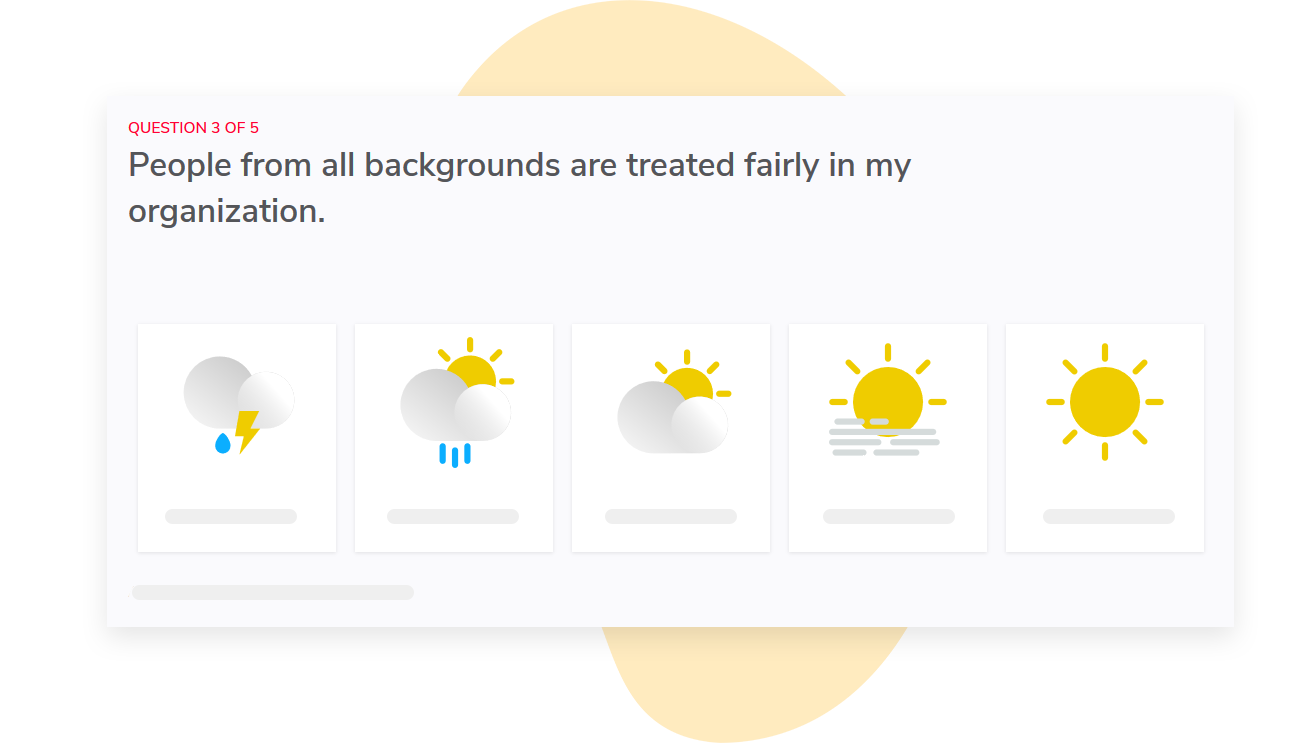
For large organizations, one of the most important features of Sparkbay is the ability to see readiness at different parts of the business.
Do you want to see how different departments, tenure groups, locations, or other segments of the workforce differ in their readiness to assess potential problems?
Sparkbay lets HR teams segment their results based on manager, department, tenure, location, and other workforce attributes so you can better understand whether there’s one part of the organization that’s ready to move and another part that needs to do more work.
HR teams can also benchmark their results against companies in the same industry using Sparkbay’s proprietary dataset. This is helpful when presenting to leaders who want to understand whether their concerns about readiness are specific to this big transformation, or perhaps due to a larger engagement phenomenon within the same sector.
Once you know where you stand, it’s time to take action. That’s why we also created a library of easy-to-implement actions that managers can use to up-level their teams.
When you’re working on change readiness, this is a great way for managers to quickly do something about low clarity, low confidence, poor team communication, or concerns about workload before they become adoption roadblocks.
If you use Sparkbay throughout your transformation, it turns change readiness into a continuous listening process rather than a one-and-done diagnostic exercise.
If you’re interested in learning how Sparkbay can help you build a more engaged workforce, you can click here for a demo.