
The silent workplace epidemic: why career satisfaction matters more than ever
The most expensive kind of disengagement never shows up on the dashboards you already run. A dependable project manager still hits her deadlines, still answers in meetings, still clears every performance metric.
What she has quietly dropped is the discretionary stuff: the unprompted process fix, the hand raised for the ambiguous project, the conversation about where she wants to go next.
That is the analytical trouble with quiet quitting. It lives in the gap between adequate output and withdrawn discretionary effort, and almost none of your operational data captures the second half.
Gallup’s 2025 workplace report put global engagement at 21% in 2024, with an estimated $438 billion in lost productivity. Useful figures for a boardroom, but the insight you can act on is local: aggregates never tell you which manager, tenure band, or business unit is bleeding effort.
By the time a resignation lands, the trend was measurable months earlier-usually as a coordinated dip across growth, manager trust, and intent-to-stay within one specific segment. The survey’s job is to catch that cluster while it is still reversible.
One discipline worth fixing at the outset: the goal is not a higher satisfaction score, and it is not to pathologize every employee who declines optional overtime. It is to tell a healthy boundary apart from a real withdrawal of commitment, and to act before a capable person decides the minimum is the only rational contribution left to make.
How to survey career satisfaction and turn low scores into retention actions
- Beyond the paycheck: what career fulfillment really means
- Reading between the lines: warning signs of quiet quitting
- The anatomy of a great survey: design principles that get honest answers
- The essential questions: measuring purpose and meaning
- Growth and recognition: questions that reveal development gaps
- Workload, balance, and well-being: probing for burnout
- Relationships and culture: gauging connection and belonging
- From data to action: turning survey results into real change
- Keeping the pulse: building a culture of continuous feedback
Beyond the paycheck: what career fulfillment really means
In most datasets, compensation behaves as a hygiene factor: it drags satisfaction down when it is wrong and does surprisingly little to lift it when it is right. That asymmetry is why pay-heavy surveys mislead.
They detect a floor, not the drivers of upside.
The practical test is simple. If you fixed the pay complaint tomorrow, would the employee re-engage, or just stop mentioning pay?
In most exit patterns it is the latter, because pay was the acceptable thing to say out loud while a growth or trust problem did the actual damage.
The distinction that matters operationally sits between job satisfaction-how someone feels about the conditions of their current role-and career fulfillment-whether that role moves them toward who they want to become. You can score well on the first and poorly on the second. That is the classic profile of the well-paid, well-treated employee who quietly checks out because the role has no credible next step.
Satisfaction and engagement part ways here too. A satisfied employee is content with the conditions; an engaged one puts in discretionary effort.
The dangerous quadrant is satisfied-but-not-engaged, because those people look fine on a satisfaction survey right up until the day they resign.
Self-determination theory earns its place only because it forces you to instrument three distinct drivers instead of one composite:
- Autonomy: employees hold real decision rights over how work gets done.
- Competence: they see evidence of mastery and progress, not just activity.
- Relatedness: they feel connected to colleagues and the organization.
The payoff is diagnostic precision, since each driver routes to a different owner and a different remedy. A pay signal goes to a comp review.
Low autonomy is a decision-rights and manager problem. Weak competence-and-growth is an internal-mobility and stretch-assignment problem.
A survey that squashes all of this into a single "how satisfied are you" item destroys the very information you need to assign the fix.
Reading between the lines: warning signs of quiet quitting
Treat quiet quitting as a measurable drop in discretionary effort, not a verdict on someone’s character. What you are watching is change from an individual’s own baseline, not how they stack up against a chatty colleague. A naturally quiet high performer who goes silent is a different signal from a person who was never talkative to begin with.
Signals worth tracking:
- Fewer suggestions, questions, or attempts to solve problems outside assigned tasks
- Reduced participation in team discussions and optional activities
- Less interest in development opportunities, internal roles, or long-term projects
- Minimal collaboration when the employee previously supported colleagues
- Lower confidence in senior leadership or the organization’s direction
- Repeated comments about unclear priorities, stalled progression, or unrecognized work
- A growing gap between adequate output and visible emotional investment
The confound is that burnout, caregiving load, team conflict, and end-of-project fatigue all produce the same surface behavior, and each calls for a different response. Read recovery-stage fatigue as disengagement and you will make it worse.
A workable rule of thumb: read a two-wave decline in the same segment before you act, and weight the cluster over the item. A synchronized drop across growth, intent-to-stay, and manager trust in one team is a retention emergency.
A single item sliding a few points on its own is noise until a second wave or an operational signal confirms it.
Triangulate survey trends against voluntary turnover, internal-move rates, absence patterns, workload data, and stay-interview themes before you act. Order matters here.
Let the numbers tell you where to look, then let a conversation tell you why-never the reverse.
The anatomy of a great survey: design principles that get honest answers
Design decisions are the single largest source of variance in your results-often larger than the underlying reality you are trying to measure. A bloated, vaguely worded instrument produces volume, not evidence.
Protect anonymity and explain it plainly
State the reporting threshold, who sees what, and how verbatims are handled before the first question, not buried in a policy nobody reads. The credibility risk is not the closed items.
It is the free text and the small demographic cross-tabs, where a specific comment sitting next to a three-person segment gives someone away.
Suppress or combine small groups by default, and never promise blanket confidentiality you cannot technically guarantee. If one skeptical employee can construct a plausible story of how you would identify them, your response rate on the honest questions is already compromised.
Use one idea per question
Double-barreled items like "My manager supports my development and recognizes my work" are unactionable. A mid-range score could mean strong recognition and zero development, or the reverse.
Split them so each response points to one owner and one fix.
Choose a consistent response scale
A five-point agreement scale suits driver items. Keep the polarity constant so that high always means good-reverse-worded items mostly generate coding errors and straight-lining, not better data.
Add a genuine "not applicable" where employees plausibly lack the information to answer, so you don’t misread ignorance as disagreement.
Combine ratings with focused comments
Closed items locate the problem; verbatims explain it. Resist the urge to drop a comment box under every item-that inflates completion time and buries the signal. One or two targeted prompts outperform ten open boxes: "What is the one change that would most improve your ability to build a career here?"
Control frequency and survey length
A pulse cadence only holds up when action is visible between waves. Monthly surveying with no follow-through actively teaches employees that feedback is pointless, and response rates fall accordingly.
Keep a small set of outcome items constant for trending, and rotate diagnostic modules instead of re-asking the full battery every cycle.
Test the questions before launch
Run cognitive interviews with a small, varied group and ask people to explain what each item meant to them and how they arrived at their answer. This is where you catch the killer ambiguities-"career opportunities" reads as promotion to one person, lateral movement or learning to another-and where translation and local context quietly shift the meaning of an item across regions.
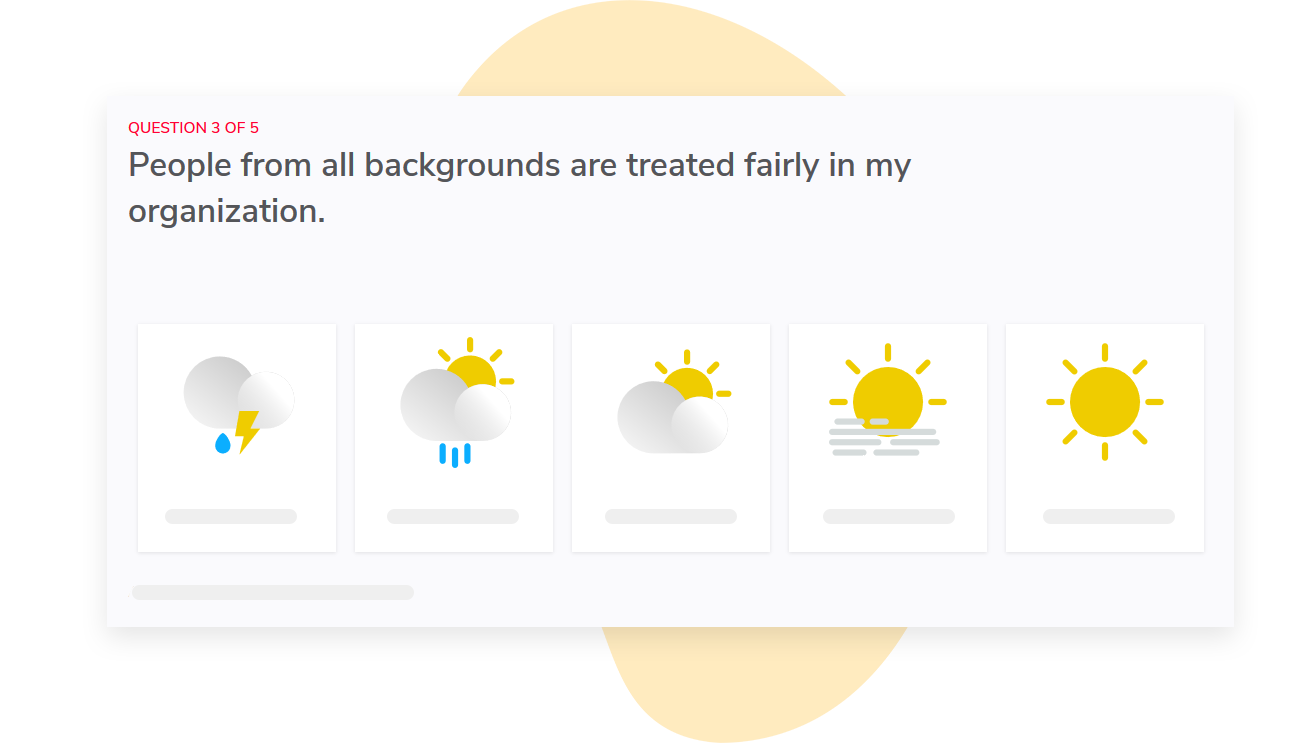
Sparkbay collects employee feedback automatically at regular intervals, and many clients run monthly pulse surveys. It reports findings against a clear engagement score out of 10, so leaders track direction without wading through raw response files.
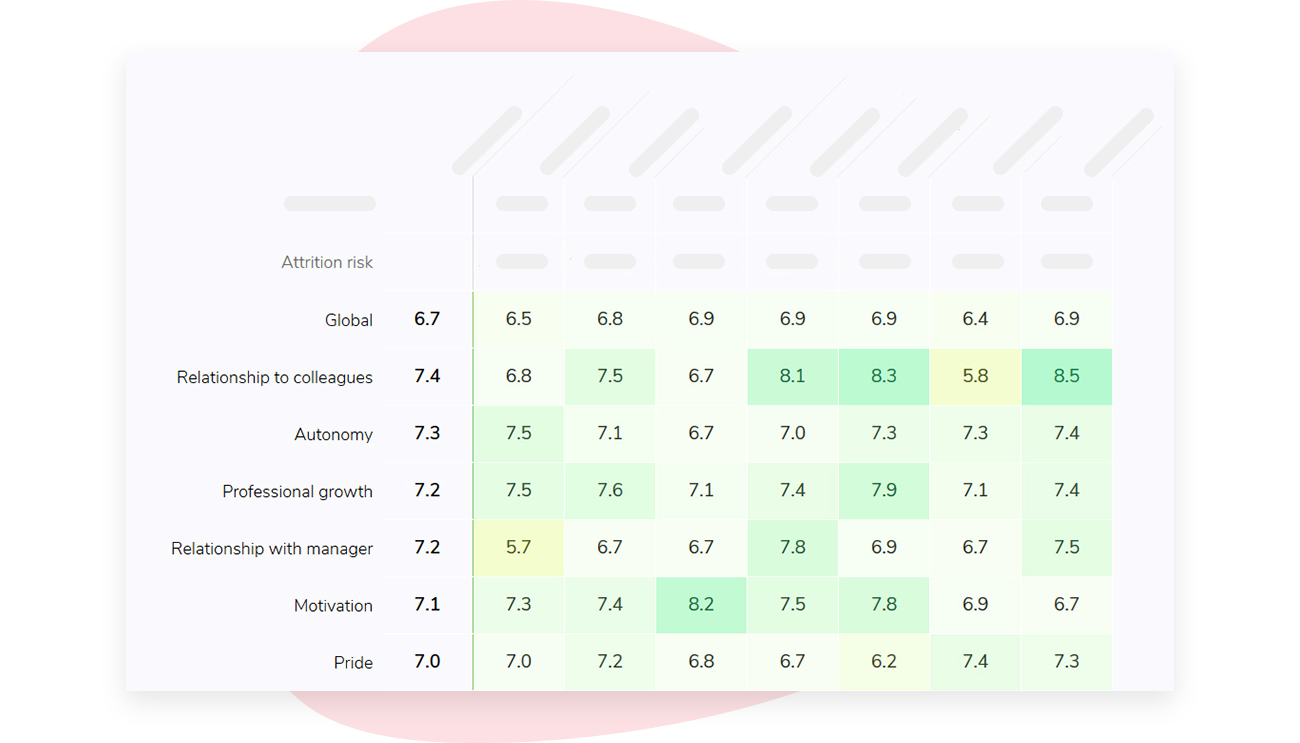
Results segment by manager, department, tenure, and other attributes, so you can separate a local management issue from a broader pattern across the organization.
Sparkbay is highly configurable, from the wording of surveys and dashboards to the content shown on each dashboard, so career items can map to your talent model and internal language rather than a generic template.
For large enterprises, report access is mapped automatically to the org hierarchy: each manager sees only their own teams, and results stay hidden below a configurable minimum number of responses, set to five by default.
Once a weak driver surfaces, Sparkbay offers a library of easy-to-implement actions tied to it-which is what closes the gap between measurement and manager action that leaves most survey programs stuck at "interesting report."
If you’re interested in learning how Sparkbay can help you build a more engaged workforce, you can click here for a demo.
The essential questions: measuring purpose and meaning
Purpose items fail when they assume everyone is chasing a calling. Most people find meaning in mastery, in service, in security, or in a clear sense of contribution-so measure line-of-sight and significance, not vocation.
Use a five-point agreement scale:
- "I understand how my work contributes to the organization’s goals." Tests line of sight between the task and business outcomes.
- "The work I do feels meaningful to me." Captures personal significance without prescribing what should feel meaningful.
- "I can see the effect of my work on customers, colleagues, or the organization." Checks for closed-loop feedback from the people the work serves.
- "My role makes good use of my strengths." Surfaces job-design mismatch.
- "I understand which results matter most in my role." Separates a purpose problem from a prioritization problem.
- "The organization’s stated values match the decisions leaders make." Measures the say-do gap, the fastest destroyer of stated purpose.
- "I am proud of the quality of work my team delivers." Captures collective standards.
Keep the items separate even when you analyze them as a set. The common false read: an employee endorses the mission but sees no thread from that mission to a repetitive daily task.
That is an org-design and communication fix, not a values campaign.
Route a low score to a specific prompt: "What would help you see a clearer connection between your work and its impact?" Answers tend to cluster into customer feedback, goal-setting, role design, or leadership communication-four different owners.
Growth and recognition: questions that reveal development gaps
Expectancy theory pinpoints where the chain breaks. Motivation collapses if people stop believing that effort leads to performance, that performance earns recognition, or that recognition yields something they actually value.
Your items should test each link, because a "growth" score that blurs them together tells you nothing about where to intervene.
Instrument growth, mobility, manager support, and recognition as distinct items:
- "I have opportunities to learn skills that support my career goals."
- "I understand the career paths available to me in this organization."
- "I can pursue a lateral move without harming my standing with my manager."
- "My manager discusses my development with me often enough."
- "I receive useful feedback that helps me improve."
- "I have access to assignments that stretch my abilities."
- "People receive advancement opportunities through a fair process."
- "My contributions receive appropriate recognition."
- "I can see a realistic future for myself in this organization."
The gap between what is offered and what people can actually reach is where most L&D investment quietly fails. Programs exist, but workload, a manager hoarding talent, eligibility rules, or poor internal communication keep people from ever touching them-so a strong offer sits right next to a weak access score.
Only the second predicts disengagement.
Recognition items must test quality, not cadence. Frequent generic praise scores well and changes nothing.
What employees actually want is specific credit, greater responsibility, or fair advancement. Measure the substance.
Cut growth data by tenure and career stage. A trough at a specific tenure point usually maps to a promotion bottleneck.
Low scores among new hires usually expose a recruiting-to-role promise the job never kept-an onboarding-and-hiring problem, not a development one.
Watch for the highest-risk profile buried in this data: a strong performer who scores high on competence and low on both mobility and "realistic future." That is not a training gap. It is someone who has concluded the ceiling is right here, and they are exactly who a competitor recruits first.
Workload, balance, and well-being: probing for burnout
Separate a hard sprint from a system that consumes resources faster than people can rebuild them. Conservation of resources theory is the useful lens here: strain accrues from repeated, unrecovered loss of time, energy, control, and support.
So the diagnostic question is whether the load resets after peaks, not whether last week happened to be heavy.
Useful items:
- "My workload is manageable within my normal working arrangements."
- "I can maintain the quality expected of me without regularly working excessive hours."
- "My team has enough capacity to meet its priorities."
- "When priorities conflict, leaders make clear trade-offs."
- "I have enough control over how I organize my work."
- "I can disconnect from work during non-working time."
- "My manager responds constructively when I raise workload concerns."
- "The flexibility available to me meets the practical needs of my role."
- "After demanding periods, my workload returns to a sustainable level."
A single global well-being item hides the most common burnout pattern of all: a supportive manager inside a broken system of unrealistic deadlines, duplicate approvals, and chronic understaffing. The manager scores well; the system is the cause.
Only decomposed items expose that.
The most predictive item here is often "control," not "hours." High load with high control is tolerable for long stretches. Moderate load with no control over sequencing, interruptions, or trade-offs corrodes faster, and it surfaces as burnout the raw hours data would never have flagged.
Cross-check perception against operational signals-backlogs, overtime, unused leave, delivery slippage, error rates, open vacancies-to tell a genuine capacity problem apart from a perception you can address with better communication.
On sensitive well-being themes, report at group level only and route urgent individual disclosures to support channels. A distressed verbatim is never an invitation to identify the respondent.
Relationships and culture: gauging connection and belonging
Employees experience "the company" almost entirely through their manager and immediate team. That is why a strong enterprise score routinely masks a local team where people withhold information, avoid speaking up, or get treated inconsistently.
The aggregate culture score is the most over-read number in the whole dataset.
Measure the social environment as several distinct constructs:
- "My manager treats me with respect."
- "My manager follows through on commitments."
- "I can raise a concern without fear of unfair consequences."
- "People on my team share information and support one another."
- "I feel accepted as a member of my team."
- "Different viewpoints receive fair consideration."
- "Decisions that affect my work are explained clearly."
- "Conflict on my team is handled constructively."
- "I trust senior leaders to make responsible decisions."
These span psychological safety, belonging, and procedural justice. Don’t fold them into one "culture" index without first confirming they load as separate factors-collapse them and you average away the actionable signal.
The most diagnostic reading is the gap between senior-leader, manager, and peer trust. Low senior-leader trust points to decision quality and consistency at the top.
Low manager trust points to local coaching, workload, or accountability. Same low number, opposite interventions.
Psychological safety deserves special attention because it hides itself: teams that lack it also tend to under-report it, handing you safe-sounding answers to the very question meant to detect the problem. Read it alongside comment volume and candor.
A team that leaves no free text and rates everything neutral is often telling you something the ratings won’t.
Never publish a manager league table. At typical team sizes, most rank differences are artifacts of response count and composition, not leadership quality-and publishing them just teaches managers to manage the score instead of the team.
From data to action: turning survey results into real change
Measuring without visible follow-through is worse than not surveying at all. It trains the workforce to see feedback as a cost with no return, and every unactioned wave lowers both the response rate and the honesty of the next one.
Use a disciplined action cycle:
| Step | What to do | Useful output |
|---|---|---|
| 1. Validate | Check response coverage, missing groups, anonymity thresholds, and changes in team composition. | A reliable analysis base |
| 2. Diagnose | Review item scores, trends, comments, outcome links, and relevant operational data. | A short list of likely causes |
| 3. Prioritize | Select one or two issues based on impact, urgency, scale, and ability to act. | Clear action priorities |
| 4. Assign | Name an owner, deadline, resources, and measure of progress. | An accountable action plan |
| 5. Communicate | Tell employees what leaders heard, what will change, and what cannot change. | A visible response to feedback |
| 6. Recheck | Use a focused pulse and operating measures to test whether the action worked. | Evidence of progress or a need to adjust |
Prioritize by driver strength, not by lowest score. The reflex to fix the reddest cell is usually wrong.
A mid-range driver tightly linked to intent-to-stay will move retention more than the worst-scoring item, which may correlate with nothing that matters.
Use driver analysis to find those links, but hold the causal claim loosely, because a survey rarely settles the direction of effect. Test it against the "would fixing this actually re-engage people, or just remove a complaint" question before you commit a budget to it.
Step 5 is the one most programs skip, and it has the highest leverage of all. Naming what you will not change-and saying why-buys more credibility than a vague promise to "look into everything," because employees can tell honesty from a listening theater.
Segment by manager, department, tenure, location, and role type, enforcing minimum response counts so you never slice the data down to the point of re-identifying individuals.
Have managers test the diagnosis with their teams before locking a local plan. The score tells you where; only the team tells you whether HR’s first read on "why" is the real one.
Act on the wrong "why" and you burn the credibility you need for the next cycle.
Keeping the pulse: building a culture of continuous feedback
Career satisfaction is event-driven. A new manager, a finished project, a reorg, a plateau-each one moves it.
An annual cadence all but guarantees you find the problem long after the employee stopped expecting anything to change.
Run a connected listening system, not a single instrument:
- A broad survey that establishes baseline drivers and outcomes
- Short pulse surveys that track selected priorities at regular intervals
- Stay interviews that explore individual experiences before resignation becomes likely
- Manager check-ins that turn team feedback into local discussion
- Exit feedback used to test whether earlier warning signs actually appeared in the data
Hold a stable core of items for trending; rotate modules on growth, workload, recognition, leadership, and change as conditions shift. The most valuable of these is the exit-versus-survey reconciliation, because it tells you whether your leading indicators are actually leading.
If your last three exits each cited a driver your survey rated healthy for that team, the instrument is not measuring what matters to your leavers. Fix the questions before you trust the dashboard.
That reconciliation is the cheapest validity check you will ever run.
Set decision rules before you see the results: what magnitude and duration of change triggers follow-up, which teams get support, who owns enterprise-wide issues. Deciding after you see the numbers just invites rationalized inaction.
Continuous listening is not continuous surveying. It is asking at a pace the organization can act on, closing loops between waves, and reporting progress before asking for more.
Key takeaways and next steps
There is one question a career satisfaction survey has to answer: can employees build a credible future here? Everything else-purpose, growth, recognition, sustainable workload, trust, autonomy, belonging-should be measured as separate drivers, because they route to separate owners.
Use this checklist to strengthen the next cycle:
- Decide which decisions the survey must inform before writing a single item.
- Measure career fulfillment separately from general job satisfaction.
- Use single-focus questions and a constant-polarity response scale.
- State anonymity, access controls, and reporting thresholds up front, in plain language.
- Pair a stable core of rating items with one or two targeted comment prompts.
- Segment without exposing small groups or individuals.
- Cross-check survey findings against retention, mobility, workload, and operational data.
- Commit to one or two owned actions rather than a long list with no accountability.
- Report what you heard, what will change, what won’t, and when the update comes.
- Recheck with a focused pulse to confirm the action actually moved the experience.
The answer to quiet quitting is not tighter surveillance or a louder push for effort-both only speed up the withdrawal. It is a system where employees can see progress, speak without cost, contribute meaningfully, and trust that leaders will move when the obstacle is the system rather than the person.
If you’re interested in learning how Sparkbay can help you build a more engaged workforce, you can click here for a demo.