
The Saturday rush is already building when your store manager texts you: three associates called out, one cashier walked off mid-shift last week, and the newest hire is asking about transferring before their first month is over.
Then the customer feedback report lands in your inbox. Complaints are up, mystery shop scores are down, and the stores with the highest turnover are also the ones missing sales targets.
As an HR leader, you know these issues are connected. Frontline and retail associates shape the customer experience in real time, but they are often the hardest employees to hear from clearly and consistently.
An associate engagement survey gives you a way to understand what is happening before resignation letters, bad reviews, and missed revenue make the problem impossible to ignore. Done well, it reveals whether employees feel supported, valued, equipped, and willing to stay.
But surveying frontline teams is different from surveying office employees. Your associates may not have company email, may work rotating shifts, may speak different languages, and may not trust that "anonymous" feedback will actually stay anonymous.
That means a generic annual survey is rarely enough. You need questions, timing, delivery methods, and follow-up practices designed for the realities of retail work.
In this guide, you'll find practical associate engagement survey questions and best practices built for frontline and retail teams. You'll learn what to ask, how to ask it, how often to survey, and how to turn feedback into visible action that improves retention, performance, and the employee experience.
On this page
- Why your frontline workforce holds the key to retail success
- What makes frontline engagement different and harder to measure
- The anatomy of a great engagement question
- 25+ must-ask questions organized by category
- Timing is everything: when and how often to survey
- Meeting associates where they are: survey delivery methods
- Boosting participation: how to get associates to actually respond
- From data to action: turning survey results into real change
- How Sparkbay can help you measure associate engagement across frontline teams
- Common pitfalls that sabotage engagement surveys
- Best practices checklist for sustainable engagement measurement
Why your frontline workforce holds the key to retail success
Retail performance is often discussed through merchandising, pricing, traffic, and conversion, but the associate remains the human layer where strategy either reaches the customer or breaks down.
Associates translate brand promises into lived experiences: whether a customer gets help quickly, whether a return feels respectful, whether a fitting room interaction creates confidence, or whether a loyalty program conversation feels useful rather than forced.
This is why associate engagement belongs in the same strategic conversation as customer experience, store operations, and revenue productivity. The service-profit chain is especially relevant in retail: employee experience shapes service quality, service quality shapes customer loyalty, and customer loyalty influences sales growth and profitability.
Retail turnover is also structurally high. Industry estimates often place annual retail turnover at around 60% or higher, though the exact figure varies by geography, role type, brand segment, and labor market conditions.
That level of churn creates operating drag. Stores absorb repeated hiring cycles, thinner benches, inconsistent customer service, lower product knowledge, and higher pressure on experienced associates who remain.
Engagement measurement helps leaders detect whether turnover risk is being created by controllable workplace conditions. Examples include poor scheduling practices, weak manager communication, low recognition, limited career visibility, understaffing, safety concerns, or a lack of trust in leadership.
The business connection is not limited to retention. Engaged associates are more likely to protect inventory standards, execute promotions accurately, resolve customer issues constructively, and maintain brand consistency during busy periods.
For large retailers, small shifts in associate experience can compound quickly across hundreds or thousands of locations. A one-point improvement in how supported employees feel may signal lower absence risk, stronger service behaviors, and more resilient teams during peak trading periods.
What makes frontline engagement different and harder to measure
Frontline engagement is harder to measure because the work environment is less controlled than an office setting. Associates may work variable shifts, share devices, lack corporate email addresses, and have limited uninterrupted time during the day.
Many retail workforces also include part-time, seasonal, student, multilingual, and multi-job employees. Their relationship with the employer can be transactional, developmental, long-term, or temporary, sometimes within the same store team.
Traditional annual engagement surveys often assume stable access, predictable working hours, and a high-trust relationship with corporate communication. Those assumptions do not always hold in retail.
There is also a visibility problem. Corporate teams may hear from district leaders and store managers, but associate sentiment can be filtered, delayed, or distorted before it reaches decision-makers.
From an employee voice perspective, frontline workers frequently make an implicit calculation before speaking up: Will anything change, and could this create risk for me? If the answer is unclear, silence becomes rational.
Several factors make associate feedback especially sensitive:
- Power distance: Associates may worry that feedback about schedules, managers, or workload will be traced back to them.
- Operational pressure: A survey can feel like one more task during already understaffed shifts.
- Survey fatigue: Employees disengage when they are repeatedly asked for input without visible follow-up.
- Language and literacy barriers: Poorly worded questions can reduce participation and data quality.
- Short tenure: New hires may leave before annual surveys ever reach them.
The result is a measurement paradox. The employees closest to customers often provide the most actionable intelligence, yet they can be the least represented in formal listening systems.
A strong associate engagement survey strategy reduces that gap. It adapts cadence, channel, question design, confidentiality practices, and action planning to the realities of frontline work.
The anatomy of a great engagement question
A strong survey question is easy to understand, specific enough to act on, and neutral enough to produce trustworthy data. For frontline teams, clarity matters more than sophistication.
Questions should use plain language without diluting the underlying construct being measured. For example, "I have what I need to do my job well" is usually stronger than "Resources are adequately allocated to enable role effectiveness."
The most useful surveys separate engagement outcomes from engagement drivers. Outcomes describe the state leaders want to influence, while drivers describe the workplace conditions that likely shape that state.
| Question type | What it measures | Retail example |
|---|---|---|
| Engagement outcome | Commitment, advocacy, intent to stay, motivation | "I would recommend this company as a good place to work." |
| Engagement driver | Conditions that influence engagement | "My manager treats me with respect." |
| Diagnostic item | Specific operational friction | "I can usually take my scheduled breaks." |
| Open-ended item | Context behind scores | "What is one thing that would make your shift easier?" |
A 5-point Likert scale works well for many associate surveys because it is familiar and fast. Common response options include "strongly disagree," "disagree," "neutral," "agree," and "strongly agree."
Some organizations prefer a 0 to 10 scale for comparability with customer metrics and executive reporting. This can work well when results are translated into simple, intuitive dashboards rather than dense statistical reports.
The employee Net Promoter Score, or eNPS, can be useful as a high-level advocacy signal. The common wording is: "How likely are you to recommend this company as a place to work?"
eNPS should not be treated as a complete engagement measure. It is an outcome indicator, and leaders still need driver questions to understand what is increasing or suppressing advocacy.
Question design should also consider psychological safety. Asking "My manager creates a respectful work environment" may feel safer than "My manager is disrespectful," while still surfacing the same issue through scoring patterns and comments.
For frontline teams, the best questions are usually:
- Short: One idea per question.
- Concrete: Linked to daily work, scheduling, communication, support, safety, and customer interactions.
- Actionable: Clear enough that a manager or corporate team can respond.
- Inclusive: Written at an accessible reading level and translated where needed.
- Non-leading: Free from assumptions about what employees should feel.
25+ must-ask questions organized by category
The most effective associate engagement surveys combine a small set of consistent core questions with rotating modules. Core questions allow trend analysis, while rotating modules help diagnose emerging issues such as new scheduling practices, new technology, or peak-season staffing.
The questions below are designed for frontline and retail teams. They can be adapted by role, brand, country, or store format.
Recognition and appreciation
Recognition is a central driver of affective commitment, especially in roles where the work can be physically demanding and emotionally labor-intensive. For associates, recognition must feel immediate, fair, and connected to the realities of the floor.
- I feel appreciated for the work I do.
- Good work is recognized in my store or location.
- My manager notices when I go above what is expected.
- Recognition is given fairly across the team.
- I feel that my contribution matters to the success of this store.
Manager and leadership support
In retail, the direct manager often represents the company more powerfully than corporate leadership does. Manager behavior shapes psychological safety, schedule fairness, coaching quality, and whether employees believe feedback will be used constructively.
- My manager treats me with respect.
- My manager listens when I raise a concern.
- My manager communicates clearly about priorities for each shift.
- I receive helpful feedback on how I am doing.
- I trust my manager to handle employee concerns fairly.
- Senior leaders understand what it is like to work in our stores.
Career growth and development
Growth does not always mean a linear promotion path. For associates, development may include cross-training, product expertise, leadership exposure, skill certification, or access to more stable hours.
- I have opportunities to learn new skills at work.
- I understand what I need to do to grow with this company.
- My manager supports my development.
- Internal job opportunities are communicated clearly.
- I can see a future for myself at this company.
Tools, resources and working conditions
The job demands-resources model is particularly useful here. When demands are high and resources are insufficient, employees are more likely to experience strain, disengagement, and withdrawal behaviors.
- I have the equipment and supplies I need to do my job well.
- Staffing levels are usually sufficient to serve customers properly.
- I can usually take my scheduled breaks.
- Our systems and technology help me serve customers efficiently.
- My work environment feels safe.
- My schedule is communicated with enough notice.
- Scheduling practices are fair.
Team dynamics and belonging
Belonging is not a soft measure in a high-turnover environment. It influences whether newer employees ask for help, whether experienced associates share knowledge, and whether teams recover quickly after conflict or pressure.
- People on my team help each other during busy periods.
- I feel included by my coworkers.
- People from different backgrounds are treated fairly here.
- Team members communicate respectfully with one another.
- I feel comfortable being myself at work.
Communication and trust in the company
Communication scores often reveal the distance between corporate intent and store-level reality. Associates may know what changed, but not why it changed, which can create resistance or cynicism.
- I receive the information I need to do my job well.
- Changes that affect my work are explained clearly.
- I trust this company to do what it says it will do.
- Leaders act on feedback from associates.
- I understand how my work contributes to company goals.
Overall satisfaction and loyalty
These items provide outcome measures that can be tracked across stores, districts, regions, and employee groups. Pair them with driver questions so leaders can identify what to fix.
- Overall, I am satisfied with my job.
- I am proud to work for this company.
- I would recommend this company as a good place to work.
- I see myself still working here six months from now.
- How likely are you to recommend this company as a place to work? Use a scale from 0 to 10.
Open-ended questions
Open text is especially valuable when leaders need to understand the operational story behind scores. Keep open-ended questions focused, since broad prompts often generate broad answers.
- What is one thing that would make your shift easier?
- What should this company keep doing to make this a good place to work?
- What is one thing your manager or leadership team could improve?
- If you were responsible for improving the associate experience, what would you change first?
Timing is everything: when and how often to survey
Annual surveys still have a place, particularly for deep diagnostics, year-over-year trend analysis, and board-level reporting. But annual measurement is often too slow for retail environments where turnover, staffing, and customer traffic shift quickly.
A blended approach usually works better. Use a shorter pulse survey to track key engagement drivers more frequently, then run a deeper survey once or twice a year for richer segmentation and planning.
| Survey type | Best use | Recommended length | Retail considerations |
|---|---|---|---|
| Monthly pulse | Track changes in support, workload, recognition, and intent to stay | 3 to 8 questions | Useful for fast-moving store environments and early warning signals |
| Quarterly pulse | Monitor priorities without overwhelming teams | 5 to 12 questions | Works well when manager action planning is still maturing |
| Annual deep dive | Comprehensive engagement diagnosis | 25 to 45 questions | Best when paired with location-level follow-up |
| Onboarding survey | Understand early experience and prevent early attrition | 5 to 10 questions | Common timing: around days 30, 60, or 90 |
| Exit or stay survey | Identify retention risks and reasons for leaving | 5 to 12 questions | Stay interviews often provide more actionable data than exit data alone |
Survey timing should account for retail seasonality. Avoid launching a full survey during the heaviest holiday trading periods, inventory counts, major store resets, or new system rollouts unless the goal is specifically to measure that experience.
Pulse surveys can still run during busy periods if they are short and relevant. For example, a three-question peak-season pulse can capture staffing pressure, schedule fairness, and manager support without creating unnecessary burden.
For frontline teams, survey length matters. A practical target is under 5 minutes for pulse surveys and under 10 minutes for broader associate surveys.
New-hire feedback deserves special attention. Many associates decide whether they will stay within the first few weeks, so waiting for an annual survey misses a critical retention window.
Meeting associates where they are: survey delivery methods
The best survey question set will fail if associates cannot access it easily. Distribution strategy is central to data quality.
Mobile-first surveys are often the strongest option for retail workforces. Associates can respond on a personal device, store device, or shared tablet when the survey is designed for small screens and quick completion.
QR codes can work well in break rooms, near time clocks, or on printed shift communications. The code should lead directly to the survey, with minimal login friction.
Text-message invitations may improve reach for employees without corporate email. If using SMS, confirm compliance with applicable consent, privacy, and labor regulations in each operating region.
Kiosks or shared tablets can be useful in lower-tech environments, but they need privacy safeguards. Employees should not feel that managers can see their responses or infer participation patterns in real time.
Paper surveys may still be appropriate for certain locations, roles, or geographies. They require careful handling to preserve confidentiality and avoid manual data-entry errors.
Language access should be built into the process rather than treated as an accommodation after launch. Translated surveys should preserve meaning, not simply provide literal word-for-word conversion.
Anonymity communication is equally important. Associates need to know who can see results, whether comments are identifiable, what minimum group size is required for reporting, and how confidentiality is protected.
Generic statements like "your answers are anonymous" are rarely enough. Explain the mechanics in plain language, especially for small stores where employees may worry their comments are recognizable.
Boosting participation: how to get associates to actually respond
Participation is an outcome of trust and access. Low response rates often indicate that employees either could not complete the survey easily or did not believe it would matter.
Large organizations often aim for response rates above 70% for employee surveys, but frontline rates vary widely by access, tenure mix, and trust. For hard-to-reach retail populations, a meaningful first goal may be lower, especially if the organization is rebuilding credibility.
The most reliable way to increase participation is to remove friction. Give associates paid time during a shift, keep the survey short, make it mobile-accessible, and avoid requiring complicated credentials.
Manager endorsement also matters, but it must be handled carefully. Managers should encourage participation and protect time for completion, without pressuring employees or appearing to monitor responses.
Clear communication should answer four questions:
- Why are we asking? Explain the business and employee experience purpose.
- How long will it take? Be specific and accurate.
- Is it confidential? Explain reporting thresholds and comment handling.
- What will happen next? Commit to when results will be shared and how action planning will work.
Past action is the strongest participation campaign. When employees can point to a scheduling change, break-room improvement, staffing adjustment, or manager coaching effort that came from feedback, future surveys feel worth completing.
Retail leaders should also monitor participation by store, district, tenure, employment type, and shift pattern. A high overall response rate can hide underrepresentation among part-time employees, night teams, or newer hires.
From data to action: turning survey results into real change
The survey is a listening mechanism, not the intervention itself. Engagement improves when leaders convert feedback into visible changes that employees recognize as connected to what they said.
Start with pattern recognition rather than isolated comments. Look for themes by store, region, manager, tenure group, role type, and employment status.
Advanced analysis should distinguish between enterprise issues and local issues. For example, low scores on scheduling notice across most locations may point to workforce planning policy, while low respect scores concentrated under a specific manager require local coaching and accountability.
A practical prioritization lens is to map survey findings across two dimensions: impact and controllability. High-impact, high-controllability issues should move first.
| Finding | Likely owner | Potential action |
|---|---|---|
| Low recognition scores across several districts | Field leadership and store managers | Introduce consistent recognition routines tied to service behaviors |
| Low scores on equipment and supplies | Operations, procurement, store leadership | Audit supply availability and escalation process |
| Low trust in direct manager in specific stores | District manager and HR business partner | Manager coaching, follow-up listening, and performance expectations |
| New hires unclear on expectations | Talent acquisition, learning, store management | Improve onboarding checklists and first-week manager touchpoints |
Closing the feedback loop should happen quickly. A simple "you said, we heard, we are doing" message can be more credible than a polished report released months later.
Store-level action planning should be focused. Asking a store manager to solve eight engagement issues at once will dilute effort and create frustration.
A stronger approach is to select one or two priorities per location, define the behavior change expected, and revisit progress in regular operating rhythms. For example, if "I receive helpful feedback" scores are low, the action might be weekly five-minute coaching conversations during the next six weeks.
Corporate action planning should address systemic friction that stores cannot solve alone. Staffing models, payroll allocation, scheduling systems, compensation philosophy, training design, and communication cascades often sit outside the control of local managers.
Negative feedback should be handled as operational intelligence, not disloyalty. In social exchange terms, employees who give candid feedback are often still invested enough to seek a better relationship with the organization.
How Sparkbay can help you measure associate engagement across frontline teams
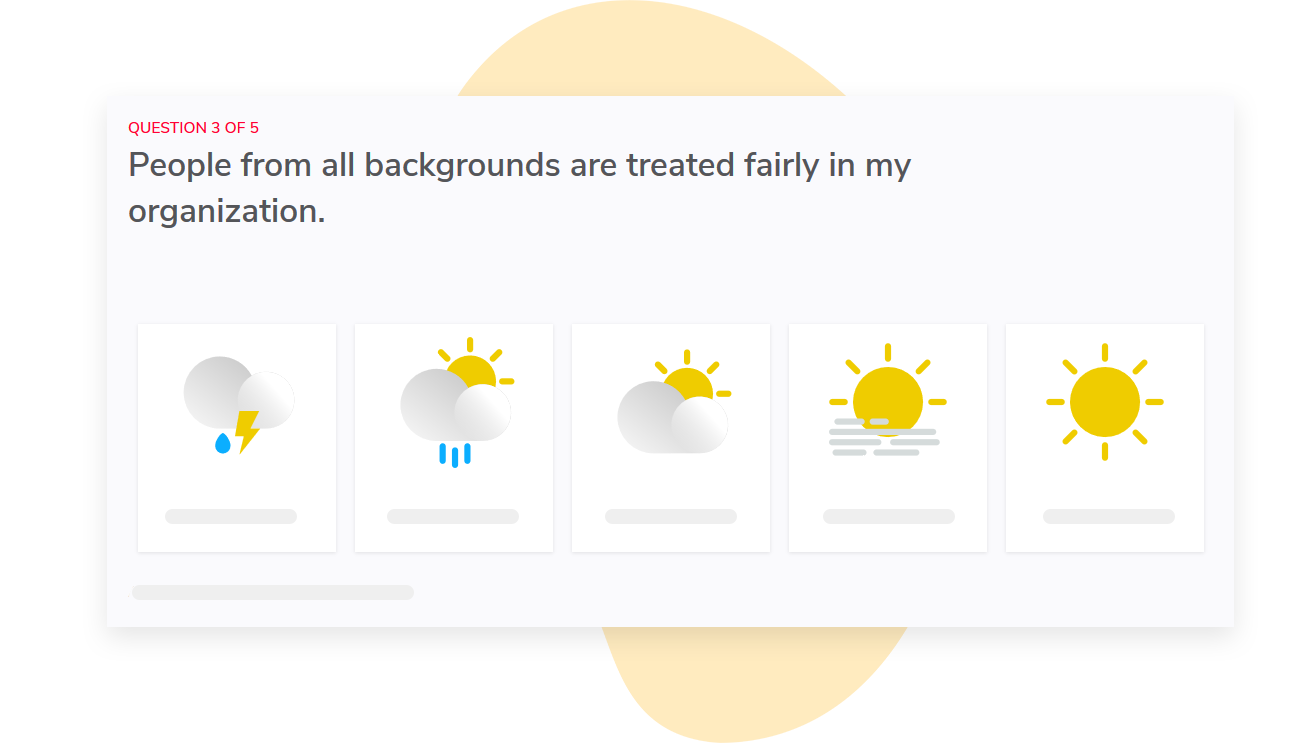
For retail organizations, associate engagement measurement needs to be frequent, simple, and usable by leaders at different levels of the business. Sparkbay helps by automatically collecting employee feedback at regular intervals, and many clients run monthly pulse surveys to keep a current view of the associate experience.
Results are presented in intuitive reports with a clear score out of 10, which makes it easier for HR, operations, district leaders, and store managers to discuss engagement without getting stuck in overly technical reporting. This is especially useful when leaders need to connect sentiment trends with turnover, customer experience, or store performance data.
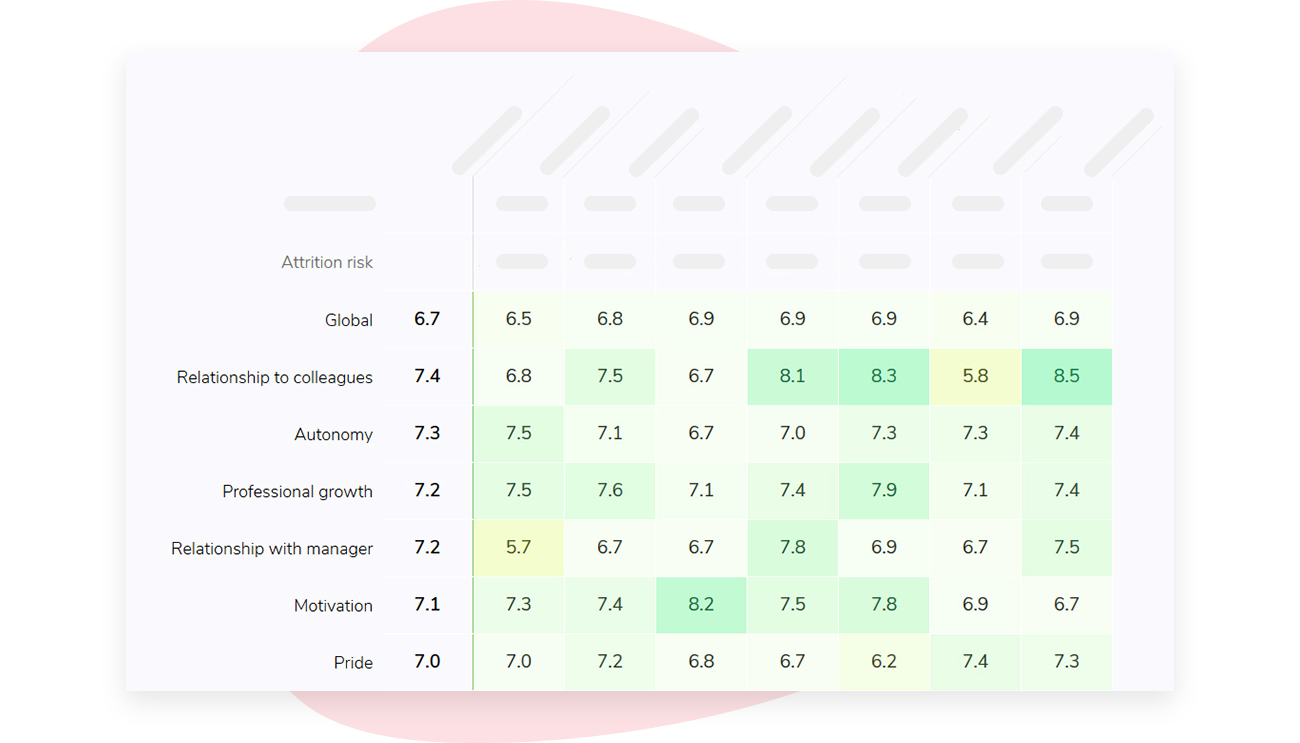
The platform is also useful for identifying where engagement issues are concentrated. Sparkbay allows teams to segment results by manager, department, tenure, location, and other employee attributes, so leaders can separate broad company-wide issues from local management or team-level patterns.
Retail leaders can also benchmark results against companies in their industry using Sparkbay's proprietary dataset. That context helps distinguish between issues that are common across the sector and issues where the organization is underperforming relative to comparable employers.
Once priorities are clear, Sparkbay offers a library of easy-to-implement actions that managers can use to improve. For frontline teams, this matters because action plans need to fit the pace of store operations, such as improving shift communication, increasing recognition, or creating more consistent coaching moments.
The strongest use case is ongoing listening paired with local accountability. HR can monitor trends over time, field leaders can identify stores needing support, and managers can work from practical actions rather than vague engagement goals.
If you're interested in learning how Sparkbay can help you build a more engaged workforce, you can click here for a demo.
Common pitfalls that sabotage engagement surveys
Engagement surveys fail when they create expectations that the organization is not prepared to meet. The damage is worse in frontline environments because skepticism travels quickly through teams.
Surveying too often without acting
Frequent listening is valuable only when employees see movement. A monthly pulse survey without any visible response can feel extractive rather than collaborative.
Asking too many questions
Long surveys suppress participation and reduce data quality, especially when employees are completing them during busy shifts. If every function adds questions, the survey becomes a corporate wish list rather than a focused listening instrument.
Using corporate language
Language that feels distant from store life creates emotional distance. Associates are more likely to respond thoughtfully when questions reflect their actual work environment.
Breaking or weakening anonymity promises
Few mistakes erode trust faster than mishandling confidentiality. This includes reporting results for groups that are too small, sharing identifiable comments, or allowing managers to infer who responded.
Ignoring manager capability
Store managers are often expected to act on engagement results without preparation. They may need coaching on interpreting survey data, discussing results without defensiveness, and selecting realistic actions.
Treating all locations the same
Averages can hide urgent local issues. A company-wide score may look stable while specific stores experience serious problems with respect, safety, staffing, or manager trust.
Over-indexing on scores and ignoring comments
Scores show where to look, but comments often explain why the issue exists. The best analysis combines quantitative patterns with qualitative context.
Punishing bad results
If managers believe low scores will only create blame, they may discourage participation or challenge the validity of feedback. Accountability is necessary, but it should be tied to response quality and improvement behaviors, not score protection.
Best practices checklist for sustainable engagement measurement
A sustainable associate engagement program should be simple enough to run consistently and rigorous enough to guide decisions. The checklist below can help evaluate whether the program is built for frontline reality.
- Keep surveys short: Use brief pulse surveys and reserve longer question sets for deeper diagnostics.
- Use plain language: Write questions that associates can answer quickly and confidently.
- Protect anonymity: Communicate reporting thresholds, comment handling, and confidentiality rules clearly.
- Make surveys mobile-accessible: Assume many associates will respond from a phone or shared device.
- Provide paid time: Build survey completion into the workday rather than expecting unpaid participation.
- Translate where needed: Make the survey accessible to the languages represented in the workforce.
- Measure both outcomes and drivers: Pair advocacy and intent-to-stay items with actionable questions about managers, staffing, recognition, tools, and communication.
- Segment results carefully: Review patterns by location, manager, tenure, role, shift, and employment type while preserving confidentiality.
- Close the loop quickly: Share what was heard and what will happen next.
- Empower store managers: Give them clear reports, guidance, and realistic actions they can implement.
- Escalate systemic issues: Do not expect local managers to solve corporate policy or resourcing problems alone.
- Track progress over time: Treat engagement as an operating metric, not a one-time HR event.
The strongest programs also connect associate feedback with business indicators. When engagement data is reviewed alongside turnover, absenteeism, customer complaints, sales conversion, shrink, and safety incidents, leaders can see where employee experience is shaping performance.
This does not mean reducing engagement to a productivity lever. It means recognizing that associate experience is part of the operating system of retail performance.
Final thoughts: building a culture where associates want to stay
Associates decide every day whether the organization deserves their effort, trust, and continued commitment. That decision is shaped by manager behavior, workload, scheduling, recognition, safety, communication, and whether leaders act when employees speak up.
An associate engagement survey gives large retail organizations a disciplined way to hear what is happening across locations before problems become resignations, customer complaints, or missed targets. The value comes from asking the right questions, reaching employees through the right channels, and responding with visible action.
Retail teams do not need a perfect listening program to start improving. They need a credible one: short enough to respect the work, frequent enough to detect change, confidential enough to earn honesty, and action-oriented enough to prove that associate feedback matters.
If you're interested in learning how Sparkbay can help you build a more engaged workforce, you can click here for a demo.