
Three resignations in six weeks. The exit interviews point to heavy workloads, unclear goals, and a supervisor who does not listen.
None of it surfaced until the notice periods began-and that is the part worth studying, not the departures.
The signals were there all along. They moved through private messages and hallway conversations, but nobody put their name to the criticism while it could still have made a difference.
That silence has a measurable cost. Gallup's State of the Global Workplace 2025 report found that global employee engagement fell to 21% in 2024, costing the world economy an estimated $438 billion in lost productivity.
An anonymous feedback form is one of the few instruments that lets employees report poor management, burnout, unfair treatment, and weak communication before those problems turn into attrition or a grievance.
Collecting the feedback is the easy part. You already know the failure mode: a survey lands, employees spend ten minutes on it, nothing visible happens, and the next response rate slips.
The instrument dies from unanswered feedback, not from bad questions.
This guide includes a free anonymous feedback template covering job satisfaction, leadership, culture, career growth, and wellbeing. It also covers the parts that separate a working program from a compliance exercise: protecting anonymity under subtraction risk, writing questions that survive cognitive testing, reading distributions instead of averages, and assigning action to named owners.
The point is not a higher score. It is to surface what people would never say to a manager, respond without getting defensive, and show that feedback actually moves decisions.
A ready-to-use anonymous employee feedback form template and a process for turning responses into action
- Why silence is not golden
- What is an anonymous employee feedback form?
- The payoff goes beyond a suggestion box
- Free anonymous employee feedback template
- How to write questions that employees can answer
- How to keep employee feedback truly anonymous
- How to analyze anonymous feedback
- How to turn feedback into visible change
- Mistakes that undermine anonymous feedback
Why silence is not golden
Before they speak, employees run a quick calculation: will raising this change anything, or just expose me? When the likely payoff is blame or a shrug from leadership, staying quiet is the rational move-not a culture problem you can slogan your way out of.
The result is an information lag. Leaders see the lagging indicators-absence, missed targets, complaints, resignations-months after employees saw the causes.
A team already knows which manager reshuffles priorities daily, where workloads have crossed into unsafe, and where promotion decisions look arbitrary. That knowledge stays scattered across private conversations, so leaders treat each resignation as an isolated event rather than a shared cause.
Anonymous feedback lowers the personal risk of speaking and pulls those fragments into a visible pattern. It also corrects the sampling bias of open forums, which reliably over-weight the senior, the confident, and the well-connected.
The form does not manufacture trust. Employees read the process-the questions you ask, the privacy controls you can actually prove, and what happens afterward-and adjust their honesty to match.
What is an anonymous employee feedback form?
Use these forms for engagement surveys, pulses, culture and change checks, upward manager feedback, wellbeing checks, and post-departure feedback.
Anonymous is not confidential, and the difference is not pedantic. In a confidential process, someone or something can re-link a response to a person and simply restricts who gets to; in a genuinely anonymous process, no administrator or manager can, and reporting suppresses any group below a defined threshold.
Get this wrong in how you describe it and you pay for it permanently. Call a confidential process "anonymous," and you lose every future response rate the moment one employee learns an administrator could identify them.
Anonymity also has a technical ceiling. "As the only night supervisor in the Lyon warehouse..." identifies its author no matter how clean your data model is. Name that limit in the instructions and ask employees to strip unique titles, specific events, and named individuals from free text.
Do not promise what free text cannot deliver.
The payoff goes beyond a suggestion box
Leadership gains access to operational blind spots
Every management layer summarizes, softens, or delays the difficult message before it travels up. Anonymous feedback routes around that filtering, and it exposes something more useful still: the gap between policy and practice-the flexible-work policy that exists on paper while managers quietly penalize anyone who uses it.
HR can detect risk earlier
Declining role clarity, weakening confidence in leadership, and persistent workload complaints tend to move before regretted attrition does. One low score is noise.
A sustained decline across several related items, backed by repeated comments, is a leading indicator you can act on while conditions are still changeable.
Leaders can test assumptions with evidence
Leaders default to broad diagnoses-"people dislike change." The data usually points somewhere narrower and more fixable: late communication, unclear decision rights, or managers fielding questions they had no answers to. That distinction is what separates a targeted fix from a vague culture campaign that eats a year.
Employees gain a safer route to participate
Take away the status pressure and people will challenge a popular proposal or name a poor manager without becoming the topic of the meeting. Broader participation improves your evidence base.
Just remember that survey answers rarely carry enough context to solve a complex problem on their own, so keep other listening channels open.
Free anonymous employee feedback template
Copy the template below into your survey platform and adapt the wording to your workforce and your reason for asking.
Use a consistent five-point scale for statements: 1 = strongly disagree, 2 = disagree, 3 = neither agree nor disagree, 4 = agree, and 5 = strongly agree. Add "not applicable" wherever employees may lack the information to answer honestly. Forcing an answer there just manufactures noise.
Keep one scale direction throughout, and never mix a satisfaction scale with a frequency scale in the same block. Employees answer on autopilot, and a scale that flips halfway through produces reversed answers you will misread as a real signal.
| Area | Survey statement or question | Response type |
|---|---|---|
| Job satisfaction | Overall, I am satisfied with my experience at work. | Five-point scale |
| Role clarity | I understand what my manager expects from me. | Five-point scale |
| Resources | I have the information, systems, and resources I need to do my work well. | Five-point scale |
| Workload | My workload is manageable within my normal working time. | Five-point scale |
| Manager support | My manager listens to concerns and responds constructively. | Five-point scale |
| Leadership | Senior leaders explain the reasons behind important decisions. | Five-point scale |
| Fairness | People in this organization receive fair treatment. | Five-point scale |
| Psychological safety | I can raise a work-related concern without fear of negative consequences. | Five-point scale |
| Belonging | I feel respected and included by the people I work with. | Five-point scale |
| Growth | I have useful opportunities to develop my skills. | Five-point scale |
| Career prospects | I understand the career paths available to me here. | Five-point scale |
| Recognition | I receive meaningful recognition when I do good work. | Five-point scale |
| Wellbeing | My work allows me to maintain my wellbeing over time. | Five-point scale |
| Improvement | What is the one change that would most improve your work experience? | Open text |
| Strengths | What should the organization protect or continue doing? | Open text |
| Other feedback | Is there anything else you want leaders to understand? | Optional open text |
For a pulse, keep four to eight scaled items plus one open question, and freeze your core trend items word-for-word. Reword a trend question to "improve" it and you silently break the comparison you built it for.
Rotate the remaining items to fit a specific event-a reorganization, a policy change, a merger, a new operating model. Change a trend item only when employees demonstrably misread it, not when a stakeholder fancies fresh wording.
Put demographic questions last, make them optional, and collect only the categories tied to a decision you can name. Every demographic field you add is a re-identification vector you then have to defend.
How to write questions that employees can answer
Measure one idea at a time
"My manager communicates clearly and recognizes good work" is two questions. An employee who agrees with one and rejects the other hands you uninterpretable data and no clear action.
Split it.
Use specific, neutral language
"Leadership does an excellent job of communicating our inspiring strategy" loads the response toward agreement and leans on words employees each define differently. "Senior leaders explain the organization's priorities clearly" does not. Drop always and never unless you genuinely need an absolute-one remembered exception is enough to make people reject an otherwise true statement.
Give questions a defined reference point
Anchor feedback, recognition, and workload items to a window that matches how often the activity happens-one month for workload, six for development conversations. "Regularly" means whatever the reader wants it to mean.
Balance scores with comments
Scales locate and size the problem; open text explains the movement. Don't require a comment on every scaled item-forcing an explanation just raises effort and produces "nothing to add."
Test the form before launch
Run cognitive testing. Have a small, cross-functional, multi-language group complete the form and talk you through how they read each item.
This catches the terms a designer is too close to notice, and it flags length and privacy concerns before they cost you a launch.
Watch the translation especially. A statement that reads as neutral in English can carry blame or deference in another language, and a scale label that maps cleanly in one culture can compress toward the middle in another.
Validate the meaning, not just the words.
- Avoid: "Do you agree that the new process has improved communication?"
- Use: "The new process gives me the information I need to complete my work."
- Avoid: "How satisfied are you with your manager and senior leadership?"
- Use: Ask separate questions about the direct manager and senior leaders.
- Avoid: "Tell us what is wrong with the culture."
- Use: "What is one part of our culture that makes your work harder?"
How to keep employee feedback truly anonymous
Anonymity is a property of the system, not a checkbox. A basic form tool that drops the name field still leaks identity through email collection, SSO logs, timestamps, and small-group filters.
Before launch, document exactly what the system records and who can reach the raw data, then confirm it in the data-processing agreement and your privacy review.
Set a minimum response threshold
Suppress results-scores and comments-below a set number of responses per reporting group, and stop managers from stacking filters down to a handful of people.
Then check for subtraction risk specifically. If a manager can view an eight-person team and, separately, a seven-person subgroup, the excluded person's response is trivially inferable.
Thresholds on their own do not close that gap.
The same holds over time. Publish a result for a team this cycle, then withhold it next cycle because one person left, and you've told everyone something about that departure.
Decide your suppression rules before you need them, not case by case.
Limit demographic questions
Department, location, tenure, age band, level, and manager all become identifying in combination. Collect only what a defined question or action requires, and use ranges-tenure bands, not start dates.
Communicate the rules plainly
Say whether the survey is anonymous or confidential, what gets recorded, who sees which reports, what the reporting threshold is, and how comments are handled. Don't promise absolute anonymity when free text can identify an author-name the limit and ask people to keep identifying detail out of their comments.
Separate urgent reporting channels
An engagement form is the wrong channel for harassment, violence, fraud, or a safety threat, because anonymity blocks the follow-up questions and protective action those cases demand. Put the formal reporting route alongside the form and state who owns those cases-HR, ethics, or another designated function.
How to analyze anonymous feedback
Start with participation coverage across units, locations, shifts, and job groups-without breaching the anonymity threshold to get it. A strong headline response rate routinely hides a silent population: office staff respond, frontline and night shifts do not, and you end up drawing conclusions from the people least affected by the problem.
Read the response rate itself as data. A sharp drop in one team after a rough patch is often not apathy; it's a quiet verdict on whether speaking up felt safe or worthwhile last time.
Review distributions, not just averages
The average is where problems hide. A team split 50/50 between strongly agree and strongly disagree lands on the same "fine" midpoint as a team that all chose neutral-and needs a completely different intervention.
Read the full distribution, the missing responses, and the "not applicable" rates over time. Use medians where they clarify, but keep the report legible to line managers.
Compare connected items
Group related items into a driver model-workload, staffing, role clarity, manager support, and resource access often move together behind an engagement decline. Correlation gives you a hypothesis, not a cause.
Test it against operational data, voluntary focus groups, and process reviews before you act.
Code comments consistently
Build a coding frame around recurring themes-workload, manager conduct, pay fairness, systems, communication, growth, recognition-and allow multiple codes per comment. Track theme, tone, frequency, business area, and severity.
Don't treat comment volume as a vote: writing is self-selected, and one person can raise five topics.
Prioritize impact, reach, and urgency
| Test | Question to ask | Possible response |
|---|---|---|
| Urgency | Could the issue harm people, breach policy, or create an immediate operational risk? | Escalate through the appropriate formal process. |
| Reach | How many teams or employee groups report the same pattern? | Address broad patterns at organizational level. |
| Impact | How strongly does the issue affect engagement, retention, service, or delivery? | Give high-impact drivers priority. |
| Control | Which leader can change the process, resource, or behavior? | Assign an owner with decision authority. |
| Evidence | Do scores, comments, trends, and operational data point in the same direction? | Act when evidence converges, or investigate further. |
Escalate any comment that signals an immediate threat or serious misconduct through established procedures, protecting anonymity while looping in only the people needed to assess and manage the risk.
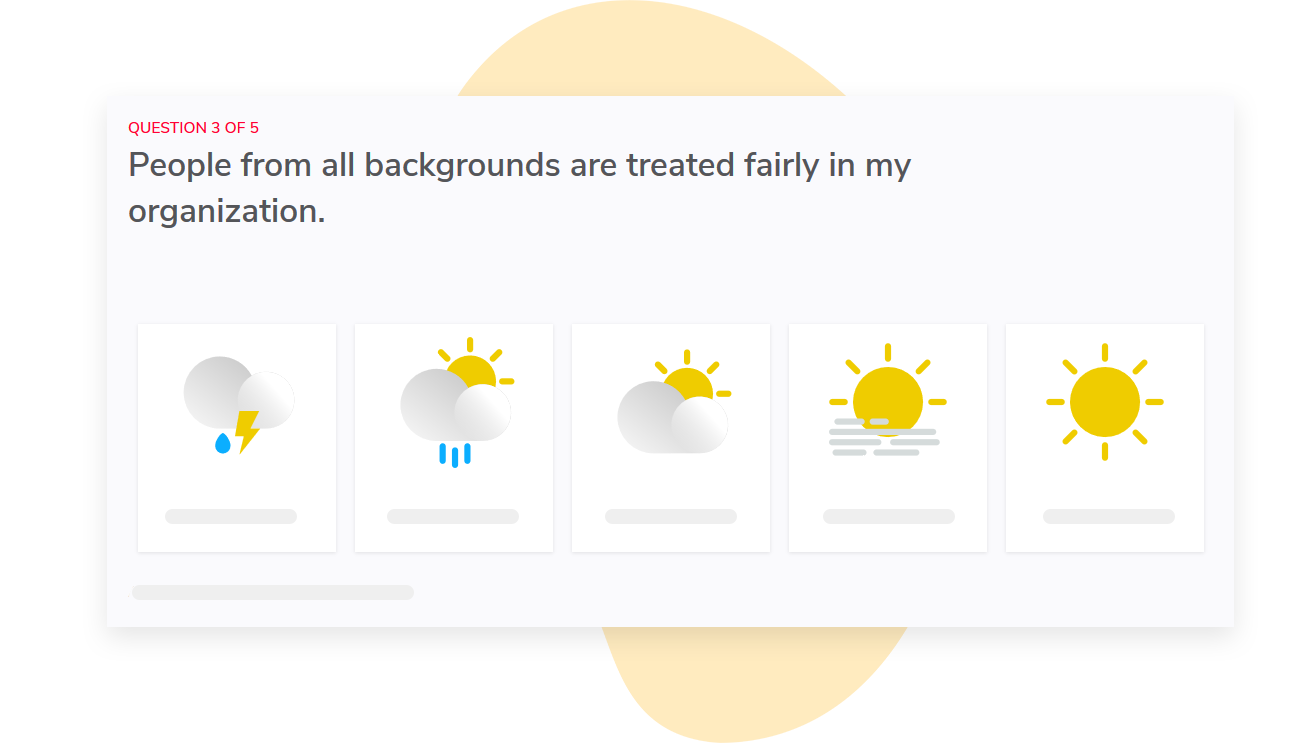
Sparkbay collects feedback on a set cadence-monthly pulses, for instance-and reports it against a clear engagement score out of 10, so leaders can track direction over time instead of reacting to one annual snapshot or a handful of loud comments.
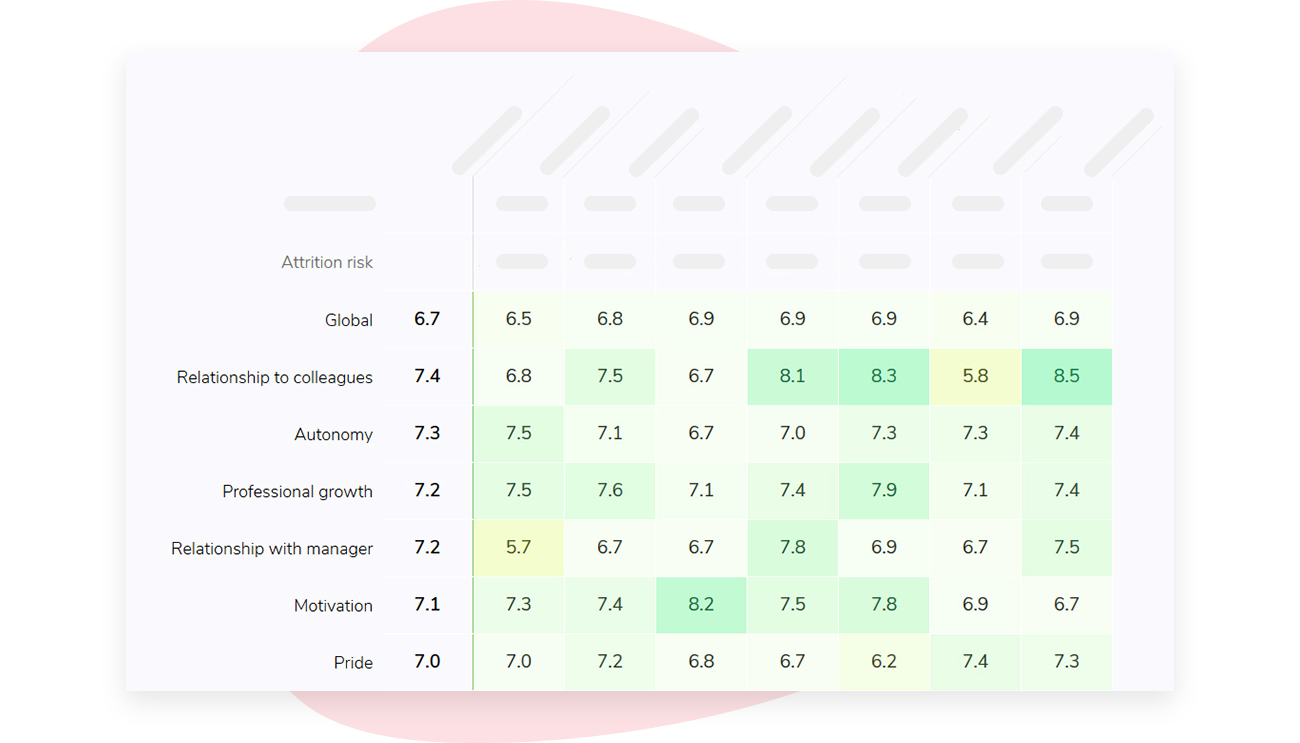
Results segment by manager, department, tenure, and other groups, so you can tell a local management issue apart from a broader pattern you can't out-manage on your own.
Sparkbay is highly configurable. You can adjust survey wording, dashboard wording, and the dashboard content itself to fit your operating model and listening strategy, rather than bending your program to fit a fixed template.
For large enterprises, report access maps automatically to the org hierarchy, so each manager sees only their own teams, while minimum-response rules hide results below a configurable threshold, set to five responses by default.
Sparkbay is ISO 27001 certified. That covers the platform's controls; you still document your own access rules, privacy notices, retention periods, and escalation procedures.
Once managers have their reports, Sparkbay's library of ready-to-implement actions helps them get from a broad finding-weak role clarity-to a concrete step, such as re-baselining priorities and decision rights in the next team meeting.
If you're interested in learning how Sparkbay can help you build a more engaged workforce, you can click here for a demo.
How to turn feedback into visible change
Employees don't expect every suggestion adopted. They do expect the findings acknowledged, the decisions explained, and the top issues addressed-including the ones you decide to leave alone.
Share a clear summary
Report the main strengths, the concerns, and the next steps within a fixed window after the survey closes. A delay of several months severs the link between input and action in employees' minds, and it reads as burial.
Paraphrase any comment whose direct quotation could identify its author.
Choose a small number of priorities
Ten simultaneous fixes produce scattered activity and no ownership. Pick two or three on impact, urgency, reach, and control-and say plainly what you will not pursue and why, especially where cost, legal duties, customer commitments, or conflicting employee needs constrain you. Naming the trade-off is what buys you credibility for the next cycle.
Assign owners and dates
| Feedback theme | Action | Owner | Deadline | Success measure |
|---|---|---|---|---|
| Unclear priorities | Publish team priorities and review them in monthly meetings. | Business unit leader | Within six weeks | Improvement in role-clarity items and fewer conflicting assignments. |
| Uneven manager communication | Introduce a standard manager briefing after major decisions. | Internal communication lead | Within four weeks | Higher scores for timely and clear communication. |
| Heavy workload | Review staffing, low-value tasks, deadlines, and approval steps. | Operations director | Initial review within eight weeks | Lower reported overload and fewer repeated workload comments. |
Ownership means a named person with authority, not "HR" or "management," which is how actions quietly die. Each one needs a deadline and a measure tied to the employee experience, not to project completion.
Watch out for the action that looks responsive but only shifts the problem. Add a wellbeing webinar in response to workload complaints without touching the workload, and it reads as evasion-the next score drops more than it would have if you'd done nothing.
Report progress before the next survey
Use a fixed structure: what employees said, what leaders decided, what has changed, and what remains open. Repeat it until each item is delivered or formally closed, then use the next pulse to test whether employees actually noticed. Shipping a project is not evidence it fixed the problem.
Mistakes that undermine anonymous feedback
- Collecting data without an action process: Fix who reviews results, who handles urgent concerns, and who approves plans before the survey opens-not after the results have embarrassed someone.
- Treating anonymity as a label, not a rule: Strip identifiers, apply thresholds, test filter combinations for subtraction risk, and restrict report access.
- Asking too many questions: Cut any item that is interesting but not tied to a decision, trend, or action.
- Rewording core questions: Every cosmetic change to a trend item destroys the comparison and makes a real movement indistinguishable from a wording artifact.
- Surveying faster than you can respond: A short monthly pulse works when teams act between cycles; it collapses the moment managers start ignoring the results, and cadence can't make up for silence.
- Running one annual survey: Long gaps leave you blind to workload and change-related problems for months.
- Reacting defensively: A manager who argues with the results teaches the team that honesty carries social risk-anonymity or not.
- Hunting for authors: Speculating about who wrote a comment burns trust and distracts from the issue.
- Publishing raw comments carelessly: They can identify colleagues or contain allegations that need controlled handling.
- Treating comments as verified fact: Take them seriously, but investigate before making any finding about a person or event.
Brief managers before you release the reports: how to read small differences as noise, why not to hunt for authors, how to discuss results with the team, and how to pick actions within their control.
Give a struggling manager private support before their low scores start circulating. A manager who fears public exposure has every reason to discourage honest answers next time, and that corrupts the very data you rely on.
Build a feedback culture that lasts
An anonymous form is one instrument in a listening system. Triangulate it with manager conversations, focus groups, operational reviews, recognition data, stay interviews, and exit feedback-no single channel carries enough context on its own.
Leaders set the norm by how they take criticism. Thank the person for raising it, ask what evidence would sharpen it, and state the next step.
Repeat that often enough and anonymity starts to become unnecessary.
Keep the rhythm predictable: when surveys run, when results appear, when teams review progress. Ambiguity here reads as avoidance.
Start from the template above, delete every question that isn't tied to a real decision, and protect anonymity through system controls and reporting rules rather than promises.
The signal that matters comes after the form closes. Named owners, firm dates, and visible change are what teach employees that speaking honestly changes how the work gets done.
If you're interested in learning how Sparkbay can help you build a more engaged workforce, you can click here for a demo.