
Beyond the ping-pong table: why most engagement surveys miss the mark
So what does your engagement survey actually tell you when the score comes back at 7.2?
For most HR leaders, the honest answer is: not much you can do anything with. You know the number moved. You don’t know which team is struggling, what broke, or which manager could fix it by Friday.
That gap between measuring engagement and acting on it is the problem the Gallup Q12 was built to close.
Start with the distinction most surveys blur. Satisfaction tells you whether people like being there.
Engagement tells you whether they’ll put in effort no one requires of them. A team can score high on the first and low on the second-comfortable, well-liked, coasting-and a satisfaction number will never catch it.
Gallup went after that gap deliberately. Its research program tested a long list of candidate items against team-level performance and kept only the statements that held up, across a very large body of business units and industries.
Those twelve became the Q12. They cover the practical things that shape a working day: clear expectations, the right tools, recognition, relationships you trust, and room to grow.
You don’t need a hundred-item instrument that takes half an hour to fill in and three months to interpret. You need items that show where the work breaks down and where a manager can actually change something.
The Q12 gives you that focus. It only pays off if you read each low item as a diagnosis to act on rather than a number to nudge upward.
The 12 Gallup engagement questions explained, with how to act on each
- The science of simple: how Gallup cracked the engagement code
- The foundation: do I even know what’s expected of me?
- The sweet spot: playing to strengths and getting noticed
- The belonging factor: does my voice actually matter?
- The team effect: quality, friendship, and feeling valued
- The growth trajectory: am I going anywhere from here?
- From data to action: what Q12 scores are really telling you
- Making it stick: common pitfalls and how to avoid them
The science of simple: how Gallup cracked the engagement code
Gallup arrived at the Q12 by testing a far larger pool of questions and keeping the ones that reliably predicted team-level performance-across decades, and across a research base spanning hundreds of organizations and millions of employees.
The survivors share a trait: they measure things employees can observe in their daily work, not vague attitudes. That’s the whole design principle.
Take an item like "I feel positive about the future." It captures a mood and hands a manager nothing to work with.
Now take a weak score on "I know what is expected of me at work." That points somewhere concrete-reset the priorities, define who decides what, strip out conflicting goals, spell out how success gets measured.
The items also stack in a rough order of need, from basic clarity and resources up toward belonging and growth. A team rarely rallies around a shared mission while it’s still guessing at its priorities.
So read a low foundational item as the ceiling on everything sitting above it.
Gallup ties stronger Q12 results to retention, productivity, customer loyalty, safety, and profit. That’s an association across teams.
It isn’t a licence to treat one score as proof that engagement caused a given business result.
The analysis that holds up pairs survey data with operating data. Compare item scores against voluntary turnover, absence, defects, customer feedback, and delivery performance-at the team level, where the pattern actually lives, not the company level.
Brevity buys you something practical too. Managers can remember what twelve items cover when they sit down with a team to talk through the results.
The foundation: do I even know what’s expected of me?
The wording below follows Gallup’s published Q12 items, which the organization groups into four ascending levels: basic needs, individual contribution, teamwork, and growth. That order is worth keeping in mind as you read the diagnoses.
Q1: "I know what is expected of me at work"
Clarity erodes as an organization grows. Matrix reporting, rotating projects, dotted lines, competing targets-capable people end up unsure which demand wins when two of them collide.
A tidy job description won’t fix that. Real clarity covers the order of priorities, the quality bar, who holds decision authority, who owns which stakeholder, and which trade-offs the manager will actually accept.
When a functional leader and a regional leader each name a different top priority, the team splits its attention and lets both of them down. That isn’t an effort problem.
A low Q1 tells you to audit the work system, not to lecture people about communicating better. Surface the conflicting goals.
Name the three-to-five outcomes that matter. Settle who decides when priorities clash.
Q2: "I have the materials and equipment I need to do my work right"
Read this past the obvious. It’s system access, reliable data, staffing levels, documentation, budget authority, and getting input from upstream teams on time.
Notice the phrase "do my work right." That’s a higher bar than getting it done. People routinely ship work through manual workarounds and overtime, aware the whole time that the process is generating errors it didn’t have to.
Put a number on the gap. A missing permission that adds twenty minutes to a daily task sounds trivial-until you multiply it across a large team and a full year.
Q1 and Q2 are the base. No amount of recognition or mission language makes up for unclear priorities or an environment that keeps getting in the way.
The sweet spot: playing to strengths and getting noticed
Q3: "At work, I have the opportunity to do what I do best every day"
This isn’t about doing only the fun tasks. It asks whether the role draws on a person’s strongest skills often enough to generate energy and good work.
A strong analyst who spends the week formatting reports is being wasted. A natural relationship-builder buried in solo admin will drift, even while hitting every target.
Fixing fit usually means moving tasks around, reassigning a project, or shifting who owns what-not rebuilding the job from scratch.
Q4: "In the last seven days, I have received recognition or praise for doing good work"
The seven-day window is deliberate. It stops anyone from counting a compliment from last quarter as recognition that’s still doing work.
Recognition that lands names the work and its effect. "Your revised handover checklist stopped us losing information during the transition" does something that "great job" never will.
It decays the moment it turns automated, gets handed out on a rota, or points at work employees consider routine. Keep it specific, believable, and close to the event.
Q5: "My supervisor, or someone at work, seems to care about me as a person"
People answer this from small evidence. Does the manager notice when someone’s been buried for weeks?
Remember a concern they raised? Respect a boundary?
Show up when asked for help?
Nobody’s asking for friendship here. They’re asking for attention, respect, and to be treated as more than output.
Q6: "There is someone at work who encourages my development"
Development needs an active sponsor-someone who spots the potential, gives feedback you can use, and opens the door to a stretch assignment or the next role.
That sponsor doesn’t have to be the line manager. In a large organization, HR should deliberately build several development relationships so that a person’s growth doesn’t ride on one boss.
Q3 through Q6 land heavily on managers. HR can set the standard and supply the systems, but employees feel strengths, recognition, care, and development in the small repeated moments with the person they report to.
The belonging factor: does my voice actually matter?
Q7: "At work, my opinions seem to count"
This measures influence, not the invitation to speak. A manager who asks for opinions in every meeting still scores low if that input never visibly changes a decision.
Leaders don’t have to say yes to everything. They do have to close the loop-what got decided, what evidence drove it, and why the alternatives didn’t win.
A low score can also flag weak psychological safety, where someone challenged a view once and paid for it with ridicule, defensiveness, or a quiet mark against their name.
Cut this item by level and tenure. If senior staff feel heard and new hires don’t, you’ve got a status-based voice problem, and the fix looks nothing like a general communication push.
Q8: "The mission or purpose of my company makes me feel my job is important"
Mission statements generate no engagement on their own. They start to matter when employees can connect them to the decisions they make every day.
That translation-turning mission into outcomes a specific team controls-is the manager’s job.
A payroll administrator, an engineer, and a facilities worker each reach purpose by a different route. One corporate line won’t carry across all three.
Purpose also has to be credible. When the stated values pull one way and the reward system pays for another, people believe the reward system.
Read Q7 and Q8 together. High mission and low voice gives you committed people with no leverage.
High voice and low mission gives you autonomy without a reason to use it.
The team effect: quality, friendship, and feeling valued
Q9: "My associates or fellow employees are committed to doing quality work"
Employees calibrate to whatever their peers get away with. When weak work carries no consequence, the strong performers pick up the slack-until resentment burns off the commitment.
A low Q9 usually points to soft accountability, uneven workloads, undefined quality standards, or a process that makes good work harder than it should be. Don’t jump to reading it as attitude.
Define quality in terms this team can see: response times, error rates, rework, documentation, handover quality, customer outcomes.
Q10: "I have a best friend at work"
The most argued-over item in the set, and the one leaders most want to cut. It doesn’t require anyone to make a friend, and it isn’t a verdict on anyone’s social life.
It works as a sensitive proxy for trust and connection. Someone with a close relationship at work has a person who shares context, catches trouble early, and tells them the truth before a small problem turns into a big one.
You can’t assign a best friend. You can build the conditions for one: stable teams, real onboarding, peer support, cross-functional work, and enough slack for a conversation nobody scheduled.
Watch this item for exclusion. A team can post high internal friendship while remote staff, new hires, or minority members sit outside the informal network where information and opportunity really move.
The growth trajectory: am I going anywhere from here?
Q11: "In the last six months, someone at work has talked to me about my progress"
This asks whether a real conversation about progress happened-not whether a form got filled in. A signed appraisal that never touched growth, obstacles, or next steps scores nothing here.
A conversation that counts looks both ways: evidence they’ve improved, one skill worth strengthening, and an agreed next move.
The six-month frame exposes what annual cycles hide. In fast-moving roles, a once-a-year chat leaves people running on stale expectations for months at a stretch.
Q12: "This last year, I have had opportunities at work to learn and grow"
Most growth happens through the work, not in a classroom-stretch projects, secondments, mentoring, shadowing, wider authority, a new stakeholder group to figure out.
The size of your course catalogue is beside the point. An organization can offer hundreds of courses while workload, a resistant manager, or a dead-end career path stops anyone from ever applying what they learned.
Segment Q12 by tenure. The classic failure shows up here: intensive development during onboarding, then a cliff the moment someone becomes fully productive.
Q11 and Q12 tell you whether people can see themselves moving forward. When they can’t name what they’re learning or where they could go, the job market outside starts to look better than it should.
If reading twelve diagnoses in a row makes the job look impossible, that’s a fair reaction. Nobody works all twelve at once-the point of item-level data is that it tells you which two matter for this team, this quarter.
From data to action: what Q12 scores are really telling you
A Q12 result opens a diagnosis. It doesn’t close one.
The overall average tells you the direction of travel; the item-level and team-level patterns tell you where to put your hands.
Don’t overreact to a small move between waves. Check the response counts, participation, changes in team composition, and effect size before you read anything into it.
Be wary of two very different teams hiding behind the same average. One team clusters mid-range on most items.
Another splits hard between very high and very low. They need different responses-the split usually means the experience varies a lot from person to person, not that it’s lukewarm all round.
Look for clusters of related items:
- Low Q1 and Q2: Employees may face conflicting priorities, broken processes, missing access, or weak staffing.
- Low Q3 through Q6: Managers may need help with job design, feedback, recognition, and development conversations.
- Low Q7 and Q8: Employees may feel unheard or disconnected from the organization’s purpose.
- Low Q9 and Q10: Team standards, trust, inclusion, or peer relationships may need attention.
- Low Q11 and Q12: Employees may lack feedback, career movement, and access to learning through work.
Segment by department, manager, tenure, location, and role group-while holding to your minimum-response threshold and refusing to conclude anything from tiny cells.
Treat the clusters above as a guide, not a diagnosis. They tell you where to look first; only the conversation with the team tells you what is actually going on.
Then join the engagement data to your workforce and operating data. Low recognition alongside rising voluntary turnover in one team is worth a closer look.
Test the rival explanations first-through comments, interviews, a conversation with the manager-before you call it cause.
Separate what a manager owns from what leadership owns. A manager can fix expectations and recognition.
Only executives can fix job architecture, staffing rules, technology, or who gets to decide across functions.
Give each team one or two priorities, not a backlog. Name the owner, the first step, the review date, and the measure that will show whether the working experience actually shifted.
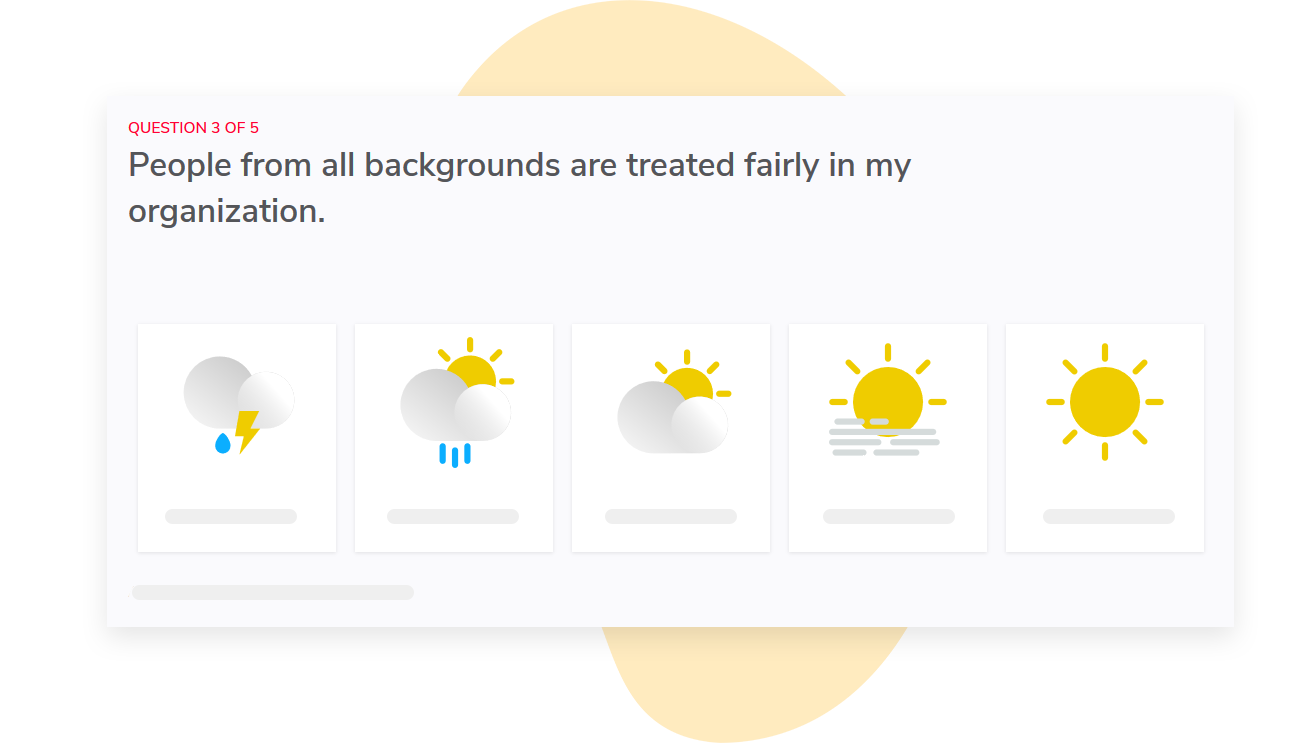
Sparkbay gathers feedback on a regular cadence-often monthly-and reports it as a clear engagement score out of 10, so leaders can watch the direction of travel without flattening the whole employee experience into one figure.
HR can segment by manager, department, tenure, and other groups-which is what lets you tell a local issue apart from a company-wide one.
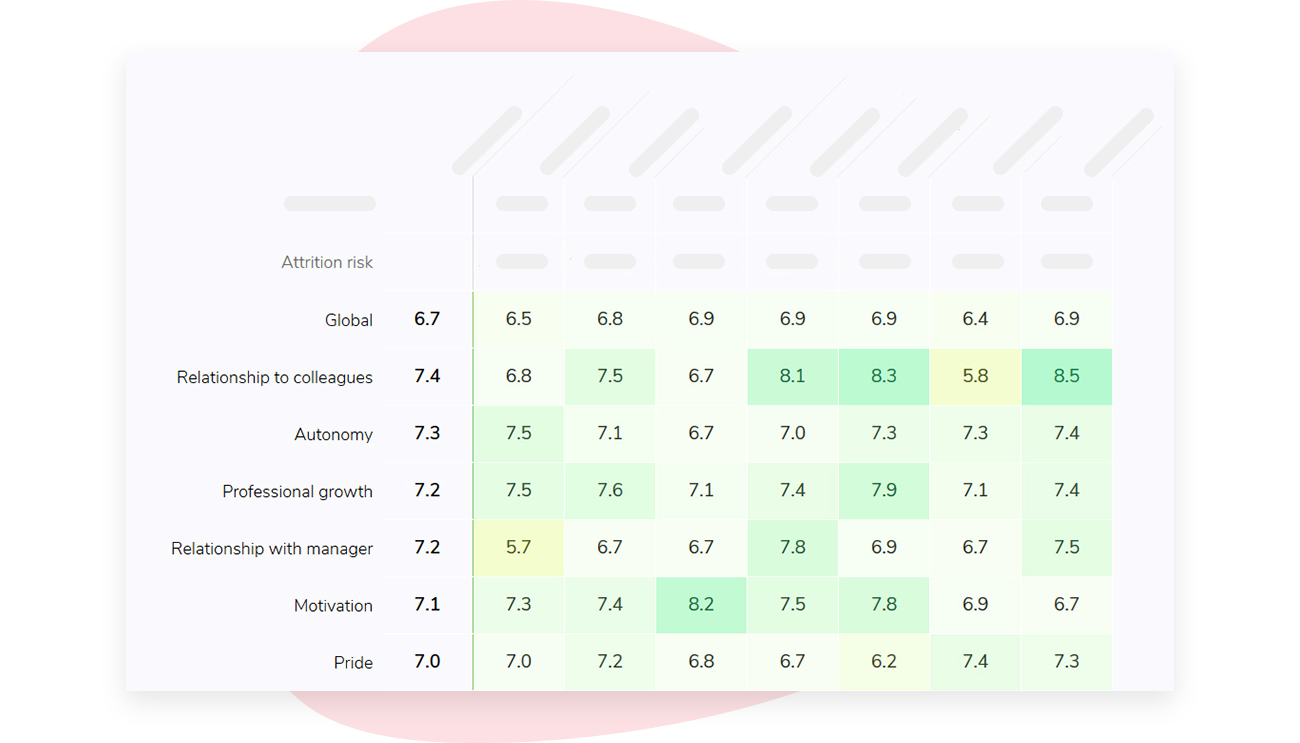
Sparkbay is highly configurable. You can adapt the wording of both surveys and dashboards, and the content of the dashboards themselves, to match your language, your operating model, and your engagement framework.
That matters when you want to draw on Q12 themes without dropping your own terminology or reacting to a live business issue. Keep a stable core for trend analysis and rotate a small set of diagnostic questions around it.
For enterprise reporting, access maps automatically to the org hierarchy, so each manager sees only their own teams instead of unrestricted results.
Anonymity holds because results stay hidden below a configurable minimum response threshold-five by default. HR reads the patterns; nothing in that implies leaders can work out who said what.
Once the reports arrive, Sparkbay offers a library of practical actions, so a manager staring at a weak result-unclear expectations, thin recognition-can move to a concrete step that fits how they actually run the team.
If you’re interested in learning how Sparkbay can help you build a more engaged workforce, you can click here for a demo.
Making it stick: common pitfalls and how to avoid them
Most Q12 programs don’t fail on the instrument. They fail on what happens in the weeks after the results land, and the failures repeat across organizations with unnerving consistency.
The first is treating the score as the goal. Pressure to move a number breeds gaming-coaching people on how to answer, arguing with weak results, or wheeling out visible perks while the work stays broken. Set targets on behaviour and conditions instead: clarify priorities each week, hold monthly development conversations, kill the recurring approval delay everyone complains about. The score comes along behind.
Closely related is running the survey and then going quiet. Silence teaches people that answering was pointless, and it drags down participation in the next round. Report back what you heard, what’s changing, what isn’t, and when they’ll hear from you again.
A well-explained "no" keeps trust intact where being ignored destroys it. People swallow an infeasible request far more easily than dead air.
Surveying too often has the same root. Pulses catch change quickly, but they don’t stand in for managing, and if every pulse spawns another action plan, teams pile up commitments they’ll never keep. Hold the core items steady enough to trend, add follow-up questions only when the answer informs a decision, and set the frequency to how fast you can actually act and report-not to how often the tool can fire off a survey.
Then there’s anonymity. Vague privacy language drags participation down, so say plainly who sees results, how comments are handled, and when small-group data stays hidden. Enforce the minimum-response threshold, role-based access, and a consistent rule for comments; never leave a manager in a position to guess who wrote a response.
The pitfall that does the most quiet damage is holding managers responsible for structural problems. They shape a lot of the Q12 conditions, but no line manager rebuilds a legacy system, redesigns the career ladder, or fixes chronic understaffing on their own. Send findings to the level that owns them: local leaders own the team’s habits, while executives and functional owners own the policies, systems, and resourcing that hit many teams at once.
Finally, be careful about lifting the wording without the trust that makes it work. The exact Q12 phrasing carries validated meaning, but dropping the items into a low-trust culture won’t reproduce Gallup’s findings-people answer honestly only when they believe the answers are safe and get used.
This last one is a genuine judgment call, and experienced HR teams land on both sides of it. Strict comparability to external benchmarks argues for the validated wording untouched; fit with your own language and operating model argues for adapting it. Either is defensible. What isn’t is changing the phrasing halfway through, which quietly breaks your own trend line-so decide up front, and then commit.
The bottom line: engagement is a growth engine
The Q12 earns its keep because it measures the conditions people run into in real work: whether they understand the job, have what they need, get to use their strengths, feel recognized, trust the people around them, have some say in decisions, and can see somewhere to grow.
The number twelve isn’t the point. The value sits in the research behind the items and in the specific management decision each low score can set off.
Treat engagement as an operating discipline rather than an annual HR event. Measure consistently, protect anonymity, read the patterns, take out a specific barrier, and come back with evidence that it worked.
Start with each team’s weakest item that actually means something. Ask what happens in the daily work to produce that score, pick one change inside the team’s control, and check the effect at the next pulse.
A short survey opens the conversation. Whether anyone believes it mattered comes down to what you do next.
If you’re interested in learning how Sparkbay can help you build a more engaged workforce, you can click here for a demo.