
Three resignation notices hit your inbox before 10 a.m. on a Monday. By Friday, an exit interview surfaces the same complaints employees have been making for months: managers who don't support them, career paths that lead nowhere, workloads that never let up.
The signals were all there. But your annual survey results landed too late to be any use, and now the company has to recruit replacements, cover the empty seats, train the new people, and lean on an already-tired team to absorb the slack.
The bill adds up fast. A 2,000-person company that loses 300 people in a year, at an average replacement cost of $20,000 each, is looking at $6 million in turnover before you count a single lost sale, stalled project, or frayed customer relationship.
You already know what a good survey looks like. The harder problem is picking a platform that survives procurement, clears security review, maps onto a messy org hierarchy, drives manager follow-through you can actually measure, and produces a business case finance won't take apart in the first meeting.
This guide sticks to those pressure points: what genuinely separates enterprise platforms from survey tools, the questions that expose a weak vendor mid-demo, and an ROI framework built on your own data instead of a borrowed engagement-to-revenue multiplier.
Tying an engagement score out of 10 to turnover cost and business impact
- Beyond the annual pulse check: what a modern engagement platform actually does
- The must-have features that separate useful platforms from basic survey tools
- Red flags and deal-breakers to uncover before signing
- Match the platform to your organization's real needs
- Test the platform's fit with your HR technology environment
- Build a business case that leadership can test
- Use metrics and ROI formulas that withstand scrutiny
- Test-drive the platform before committing
- Use a weighted vendor comparison checklist
Beyond the annual pulse check: what a modern engagement platform actually does
The real change isn't going from annual to continuous. It's moving away from one-off survey projects toward a connected listening system, where lifecycle, pulse, and event feedback share a measurement model and speak to each other.
The test is whether the data links across time and life stages:
- Recurring pulse surveys track engagement drivers at monthly, quarterly, or other planned intervals.
- Lifecycle surveys gather feedback during onboarding, role changes, promotions, and departures.
- Event-based surveys assess experiences after reorganizations, leadership changes, or workplace policy shifts.
- Targeted surveys explore a specific issue, such as workload, inclusion, manager communication, or career growth.
Here's the question worth asking in a demo: can you trace whether a weak 30-day onboarding score predicts a lower engagement score at six months? Or whether a particular reorg dragged down one function's scores while leaving the rest untouched?
Tools that treat each survey as a fresh export have no way to tell you.
Distribution architecture matters just as much. Executives want enterprise trends, HR wants to cut the data any way it likes, and managers want only their own teams' results delivered to them without having to ask.
Manual report distribution breaks the moment a reorg lands. Someone forgets to pull a departed manager's access, or a transferred team's results show up under two leaders at once, and suddenly you've got a privacy problem on your hands rather than a reporting one.
Something experienced teams tend to underrate: listening repeatedly without visibly responding chips away at trust. Participation slides, comments turn cynical, and you end up worse off than before you measured anything.
Call it the cadence trap. Switch to monthly pulses without building the capacity to act on them, and all you've done is industrialize the disappointment.
Work out how much response bandwidth you actually have before you set the frequency.
The must-have features that separate useful platforms from basic survey tools
Feature lists reward breadth over depth. Look instead at the handful of capabilities that decide data quality, respondent trust, and whether anything happens once results ship.
Flexible pulse and lifecycle surveys
The requirement most teams overlook: a locked core of trend items that never changes, plus a rotating layer for whatever's emerging. Vendors that let managers or local admins edit core questions wreck comparability, and you'll spend a year unable to say whether engagement shifted or the instrument did.
Check that you can vary cadence without forking the measurement model, so a call center on a monthly pulse and a corporate function on a quarterly one still roll up into the same index.
Strong anonymity controls
The threshold number is the easy part. Whether the rule holds under intersecting filters, in comment views, and in exports is where it gets hard.
Push the vendor: what happens when a manager stacks location, tenure, and role until the segment is one person? A credible platform suppresses the cell.
A weak one shows it.
Force the distinction between anonymous and confidential. If metadata exists that could re-identify someone, name who can touch it and under what governance. "Fully anonymous" sitting on top of re-identifiable metadata is a compliance liability, not a feature.
Useful benchmarks
A benchmark is only worth anything if you know what's in it. Ask for the dataset's size, how recent it is, its industry mix, and whether it's weighted.
Comparing your score against a stale, cross-industry pool tells you nothing about whether it's normal for your sector and workforce shape. And be wary of the vendor whose benchmark always makes new clients look good, which usually means the comparison group skews toward struggling organizations rather than a neutral norm.
Dashboards that lead to decisions
The dividing line is driver identification versus average reporting. A good dashboard shows you which drivers move the engagement score, and flags where the score distribution is bimodal rather than uniformly mediocre.
A mean of 6 can hide a workforce split between enthusiasts and the actively disengaged, and those two halves need opposite interventions. If your analysts are still exporting to a spreadsheet to find their priorities, the platform has failed at its main job.
Manager views should be narrower on purpose: a couple of priorities, comments where the threshold allows, and next steps. Hand a line manager the full analytics suite and you'll get paralysis.
Text analysis and responsible AI
Theme clustering and sentiment shifts genuinely save time once you're dealing with thousands of comments. But test the accuracy on the cases that trip it up, short comments, code-switching, sarcasm, and your secondary languages, not the polished English sample the vendor brings along.
Two procurement-grade questions: does customer data train shared or third-party models, and can a user trace a generated summary back to the source comments to verify it? "The AI said morale is low" won't hold up in front of a skeptical executive.
Action planning and accountability
The platform should let managers commit to owners and dates, and let HR see where plans exist and where they've stalled, all without ever exposing the underlying responses. Whether you can see action-plan completion is the single best predictor of whether the program survives its second year.
Run through this screening list before you advance a vendor:
- Configurable pulse, diagnostic, and lifecycle surveys
- Stable trend measures and question history
- Configurable anonymity thresholds
- Protection against identification through filters
- Industry-relevant benchmarks
- Role-based dashboards and report permissions
- Comment analysis with clear privacy controls
- Manager action plans and follow-up tracking
- Multilingual survey and reporting options where required
- Accessible mobile and desktop experiences
- Reliable exports and data retention controls
- Documented security and implementation processes
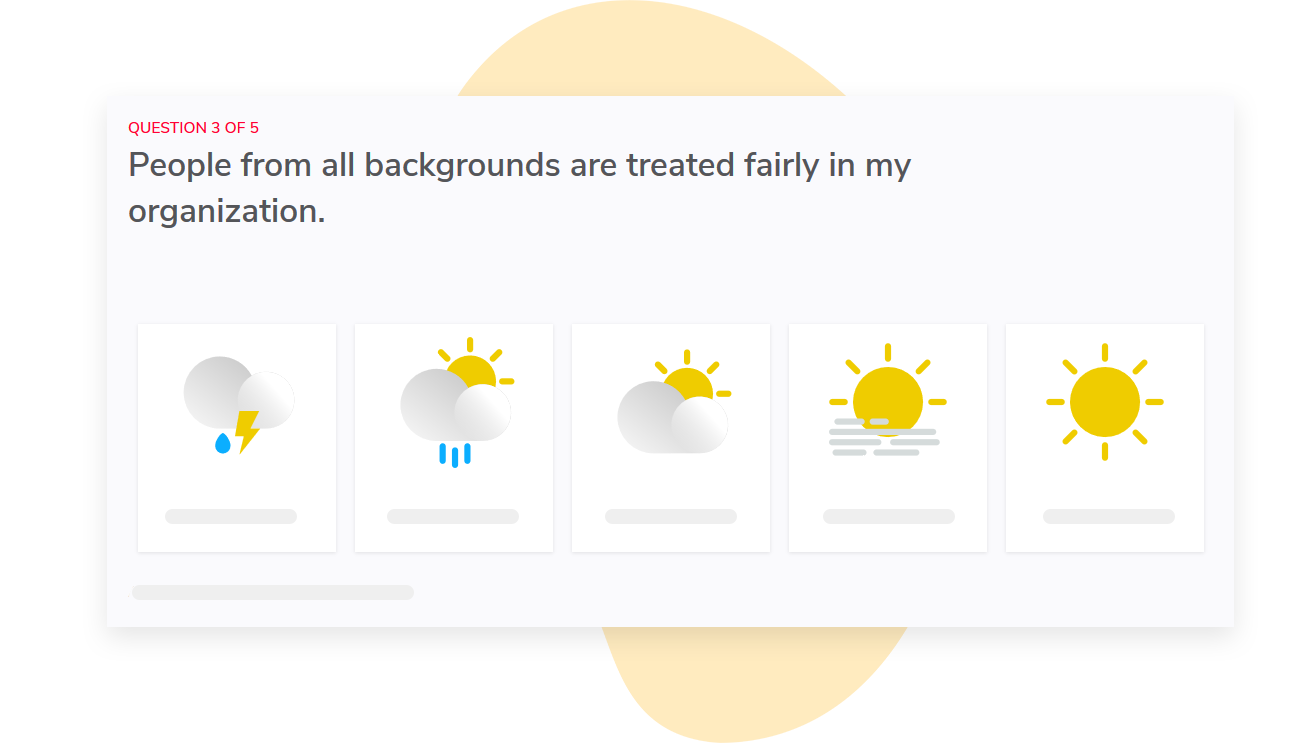
Sparkbay collects employee feedback automatically at regular intervals, and many clients run monthly pulse surveys. It turns those responses into intuitive reports built around a clear engagement score out of 10, with eNPS available as a secondary measure.
HR teams can segment results by manager, department, tenure, and other employee attributes, and benchmark against companies in their industry using Sparkbay's proprietary dataset.
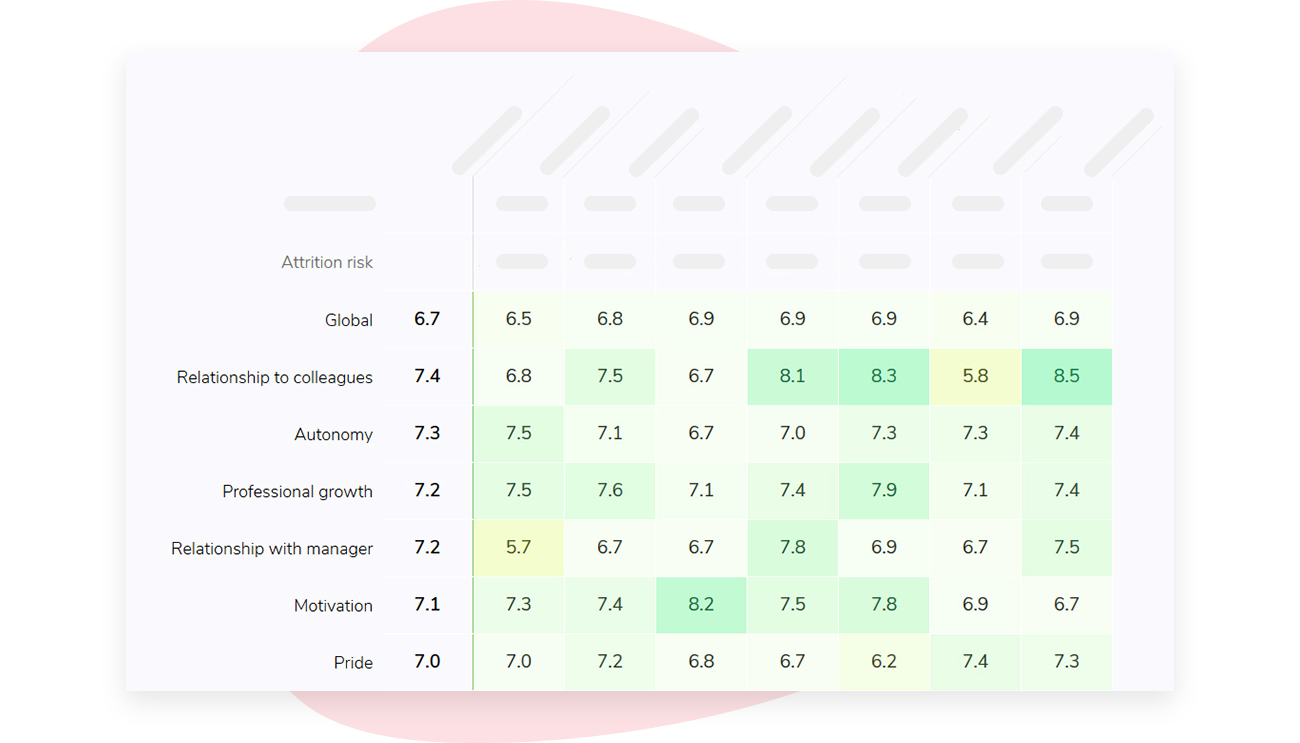
That segmentation is what tells a systemic problem apart from a local one. A low career-growth score across most departments points to a talent-architecture issue; the same score isolated under one management layer points to a specific leader.
The two call for entirely different responses.
Sparkbay is highly configurable, down to the wording of surveys and dashboards and the content shown on each dashboard. An enterprise can hold one measurement model constant while adapting the language and reporting to each business unit's reality.
Report access maps automatically to the org hierarchy, so each manager sees only their own teams, and access repairs itself after a reorg instead of waiting on manual redistribution. Results stay hidden below a configurable minimum number of responses, five by default, which keeps small teams protected and means no employer can see who said what.
Sparkbay also gives managers a library of easy-to-implement actions to draw from after reviewing their results, closing the gap between a diagnosed driver and a concrete commitment, whether that's tightening priorities or building a recognition habit.
For security review, Sparkbay holds ISO 27001 certification. Procurement and privacy teams can weigh that control framework alongside data-processing terms, access rules, retention needs, and your own employee-data requirements.
If you're interested in learning how Sparkbay can help you build a more engaged workforce, you can click here for a demo.
Red flags and deal-breakers to uncover before signing
The executive dashboard always demos well. Insist on watching a survey admin, an HRBP, and a line manager run ordinary tasks, because that's where the friction and the failure modes actually live.
Weak employee experience
Test the response path the way a frontline worker meets it: on a phone, in a secondary language, over a slow connection. Every extra step and every login barrier suppresses deskless response more than any other, and that suppression then poses as disengagement in your data.
Watch for the specifics, a forced app download, a corporate SSO wall a warehouse worker can't clear from a personal device, surveys that assume a keyboard. Each one quietly deletes a slice of your workforce from the results.
Vague anonymity claims
Don't accept "fully anonymous" until the vendor walks you through the controls. The revealing scenarios are stacked filters, comment exports, and small teams sitting right at the threshold.
A vendor who can't articulate its confidential-versus-anonymous model and its metadata access rules won't make it through your privacy review anyway.
Security answers that lack evidence
Pull the security documentation before the second demo: access controls, encryption, audit logs, incident procedures, subprocessor list, data-residency options, deletion process, certifications. A certification badge is where the conversation starts, not where it ends.
The platform still has to fit your DPA, retention standard, consent model, and access policy, and that's usually where deals stall. Ask when the certification was last audited and whether the scope covers the actual product you're buying rather than a parent company or a single data center.
Hidden work and hidden cost
Build a three-year total cost, not a subscription comparison. The line items vendors tend to leave out: implementation, translation, historical data migration, custom reporting, manager enablement, advisory support.
Then add the internal labour. A "cheaper" tool that leaves your analysts hand-cleaning files and rebuilding manager reports every cycle is the expensive one.
Watch for pricing that jumps at renewal, charges per language or per additional survey, or hides hierarchy-based access behind a premium tier.
Reports that stop at diagnosis
Telling a manager "workload is poor" and leaving them there is where most programs die. Make the vendor show the full loop live: results come in, a priority gets chosen, a commitment gets recorded, progress gets checked at the next pulse.
Match the platform to your organization's real needs
Fit comes down to scale, workforce composition, operating model, and your real capacity to act on results. Document those constraints before any vendor sees your requirements, or you'll get sold their strengths in place of your needs.
Map the workforce and reporting structure
Inventory your entities, business units, locations, languages, management layers, and workforce groups, then decide who should see what. Past a certain complexity, hierarchy-based access has to be automated.
Manual distribution is a privacy incident waiting for the next reorg to set it off.
Deal with the awkward cases early: dotted-line reporting, matrixed teams, shared-service functions, managers who lead one team while reporting into another. If a vendor's access model only handles a clean tree, it'll misroute results the day your real structure meets it.
Define the listening model
Settle up front which items are enterprise-mandatory and where local flexibility is allowed. A distributed business usually needs one engagement index with wording adapted locally.
A regulated organization will care far more about audit logs, data residency, approval workflows, and retention than about how polished the analytics look.
Account for every employee group
Remote, office, frontline, field, and deskless populations don't share the same access realities, whether that's company email, computer access, a supported device, or paid time to respond. Don't read a participation gap as disengagement until you've ruled out access, or you'll spend your energy chasing a problem that isn't there.
Assess internal capacity
Advanced analytics are dead weight if nobody can interpret or land them. Name the people who'll administer surveys, keep the data feed running, coach managers, review comments, and brief executives.
A lean people-analytics team needs guided workflows and vendor support. A mature one needs deep configuration, clean exports, and configurable dashboard content.
Buy the wrong end of that spectrum and you waste the investment.
Test the platform's fit with your HR technology environment
A long integration catalogue proves nothing. What counts is the specific data flows that keep records accurate, deliver surveys, enforce access, and return insight, plus the quality of the source data feeding them.
Map each flow before procurement:
- How will employee records enter and leave the platform?
- Which system owns department, manager, location, tenure, and employment-status data?
- How quickly will hires, departures, transfers, and manager changes appear?
- Will single sign-on simplify access for administrators and managers?
- Can communication channels send invitations or reminders without exposing responses?
- What happens when a record fails to update or contains conflicting information?
HRIS data quality beats connectivity every time. Stale reporting lines or inconsistent department naming will corrupt every manager report the platform generates, however clean the integration.
Decide who owns error handling before go-live, not after the first failed sync. Match the sync frequency to your survey cadence too: a nightly feed is fine for a quarterly pulse, but it leaves a manager who changed teams last week looking at the wrong report during a live monthly cycle.
Make each vendor demonstrate the actual connection rather than tick "integration available." Confirm direction, frequency, required fields, authentication, monitoring, and who owns the build.
Apply data minimization on purpose. Send only the attributes needed for delivery, segmentation, benchmarking, permissions, and approved analysis.
The engagement platform has no reason to hold compensation or banking fields. Pulling them in creates risk with no analytical payoff.
Build a business case that leadership can test
Executives don't fund surveys. They fund the reduction of a named risk or the improvement of a number they already report on. "Improve culture" doesn't get funded.
Anchor the case to two or three specific problems: regrettable turnover in critical roles, chronic absence in one operation, slow time-to-productivity, a measured manager-effectiveness gap.
Calculate the cost of the problem
Build the cost bottom-up from your own finance, recruitment, and operations data. The base model:
Annual turnover cost = number of avoidable exits × average cost per exit
Cost per exit covers recruitment, selection time, onboarding, training, temporary coverage, overtime, and lost output during ramp-up. Keep the harder-to-prove effects, customer disruption and the like, in a separate scenario so a skeptic can't use one soft number to discredit the whole case.
Estimate the recoverable share
No platform eliminates turnover. Isolate the exits driven by factors you can actually influence, manager quality, workload, recognition, career path, role clarity, and stake your claim only on that fraction.
Then run conservative, expected, and ambitious cases, with every assumption labelled, owned, and evidenced.
| Business case element | Conservative case | Expected case | Evidence source |
|---|---|---|---|
| Avoidable exits prevented | Small improvement | Moderate improvement | Exit data and retention trends |
| Cost per exit | Direct costs only | Direct costs plus validated ramp-up loss | Finance and recruitment records |
| HR administration time saved | Survey production only | Production plus reporting time | Time logs or process mapping |
| Manager action rate | Limited adoption | Targeted adoption with support | Pilot results |
Include the full investment
Count subscription, implementation, data prep, privacy and security review, translation, manager enablement, communications, and ongoing administration, both one-time and recurring. Then say plainly what the organization has to do to earn the return, because the software can't deliver if leaders bury bad results or managers never act.
Naming that dependency up front is what makes the case credible instead of optimistic. It gives you cover later too: if adoption fails because managers were never given time to debrief, the record shows that was a known condition, not a platform defect.
Use language the executive team recognizes
Frame it as workforce risk, operational performance, and management accountability. Don't claim that one engagement point equals a fixed revenue figure unless your own data supports the link, because that's the fastest way to lose a finance audience.
Useful executive talking points include:
- "We will identify which controllable factors drive exits in critical teams."
- "Managers will receive results for their own teams within defined anonymity rules."
- "We will measure action completion and track whether scores change after interventions."
- "The financial case uses internal turnover and labour-cost data rather than a generic industry multiplier."
- "We will stop or redesign the program if the agreed adoption and outcome measures do not improve."
Use metrics and ROI formulas that withstand scrutiny
Keep adoption, sentiment, action, and outcomes in separate layers. Collapse them and a high response rate starts posing as business value, which is exactly the sleight of hand a CFO is watching for.
| Measurement layer | Example metrics | What it shows |
|---|---|---|
| Adoption | Participation, manager dashboard use, report delivery time | Whether people use the system |
| Employee experience | Engagement score out of 10, driver scores, eNPS, comment themes | Where employee experience changes |
| Action | Action-plan creation, completion, follow-up discussions | Whether managers respond |
| Business outcome | Regrettable turnover, absence, internal movement, time to productivity | Whether workforce results change |
| Efficiency | HR administration hours, reporting time, cost per surveyed employee | Whether the platform reduces process work |
Use an ROI formula finance can audit line by line:
ROI percentage = (validated financial benefit − total investment) ÷ total investment × 100
Invest 100, validate 160 in savings, net 60, ROI 60%. Keep the currency neutral in shared materials if you operate across markets.
Then add the payback period, which leadership often cares about more than the percentage:
Payback period = total investment ÷ average validated benefit per month
Guard the attribution. Compare exposed and non-exposed groups where you can, control for confounders like restructuring, pay changes, leadership turnover, and staffing, and never let the platform take credit for a favourable trend it didn't cause.
That discipline is what protects the program the year a number moves the wrong way. Show that the drop tracked a specific reorg rather than the listening effort, and you keep the budget instead of handing it back.
Sequence your indicators honestly. Action completion and workload scores can shift within a few cycles, but regrettable-turnover signals need bigger samples and longer windows.
Promising retention movement in the first quarter is a trap you'll walk straight into.
Test-drive the platform before committing
Give every vendor the same short scenario and a sample org structure, so you're comparing solutions to one problem rather than competing sales narratives.
Ask them to demonstrate these tasks live:
- Configure a pulse survey with one stable engagement measure and several rotating questions.
- Load a hierarchy with several management levels and a recent team transfer.
- Apply anonymity thresholds to a small team and overlapping demographic filters.
- Show what an executive, HR partner, and manager can each access.
- Find the main driver of a score decline and inspect supporting comments safely.
- Create an action plan, assign ownership, and track follow-up.
- Correct an employee-data error and explain how the system records the change.
- Export approved results and delete data according to a defined retention rule.
If you pilot, stack the deck against the platform, not for it: a complex business unit, a small team that trips the anonymity threshold, a mobile workforce, managers with weak data skills. A pilot on the enthusiastic head-office team tells you nothing you needed to know.
Set pilot success measures in advance
Lock the criteria before launch, response completion, support tickets, hierarchy accuracy, report delivery time, manager dashboard use, action-plan adoption, HR admin hours, and gather structured input from employees, managers, admins, privacy, and security. Moving the goalposts after the results are in is how selection committees talk themselves into a favourite vendor.
Question the service model
Pin down who owns implementation, survey design, data loading, manager enablement, and incident response, along with SLAs, escalation, and what the price actually includes. With references, skip "would you recommend them" and probe the process instead: how did they handle a botched hierarchy load, a low-participation launch, an awkward configuration request?
Ask a reference at your own scale in particular, since a vendor that runs smoothly for a 500-person client can buckle under multi-entity, multilingual complexity. And ask what the vendor stopped doing well once the sale closed.
Use a weighted vendor comparison checklist
A weighted scorecard forces the committee to agree on priorities before anyone falls for a demo. Set the weights against your risks and require written evidence behind every score.
| Decision area | Suggested questions | Example weight |
|---|---|---|
| Survey and measurement design | Can the platform support pulses, lifecycle surveys, trends, languages, and configurable questions? | 15% |
| Anonymity and privacy | Do thresholds, filters, comments, permissions, and exports protect respondents? | 20% |
| Analytics and benchmarking | Can teams find drivers, compare relevant groups, and use credible industry benchmarks? | 15% |
| Manager action | Can managers understand results and move from insight to tracked action? | 15% |
| Enterprise administration | Can HR automate hierarchy-based access and manage organizational changes at scale? | 15% |
| Data flow and security | Does the proposed setup meet technical, security, and data-processing requirements? | 10% |
| Service and implementation | Will the vendor provide the guidance, training, and issue resolution required? | 5% |
| Total cost | What will the platform and internal work cost over three years? | 5% |
Treat these weights as a starting point and tune them to your risk profile. A complex multi-entity enterprise should raise hierarchy-based access; a multilingual workforce should raise language support.
Consider marking one or two areas pass/fail rather than weighted. If a platform can't enforce anonymity thresholds under stacked filters, no score anywhere else should rescue it.
Have evaluators score independently before any discussion, then dig into the widest gaps. Divergence usually points to an untested assumption, which is worth more than a comfortable consensus.
Turn survey data into measurable change
A platform earns its place when it helps leaders spot the problems that matter, pick focused responses, and confirm whether those responses worked. The volume of feedback is not the point.
Get the foundations right before you build a shortlist: a written listening strategy, a defined anonymity model, a clean employee-data feed, and a short list of target outcomes. Then decide on live scenarios, security review, three-year cost, manager usability, and a hard pilot.
Once you've chosen, run a fixed operating rhythm: HR reviews enterprise patterns, managers debrief their teams, owners log actions, leaders verify progress at later pulses. Drift from that rhythm and the program dies quietly.
Cap the action load on purpose. One or two visible commitments per team is a real test; a twenty-item plan is a to-do list nobody finishes and a signal to employees that nothing is going to change.
Report the movement and the uncertainty together. Show participation, scores, priority drivers, action rates, retention outcomes, costs, and your assumptions, so executives can see both what changed and how confidently you can attribute it.
Presenting the confidence level is what earns you the next budget cycle. The teams that keep their programs are rarely the ones with the best scores.
They're the ones who show, cycle after cycle, that a diagnosed problem led to a specific action and a measured change.
If you're interested in learning how Sparkbay can help you build a more engaged workforce, you can click here for a demo.