
The message lands just before 8 a.m.: the acquisition is signed, the press release is queued, and the executive team wants employees informed before the news goes public.
For a moment, everything feels orderly. Then the questions start forming in your mind before anyone has even asked them: Who already knows, what can we legally say, how will managers respond, and what will employees assume if the first message feels too polished or too vague?
As an HR leader, you know employees rarely hear the word "acquisition" as neutral business news. They hear possible layoffs, new reporting lines, culture changes, benefit shifts, relocation rumors, and the unsettling feeling that decisions about their future may already be happening behind closed doors.
That is why your acquisition announcement is not just a communication task. It is a trust moment.
Handled well, the announcement can steady the organization, reduce rumor-driven anxiety, and help employees understand why the deal is happening and what comes next. Handled poorly, it can trigger disengagement, retention risk, manager confusion, and a flood of backchannel speculation that becomes harder to correct with every passing hour.
In this guide, you will learn how to craft an acquisition announcement that is clear, humane, and credible. You will also find practical templates, examples, language guidance, and engagement strategies to help employees feel informed instead of blindsided during one of the most sensitive transitions a company can face.
On this page
- The psychology of an acquisition: what employees really worry about
- Timing is everything: when and how to break the news
- The anatomy of a great acquisition announcement
- Ready-to-use acquisition announcement templates
- Real-world patterns: announcements that hit and missed the mark
- Words matter: phrases to use and pitfalls to avoid
- After the announcement: protecting engagement for the long haul
- Your acquisition communication checklist
The psychology of an acquisition: what employees really worry about
Employees interpret an acquisition through a highly personal lens: What does this mean for my job, my manager, my team, my pay, and my future? Even when the deal rationale is strategically sound, employees often process the announcement as a potential threat to status, certainty, autonomy, relatedness, and fairness.
That is why acquisition communications should account for threat appraisal, not just information transfer. Employees will quickly assess whether the event increases or reduces their control, whether leaders appear credible, and whether the organization is being fair with information.
Several concerns usually surface within minutes of the announcement:
- Job security: Will there be layoffs, duplicative roles, restructuring, or hiring freezes?
- Role clarity: Will responsibilities, titles, reporting lines, or decision rights change?
- Leadership trust: Who is now making decisions, and do they understand the business?
- Cultural compatibility: Will the acquiring company preserve what employees value?
- Rewards and benefits: Will compensation, equity, bonuses, pensions, healthcare, or time-off policies change?
- Career trajectory: Will the deal create opportunity or stall progression?
- Identity and belonging: Will employees still recognize the company they chose to join?
From an organizational psychology perspective, acquisitions disrupt the psychological contract: the unwritten expectations employees hold about stability, reciprocity, and how leaders will behave. When the official message is silent on the topics employees care about most, employees fill the gap through social sensemaking, usually in Slack threads, private group chats, and informal manager conversations.
That sensemaking process is not inherently negative. It becomes damaging when employees believe leaders are withholding information, minimizing risk, or using polished language to avoid hard truths.
The goal of the announcement is not to remove uncertainty, because some uncertainty is unavoidable in M&A. The goal is to distinguish clearly between what is known, what is not yet known, who is deciding, when updates will come, and how employees can raise concerns.
Timing is everything: when and how to break the news
Acquisition announcements sit at the intersection of legal disclosure, market sensitivity, employee trust, and operational readiness. HR should be involved early enough to shape the internal sequence, not brought in after the press release is final and managers are already hearing rumors.
The timing will depend on deal structure, regulatory obligations, confidentiality requirements, labor law, works council consultation where applicable, and whether the company is public or private. In large organizations, HR, legal, communications, finance, investor relations, and executive leadership should align on a minute-by-minute release plan.
A strong announcement sequence usually looks like this:
- Core leadership alignment: CEO, CHRO, legal, communications, and integration leadership agree on message boundaries.
- Manager preparation: People managers receive talking points, FAQs, escalation paths, and guidance on what they cannot yet answer.
- Employee announcement: Employees hear the news directly from leadership before or at the same time as external stakeholders, depending on legal constraints.
- Immediate Q&A: Leaders create space for questions quickly, ideally the same day.
- Follow-up cadence: Employees know when the next update will arrive, even if there are no major changes.
Leaks change the calculus. If employees are likely to hear the news from media, customers, LinkedIn, or vendors, the internal message needs to move quickly and acknowledge that some details may still be limited.
Channel choice matters because the medium signals the level of seriousness. A major acquisition should rarely be communicated by email alone, unless legal timing makes it unavoidable.
| Channel | Best use | Risk to manage |
|---|---|---|
| CEO email | Creates a consistent record of the announcement, rationale, and next steps. | Can feel distant if not paired with live discussion. |
| Live all-hands | Allows tone, empathy, and leadership presence to come through. | Can create frustration if Q&A is overly controlled. |
| Manager team meetings | Translates enterprise-level news into local meaning. | Managers may improvise if they are underprepared. |
| FAQ hub | Centralizes approved answers and reduces rumor drift. | Can become stale if ownership is unclear. |
| Anonymous Q&A | Surfaces sensitive concerns employees may avoid raising publicly. | Requires visible follow-through to build credibility. |
For global companies, time zones create equity issues. If one region receives a live leadership briefing while another wakes up to a recording and social media commentary, employees may interpret the difference as a hierarchy of importance.
The anatomy of a great acquisition announcement
A strong acquisition announcement is clear enough to reduce speculation and human enough to preserve trust. It should avoid the two common extremes: legalistic understatement that leaves employees anxious, and exaggerated optimism that feels disconnected from the real implications of the deal.
At minimum, the announcement should cover the following elements:
- What happened: State the acquisition plainly, including who is acquiring whom and the status of the transaction.
- Why it is happening: Explain the strategic rationale in terms employees can connect to their work.
- What changes now: Clarify immediate operational, leadership, customer, brand, and employment implications.
- What does not change now: Identify areas that remain stable in the short term.
- What is unknown: Name open questions without pretending to have answers prematurely.
- How decisions will be made: Explain the integration governance process, including who is accountable.
- When employees will hear more: Provide a concrete update cadence.
- Where questions should go: Offer channels for manager, HR, legal, and anonymous questions.
The most important section is often the one leaders are tempted to soften: job impact. If there are no immediate workforce changes, say that carefully and precisely.
For example, "There are no role changes or workforce reductions being announced today" is more credible than "Nothing will change". The first statement is bounded and verifiable, while the second is likely to be disproven by integration reality.
If reductions are possible but not yet defined, avoid false certainty. A more credible formulation is: "We know employees will have questions about roles and structure. Those decisions have not been finalized. We will share updates as decisions are made, and we will not ask managers to speculate."
Leaders should also address the emotional layer directly. A sentence such as "We recognize this news may create excitement for some employees and anxiety for others" signals that leadership understands the employee experience without overpromising outcomes.
The announcement should close with process, not vague inspiration. Employees are more likely to stay engaged when they know what happens next, who owns it, and when they will receive further information.
Ready-to-use acquisition announcement templates
The following templates are written for adaptation. They should be reviewed by legal, communications, and deal leadership before use, especially in regulated, unionized, publicly traded, or multi-jurisdictional environments.
Template 1: the CEO company-wide email
Subject: Important news about our company
Team,
Today, we announced that [Company name] has entered into an agreement to be acquired by [Acquiring company]. This is an important milestone for our business, and I want you to hear directly from me about what this means, what we know today, and what will happen next.
The decision to move forward with this acquisition was based on [brief strategic rationale: market expansion, product capabilities, customer reach, technology, financial strength]. We believe the combination of [Company name] and [Acquiring company] will allow us to [specific future opportunity].
I also recognize that news like this immediately raises personal questions. Many of you will want to know what this means for your role, your team, your manager, your benefits, and the culture we have built together.
Here is what we can share today: [insert confirmed details, such as no immediate changes to roles, reporting lines, pay, benefits, offices, customer commitments, or operating model]. Here is what is still being evaluated: [insert open areas, such as future structure, systems integration, branding, long-term location strategy, or leadership alignment].
We will not speculate on decisions that have not been made. We will share updates as soon as we can, and we will be clear when an answer is not yet available.
We will hold a company-wide meeting today at [time] to discuss the announcement and answer questions. Managers will also receive guidance to support team conversations, and we will maintain an updated FAQ at [link].
Thank you for the work that brought us to this point. I know this is significant news, and I am committed to communicating with as much clarity and respect as possible throughout the transition.
[CEO name]
Customization tips
- Replace abstract strategy language with concrete business logic employees will recognize.
- Avoid saying "business as usual" unless it is narrowly true for the immediate period.
- Add a time-stamped FAQ link so employees know where to find the latest version.
Template 2: the all-hands meeting script
Good [morning/afternoon], everyone. Thank you for joining on short notice.
Today, we announced that [Company name] will be acquired by [Acquiring company]. I want to explain why this decision was made, what we know today, what remains undecided, and how we will communicate throughout the transition.
First, the rationale. [Explain the strategic reason in plain language.] This combination gives us [specific advantages], and it positions the business to [specific outcome].
Second, I want to address what many people are likely thinking about first: the impact on employees. As of today, [insert confirmed employment-related information].
Areas such as [insert open topics] are still being reviewed, and we will communicate decisions when they are ready.
Third, I want to acknowledge that reactions will vary. Some employees may see opportunity in this announcement.
Others may feel uncertain or concerned, and that is understandable.
Our commitment is to communicate regularly, to answer what we can, and to be honest about what we do not yet know. After this meeting, managers will hold team-level conversations, and HR will collect questions through [channel].
We will now move to Q&A. If we cannot answer a question today, we will capture it, assign ownership, and provide an update through the FAQ.
Customization tips
- Prepare leaders to answer the first three employee questions directly: "Will there be layoffs?", "Will my manager change?", and "Will my compensation or benefits change?"
- Use a moderator who can group repeated questions and flag unanswered themes.
- Do not screen out difficult questions unless legal obligations require it.
Template 3: the manager's talking points for team conversations
Today's announcement is significant, and I know it may raise a lot of questions. I want to make space for that conversation and share what I know, what I do not know, and how I will keep this team informed.
Here are the confirmed points: [insert approved facts]. Here are the areas still being evaluated: [insert approved open items].
I will not guess about decisions that have not been made. If I do not know the answer, I will capture the question and escalate it through the process HR has established.
For our team, the immediate priorities are [insert near-term priorities]. If anything changes that affects our work, I will communicate it as quickly as I am able.
I also want to acknowledge that this may feel unsettling. Please bring questions to me directly, use [anonymous channel] if preferred, and review the FAQ at [link].
Customization tips
- Give managers a "say this, not that" guide to reduce inconsistent interpretations.
- Include escalation guidance for compensation, immigration, works council, legal, and retention concerns.
- Remind managers that tone matters as much as content, especially for teams at higher integration risk.
Template 4: the acquired company's welcome message
Team,
Today, we begin a new chapter as [Acquired company] joins [Acquiring company]. We chose this path because [strategic rationale], and because we believe this combination can strengthen our ability to serve [customers/markets/communities].
We know that being acquired can create questions about identity, culture, and autonomy. The work you have done, the relationships you have built, and the expertise you bring are central to why this acquisition happened.
In the immediate term, [insert what remains the same]. Over the coming [weeks/months], we will work through integration planning in areas such as [systems, benefits, branding, reporting lines, operations].
We will communicate regularly and directly. Your questions and feedback will help us understand where clarity is needed most.
[Leader name]
Customization tips
- Preserve dignity by recognizing the acquired company's capabilities, history, and cultural strengths.
- Avoid language that implies the acquired company is being "absorbed" unless that is the explicit operating model.
- Be specific about integration pace, especially if employees are worried about losing autonomy quickly.
Real-world patterns: announcements that hit and missed the mark
Public M&A examples offer useful communication patterns, even when the internal employee messages are not fully visible. The strongest announcements tend to combine strategic clarity with cultural reassurance and rapid follow-through.
When Microsoft announced its acquisition of GitHub in 2018, a major employee and user concern was whether GitHub's developer-centered identity would survive under a large enterprise owner. Microsoft's public messaging emphasized GitHub's independence, developer trust, and the appointment of a leader with credibility in the developer community.
The lesson for HR is clear: when the acquired company has a strong identity, the announcement must address identity preservation explicitly. Employees need to understand which aspects of culture are valued, which will be protected, and which may evolve.
Disney's acquisition of Pixar is often cited as a case where cultural respect mattered. While every integration has complexity, the broader narrative emphasized preserving Pixar's creative model rather than forcing immediate conformity to a parent-company operating rhythm.
The lesson is that integration communication should not treat culture as a soft topic. For many employees, culture is a proxy for decision rights, creative autonomy, promotion norms, psychological safety, and leadership behavior.
Cautionary examples tend to share a different pattern: vague workforce language, underprepared managers, delayed answers on practical matters, or a mismatch between optimistic announcement language and later restructuring. The AOL Time Warner merger, while historically larger and more complex than most acquisitions, remains a frequent reminder that strategic ambition does not compensate for cultural friction and unclear integration logic.
Employees do not expect every acquisition to be seamless. They do expect leaders to avoid pretending that complexity does not exist.
Words matter: phrases to use and pitfalls to avoid
Acquisition language should be precise, bounded, and emotionally intelligent. Employees will parse every phrase for hidden meaning, especially if there is a history of opaque communication or restructuring.
| Instead of saying | Say this | Why it works |
|---|---|---|
| Nothing will change. | There are no immediate changes to roles, reporting lines, compensation, or benefits being announced today. | It limits the promise to what is actually known. |
| This is business as usual. | Our near-term priorities remain the same while integration planning begins. | It acknowledges the deal without creating false normalcy. |
| There will be synergies. | We will review where our teams, systems, and processes overlap, and we will share decisions when they are made. | It translates jargon into operational reality. |
| Employees are our greatest asset. | The expertise in this organization is one of the reasons this acquisition happened. | It is more specific and less performative. |
| We cannot comment on that. | That decision has not been finalized, and we expect to provide an update by [timeframe] if the timeline holds. | It gives employees a process rather than a wall. |
Words that trigger anxiety often have a corporate euphemism quality: optimization, rationalization, consolidation, efficiencies, alignment, transformation. These terms may be accurate in executive settings, but they can sound like coded layoff language to employees.
Honest uncertainty is usually better than evasive reassurance. "We do not yet know" can build trust when paired with ownership, timing, and a commitment to update.
After the announcement: protecting engagement for the long haul
The first announcement is only the opening move. Engagement risk often increases after the initial news, when employees realize that integration decisions may take months and that managers do not yet have answers to practical questions.
HR should treat the post-announcement period as an extended sensemaking window. Employees will continuously update their beliefs based on leadership behavior, manager consistency, decision transparency, and whether feedback channels lead to visible action.
Several practices help protect engagement during this period:
- Create a live question log: Track questions by theme, owner, status, and target response date.
- Run regular leader updates: Even a "no major decision this week" update can reduce rumor volume.
- Equip managers weekly: Provide updated talking points, risk signals, and escalation routes.
- Identify critical talent segments: Map roles with high business continuity risk, scarce skills, customer dependency, or institutional knowledge.
- Monitor sentiment by group: Enterprise averages often hide anxiety concentrated in acquired teams, duplicated functions, or recently hired employees.
- Close the feedback loop: Tell employees what themes were heard and what action is being taken.
Organizational justice theory is useful here. Employees evaluate acquisitions through distributive justice, which concerns outcomes; procedural justice, which concerns decision-making fairness; and interactional justice, which concerns the respect and candor shown by leaders and managers.
Even when outcomes are difficult, perceived fairness can reduce avoidable disengagement. A role elimination communicated with dignity, clarity, and support will land differently than the same decision delivered late, inconsistently, or through rumor.
Managers become the primary engagement anchors after the announcement. They need more than FAQs; they need coaching on emotional containment, rumor correction, boundary-setting, and how to avoid making promises that integration teams cannot keep.
During an acquisition, HR needs a reliable way to understand how employees are experiencing the transition beyond anecdotal manager feedback. Sparkbay helps by automatically collecting employee feedback at regular intervals, and many clients run monthly pulse surveys during sensitive change periods such as M&A integration.
The platform presents results in intuitive reports with a clear score out of 10, making it easier for leadership, HR, and managers to see whether confidence, engagement, belonging, and trust are improving or deteriorating over time.
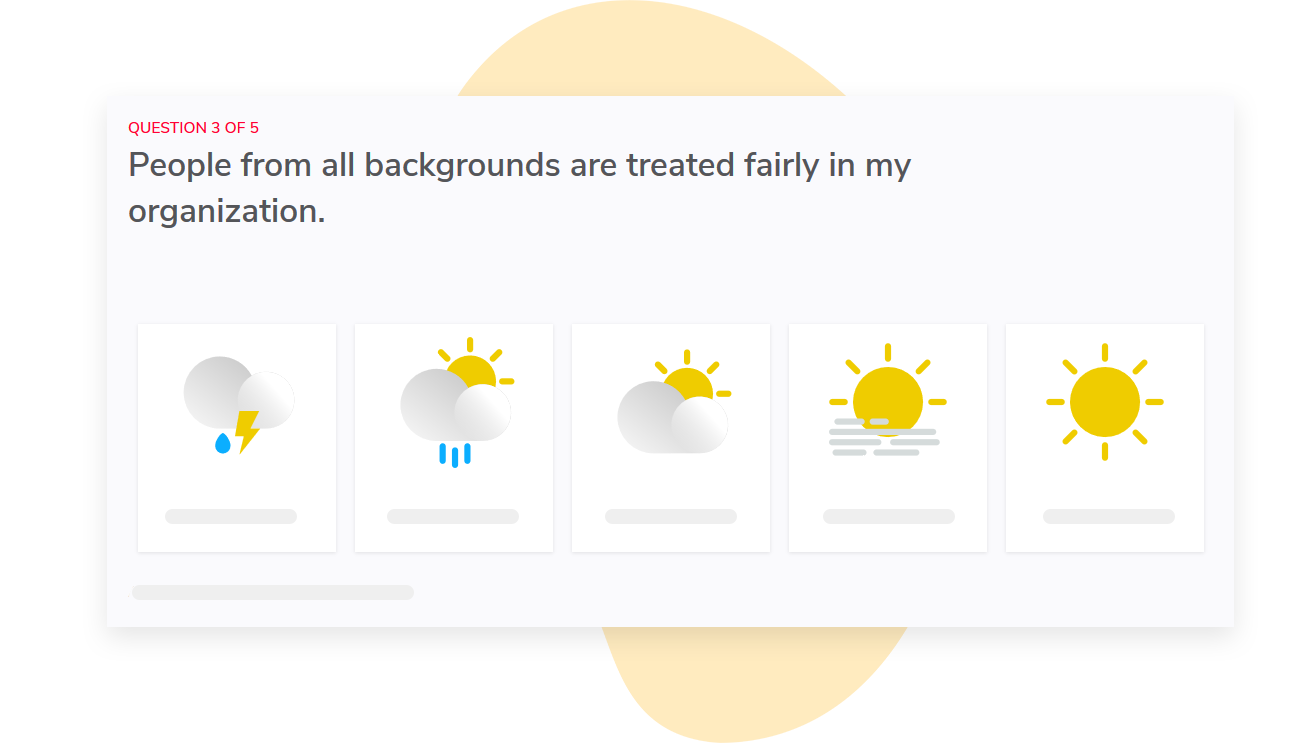
This is particularly valuable after an acquisition announcement because sentiment can shift quickly. An all-hands meeting may seem well received, but pulse data can show whether employees still feel unclear about job security, leadership credibility, or the future culture of the combined organization.
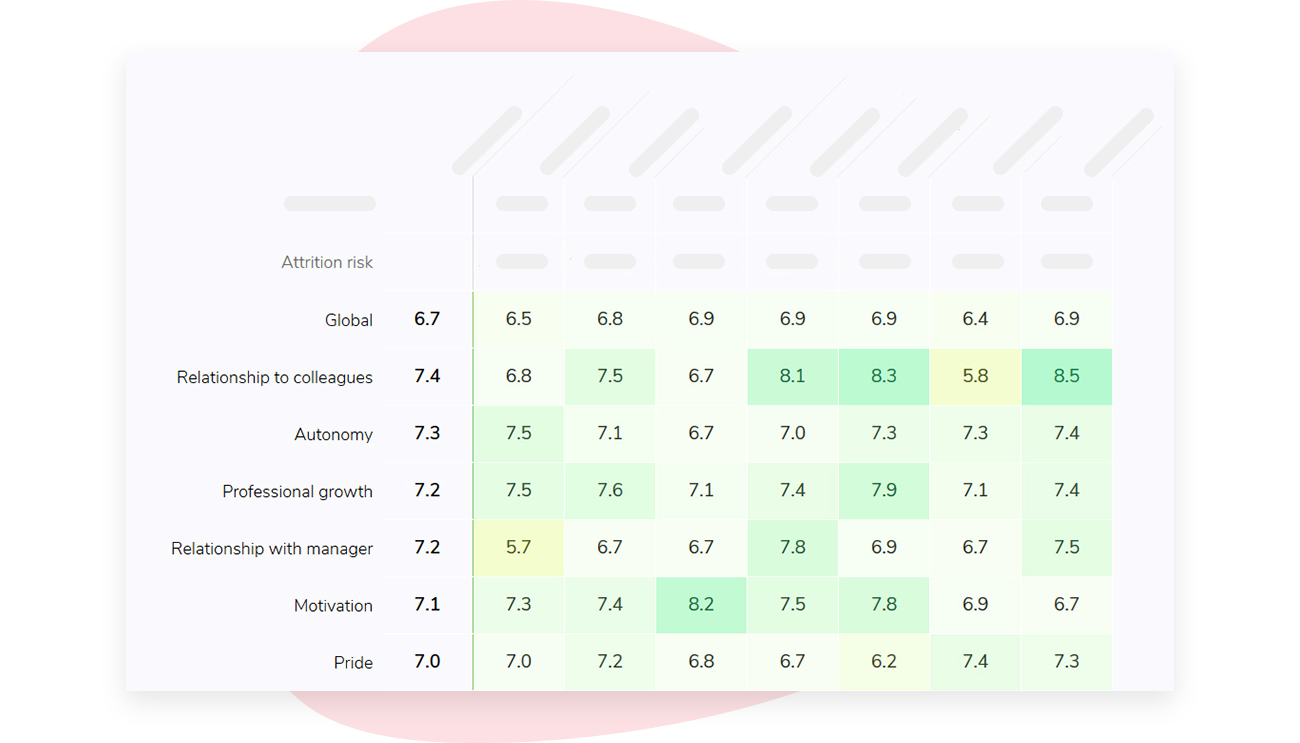
Sparkbay also allows results to be segmented by manager, department, tenure, and more. That matters in M&A because engagement risk is rarely evenly distributed: duplicated functions, acquired-company employees, long-tenured employees, and teams with high customer exposure may experience the same announcement very differently.
HR teams can also benchmark results against companies in their industry using Sparkbay's proprietary dataset. This helps leaders distinguish between normal transition-related uncertainty and warning signs that require faster intervention.
Once the risks are visible, managers need practical support. Sparkbay offers a library of easy-to-implement actions that help managers respond to low scores, address team concerns, and improve engagement in specific areas such as recognition, communication, trust, and workload.
For acquisition communications, this creates a stronger feedback loop: announce clearly, measure employee response, identify the groups most at risk, support managers with targeted actions, and track whether those actions are improving sentiment over time.
If you're interested in learning how Sparkbay can help you build a more engaged workforce, you can click here for a demo.
Your acquisition communication checklist
Before announcing an acquisition, HR should confirm that the organization is ready for both the message and the reaction. The checklist below is designed for large organizations where timing, consistency, and manager enablement are critical.
Pre-announcement checklist
- Confirm legal, regulatory, investor relations, and confidentiality constraints.
- Align on the approved narrative: what happened, why it happened, and what happens next.
- Define what can be said about jobs, structure, compensation, benefits, locations, and leadership.
- Prepare a manager briefing before the wider announcement whenever legally possible.
- Create FAQs for employees and a separate guide for managers.
- Set up a central question channel, including an anonymous option.
- Plan the first three follow-up updates before the initial announcement goes out.
- Identify employee groups likely to experience higher uncertainty or retention risk.
- Prepare escalation paths for legal, immigration, compensation, employee relations, and customer-facing concerns.
- Decide how employee sentiment will be measured after the announcement.
Do's and don'ts at a glance
| Do | Don't |
|---|---|
| Lead with the strategic rationale and the human implications. | Open with corporate celebration while ignoring employee concerns. |
| Say what is known, unknown, and still being decided. | Use vague optimism to cover unanswered questions. |
| Equip managers before employees turn to them. | Assume managers can interpret the deal consistently on their own. |
| Update employees on a predictable cadence. | Communicate once and go quiet during integration planning. |
| Measure sentiment by segment. | Rely only on enterprise-wide averages or leadership impressions. |
Turning uncertainty into opportunity
An acquisition announcement will never answer every employee question on day one. Its real purpose is to establish credibility for the months of communication that follow.
The strongest messages are transparent without being reckless, optimistic without being dismissive, and specific without overpromising. They recognize that employees are assessing the future of their own roles, teams, and careers, not just the strategic logic of the transaction.
For HR leaders, the opportunity is to shape the acquisition as a disciplined trust-building process. Clear announcements, prepared managers, frequent updates, and active sentiment measurement can reduce avoidable anxiety and protect the engagement needed for integration to succeed.
When employees feel informed, respected, and heard, uncertainty does not disappear. It becomes easier to navigate together.
If you're interested in learning how Sparkbay can help you build a more engaged workforce, you can click here for a demo.